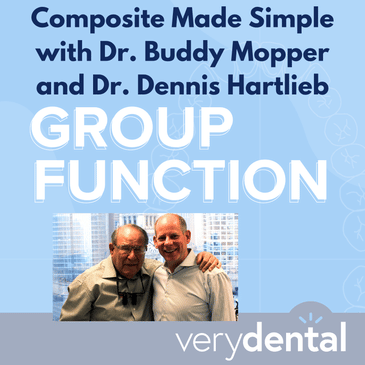
This throwback Group Function features two luminaries in direct dentistry, Dr. Buddy Mopper and Dr. Dennis Hartlieb. Al took a Cosmedent course back in May of 2022 and had a chance to interview these two in person. The result is a great back and forth about how we've overcomplicated composite dentistry and how to simplify it for everyday use!
Dr. Buddy Mopper has been teaching composite dentistry for over 40 years and his focus has been on teaching a skill set that can work for everyone. Buddy started Cosmedent to give dentists the materials and techniques to create composite dentistry that was as beautiful as it is predictable. Dr. Dennis Hartlieb joined Buddy to explain how they teach composite dentistry of all kinds (from gorgeous veneers, to endo access repairs) that any dentist can do predictably and profitably.
Some links from the show:
Join the Very Dental Facebook group using the password "Timmerman," Hornbrook" or "McWethy," "Papa Randy" or "Lipscomb!"
The Very Dental Podcast network is and will remain free to download. If you'd like to support the shows you love at Very Dental then show a little love to the people that support us!
--
Crazy Dental has everything you need from cotton rolls to equipment and everything in between and the best prices you'll find anywhere! If you head over to verydentalpodcast.com/crazy and use coupon code "VERYDENTAL10" you'll get another 10% off your order! Go save yourself some money and support the show all at the same time!
--
The Wonderist Agency is basically a one stop shop for marketing your practice and your brand. From logo redesign to a full service marketing plan, the folks at Wonderist have you covered! Go check them out at verydentalpodcast.com/wonderist!
--
Enova Illumination makes the very best in loupes and headlights, including their new ergonomic angled prism loupes! They also distribute loupe mounted cameras and even the amazing line of Zumax microscopes! If you want to help out the podcast while upping your magnification and headlight game, you need to head over to verydentalpodcast.com/enova to see their whole line of products!
--
CAD-Ray offers the best service on a wide variety of digital scanners, printers, mills and even their very own browser based design software, Clinux! CAD-Ray has been a huge supporter of the Very Dental Podcast Network and I can tell you that you'll get no better service on everything digital dentistry than the folks from CAD-Ray. Go check them out at verydentalpodcast.com/CADRay!
[00:00:00] This is a production of the Very Dental Podcast Network.
[00:00:12] First, you take a group of very dental people. Then you add some interesting topics and a few microphones. Finally, add some laughs and collegial good cheer and you get the Group Function Podcast.
[00:00:24] Very Dental people, welcome to another episode of the Group Function Podcast. And you know when I say group function that means I have multiple guests.
[00:00:32] And I'm really happy to bring this one to you. I'm sitting here high above Michigan Avenue looking out at the Wrigley Building.
[00:00:40] You know when I say that? I am visiting Cosmodent and I'm sitting in the boardroom with Dr. Buddy Mopper and Dr. Dennis Hartlieb. How are you guys doing?
[00:00:48] Great. Doing good. Okay, so Dennis lost his voice yesterday. He was lecturing so hard that he's losing his voice. But I like it. It's kind of a Kathleen Turner thing.
[00:00:58] Right. It's kind of hot. It's purr really. My two pack a day cigarettes is starting to catch up with me.
[00:01:03] It's catching up with you. So yesterday was the first day of Catch the Composite Wave and Surf Its Potential, which is a course that, Buddy, you've been giving this course for a long time.
[00:01:14] A long time. Years. Years. Like I remember when I first got out of dental school.
[00:01:18] At least 20 or 30 years of that. Yeah.
[00:01:21] It's not the only course I've taught, but it's what I teach. Maybe change the name and make it more interesting.
[00:01:30] I get it. I get it. And make it more interesting. But I like the title. That course has been on for about, what, 15 years? Catch the Composite Wave? Yeah.
[00:01:41] I always was coming to the midwinter forever since I was basically, actually my dad used to bring a bunch of classmates and I from the University of Minnesota down to Chicago, which was a hot mess.
[00:01:53] Right.
[00:01:53] But, and I mean, I remember seeing you on, you were a fixture there even then. And so it's like you've been given a form of this course for a long, long time.
[00:02:03] At least 40 years.
[00:02:05] Sure. Which says a lot. And what's really interesting too is that it's not that you haven't updated it, but the principles have really remained kind of the same. Am I right?
[00:02:17] Of what I do, they're actually, they are the same.
[00:02:21] It's the, the materials have changed over the years, but the concept has been always the same.
[00:02:28] The technique has worked for me in every, every system that I've used. And, and it's a workable system that anybody can use and it's easy to use. That's the whole thing.
[00:02:39] That was one of the points that I wanted to, I wanted to talk about because, so much of the continuing education, Dennis and I have talked about this before, much of the continuing education you get now is an exceptional clinician.
[00:02:52] Like a, like a, like a, like a far high end of the bell curve clinician showing you cases and how they do cases, which is awesome. It's great.
[00:03:02] However, it's a lot harder to take that back to your office and do it.
[00:03:08] It's hard to replicate exactly what they do.
[00:03:11] Exactly. And what I, what you said yesterday and what I agree with having done the, the hands on in the afternoon is that this, you guys are teaching a technique that is, is replicable by anyone.
[00:03:26] Yeah. Like I, I struggle sometimes with the fact that continuing education really aims towards the, that far end of the bell curve when the reality is we're all, most of us are in the middle somewhere.
[00:03:37] So what do you, tell me a little bit about that, buddy. What, how do you feel about that?
[00:03:41] Well, Dennis knows how I feel about it. I, I, I, the reason I teach is I don't want to show people how good I am.
[00:03:52] I want to show people how good they can be. That's the object of this whole course.
[00:03:57] And I, I've developed a system that is, that gives quality results. You've seen the results.
[00:04:03] Yep.
[00:04:03] And I've got thousands of slides and I've got more, more material than anybody in the world.
[00:04:07] Because I've documented more material than anybody in the world.
[00:04:11] But, uh, it's, it's a system and a concept that works in everybody's hand.
[00:04:19] It's just the idea of the way we teach, the way we teach it is really important.
[00:04:23] Yeah.
[00:04:23] You saw, we're starting not, we, we don't work with color or anything else like that.
[00:04:28] Morphology is our big thing.
[00:04:30] It really is.
[00:04:30] That's the whole thing.
[00:04:31] And what we did in the hands-on yesterday was we taught you how to get the morphology you're looking for,
[00:04:36] which most people can't get because they don't know how to use the instruments.
[00:04:40] They don't know where things belong.
[00:04:42] It's a very simple technique, but it's an easy technique.
[00:04:45] And once you get it and the people that did it yesterday, everybody did a great job.
[00:04:50] And it's easy to do.
[00:04:51] Once you get the morphology, everything else goes into place.
[00:04:55] One of the things about your talk about morphology is that, that, um, a lot of people think of composite as,
[00:05:01] as, um, well, what we were doing was essentially a kind of a full veneer where we were, we're placing material directly.
[00:05:09] And, and I mean, I, I, we can go into it, but, and it's not like you're placing it, hitting it with the light.
[00:05:15] It's, you're placing it and you're sculpting as much of that morphology into the material before you ever touch it with the light.
[00:05:22] And, and so like, you know, most people were doing okay with it, just not having light directly on it or, or a amber filter or whatever, which we all know.
[00:05:30] But I think in a lot of dentist minds, they're like, oh, we got to get that in there because it's going to start curing.
[00:05:34] And the reality is we, I mean, I think I probably manipulated that for 20 or 25 minutes.
[00:05:39] I had an amber thing on.
[00:05:40] Yeah.
[00:05:41] Yeah.
[00:05:41] So people don't think about composite that way at all.
[00:05:44] Well, because they're using bright lights on it and they're working with them.
[00:05:49] It sets.
[00:05:49] Okay.
[00:05:49] If you don't have an amber light, all you have to do is turn the light down to the chin point.
[00:05:54] And we worked that way for years.
[00:05:56] And, and, and, and you can still see and sculpt because I think, as we explained, I think sculpting and placement and sculpting is the most important aspect of the whole procedure.
[00:06:07] I really do.
[00:06:08] Because it shortens your polishing time like, oh my God, does it ever.
[00:06:12] Like crazy.
[00:06:14] And it's so much more accurate than doing it any other way.
[00:06:18] Yeah.
[00:06:18] Yeah.
[00:06:18] I agree.
[00:06:19] And I did one tooth where I over bulked it and it took me forever to grind it back.
[00:06:23] Yeah.
[00:06:23] And if you can just spend the time getting the contour before you cure, you're just way ahead.
[00:06:28] Yeah.
[00:06:29] I think, um, interestingly, there's, there's some techniques taught that you talked about it.
[00:06:34] Some of the injector molding techniques where you build up real big and then cut back fast.
[00:06:38] Well, this is the exact opposite of this.
[00:06:41] And I have to tell you that like, I, I appreciate it.
[00:06:44] I appreciate it.
[00:06:45] But it also is like the handling of this material.
[00:06:48] We used a nano yesterday.
[00:06:49] We didn't even, we didn't even use microfill yet.
[00:06:51] A microfill is even easier to polish than the nano.
[00:06:53] It's crazy.
[00:06:54] But, uh, so I mean like probably the techniques that people are using with composite are not, not the right techniques on some level.
[00:07:03] Like, and this is, like I said, we're doing kind of a full veneer, but I mean, they're, they're applicable.
[00:07:08] To, to smaller, you know, smaller restorations as well.
[00:07:11] You wouldn't probably have to manipulate a class three as long as you did this.
[00:07:14] But in any case, like, I think people take for granted composite the way that it's sold as a fast.
[00:07:22] And, you know, it's the, it's the low production, the low, the, it's the stuff that you have to do because you're a dentist when you're not doing the great big porcelain case or something like that.
[00:07:31] I'm like, I don't know, man.
[00:07:32] I'm not sure that's good for teeth.
[00:07:34] And it, I mean, it can be a profitable.
[00:07:36] You can use composite profitably too.
[00:07:39] Oh, for sure.
[00:07:40] We do big cases with, you hadn't even seen our big cases yet.
[00:07:44] You didn't see, I didn't get to the advanced cases.
[00:07:47] I do everything in composite, almost everything.
[00:07:50] Okay.
[00:07:51] And as far as I'm concerned, it rivals or exceeds porcelain in every way, you know.
[00:07:59] And it's an unbelievable material when you know how to use it.
[00:08:02] Yeah.
[00:08:03] And you pay attention to occlusion.
[00:08:04] Yeah.
[00:08:05] That's the real thing.
[00:08:06] You've got to have, without occlusion, without function, everything is going to fail.
[00:08:10] Sure.
[00:08:10] Including porcelain and composite.
[00:08:13] Yeah.
[00:08:13] Okay.
[00:08:13] Yeah.
[00:08:13] But if you get the function right, and you know how to manipulate these materials, this
[00:08:18] will look better.
[00:08:24] Aesthetically, it'll look better than any other material that you can put in the mouth.
[00:08:28] And biologically, it's more compatible to the tissues than any other material.
[00:08:33] Do you agree with that?
[00:08:34] Yeah.
[00:08:34] And I like what Corky says.
[00:08:36] Corky says, I almost feel like people should be paying me more to do this because I'm taking
[00:08:39] away less of their tooth structure.
[00:08:41] So there's a higher value.
[00:08:42] Yeah.
[00:08:43] And I think that's a real thing.
[00:08:44] Yeah.
[00:08:44] And it's on some level that, it'd be interesting to know how you guys would recommend pricing
[00:08:48] stuff like that.
[00:08:48] But go ahead, buddy.
[00:08:49] Well, if you can't charge for it, don't do it.
[00:08:51] Yeah.
[00:08:52] Well, that's what I think a lot of people think that's the problem with composite.
[00:08:55] I charge the same thing I would charge for porcelain to tell you the truth.
[00:08:58] That's basically what you do.
[00:08:59] Yep.
[00:08:59] For sure.
[00:09:00] Because there's a little more effort.
[00:09:03] Mm-hmm.
[00:09:04] And as far as time, I don't think there's much difference in the time that you can do
[00:09:09] a case if they're dentists.
[00:09:11] Well, you know, I mean, it's split up.
[00:09:12] If you're doing porcelain, you're breaking into two appointments.
[00:09:14] So you have to be a dentist who can sit down and spend, you know, literally hours doing
[00:09:19] a case.
[00:09:20] If you're not that dentist, then direct resin is probably not for you because it takes
[00:09:25] time.
[00:09:25] Yeah.
[00:09:26] And if you just like, you know, going in, doing some drilling, getting out of there,
[00:09:29] you know, having your assistant scan, you get to another room, come back,
[00:09:33] slap in some veneers, that's different.
[00:09:35] But this, it takes time.
[00:09:36] You gotta be willing to sit and spend the time to do it right.
[00:09:40] If you're doing veneers.
[00:09:41] But there's so, I showed you so much more with composite.
[00:09:45] Most people don't show the cases I show that you can do.
[00:09:48] For me, composite is today's restorative material of choice.
[00:09:53] Sure.
[00:09:53] What are you going to do it with?
[00:09:55] And I showed a myriad of things you can do with it.
[00:09:58] And I didn't even get to the second part of my session because we didn't have time.
[00:10:03] Sure.
[00:10:03] I just wanted to go through the basics.
[00:10:05] And it goes from repairs to class threes to cervical restorations, diastema closure,
[00:10:11] veneers, on and on.
[00:10:12] The things that you can do with compositors, you can't do with any other material.
[00:10:16] Yeah.
[00:10:16] So, I think today's dentists really need to know how to do this stuff.
[00:10:20] Yep.
[00:10:21] Yep.
[00:10:21] There's no doubt.
[00:10:22] I mean, you could do class fives all day long in most practices with all their fractions out there, right?
[00:10:26] Absolutely.
[00:10:27] Or?
[00:10:27] With this technique, they disappear, so you can't even see them.
[00:10:31] You can't find them.
[00:10:32] Or incisal reinforcement where you've got wear on the incisors and attrition,
[00:10:38] and you can reinforce those so beautifully.
[00:10:40] It's unbelievable.
[00:10:41] They're like natural tooth again.
[00:10:43] And it's on and on, and it's very profitable.
[00:10:47] Those procedures are extremely profitable.
[00:10:50] Mm-hmm.
[00:10:50] It's in it, but I think just knowing the materials, knowing what materials can do what.
[00:10:56] I've got to tell you, so I was moved yesterday a lot by you showed a whole segment on repairs, composite repairs,
[00:11:03] which is to say, and some of the things you showed were, for instance, an endo access into a crown,
[00:11:10] or even the access for a screw retain implant.
[00:11:14] Right.
[00:11:14] And how a lot of us don't even think about that.
[00:11:18] We just, something in there, and that's the done deal.
[00:11:20] Where in reality, like what you guys showed was cosmetic dentistry.
[00:11:24] That's exactly right.
[00:11:25] It was like, like you've got a crown that looks like a virgin tooth, and you just literally, you're telling a story with it.
[00:11:34] It was amazing.
[00:11:34] And I do think that it goes to show that there's so much more to it than a body composite, per se.
[00:11:42] I mean, like opakers and tints are, that's a cosmonet thing.
[00:11:46] Everyone kind of knows that cosmonet has that.
[00:11:47] But I think a lot of people go, I don't have time for that stuff.
[00:11:50] The reality is, is that if you can use that effectively, you're at a whole different level.
[00:11:57] If you haven't used it, I've talked about pink opaque a million times on here.
[00:12:01] And even then, I still struggle with it sometimes because it's, you have to use it so judiciously.
[00:12:05] But, so, the difference between an opaker and a tint, I never realized really how it affects the color until you guys were lecturing about it yesterday.
[00:12:15] Buddy, tell me, what does an opaker do versus a tint to change the color?
[00:12:20] It doesn't, it modifies the color.
[00:12:23] It's a color blender, okay?
[00:12:25] Our opaic system relates to the composite itself.
[00:12:29] Remember, I told you, we work with one shade.
[00:12:33] It's a one shade system, okay?
[00:12:35] So, what it does is, is it blocks translucency, blocks undercolor that you don't want.
[00:12:45] So, let's say you're putting in a, it's hard to describe this without them seeing it.
[00:12:51] Yep.
[00:12:52] Don't you think, Dennis?
[00:12:53] It is.
[00:12:53] It's a pretty visual thing.
[00:12:54] It is a visual thing for sure.
[00:12:55] It's visual.
[00:12:57] An opaker has to be, not only produce opacity, but it has to color blend at the same time.
[00:13:03] The wrong, the thing that's wrong with other opaicing systems is they don't.
[00:13:07] We've developed our opaicing system so it works with the beta system, with our entire system,
[00:13:13] where every one of our materials match beta and match themselves.
[00:13:18] So, if you're opaicing, if you want to opaque something that you've determined is an A2,
[00:13:24] or if you want a tint, you're going to use the A2 opaker with it.
[00:13:28] Absolutely.
[00:13:29] You're going to use the A2 microfill.
[00:13:30] You're going to use the A2 microhybrid.
[00:13:33] Absolutely.
[00:13:33] Because they're standard across the board.
[00:13:35] So, I take Denton color out of the scenario.
[00:13:37] Yeah.
[00:13:39] Our Denton is basically for strength and opacity.
[00:13:43] That's the way it works.
[00:13:44] That's our microhybrid or our nano, which serves as our understructure and the stronger material.
[00:13:50] Our enamel, on the other hand, especially anteriorly, is always microfill
[00:13:56] because it lets the tints work from underneath, just like a tooth.
[00:14:01] Okay?
[00:14:02] The tinted areas on a tooth, on the cervix or the incisal,
[00:14:09] they're underneath shining through the body enamel.
[00:14:12] Okay?
[00:14:12] That's exactly the way this system works.
[00:14:15] Yeah.
[00:14:15] I think the thing that, and when I learned this from Buddy,
[00:14:18] and I think so many other people have the same challenges,
[00:14:21] when I think about opakers, I'm thinking about blocking out shine through or blocking out color.
[00:14:26] So, the opaker wants to block out, but bring it to the Vita shade of the tooth that we're working on.
[00:14:31] So, if it's an A1 tooth, I'm going to use an A1 opaker.
[00:14:34] It's going to block out the shine through.
[00:14:36] If I'm doing a class 4 composite, where that composite will be too translucent,
[00:14:40] and you can see where the composite begins and the tooth ends,
[00:14:43] we're going to use the opaker to get that opacity at the correct Vita shade.
[00:14:49] Tints I use to add color, to add effects.
[00:14:51] If I need hypocalcifications, if I need warmth, if I need translucency effects,
[00:14:56] we're going to use tints to add color.
[00:14:57] We're using opakers to block out color, block out shine through.
[00:15:01] Okay.
[00:15:01] That's the way that I think of it.
[00:15:02] And you said, I'm just going to spell out what you said yesterday, buddy.
[00:15:05] Basically, when you have a, like a, let's say you're doing a big class 3 or a small class 4,
[00:15:10] you basically, you prepare to remove, to clean out the decay, to remove the decay.
[00:15:15] You have what you call the leading edge, which is basically the end of your actual prep.
[00:15:21] And then that's where you start your big bevel.
[00:15:23] You build the understructure, which is microhybrid or nano, to that leading edge.
[00:15:28] And then if you're going to add tint or opaker, you do it after that.
[00:15:32] Is that right?
[00:15:33] That's right.
[00:15:33] Okay.
[00:15:34] Okay.
[00:15:34] And then you layer over that with your final layer.
[00:15:37] So in a class 3, for instance, you've got a long bevel.
[00:15:41] Prep ends, okay?
[00:15:43] The material for strength is the microhybrid or the nano.
[00:15:48] Build that to the leading edge.
[00:15:49] Now you've got a long bevel that continues all the way into the inner proximal.
[00:15:54] Then you use the opaque on the middle of the long bevel and blend it towards the proximal.
[00:16:01] And that's how, so you're making tooth all the way down the line.
[00:16:06] And where people get in trouble with the opaque, so they use too much of it.
[00:16:10] Yeah.
[00:16:10] Yeah.
[00:16:10] It's easy to.
[00:16:11] And remember I say use it sparingly or use it gingerly.
[00:16:14] And I said off the tip of the brush, that's the way you use it.
[00:16:17] And it's just like watching things blend as you place it.
[00:16:21] It's unbelievable how you watch that differentiation disappear with a very little amount of material.
[00:16:28] And it's amazing.
[00:16:30] And it's rapid.
[00:16:31] You can do it very fast.
[00:16:32] It's unbelievable.
[00:16:33] It's really funny because the tinted opacers from Cosmin come in a syringe that's like a flowable.
[00:16:38] Here's the thing.
[00:16:39] Don't use it like a flowable.
[00:16:40] Do not use it out of the syringe.
[00:16:41] Don't use it like a flowable.
[00:16:42] No.
[00:16:42] Like if you use it out of the syringe, you're going to have too much.
[00:16:44] That has typically been my problem.
[00:16:46] So you literally, you're going to dispense some into a dappin dish.
[00:16:48] And you're going to use a very little on the very tip of a brush.
[00:16:51] And then you may use too little then and you can add just a little more.
[00:16:55] But if you have it coming out of the tip, you're already using too much.
[00:16:59] You're going to overdo it.
[00:16:59] And that's something that's not.
[00:17:01] You're going to see.
[00:17:02] You know the resin keeper that we have?
[00:17:04] Yes.
[00:17:04] Yes.
[00:17:04] It's the best design system in the world.
[00:17:06] It's awesome.
[00:17:07] It really is.
[00:17:07] I'm telling you.
[00:17:08] And everybody should have it.
[00:17:10] I'm not kidding you.
[00:17:10] Nobody's ever replicated it.
[00:17:12] And it's got wells in there where you can not only a pallet where you can cut your paste like Dennis here.
[00:17:18] We had a cleat.
[00:17:19] Did you learn something about dispensing the material?
[00:17:23] Yeah.
[00:17:24] That's the way I always did it.
[00:17:25] And Dennis got it from me.
[00:17:27] And that's the way I do it.
[00:17:28] But clean and neat.
[00:17:30] You swipe it.
[00:17:30] You produce air.
[00:17:31] You ruin the syringe.
[00:17:32] You do all kinds of things.
[00:17:34] But you cleave it and cut it exactly the way Dennis does it.
[00:17:37] But there's wells in that thing where you can put your tints and your opaques and everything up.
[00:17:41] And you cover it up.
[00:17:43] And it's light proof.
[00:17:44] And nothing pre-pre-polymerizes.
[00:17:50] Yeah.
[00:17:51] Pre-polymerizes.
[00:17:52] And so you know what you're doing in advance.
[00:17:54] You dispense your composite in advance.
[00:17:56] I'm going to tell you.
[00:17:57] Most dentists are like, well, I'm not going to take the time to do that.
[00:17:59] But it's not hard.
[00:18:00] It really isn't.
[00:18:01] Opacal and tinting.
[00:18:01] In your brain, it seems like it's this big deal that you've got to tip.
[00:18:05] But it's not hard.
[00:18:05] It's not hard.
[00:18:06] It's fast.
[00:18:07] And like you say, your resin keeper is essentially like a composite palette.
[00:18:11] When you know in advance what you're going to use.
[00:18:15] It's not hard.
[00:18:16] I'm a guy who even has said, well, that's more than I want to deal with.
[00:18:19] First of all, your assistant should be able to do that.
[00:18:21] Sure.
[00:18:22] You train your assistant to do that.
[00:18:24] I think dentists think it's going to take too much time to do the opaquing and tinting.
[00:18:27] But it takes a minute to opaque.
[00:18:29] Literally.
[00:18:30] Including curing time.
[00:18:31] It's a lot faster than taking material.
[00:18:35] Say you've got something that's too translucent.
[00:18:37] Yep.
[00:18:37] And you polymerize it.
[00:18:39] Then you've got to take material and try to block it out.
[00:18:42] Another dentin layer of your composite.
[00:18:44] Yeah.
[00:18:44] It takes so much more time to do that.
[00:18:46] Sure.
[00:18:46] And it's not as smooth or anything as it is with the opaquer.
[00:18:50] And it takes up space that you need for your enamel layer.
[00:18:52] Yes.
[00:18:53] It does.
[00:18:53] Yeah.
[00:18:54] And all that stuff is interesting because the way that you guys have when you're applying composite.
[00:19:03] Here's something that I have to tell you that I remember this from other courses and I still wasn't using.
[00:19:09] First off, nonstick instruments actually will stay nonstick if you clean them between applications with literally the least expensive thing that you're ever going to have in your office that no one thinks about.
[00:19:21] You guys have those little square.
[00:19:23] I'm going to put a picture in the show notes.
[00:19:24] I have them.
[00:19:24] I bought them last time I was here.
[00:19:26] Still don't use them because I don't think of it.
[00:19:27] It's just a little square container with gauze and isopropyl alcohol.
[00:19:33] Nothing cheaper.
[00:19:34] I don't even use the isopropyl.
[00:19:36] He does more of it than I do.
[00:19:38] I just I use the dry wipe.
[00:19:40] But the thing about the gauze is you want the new gauze which has no fibrils in between.
[00:19:47] Because those fibrils will come down and impact in your resin.
[00:19:50] Exactly.
[00:19:50] But the story is a nonstick instrument will actually stay nonstick if you don't let crap stick to it.
[00:19:55] Absolutely.
[00:19:55] That's exactly right.
[00:19:55] And every dentist listening has seen that.
[00:19:59] You've got stuff from the line.
[00:20:01] Here's the thing.
[00:20:02] Wipe it off while you're using it and it'll never be a problem.
[00:20:05] Your instruments obviously last longer too.
[00:20:07] But I mean like these are dumb things that I don't think about.
[00:20:10] But like it doesn't get any easier than just that.
[00:20:14] But I so that's why you need to come and do a course like this.
[00:20:16] Can I say something about wiping it off?
[00:20:17] You don't wipe it off.
[00:20:19] Sure.
[00:20:19] Your assistant you're going to your work in your side.
[00:20:22] You take the instrument out.
[00:20:24] She wipes it off and you go back into the mouth.
[00:20:26] Yeah.
[00:20:26] It's not you wiping it off.
[00:20:28] I mean it's simple.
[00:20:31] But I think a lot of dentists don't, for whatever reason, don't think about that.
[00:20:36] That literally would be the least expensive thing to automatically change how you're doing things.
[00:20:40] It's like, so on some level, that's one of the reasons that you want to come and take a hands-on course like this.
[00:20:46] Because you're just seeing how you guys who've done this are doing it on a regular basis.
[00:20:51] It's like, you know, it's funny to think that I'm walking away partly with that simple of a trick.
[00:20:58] But it works amazing.
[00:20:59] It makes a huge difference.
[00:21:00] Yeah.
[00:21:00] Little things are what make the big difference.
[00:21:01] Yeah.
[00:21:02] With the alcohol, I take it back.
[00:21:05] What we did is we extra dried the alcohol wipe.
[00:21:09] So we have, and I said yesterday, typically we'll have our system with one alcohol gauze with one dry gauze.
[00:21:15] Because you don't want to bring alcohol to the composite.
[00:21:17] You just want to keep your instrument clean.
[00:21:19] Yeah.
[00:21:19] So that's how we do it.
[00:21:20] And we have the alcohol gauze not soaked.
[00:21:23] It's just a little damp with it.
[00:21:25] Right.
[00:21:25] Yeah.
[00:21:25] Exactly.
[00:21:26] Yeah.
[00:21:27] It's just little tips like that.
[00:21:29] And that's why I'm telling someone, I'm like, having, having, it's really kind of cool because we have two instructors here.
[00:21:36] So there's a lot of FaceTime.
[00:21:38] Like you're able to have one of you guys look over what we're doing pretty much at any point.
[00:21:43] And it's, I mean, two instructors makes a big difference that way too.
[00:21:46] There's a lot of good hands-on stuff going on.
[00:21:48] But it's also just sort of the little, and actually showing that, showing yourself that, yeah, you can do this.
[00:21:53] It's not that, like I definitely could do what I was doing yesterday in the office on Monday.
[00:21:57] It was not, I mean, paying more attention to morphology.
[00:22:01] Yes.
[00:22:01] We all know that stuff.
[00:22:02] Right.
[00:22:02] We all went to dental school.
[00:22:03] We all learned it in oral anatomy and that sort of thing.
[00:22:05] But we get lazy with it.
[00:22:07] Well, the story is that wasn't that hard.
[00:22:08] That was, that's not that hard.
[00:22:09] Having, and you have a big burr block of all the, all the burrs that you guys are using to show.
[00:22:13] It's just having, going through it when you've got someone to help you figure it out makes a ton of difference.
[00:22:20] For sure.
[00:22:21] And, and I mean, a lot of the learning happens kind of by the doing, seeing what else everyone else is doing and stuff like that.
[00:22:28] And, and I don't know, I just, I just feel like you guys have a really good place to do it.
[00:22:33] I did, I did want to ask you that too.
[00:22:35] When you started, buddy, when you started teaching hands-on stuff, you, you made a joke about someone coming into your basement.
[00:22:41] I was trying to talk to Jimmy.
[00:22:42] So you, you, I had, I took eight students at a time and taught in my basement.
[00:22:49] Yeah.
[00:22:50] And I did hands-on lecture.
[00:22:52] It was a two-day program and they came to my basement.
[00:22:55] Okay.
[00:22:55] You know, and that's where I did it.
[00:22:57] Okay.
[00:22:58] Okay.
[00:22:58] That's how I got it.
[00:22:59] So, so when did you decide to, to come to downtown Chicago and start doing courses here in essentially my suspicion is this is probably the first real, like you guys have it set up really well where you can, you can really use all the instrument stuff.
[00:23:16] But I, my guess is yours is like the first.
[00:23:19] When did you start doing that?
[00:23:22] 99.
[00:23:23] When did we come to this building?
[00:23:25] I think the first course is 99 down here.
[00:23:27] Wait a minute.
[00:23:28] 99 is how many?
[00:23:29] Yeah.
[00:23:29] It was January 99 was your first course here.
[00:23:32] You did with Bob Margis before the center was finally finished up.
[00:23:35] It's, it's almost 20 years old.
[00:23:37] We've been here 20 years.
[00:23:39] It's over 20 years.
[00:23:40] Okay.
[00:23:40] So you've been in this building for 20 years.
[00:23:41] And we had the center.
[00:23:42] Did you, did you teach hands-on outside?
[00:23:46] Like.
[00:23:47] I taught, we teach hands-ons all over the country.
[00:23:49] That's a good point.
[00:23:50] Like the AACD, all you guys are teaching that stuff all the time.
[00:23:52] See, we are set up.
[00:23:54] That's what, first of all, let me explain.
[00:23:56] What Cosmiden is.
[00:23:58] I'm going to tell you right now.
[00:24:00] We sell through education.
[00:24:02] I want people to know how to use the products.
[00:24:04] Yep.
[00:24:04] You know that.
[00:24:05] We taught you how to use a disc yesterday where people don't know how to use a disc properly.
[00:24:10] They really don't.
[00:24:13] And our thing is to make them understand how to use everything that we sell.
[00:24:18] And that's not the premise of most companies.
[00:24:22] So we sell through education.
[00:24:25] You know, the people that work for us are basically educators.
[00:24:29] My son teaches all over the world.
[00:24:32] Bennett teaches.
[00:24:33] They're trained to teach.
[00:24:35] And they're great.
[00:24:36] You can learn from them like crazy.
[00:24:38] And then we have, at this center, the best composite people in the world that teaches at the center.
[00:24:43] Not just Dennis and I.
[00:24:45] There are other people.
[00:24:47] The higher up that you're talking about.
[00:24:49] Okay.
[00:24:50] So we run the gamut.
[00:24:52] But this course that we teach is a basic course with basic philosophy.
[00:24:58] I personally believe.
[00:24:59] This is the way I feel.
[00:25:01] And I've always felt it.
[00:25:01] You ask me how I feel.
[00:25:03] I think our course is the best basic.
[00:25:06] It's the best learning course to do composite that there is out there.
[00:25:11] Because we teach them how to do it easily and without stress.
[00:25:16] And they can replicate it.
[00:25:18] That's the big thing about our course.
[00:25:20] You got a comment on that?
[00:25:21] Two things.
[00:25:22] So I think one of the reasons why Cosminet does not sell their products through big companies like Patterson and Benco.
[00:25:30] Because they don't want some sales guy who doesn't know how to use the material telling dentists how to use the material when they're not trained.
[00:25:38] So I think this is one of Cosminet's beliefs is they want to control so they can teach dentists the proper way to use the materials.
[00:25:45] And I think that's critical.
[00:25:46] And I think they're the only company that does that.
[00:25:48] And I think that's been the success of the company.
[00:25:51] And I think the reality check on private practice, hygiene checks, having emergencies, you have to have a technique that's reproducible.
[00:26:00] That's predictable.
[00:26:01] And that's what this system does.
[00:26:03] So while there are other just wonderfully talented dentists that have beautiful results, my question always is can you run a busy practice and do that sophisticated dentistry?
[00:26:14] It's tough to do.
[00:26:16] You know, I mean, we have a nice high-end practice, but we're still super busy.
[00:26:21] You know, we still have hygiene checks.
[00:26:23] We still have to do all that stuff.
[00:26:24] You have to have a system that's going to make it predictable for you so that you can be profitable in your dentistry and you can still continue to run your practice and enjoy what you're doing.
[00:26:34] For sure.
[00:26:35] You'll see today how it's possible.
[00:26:40] The next series of hands-on you're going to do today will prove that to you and how easy it is to do.
[00:26:47] Yeah.
[00:26:48] And I've always said keep it simple.
[00:26:50] And you have to keep it simple or you've got a problem for most people.
[00:26:56] Yeah.
[00:26:56] And there are lots of people who use our materials, but they use it in different ways.
[00:27:01] Sure.
[00:27:02] And that's fine, you know.
[00:27:04] But can you replicate what they do?
[00:27:07] Can you take out of their course what they do?
[00:27:09] Okay.
[00:27:10] There are many people that want to do that.
[00:27:12] I encourage them to go to higher rep.
[00:27:15] Sure.
[00:27:15] Higher expectation.
[00:27:17] But the stuff that we – you can't argue with the stuff that we do.
[00:27:21] Yeah.
[00:27:21] This is a really good fundamentals course.
[00:27:24] Yeah.
[00:27:24] There are many patients that have been out there for 45 years that I've been doing this
[00:27:28] stuff on.
[00:27:30] And the stuff that lasts – the interesting thing is the durability of this material is
[00:27:38] unbelievable when it's done properly.
[00:27:40] And it amazes you.
[00:27:42] It maintains its – it's incredible.
[00:27:44] Yeah.
[00:27:44] And so it's – but there's something people have to see.
[00:27:48] If they don't see it, they won't understand it.
[00:27:52] I think this is just such a strong foundation course.
[00:27:54] You get to understand the different materials.
[00:27:56] What's different between a nanofill and a hybrid?
[00:27:58] What's different between a microfill and a nanofill?
[00:28:00] When do you use opakers?
[00:28:01] How do you use them?
[00:28:02] What are tints?
[00:28:03] Where do you use the tints?
[00:28:04] I think that foundation is important.
[00:28:06] So then as you get strength of that, then you can move on and you can start doing,
[00:28:10] you know, higher level procedures.
[00:28:11] But I think this is a great foundation course that I think sets the dentist up for success
[00:28:17] with other courses they'll take.
[00:28:18] Regardless of the, you know, the teacher or the manufacturer or whatever, this is such
[00:28:22] a great foundation course.
[00:28:23] It really is.
[00:28:24] It really is.
[00:28:25] There's one thing before we go that makes me laugh because one thing that Buddy showed,
[00:28:30] a lot of us learned to place composite by kind of injecting composite into a Mylar strip
[00:28:37] around a tooth and Buddy is basically allowing us to do the sacrilege of taking composite
[00:28:45] and rolling it in your gloved fingers and applying it with you.
[00:28:48] And I have to tell you, if you've never done that before, it's really good.
[00:28:52] It's really good.
[00:28:53] And it's because you're pretty used to using your fingers on a regular basis, really,
[00:28:57] when you think about it.
[00:28:59] And then you're sculpting with an instrument after that.
[00:29:02] But as Buddy said, you know, you're like 60% of the way there just by putting on like that.
[00:29:07] And I guarantee you, I'm not going to touch the composite with my fingers.
[00:29:12] You can't, you know, they told us we couldn't do that in dental school or whatever.
[00:29:15] So it's just an interesting take because.
[00:29:20] Look, you can't teach what you don't know.
[00:29:22] Yeah.
[00:29:23] They haven't been doing this for 50 years like I have.
[00:29:27] Yeah.
[00:29:27] Okay.
[00:29:27] Yeah.
[00:29:28] I know how forgiving the material is, number one.
[00:29:31] Number two, if your gloves are clean and uncontaminated, you're not going to contaminate
[00:29:36] that material.
[00:29:36] Oh, by the way, we've got gauze with alcohol on them to make sure your gloves are clean
[00:29:40] too.
[00:29:41] We've already got that part figured out.
[00:29:42] That's right.
[00:29:43] Same gauze, guys.
[00:29:45] Right?
[00:29:45] Exactly.
[00:29:45] And then you dry your fingers.
[00:29:47] That's all you do.
[00:29:48] Yeah.
[00:29:48] Oh, yeah.
[00:29:49] And it's easy.
[00:29:50] And you make, we call them convenience for.
[00:29:53] Yeah.
[00:29:54] For the shapes that you're putting in.
[00:29:55] So it's twice as fast, easily twice as fast as doing it.
[00:29:59] Yeah.
[00:30:00] If you inject this stuff, you got a glob of material on there.
[00:30:04] Where are you going to go with it?
[00:30:06] You got to shape it.
[00:30:07] You got to, I mean, it takes longer to shape it.
[00:30:09] For sure it does.
[00:30:09] I mean, like this is, this is, it's interesting.
[00:30:11] And I think a lot, it's not, it's not what a lot of dentists have learned over the years.
[00:30:15] It's just, that's why I feel like people need to come take the course from you guys.
[00:30:18] And it's, the wallpaper analogy was not lost on me.
[00:30:23] Or if you've ever, if you ever put a screen, a screen cover on a phone or whatever.
[00:30:27] Right.
[00:30:27] You're working it in the same way so that you get this adaptation.
[00:30:30] It's not that much different.
[00:30:32] And it makes a ton of sense, you know, and you couldn't do that without.
[00:30:34] We teach simple things.
[00:30:36] For instance, how to apply the material, not to compact it or condense it, but to spread it.
[00:30:44] Yeah.
[00:30:44] And, and, and, and gently move with it, with your, your, with your instrument.
[00:30:51] Okay.
[00:30:52] That's, and Dennis showed that so beautifully yesterday in how he applied it.
[00:30:56] And these are simple things that people don't understand.
[00:30:59] Yeah.
[00:30:59] Most people want to condense this material.
[00:31:02] It's not a condensable material.
[00:31:03] You use your instruments more like a brush rather than pat it.
[00:31:06] And boy, you see a lot of padding composite stuff.
[00:31:08] Because when you pat, you have the potential to kind of pull it away.
[00:31:10] Exactly.
[00:31:10] You're constantly trying to push it, push it onto the, adapt it on directly onto the tooth.
[00:31:14] It's just, all this stuff is, it's hard to see.
[00:31:18] It's hard to picture, you know, through a podcast.
[00:31:20] But the reality is you, if you come here, take a course like this from these guys, you're going to, they're going to show you.
[00:31:27] And it's going to make a lot of sense when you can do it with your own hands.
[00:31:30] And I mean, plus the advantage of you're in downtown Chicago.
[00:31:34] So it's a great place for families to come.
[00:31:36] I mean, it doesn't hurt that today and yesterday are 87 degrees.
[00:31:40] It's sunny.
[00:31:40] It's perfect outside.
[00:31:42] You know, it's a really, it's a really great place to come.
[00:31:45] There's just lots going on, restaurants.
[00:31:46] And we had a long happy hour after the course yesterday at Michael Jordan's, which was delightful.
[00:31:53] And we got to kind of meet the class.
[00:31:55] There's a lot to it.
[00:31:56] There's plenty of, plenty of, you know, socializing, but also kind of learning what other people are doing.
[00:32:02] It's been great.
[00:32:04] It's been really good.
[00:32:04] I mean, I got a whole other day coming.
[00:32:06] So this is, it's very exciting.
[00:32:07] And I think one of the big benefits, it's limited to 15 students.
[00:32:10] Yes.
[00:32:10] Yeah, exactly.
[00:32:10] So if you're not, you know, you don't have 30 or 40 people in a class.
[00:32:13] It's a small class.
[00:32:14] You get to learn about other people.
[00:32:16] Some, you know, you're just hanging out and you're hearing about other people's stories.
[00:32:19] Their backgrounds.
[00:32:20] It's, I think it's great.
[00:32:22] I think it's, it's intimate.
[00:32:24] And with the small group, there's enough attention.
[00:32:27] Yeah.
[00:32:27] So people should feel that they're really helping to improve their skills.
[00:32:30] So they get back to the office and they can apply it.
[00:32:32] Yeah.
[00:32:32] I really, I really think that's, that's how it's supposed to work.
[00:32:35] So, well, you guys, this was great.
[00:32:37] We got class coming up here.
[00:32:38] So I don't want to, and this is about the time we normally run.
[00:32:41] If you guys are interested, again, we've got links.
[00:32:45] I got some pictures in the show notes, but very dental podcast, very dental podcast.com slash CE.
[00:32:50] We'll take you to all the courses that they're offering this summer, which we've been talking about.
[00:32:54] And I'll make sure you guys have the link to the next, the next one of this, which is kind of like the best fundamentals in composite I've probably ever taken.
[00:33:01] So buddy and Dennis, thank you for being on.
[00:33:04] This was great.
[00:33:04] Thanks.
[00:33:05] I'll bring my voice next time.
[00:33:06] Okay.
[00:33:06] We appreciate that.
[00:33:11] You guys are hardworking.
[00:33:12] Yeah.
[00:33:13] All right.
[00:33:14] Thanks very much.
[00:33:14] Thanks.