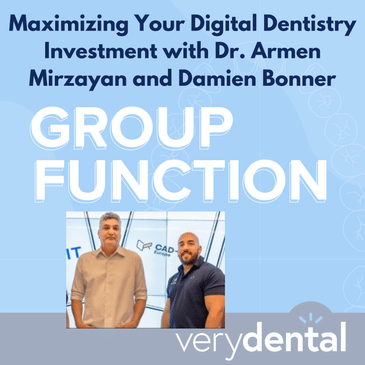
Alan is joined with Dr. Armen Mirzayan and Damien Bonner of CAD-Ray for a second round of discussion on digital dentistry!
- Damien explains a typical progression of someone moving into digital dentistry.
- Companies shouldn't sell digital products to dentists that aren't ready for them.
- Armen is a very cheap salesperson.
- Buy your scanner from someone who knows something about scanners.
- CAD-Ray are terrible sales people but amazing support people.
- Armen on scan bodies
- One very cool thing about digital dentistry is that we can verify accuracy in ways that you can't in analog dentistry.
- Digital margins are tiny enough that we cannot manufacture to the tolerances that we actually see on the digital impression.
- The slop is in manufacturing more than digital scanning
- Photogrammetry and the accuracy of digital scanners over an edentulous scan.
- How to make an accurate scan for full arch implants
- Intraoral photgrammetry with the Shining 3D Aoralscan Elite
- This is going to start making smaller implant cases faster and cheaper!
- Why start a teaching center in Vegas?
Some links from the show:
Join the Very Dental Facebook group using the password "Timmerman," Hornbrook" or "McWethy," "Papa Randy" or "Lipscomb!"
The Very Dental Podcast network is and will remain free to download. If you'd like to support the shows you love at Very Dental then show a little love to the people that support us!
--
Crazy Dental has everything you need from cotton rolls to equipment and everything in between and the best prices you'll find anywhere! If you head over to verydentalpodcast.com/crazy and use coupon code "VERYDENTAL10" you'll get another 10% off your order! Go save yourself some money and support the show all at the same time!
--
The Wonderist Agency is basically a one stop shop for marketing your practice and your brand. From logo redesign to a full service marketing plan, the folks at Wonderist have you covered! Go check them out at verydentalpodcast.com/wonderist!
--
Enova Illumination makes the very best in loupes and headlights, including their new ergonomic angled prism loupes! They also distribute loupe mounted cameras and even the amazing line of Zumax microscopes! If you want to help out the podcast while upping your magnification and headlight game, you need to head over to verydentalpodcast.com/enova to see their whole line of products!
--
CAD-Ray offers the best service on a wide variety of digital scanners, printers, mills and even their very own browser based design software, Clinux! CAD-Ray has been a huge supporter of the Very Dental Podcast Network and I can tell you that you'll get no better service on everything digital dentistry than the folks from CAD-Ray. Go check them out at verydentalpodcast.com/CADRay!
[00:00:00] Benco Dental believes you deserve a trusted partner, a team that makes it easier to grow and deliver the best patient outcomes.
[00:00:07] And what could be easier than knowing everything you need is all in one place?
[00:00:11] Expert advice, dependable value on everyday supplies, fast shipping, plus center point showrooms to try the latest tech before you buy, and experts to help at every turn.
[00:00:21] Visit Benco.com and discover why 81% of their customers agree buying from Benco Dental saves practices time and money.
[00:00:31] This is a production of the Very Dental Podcast Network.
[00:00:42] First, you take a group of Very Dental people.
[00:00:45] Then you add some interesting topics and a few microphones.
[00:00:48] Finally, add some laughs and collegial good cheer and you get the Group Function Podcast.
[00:00:54] Very Dental people, welcome back to another episode of the Group Function Podcast.
[00:00:57] We're doing round two with Dr. Armen Mirzayan and Damien Bonner.
[00:01:01] How are you guys doing?
[00:01:02] Day two, you ready? Rock and rolling.
[00:01:04] We're ready to go.
[00:01:05] Damien is about to fly out here, literally.
[00:01:08] So I'm going to pitch my first question to him as sort of the...
[00:01:12] He's the guy that's likely to answer the phone or the email or the text if you have questions about your...
[00:01:18] He's one of the guys anyhow that would.
[00:01:20] But he also...
[00:01:21] He's kind of the contact point to a lot of cadre clients, customers.
[00:01:28] And so, I mean, there's probably a lot of customers that are like me that come because they're like,
[00:01:33] Okay, everyone says I need to get a scanner or I'm interested in a scanner.
[00:01:36] And so start me out with a scanner.
[00:01:37] And you get those people.
[00:01:39] And, you know, I literally have used the scanner basically as my workflow for Crown & Bridge and kind of nothing else.
[00:01:44] I don't do a ton more with it.
[00:01:47] Watching Armin speak for the last two days, I'm like, God, there's a lot I can be doing with this.
[00:01:51] And it's...
[00:01:52] Part of it is like how often do you see clients bridge the, okay, this is just a tool in my office to becoming more of an enthusiast with all the different stuff you can do?
[00:02:02] Does that make sense?
[00:02:03] Yeah.
[00:02:04] I mean, it's a pretty amazing aspect of Dr. Coleson doesn't know what they want to do.
[00:02:11] They know they need to do something.
[00:02:12] Mm-hmm.
[00:02:13] So they start with a scanner.
[00:02:16] From there, they see the support that we offer.
[00:02:19] Mm-hmm.
[00:02:20] They get comfortable with the scanner.
[00:02:21] They come out to one of Armin's courses.
[00:02:23] The education.
[00:02:23] Yeah, yeah.
[00:02:24] And they realize that this other stuff isn't so hard.
[00:02:27] It's not so...
[00:02:32] It's...
[00:02:32] He's...
[00:02:33] Armin puts it in a way that simplifies it for them.
[00:02:35] Yeah.
[00:02:35] Because otherwise it's intimidating.
[00:02:37] Exactly.
[00:02:37] Like it can be intimidating.
[00:02:40] And I don't...
[00:02:41] You're right.
[00:02:42] How do you make it so it doesn't seem...
[00:02:43] I mean, his knowledge base is such that like...
[00:02:47] We were talking about this in the last one.
[00:02:48] There's a lot of different tools in that medic kit.
[00:02:50] And I got to learn what they are.
[00:02:52] And Armin kind of flies through it.
[00:02:53] But the reality is, is it's like, oh, I see why he's doing this now.
[00:02:56] And that's...
[00:02:56] It's...
[00:02:57] It's...
[00:02:57] It's...
[00:03:16] It's...
[00:03:17] Mm-hmm.
[00:03:18] Mm-hmm.
[00:03:26] There...
[00:03:52] It's...
[00:03:53] Yeah.
[00:03:54] And...
[00:03:54] It's...
[00:04:07] So there's no...
[00:04:10] bundle discounts that we wouldn't offer you today that we would offer you in the future.
[00:04:15] So we try to make it as easy and simple as possible and to transition into a workflow
[00:04:21] that's comfortable for them.
[00:04:22] Yeah.
[00:04:22] It's funny because, so yesterday I was pretty sure I was going to be hitting you guys up
[00:04:27] for a scanner with a bigger scanning area and I still might, but I've decided just
[00:04:33] because I need to start using what I already have more effectively.
[00:04:38] So I know, cause I don't, on some level, I'm not sure that I need to do a change in scanner
[00:04:45] as much as use the scanner better and more comprehensively.
[00:04:49] And honestly, the taking, listening to Armand speak and just showing what it could do.
[00:04:55] What I actually am going to do is I'm going to get my, my cart that the thing is on is really hard.
[00:05:00] It's, it's crowded and it's kind of, I need a better work surface.
[00:05:03] And then I need to just dig into the different tools and see what the heck I can do.
[00:05:07] And I, but that's already there.
[00:05:08] I mean, that's like, that's easy.
[00:05:09] I just need to, so I'm going from the guy who is like, just, this is the tool to what
[00:05:13] else can I do with it?
[00:05:14] And so I'll, I'll keep you posted, but that's sort of what I think I'm going to do.
[00:05:17] It's very, very similar to a smartphone.
[00:05:20] Yeah.
[00:05:21] You know, most people, 90% of the people out there use their smartphone to make phone calls,
[00:05:25] text and take pictures of their grandkids.
[00:05:27] Yeah.
[00:05:27] Yeah.
[00:05:27] But it's a powerful machine in your hand capable of so much more than what you're currently doing
[00:05:31] with it.
[00:05:31] And when you unlock that, there's unlimited potential of what you can do digitally.
[00:05:36] That's exactly, that's a, that's a perfect example.
[00:05:38] That's perfect.
[00:05:38] I agree.
[00:05:39] Just think of the hesitation you had to get on board with scanning.
[00:05:42] Remember how much, how much time you spend like doing your due diligence.
[00:05:45] Yeah.
[00:05:45] I want to get into this.
[00:05:46] Yep.
[00:05:46] You finally bit the bully, you jumped on and now you're seeing the, you saw the value of
[00:05:51] that.
[00:05:51] Now you're starting to explore all these.
[00:05:52] There's actually an easier decision than the first decision.
[00:05:54] It is.
[00:05:55] The worst thing we can do, the worst thing Damien can do is give you something, sell you something
[00:05:59] that you're not going to use because the fallback from that is horrible.
[00:06:03] Yeah.
[00:06:03] It's just like when you do a veneer case on a patient who wasn't prepared for it and they
[00:06:07] were very unhappy with you.
[00:06:08] There's nothing you can do to reverse course and make them happy.
[00:06:11] Yeah.
[00:06:12] It's the same concept.
[00:06:13] We don't ever want somebody to buy something they don't need or want.
[00:06:17] We need you to be convinced that it works and then you make a very comfortable.
[00:06:21] Next time you call Damien and say, Damien, I want that printer.
[00:06:23] You're not going to say, Damien, how does the printer work?
[00:06:26] Yeah.
[00:06:26] You're better prepared.
[00:06:27] It's an easy decision for you and we have the long-term goal in mind and all this and
[00:06:31] everyone's going to approach it with the right pace and the right degree with which they
[00:06:34] incorporate it.
[00:06:35] Yeah.
[00:06:35] They got to convince themselves it was worth the money.
[00:06:38] It was worth their time.
[00:06:39] They benefited.
[00:06:39] The patients benefited.
[00:06:41] That is much easier to make the next decision.
[00:06:43] Yeah.
[00:06:43] It's funny too because you were a dentist first and you're a distributor of this stuff
[00:06:50] now and it is interesting.
[00:06:52] Your role has changed quite a bit in this stuff because not only are you, you're sort of one
[00:06:56] of the guys doing the, okay, this is how we use these tools like from the early 2000s,
[00:07:01] but now you're at a point where you have to decide what companies really deserve to play
[00:07:05] ball in your sandbox and all that stuff.
[00:07:07] It's a very, your role is sort of, I don't know, man, I'm not sure I'd want, I'm not sure
[00:07:12] I'd want that kind of pressure to tell you the truth.
[00:07:13] How do you feel about, are you any regrets becoming the guy who is the making these decisions?
[00:07:18] No, I get a lot of shit from people calling me a salesman and stuff.
[00:07:22] Yeah.
[00:07:22] It doesn't affect me in any way.
[00:07:25] Let me rephrase it another way.
[00:07:27] I was doing exactly what I'm doing now, but I was getting paid to buy companies to teach
[00:07:32] people how their product works, which doesn't pay nearly as much as convincing people to
[00:07:37] buy the product.
[00:07:38] Yeah.
[00:07:38] I'm like, I'm an extremely cheap salesperson just using education to teach people how it
[00:07:45] works.
[00:07:45] Now I can sell the product myself and support it and teach it better than any other company
[00:07:50] can out there with the team we have assembled.
[00:07:51] So it's actually a pretty easy trend.
[00:07:54] I'm doing the same thing I've always done.
[00:07:55] I'm convincing people this works as I use it.
[00:07:57] I used to be part of just education now.
[00:07:59] Now the education is part of supporting these scanners.
[00:08:02] One thing that does bug me is there are quite a few outfits out there who have no business
[00:08:07] selling scanners.
[00:08:08] Of course, the manufacturers want to move their scanners.
[00:08:10] So the way some positions market it is it sells itself.
[00:08:13] You can scale.
[00:08:14] You don't need much handling.
[00:08:15] You don't need much scanning.
[00:08:16] As you see this weekend, I outline like a thousand ways things can go right.
[00:08:19] Yep.
[00:08:20] Yep.
[00:08:20] One more day to go.
[00:08:21] There's so many ways you can do this in there.
[00:08:23] So I think it's a disservice when manufacturers have random people who have zero support or
[00:08:28] know how to even turn on the scanner.
[00:08:31] They start selling.
[00:08:31] Yeah.
[00:08:31] That hurts the industry, I think.
[00:08:34] If your sales guy, if your shine rep comes in and they're selling you the latest mega
[00:08:41] super composite from 3M and also we have a new scanner, beware because that sales guy
[00:08:47] doesn't really know very much about the scanner.
[00:08:49] And, you know, they're there.
[00:08:50] And I mean, the big companies are, it always blows me away to see them on their magazine
[00:08:56] color covers, you know, the scanner.
[00:08:58] They don't know anything about it at all.
[00:09:00] They know nothing.
[00:09:00] And they just want to, it's a little, it blows my mind how many people are still sort of like,
[00:09:07] they just trust their, whoever walks in, you know, from Shine or Benco or whatever.
[00:09:10] And then, and that they're just buying whatever they're selling.
[00:09:13] That's a very, that's a, that's a 30 years ago model.
[00:09:16] It seems like to me, I would much rather, I mean, I'd much rather, yeah, I would, I would
[00:09:21] much rather deal with someone who's, well, I mean, you guys have been in the space for
[00:09:25] a while and I can get my hands on you too.
[00:09:27] That's the other thing.
[00:09:28] We are probably the worst sales organization in the world, but we're the best support
[00:09:33] organization, which means that people trust what we have to say.
[00:09:37] Uh, when I'm working with a customer, um, who's thinking of what scanner to get, I don't
[00:09:43] sell them any which way.
[00:09:44] I just educate them on their products and, uh, and they appreciate that and buy what's
[00:09:48] best for them.
[00:09:49] We sell so many Medit i600s, uh, which is seven, $8,000 less than the other Medits.
[00:09:57] When a doctor comes and says, I want to Medit i700, we talk them to the lower product, uh,
[00:10:01] because at the end of the day, we know it works just as well.
[00:10:03] Uh, and we're going to save them six or $7,000 that they can then invest in a printer or other
[00:10:08] technology they want to buy.
[00:10:10] Uh, so having that knowledge, understanding how the systems work, being able to support
[00:10:14] them, uh, when you do those things, right, the sales follow and other companies lead with
[00:10:20] the product and not the why behind it.
[00:10:23] Yeah.
[00:10:23] I love the fact that you guys distribute for a bunch too.
[00:10:26] It's, that's very cool.
[00:10:27] So if you guys are looking at any of this stuff, I'll put the show notes, you know, the
[00:10:33] cadre in the show notes and all this stuff.
[00:10:34] I, it's, I, it's been a really good experience to, to be watching Armin speak about this
[00:10:39] stuff.
[00:10:40] And the best part is Armin's lecture is sort of evolves throughout the day, depending
[00:10:45] on Damien.
[00:10:46] It's been good to see you.
[00:10:47] We'll, we'll catch you later.
[00:10:48] Catch you next time.
[00:10:49] Thank you so much.
[00:10:49] You bet.
[00:10:50] Probably New York like last time, right?
[00:10:51] Yeah.
[00:10:52] Hopefully we'll see.
[00:10:52] We'll see.
[00:10:53] Pull right up to that mic.
[00:10:55] Armin, we got you.
[00:10:56] We got just Armin now.
[00:10:57] It's funny because your lecture evolves by how people are asking for stuff.
[00:11:02] And another two times today, he said, so did, was this worth your while?
[00:11:06] And everyone clapped today.
[00:11:07] You got claps today.
[00:11:08] So clearly you're doing, you're doing something.
[00:11:09] All right.
[00:11:10] It's so important to me.
[00:11:11] Yeah.
[00:11:11] I take it very seriously.
[00:11:12] I look like a goofball most of the time, but this stuff I take very seriously.
[00:11:16] You take time away from your family, take time away from work.
[00:11:19] You come to this, you're dedicated to be here for two days.
[00:11:21] I've got to deliver.
[00:11:22] I got to make sure it's worth your time.
[00:11:23] It would drive me nuts if I didn't.
[00:11:25] It has been too.
[00:11:26] I got to say, there's a lot of, there's, there's a lot of stuff that might not be perfectly
[00:11:29] applicable to everyone, but I think even my dad, who's not, you know, particularly worried
[00:11:33] about it, there's, there's always something.
[00:11:35] Oh, I mean, you're talking about different implant shapes and, and, and bearing.
[00:11:39] It's really funny.
[00:11:39] You, you were given some love to the Bicon implant, which is sort of that it's pretty
[00:11:43] old school implant and, and not so much the implant, but the concepts you learn
[00:11:49] by placing them.
[00:11:49] And, you know, and I think a lot of people were, you got a lot of questions after that.
[00:11:53] There was a lot of people were, why aren't you placing the Bicons?
[00:11:55] But then also the concepts are, so you've got a lot of, you got deep cuts in your lecture
[00:12:00] that for, for people, it's pretty cool.
[00:12:02] Actually.
[00:12:02] I appreciate that very much.
[00:12:03] Yeah.
[00:12:04] I think I'm a, I know all the questions.
[00:12:07] Usually I don't want to be the lecturer that's up there just spewing what I think is relevant.
[00:12:11] I do like feedback.
[00:12:13] And once in a while you get a very quiet group.
[00:12:15] You kind of have to, you got to, you got to go through it.
[00:12:18] You got, you have no idea what they're thinking, but this group was phenomenal.
[00:12:22] All the questions I get, I need to know if I need to dial things back down.
[00:12:26] I do like to show things that, like you said, that they may not, it may not be applicable
[00:12:30] right now.
[00:12:31] Yeah.
[00:12:31] But it's happened so many times over the years where they've seen something and a year from
[00:12:35] now they come across that and they're like, okay, I know how to do this instead of punting
[00:12:39] or instead of trying to figure this thing out the hard way.
[00:12:42] I know I can get in touch with our man and he'll, I have content on it.
[00:12:44] I'll show him how to do it.
[00:12:46] Particularly using other implants, super structures, a scam body.
[00:12:49] That's a pretty popular one because we're always struggling with having different parts, different
[00:12:54] impression copings.
[00:12:55] Like whenever you see a new implant system and you've haven't worked with it before,
[00:12:59] you probably do the first one at a loss because you're going to buy all this extra
[00:13:02] stuff.
[00:13:03] You don't really know how it works.
[00:13:04] So you wasted money.
[00:13:05] You need like a few of those to actually break even to recoup your investments.
[00:13:10] So a lot of what I do is it's all making sure the doctors are efficient.
[00:13:14] The doctors are saving money.
[00:13:16] They're not wasting money and they're getting the end result very, very quickly.
[00:13:19] And again, we win when we do that.
[00:13:20] It's actually great that you're kind of a cheapskate on that way.
[00:13:23] Like I can tell, I can tell you're not, you're not the guy that really wants to spend that
[00:13:26] money.
[00:13:27] And so you've got, it was really you just libraries of different scan bodies that you
[00:13:32] were basically, you were, you were essentially connecting them to a whatever implant superstructure
[00:13:37] the person kind of had like you were using like a tie base or something like that, that
[00:13:41] was connected, which was kind of fascinating to me.
[00:13:44] Cause I, I haven't had, I literally have, when I restore implants, I still do polyvinyl
[00:13:48] because in my lab tech told me, you're crazy.
[00:13:50] You need to come over and I've got, I've got the implant, you know, in a lot of the surgeons
[00:13:54] are on his places, a similar implants.
[00:13:56] He's got a bunch of them.
[00:13:57] So I need to start doing that with him too.
[00:13:59] But I will say that for people who are restoring a lot of implants, just hearing Armin talk about
[00:14:04] this is pretty fascinating.
[00:14:06] It's sort of, I was like, man, you know, that is a really, it's a great hack to get
[00:14:10] around all the different, you know, there's clearly a lot of scan bodies out there and
[00:14:14] it's hard to know which one you're supposed to be using and all that stuff.
[00:14:17] I appreciate that.
[00:14:18] Actually, there's a, there's a little side conversation here to be had.
[00:14:21] Like, you know how you do a procedure for the first time in your office and you're likely
[00:14:25] to blunder it and you're likely to repeat it and you're no longer profitable with that
[00:14:30] process.
[00:14:30] It sucks, right?
[00:14:31] We've all been there, but this is a very unique situation I'm in.
[00:14:34] And I'm blessed that way because all those screw ups are actually great material to show
[00:14:39] people.
[00:14:40] Because if you, if you, if you look at this from a big point of view, what I've done
[00:14:43] this weekend, I pretty much cataloged the 500 ways we introduce errors, you know, all
[00:14:48] the mistakes we make.
[00:14:49] Cause we get them all.
[00:14:50] I know what the, I know what the blunders are.
[00:14:52] I know where people struggle.
[00:14:53] I know what the questions are.
[00:14:55] So I've sculpted it that way.
[00:14:56] So I address things.
[00:14:57] I put out fires before I do.
[00:14:58] Cause nothing more frustrating than having to redo something that you already lost your pants
[00:15:02] on.
[00:15:03] Yeah.
[00:15:03] You're worried about the liability.
[00:15:05] So you do it for free.
[00:15:06] You eat the cost of the new restoration.
[00:15:08] You're trying to remedy things.
[00:15:09] It's not fun.
[00:15:11] But again, I'm fortunate enough because that is actually much better content than the success
[00:15:16] case A to Z.
[00:15:17] Cause everyone, everyone relates to it for one thing.
[00:15:19] The perfect example was that I used one scan body early on and I made the mistake of not
[00:15:24] knowing his exact reference number.
[00:15:26] Okay.
[00:15:27] So I would constantly pick the wrong selection in the design process.
[00:15:31] So for a year, my crowns are 0.82 millimeters too tall, 0.4 millimeters too short.
[00:15:36] I'm going absolutely crazy until I realized, oh, I screwed up.
[00:15:40] I have no idea what the scan body is.
[00:15:42] The reference marker number wasn't on there.
[00:15:44] It wasn't tattooed on there.
[00:15:45] It was a $20 mistake that cost me thousands of dollars to redo and lots of headache.
[00:15:51] That's not fun.
[00:15:52] So if I prevented someone from being in that same boat, I'm pretty stoked.
[00:15:56] Yeah.
[00:15:56] No, that's, that's fantastic.
[00:15:57] I like that.
[00:15:58] Something I just thought of too.
[00:15:59] You're like all the different ways that we introduce error.
[00:16:03] What's interesting in a digital world, you're, you offered up a lot of different ways for us
[00:16:09] to recognize those errors before we proceed further.
[00:16:13] That is interesting.
[00:16:15] There are not ways that we could do that in an analog world.
[00:16:18] In other words, how do you know, how do you know when, when your impression was distorted?
[00:16:23] If it's a polyvinyl impression, you probably know that.
[00:16:26] I mean, maybe at a try-in or if you're trying to deliver something.
[00:16:30] That's when you find out.
[00:16:32] Why do you go and produce?
[00:16:33] It's an expensive way to do it.
[00:16:34] Yeah.
[00:16:34] Why do you, why do we manufacture something without confirming our impressions accurate?
[00:16:39] Yeah.
[00:16:40] Yeah.
[00:16:40] Yeah.
[00:16:40] Yeah.
[00:16:40] So it's weird.
[00:16:41] I love this.
[00:16:42] I love having these conversations with you because I think you, you wrap that up very
[00:16:45] succinctly for me because that's exactly what I've been trying to do, but I just never
[00:16:47] had the worst to put that together.
[00:16:49] Yeah.
[00:16:49] Yeah.
[00:16:49] Like to confirm your scan while you're scanning, to stack the odds in your favor is all I've
[00:16:55] been trying to show all weekend.
[00:16:56] And I never put it together that succinctly, that precise.
[00:16:59] It's funny because a couple of times earlier today, you were like, okay, I'm going to see
[00:17:03] if I can make this thing mess up.
[00:17:04] And it didn't.
[00:17:05] Yeah.
[00:17:05] And you're like, okay, well, but, but the reality is you were showing how you would
[00:17:10] see a, you know, like if you're scanning, you were scanning a denture and you went literally
[00:17:15] from, you know, the left side of the right side across the palette and in, in, in lo and
[00:17:19] behold, it actually, it actually got the relatively accurate kind of seam.
[00:17:23] But, but a lot of times if you're not grabbing that reference bit of whatever you're scanning
[00:17:28] to kind of bring it over, you'll get the distortion there.
[00:17:31] So in some ways, digital, you see the distortion that might be irritating to you, but on the other
[00:17:36] hand, that's telling you that you've got the air.
[00:17:38] You don't want it to go back, do something different.
[00:17:40] It's massive.
[00:17:41] It's huge.
[00:17:42] It's huge.
[00:17:42] You can't do that in analog.
[00:17:44] No, you can't.
[00:17:45] Every, every presentation I start, and usually there's a lot more assistants.
[00:17:48] There's only one assistant.
[00:17:49] And she was a trader for the lab company, right?
[00:17:52] I always start with such, and it's, it stomps a lot of people.
[00:17:55] It's really weird because it kind of is a trick question.
[00:17:58] I just ask a very simple question.
[00:17:59] You take an outward impression.
[00:18:01] How do we know that's accurate?
[00:18:03] Yeah.
[00:18:03] We have no clue.
[00:18:04] Yeah.
[00:18:05] Like we, we will pour it up.
[00:18:07] We'll go through the hassle of pouring it up, sending it to the lab, get the night guard
[00:18:12] back.
[00:18:12] And most of the time we get lucky.
[00:18:14] It fits.
[00:18:15] Yeah.
[00:18:15] When it doesn't, you're annoyed.
[00:18:17] You got to take a new impression.
[00:18:18] But it's crazy to me that we would produce something without verifying that we're accurate.
[00:18:23] Yeah.
[00:18:23] So the simple remedy to that is, the doctors just talk themselves into this.
[00:18:28] Okay.
[00:18:28] The only way I can know I have an accurate impression is if I took two impressions.
[00:18:33] If I took two PVS impressions and the lab digitally poured it up, they scan it with a desktop scanner
[00:18:38] and these two models that are rendered merge each other and they match each other very nicely.
[00:18:43] We can conclude if two separate impressions produce the same result, we can conclude that
[00:18:48] you're going to have a well-fitting restoration.
[00:18:50] Now, there is a one in a trillion chance that they're off so bad themselves that they match each other.
[00:18:56] There's always one dentist that thinks that way.
[00:18:57] Yeah, yeah, yeah.
[00:18:58] They're both so horribly off, but they're identically off.
[00:19:01] So you have an inaccurate model render.
[00:19:03] Exactly, exactly.
[00:19:04] One in a bazillion chance.
[00:19:05] Other than that, though, we just found a way to verify our impressions accurate before we waste any more time.
[00:19:11] And then I just hammered that home a thousand times, a thousand different ways, how to use
[00:19:16] a scanner advantage to verify something before you send it off.
[00:19:19] And it's worth mentioning, too, that we have clinically acceptable stuff is sort of the
[00:19:25] slot factor in everything a little bit.
[00:19:27] So you multiple times were saying, well, there's a little bit of distortion here, but you literally
[00:19:34] can't manufacture this to a standard that that variation would make a difference.
[00:19:38] I think it was in some crown margin stuff you were talking about yesterday.
[00:19:42] So it's good to know that the accuracy of some of the digital imaging is beyond what
[00:19:49] we can manufacture.
[00:19:50] Yes, that's a very, very good point.
[00:19:51] So you see your margin blown up 50-fold, 100-fold, whatever it is, and you're trying to mark
[00:19:57] it as detailed.
[00:19:59] There's no way.
[00:20:00] Under 200 microns, a million machines are going to struggle manufacturing.
[00:20:05] It's just going to chip.
[00:20:05] It's just too thin, right?
[00:20:07] Yep.
[00:20:07] So if I can't manufacture something under 200 microns, what's the difference between a
[00:20:12] 20-micron difference and the margins we're trying to draw?
[00:20:15] It's just, you just can't manufacture that.
[00:20:17] It's an interesting point because there are times, it's not often, but occasionally, I
[00:20:22] looked at it, it looked like the margin was good.
[00:20:23] And you mentioned something I didn't realize.
[00:20:26] A lot of times, you're seeing the cartoon of what the scanner has until it's processed.
[00:20:33] Yes.
[00:20:33] So, I mean, a lot of times, I'm marking my margins on the Meta software before it's processed.
[00:20:38] So is that accurate?
[00:20:39] Oh, no, no, I'm sorry.
[00:20:40] It's locally processed.
[00:20:41] It takes the little, it takes, you select it, and then it processes just that spot.
[00:20:45] Yes.
[00:20:46] Because it'll take too long for it to process the whole model.
[00:20:49] Exactly.
[00:20:49] Okay.
[00:20:49] And I can, if you've used a Meta, you know what I'm talking about.
[00:20:52] Because when you're doing the margin marking, you select the tooth specifically, and it
[00:20:56] processes just for a short time so it gives you the accurate version of it.
[00:21:01] And then you mark your margins on that.
[00:21:02] I got to tell you, I find that almost always the margins are, and I use color.
[00:21:07] I know that everyone's like, oh, I use the color because I feel like I just saw the preparation.
[00:21:11] I'm literally sitting in the room with the patient.
[00:21:12] That's the best time for me to do it.
[00:21:14] I shouldn't be trying to remember it later.
[00:21:17] But sometimes I'm like, is this exactly where it was?
[00:21:20] And your point is that if you're marking the margins blown up that big, you're doing a pretty
[00:21:26] great job of it at that point.
[00:21:27] It's like, and I have to say, a lot of times I'm like, boy, I hope this margin is, and
[00:21:31] the crown is awesome when you put it in.
[00:21:33] So the reality is, is like, that is a lot of precision that can't even actually make
[00:21:38] it to the manufacturing process.
[00:21:39] So it's a very common question people ask, is a scanner accurate enough to pick up that?
[00:21:43] Yeah, absolutely is.
[00:21:44] You just can't manufacture.
[00:21:45] I don't even think by hand you can manufacture that much detail either.
[00:21:48] Good point.
[00:21:48] Really good point.
[00:21:49] That's right.
[00:21:49] So I think the conversation is going to move over time.
[00:21:52] It's going to move from scanners to the manufacturing process because there's a lot of slop and
[00:21:57] printing and milling, and that'll be the focus once everyone's comfortable with hammering
[00:22:01] out all the errors we introduce while scanning.
[00:22:03] Okay.
[00:22:04] So this was the thing we didn't get to yesterday that I want to bring up to you here.
[00:22:08] So I'm going to have you, we're going to talk about the new intraoral photogrammetry
[00:22:14] stuff.
[00:22:14] But I first, because I don't really understand it myself.
[00:22:16] I've never done it.
[00:22:18] I've seen lots of it online and stuff.
[00:22:20] What is photogrammetry?
[00:22:22] And explain the big expensive cameras that we've been using up to this point and why, how do they
[00:22:29] work and why are they so accurate?
[00:22:30] Sure.
[00:22:32] So first, let's really map out, in a certain manner, why intraoral scanners, there's a
[00:22:39] lot of talk.
[00:22:39] Actually, most of the studies say they're horribly inaccurate for implants, full arch
[00:22:43] implant restorations.
[00:22:45] Some people know how to work them.
[00:22:46] And the summary of the problem is that the longer you go on a dentualist span between two
[00:22:54] implant superstructures or two preps, the longer the dentualist span, the less likely it
[00:23:00] is that you're accurate.
[00:23:01] You may introduce errors.
[00:23:04] You may veer off track.
[00:23:05] So there's this thing, the field of view that we touched on earlier, there's a, usually
[00:23:09] it's a green box for most scanners.
[00:23:11] And the more data you fit in that green box, which is the field of view of that scanner,
[00:23:16] the more likely it is that you'll be accurate.
[00:23:18] So a quick example of that is if you have a tooth or an implant superstructure and a
[00:23:24] dentualist span and then another implant superstructure at the tail end of that, if you don't
[00:23:29] fit that whole complex in a single frame, you must assume that there's inaccuracies involved.
[00:23:35] If you can fit them both in the frame, they're bookended, like you have that green box and
[00:23:39] on the mesial end, there's a tooth or implant superstructure.
[00:23:43] And on the left side of the screen, there's an implant superstructure or prep.
[00:23:46] There's a dentualist patch in between.
[00:23:48] And you capture all that in one single frame, your odds of it being accurate skyrocket.
[00:23:52] Yeah, yeah, yeah.
[00:23:53] And generally, an all-on-four type of case, the whole point is to spread those implants
[00:23:58] out along the sedential spans as far apart as possible so you have an AP spread.
[00:24:02] So technically, if you have six implants or eight implants, you're more likely to stay
[00:24:06] accurate than you are with a four unit.
[00:24:09] So that distance between, the summary of all this is, the distance between two implant
[00:24:13] superstructures and all-on-four type of case in the lower jaw in a flat plane is very
[00:24:19] ripe and prone for error and creating issues.
[00:24:23] I mean, this is why when you're doing analog that you really, you want to do the, you want
[00:24:27] to make sure that you've got a stiff tri-ingera verification jig.
[00:24:32] That's why they do the same thing just for, just because accuracy around the arch is hard.
[00:24:37] It's just a difficult, and it's vitally important that you're getting a passive fit on these
[00:24:43] things or, you know, so, and a lot of people have said you can't do it digitally because
[00:24:47] of this.
[00:24:48] So then, then they started, that's the problem.
[00:24:51] The problem is the accuracy is the, the, the intra, the space between the implants, it
[00:24:58] has to be recorded wildly accurately or it's good or the case is going to be in jeopardy
[00:25:04] basically.
[00:25:05] So, so the options you have, and a lot of smart people have, uh, uh, have developed adjuncts
[00:25:11] to help you break up that symmetry, to break up that flat plane of an edentulous ridge.
[00:25:16] So you have all kinds of products that you place on the multi-unit abominant.
[00:25:20] I'll just rattle off a few.
[00:25:21] There's one called OptiSplint.
[00:25:22] That's more of a analog, uh, uh, solution to this, uh, to this situation.
[00:25:26] But then you have scan ladders.
[00:25:28] You have, uh, quite a, they have the next day, I have quite a few different, um, um,
[00:25:34] superstructures you place on the multi-unit abominant to help it stay on track.
[00:25:37] You're trying what you're doing, everything you can in your power to disrupt that symmetry.
[00:25:43] The less symmetry there is, the less flat, the, the, the, the fatter the abominants, the
[00:25:48] shorter they are, the less irregular they are, uh, the better off you are to keeping on track.
[00:25:52] So there's some great solutions out there.
[00:25:55] Blue sky, I'm sorry, true Batman came out with one.
[00:25:58] There's quite a few solutions out there for introoral scanners.
[00:26:02] And I draw the line for myself because I have a lot of responsibility.
[00:26:05] I tell people, if you use any of these products, uh, I can show you how to use them.
[00:26:09] I can get you there, but I discourage you from go out committing to finals, uh, without
[00:26:14] a verification, right?
[00:26:15] Yep.
[00:26:15] Because what you can do a hundred cases in a row, perfect.
[00:26:19] That hundred and first case that doesn't fit can ruin the first hundred.
[00:26:22] You're miserable.
[00:26:23] Yep.
[00:26:23] Patient's miserable.
[00:26:24] You're charging quite a bit for these.
[00:26:26] Yep.
[00:26:27] You just, you know, it's just, uh, it's not fair to the patient if you're, you want
[00:26:31] to deliver it at the same time.
[00:26:33] So, but I know plenty of people who use those and skip their verification jig.
[00:26:36] That's your decision.
[00:26:38] After you've done a bunch, maybe you decide, Hey, you know what?
[00:26:40] This is overkill.
[00:26:41] I don't need it.
[00:26:41] That's your decision to make with a photogrammetry.
[00:26:44] The solution is so good minus human error.
[00:26:47] I'm perfectly comfortable telling people skip the verification.
[00:26:50] They can skip that part.
[00:26:51] Okay.
[00:26:51] Because what this does completely different technology.
[00:26:54] So there's quite a few ways to describe it.
[00:26:57] Photogrammetry is basically taking multiple images with cameras from different
[00:27:01] angles and putting together a 3d object.
[00:27:04] Uh, some people say you need to capture all the objects in one shot in one field of view.
[00:27:08] Others say, no, it doesn't quite work that way.
[00:27:10] A lot of, uh, none of us are engineers could, could talk to that.
[00:27:14] But the whole point is the photogrammetry scanner up until recently, we only had extra
[00:27:18] oral options.
[00:27:19] You put these dominoes on top of the implant fixtures and these dominoes have markers on
[00:27:24] them.
[00:27:25] And then when you're scanning with this extra oral scanner, you're looking for those markers
[00:27:29] on the dominoes or known positions.
[00:27:31] So you no longer deal with soft tissue, blood, long edential spans.
[00:27:36] Everything I just detailed earlier that it's a cause of the problem is no longer in the
[00:27:40] equation.
[00:27:40] So you're scanning something very different than an internal scanner scanner.
[00:27:44] You're scanning these markers that are not moving.
[00:27:47] They're well known.
[00:27:47] And then once the, uh, photogrammetry unit recognizes those markers, they need to pick
[00:27:52] up enough points.
[00:27:53] Then they can spit out what's called an output file where they render the implant positions
[00:27:58] perfectly.
[00:28:00] Um, when it replicates exactly what's happening in the mouth.
[00:28:03] And oftentimes I'll look at an intro scan.
[00:28:05] I'll look at a scan from that.
[00:28:06] And the discrepancy is so subtle.
[00:28:08] You may not notice it until you look at it in cross section.
[00:28:10] And then once you see that, like, oh, there's no way that screw was going to fit.
[00:28:14] The screw is wider than a discrepancy.
[00:28:17] I'm not going to be able to see this.
[00:28:18] It's really obvious.
[00:28:19] So, um, when you start looking at it in that much detail.
[00:28:22] So up until now, we had the big cameras that you were mentioning and their, their cost
[00:28:26] was insane.
[00:28:28] When we started carrying one called the iCam during the pandemic and quite a few people
[00:28:32] purchased those from us.
[00:28:34] Um, and that was a 23 grand.
[00:28:37] That's at 45 grand, the same machine, like no improvement.
[00:28:39] It's just the demand drove the, drove the price up.
[00:28:42] Now we got a great solution, an intraoral, uh, scanner, uh, that couples as a intro photogametry
[00:28:48] machine.
[00:28:49] Now, instead of putting vertical, vertical dominoes in the equation, you put horizontal
[00:28:53] dominoes in the equation and the same intro scanner while that you're using to scan this
[00:28:57] off tissue.
[00:28:58] Uh, I don't know exactly the technology is proprietary.
[00:29:00] They won't share it with us, but it basically flips the switch.
[00:29:03] No, you don't have to even change the tip.
[00:29:05] It's the same tip, but the way the camera works is different camera.
[00:29:09] It looks for those exact markers on the horizontal plane.
[00:29:12] It's the vertical plane, like every other system was today.
[00:29:15] And then it perfectly finds your, it'll index where your implant positions are.
[00:29:19] So you're, you're accurate enough that you could potentially for your framework.
[00:29:22] Anyhow, you're potentially could, could skip that, that, that verification.
[00:29:26] I wouldn't even say potentially you could absolutely skip it.
[00:29:29] Okay.
[00:29:29] Money back guarantee.
[00:29:30] Okay.
[00:29:31] And they just minus human error.
[00:29:32] Yeah.
[00:29:32] Cause you could conceivably not.
[00:29:34] Okay.
[00:29:35] The most likely errors are you don't see the domino.
[00:29:37] Yeah.
[00:29:37] Yeah.
[00:29:38] Yeah.
[00:29:38] Or the bigger one is you see the domino on a multi and the multi and domino connection
[00:29:44] are stiffer than the multi and implant connection.
[00:29:47] I got it.
[00:29:47] So you, without you knowing it, you undo it and you unravel.
[00:29:51] I got it.
[00:29:52] And you didn't, you didn't catch that.
[00:29:53] Right.
[00:29:54] And you go to deliver the prosthesis and it doesn't quite work out to your favor.
[00:29:57] Yeah.
[00:29:57] God damn.
[00:30:02] The technology itself, if you do everything right, money back guarantee from us.
[00:30:06] They actually, we have that with every product.
[00:30:08] We, we don't like unhappy users.
[00:30:09] So we buy them back.
[00:30:10] Yeah.
[00:30:10] But we, we're, we're not going to leave you stranded.
[00:30:13] That's, that's, it's, it's really cool.
[00:30:15] And the thing about it is, is it's like for someone who's, my question to you is that,
[00:30:22] I mean, you, the, the cost for the extra oral unit, you said went up just because of demand,
[00:30:27] but now all of a sudden you've got this scanner and I'll put a photo of it.
[00:30:31] And I took a photo of it.
[00:30:32] It's this, it's the tiniest scanner I've ever seen.
[00:30:33] It's just, it's really small.
[00:30:36] It's very cool.
[00:30:36] It's the shining 3d, uh, their newest one that came out just last week.
[00:30:41] Um, it, it's a fine scanner.
[00:30:43] It scans, you can use it for everything else you're already using it for, but now you can
[00:30:46] also add this.
[00:30:47] If, if you're, if you're doing full large workflow, you just save yourself from having to buy a
[00:30:52] potentially very expensive camera and you get a similar functionality out of it.
[00:30:55] Yes.
[00:30:56] Uh, I think where the company is falling short and I've been hammering on this as well is,
[00:31:01] um, the, the market for full large implantology is so small compared to just, uh, the average
[00:31:08] GP bread and butter single or two.
[00:31:11] I would use this on single units and two units even.
[00:31:14] It's so good.
[00:31:15] Like I saw, I showed how easy it is to introduce errors with two scan bodies in a dent take case.
[00:31:20] Plenty of errors you can introduce.
[00:31:22] Oh, so you're saying this isn't just, I mean, this isn't just a full arch solution.
[00:31:25] It is right now.
[00:31:26] Okay.
[00:31:27] And I'm just on, I'm like, dude, you got to make us dominoes for even single units.
[00:31:31] Interesting.
[00:31:31] I think it'll replace, it'll replace all the scan bodies that we've discussed all week.
[00:31:36] Which is, I mean, it was quite a discussion because there's, I mean, there's just a ton
[00:31:41] of them, you know, and everyone probably has their favorite and stuff, but it's, it's for
[00:31:44] someone who's just getting into it, it's pretty overwhelming how much stuff there is.
[00:31:47] It'd be nice to have something to go to that way.
[00:31:49] Interesting.
[00:31:49] I hadn't thought about that.
[00:31:50] Yeah.
[00:31:50] So do you feel like, you feel like knowing that this technology is coming into the field?
[00:31:56] Is that going to, what is that going to do to full arch?
[00:31:58] You know, I mean, you still have to have the implant surgical skills.
[00:32:02] You still have to know how to plan the cases and stuff like that, but it does take, you
[00:32:05] know, it takes a pretty expensive piece of technology down quite a bit.
[00:32:09] I mean, everything we ever do in dentistry is we always want it to be faster and cheaper
[00:32:15] without compromise.
[00:32:16] Right.
[00:32:17] Yeah.
[00:32:17] And, you know, you've, you talk about things, well, you can't, you know, it's very difficult
[00:32:21] to find that balance, but we do make progress.
[00:32:23] Like there's certain things in dentistry that have gotten better and cheaper and custom
[00:32:28] abutments have gotten better and cheaper all the time.
[00:32:30] Right.
[00:32:30] Yeah.
[00:32:31] Same with this.
[00:32:32] And what it translates to is just better care for our patients, faster, cheaper that
[00:32:37] we can pass on to the patients.
[00:32:39] Um, I don't do that many full arches, but when I first started doing them, it's stressful.
[00:32:43] Like, oh man, I hope this fits.
[00:32:45] Yeah.
[00:32:45] Like to, to address all those things, the, all, all the unknowns and not to have a repeat,
[00:32:50] not to have to reduce ceramics or zirconia and, uh, hassle with the lab is just, uh, the
[00:32:57] predictability, the, the ease of use, how fast it is.
[00:33:00] And the cause is just perfect.
[00:33:01] It's everything we ask for in dentistry.
[00:33:03] Yeah.
[00:33:03] Make it faster and cheaper for me.
[00:33:04] I don't want to compromise on the care, but make it faster and cheaper and I'll jump on
[00:33:08] board and you reap the rewards for that.
[00:33:10] Definitely.
[00:33:11] So I'm trying to picture what Armin's life is like.
[00:33:14] You teach a lot.
[00:33:15] You're like you said, most weekends that are not holidays, you're teaching somewhere, whether
[00:33:19] it's in your, the teaching center in Las Vegas or, or, you know, you're at a meeting
[00:33:23] somewhere or something like that.
[00:33:25] What, what is your, when you're seeing patients, you do clinical work, how often are you, how
[00:33:29] often is it, how many days a week?
[00:33:31] Pretty much early in the week.
[00:33:33] Uh, mostly Monday afternoons.
[00:33:35] I'm in LA Monday, Tuesday, Wednesday, uh, still see patients that are old practice.
[00:33:40] And then usually this, like you ask me this question a month from now, I'll have a completely
[00:33:44] different answer.
[00:33:45] I get it.
[00:33:45] I get it.
[00:33:45] So, uh, you know, uh, we're in Vegas now.
[00:33:48] That's where the facility, the cool thing, the whole reason we moved to Vegas was, uh, people
[00:33:52] from the East coast hate traveling to the West coast, of course, understand they lose
[00:33:55] production one day and they lose family time the next day.
[00:33:58] Like they don't catch their flight at noon or one on Saturday.
[00:34:01] It's true.
[00:34:02] They're either have to do the red eye, which is not fun or travel on Sunday.
[00:34:06] So it's, it's pretty, for a two day course, you're spending four days coming from New York
[00:34:11] to LA.
[00:34:11] Because it's a solid day travel both ways.
[00:34:13] Yeah.
[00:34:13] Vegas is positioned so well that you can work all day till 6 PM on Thursday, no matter where
[00:34:18] you're in the country, still fly in Thursday night, get in a reasonable hour, get some good
[00:34:23] rest.
[00:34:23] Just take the course Friday, Saturday and still catch a flight home Saturday night and
[00:34:28] be home with family.
[00:34:29] Well, Vegas has every, every place has direct flights to Vegas too.
[00:34:32] That's what I mean.
[00:34:32] That's exactly it.
[00:34:33] The reality is, is like Vegas might be the only place that I don't have to, our local airport
[00:34:39] is tiny.
[00:34:40] And so it basically flies to Chicago or Detroit, but, but Flint, which is only another 20
[00:34:46] minutes from where we are, has a direct flight to Vegas.
[00:34:49] It's the only other place.
[00:34:51] So it's one of those things where even we're out in the middle of nowhere and you can get
[00:34:54] to Vegas pretty easily.
[00:34:55] So that's, you're just defining it.
[00:34:57] Makes a ton of sense.
[00:34:58] Uh, you know, I know when I make plans like, oh, I can't go there direct.
[00:35:02] I might not even go because I don't want to deal with the transfer.
[00:35:04] Yeah.
[00:35:05] We've all, we've all been burned by that, uh, where you show up late, you haven't slept
[00:35:09] and you're sleeping through the whole class.
[00:35:10] That's useless.
[00:35:11] Right.
[00:35:11] It's useless.
[00:35:12] Yeah.
[00:35:12] So, uh, so we have a facility in Vegas.
[00:35:15] I have my license in Vegas.
[00:35:16] I don't see patients in Vegas and Vegas is pretty much a suburb of LA.
[00:35:20] Yeah.
[00:35:20] So I'm back in LA all the time and I see patients there.
[00:35:24] Uh, there's some weeks I can go two weeks without seeing any patients there, but, uh, none of
[00:35:28] this stuff works unless I've tested it.
[00:35:30] I've proven that it works internally.
[00:35:32] Sure.
[00:35:32] It has more credibility, uh, for people who can have like, oh, again, I gotta, I gotta test
[00:35:37] all this stuff, see where the pitfalls are so I can communicate it to people.
[00:35:40] So that's pretty much it.
[00:35:41] I mean, it's, it's a lot easier now because our daughter graduated college.
[00:35:45] She lives in New York city.
[00:35:47] So, uh, it's, it's a lot easier than when you have a child.
[00:35:50] Yeah.
[00:35:50] That's, that's hard when you're, when you don't want your wife to be or your spouse to be
[00:35:54] a single parent.
[00:35:55] So you'll, you can't do certain things.
[00:35:58] And, uh, uh, that's, that's one of the things that I've, I've struggled to, to do
[00:36:02] a lot of the travel, especially, and actually I did more when they were little now that
[00:36:06] they're both in high school.
[00:36:07] It's amazing how, man, school started up and it is, the schedule is crazy.
[00:36:11] Yeah.
[00:36:11] So, yeah.
[00:36:12] I mean, you don't want to miss out on that.
[00:36:13] No, you can't.
[00:36:14] And it's, it's one of these things where I always wonder how a lot of these people who
[00:36:17] did a lot of teaching while they had little kids, I don't know how they do it.
[00:36:20] It's definitely not easy.
[00:36:21] It's too much.
[00:36:22] Yeah.
[00:36:22] So, but that's, I do think Vegas was a good choice that way.
[00:36:26] And I mean, so many places, so many classes are offered in Scottsdale.
[00:36:30] It's not the same, man.
[00:36:31] It's not as direct, you know, you're flying into Phoenix and you got to get to Scottsdale,
[00:36:34] all that stuff.
[00:36:38] I don't know if it's a good choice.
[00:36:39] I'm not, I'm not the biggest fan of all that Vegas has to offer, but I'll say the traveling
[00:36:42] is real easy.
[00:36:43] Our, our facilities, uh, off the strip and, um, yeah, there's a good number of people.
[00:36:48] So a good number of people show up and they bring, you know, spouse, partner, whoever,
[00:36:52] and they stay on the strip.
[00:36:53] They have it.
[00:36:54] They have a blast.
[00:36:55] Um, usually by day two, a couple of people show up an hour late, sunglasses on at a
[00:36:59] rough night.
[00:37:00] Yeah.
[00:37:00] Uh, but, uh, probably 10% of the people hate what you just said.
[00:37:04] So they stay close to us.
[00:37:06] Yeah.
[00:37:06] Uh, there is a casino close by, but there's a hotel, home two suites next door.
[00:37:10] Yeah.
[00:37:11] Uh, so you can avoid all that.
[00:37:12] And it's a 15 minute drive from the airport.
[00:37:14] Very, very easy to get.
[00:37:15] It's massive.
[00:37:15] Like, you know what?
[00:37:16] It gets stuck with.
[00:37:17] Uh, you can get to our facility and faster than a strip at the hotel on the strip.
[00:37:22] Yeah.
[00:37:22] It's a very, very easy straight shot.
[00:37:24] That's awesome.
[00:37:24] I have, I'll put that, I'll put some links up so people can see.
[00:37:26] And you guys offer a lot of different classes out there.
[00:37:28] You've got the basic, it sounds like the basic scanning course is really good for team
[00:37:32] members too.
[00:37:33] Yes.
[00:37:33] We highly encourage it.
[00:37:35] We have, uh, we have quite a few people who'll take the course and then they hire somebody
[00:37:39] new.
[00:37:40] If we got the space, send them over and we'll teach them.
[00:37:42] You don't have to take the time.
[00:37:43] Like we've all gone through this, right?
[00:37:44] You, you take a weekend off.
[00:37:46] You spend thousands on a course.
[00:37:47] You take the team members.
[00:37:49] They leave, they get married, they move on, whatever life happens.
[00:37:52] You hire somebody and you're like, oh damn, I don't want to go through all that expense
[00:37:56] and headache again.
[00:37:57] We'll just send them to us and they'll sit in with everybody else.
[00:38:00] We got the room.
[00:38:00] We'll train them.
[00:38:01] We have other clinicians now that use our space, our partners, our friends.
[00:38:05] That makes a lot of sense too.
[00:38:06] We, uh, we, uh, we offer it to them, uh, uh, to utilize it.
[00:38:10] So we have quite a few who want to use the facility for all the things that we just
[00:38:14] discuss just so easy for, uh, for, uh, for the students and stuff to show up.
[00:38:19] So it's worked out really, really nicely.
[00:38:20] So then I take off into my wife works there.
[00:38:23] She works at a dental office in a Summerlin.
[00:38:26] She's loving that.
[00:38:27] So she's, uh, there most of the week.
[00:38:29] And then I traveled back and forth to LA in the beginning of the week.
[00:38:31] It's, it's very simple.
[00:38:32] It's a quick little flight.
[00:38:33] That's cool.
[00:38:34] That's fantastic.
[00:38:35] It's, it's a lot, but it's, but it's, it's a good way.
[00:38:37] Like people who do this and decide they want to do it for the long haul, have to figure
[00:38:41] out a way to make it work.
[00:38:42] It's definitely a lot easier now.
[00:38:44] And then the other thing actually is a friend of ours, Brian Teranian, if you know that.
[00:38:47] Sure.
[00:38:48] Yeah.
[00:38:48] Yeah.
[00:38:48] So Brian, I would give him hell for this.
[00:38:50] He flies now.
[00:38:51] Yes.
[00:38:51] He's a pilot.
[00:38:52] It's worked out so nicely.
[00:38:53] I just flew with him, uh, on Monday or Tuesday it was.
[00:38:56] Uh, so anyway, he does the classic thing you're not supposed to do as a dentist.
[00:38:59] He climbs a ladder to put up Christmas lights.
[00:39:02] He falls and breaks his wrist.
[00:39:03] Yeah.
[00:39:03] Done.
[00:39:04] Yeah.
[00:39:04] Career is over.
[00:39:05] Uh, very unfortunate.
[00:39:06] So now he's a pilot and he's working up to get his hours so he can, uh, become a commercial
[00:39:12] pilot.
[00:39:13] That's his, uh, that's his ultimate goal.
[00:39:14] So he needs the hours.
[00:39:16] So we just trade up.
[00:39:17] Like I look up a flight from LA or Vegas to LA, and then I just buy the exact amount
[00:39:23] and fuel for him.
[00:39:24] So he just flies up, picks me up, takes me to LA.
[00:39:26] He gets his hours and I get to fly.
[00:39:28] Oh, that's cool.
[00:39:29] And miss, uh, all the chaos at the airport.
[00:39:31] Oh yeah.
[00:39:31] Totally.
[00:39:31] It's, it's worked out really nicely.
[00:39:33] That's awesome.
[00:39:33] And, uh, I need, I know how to pull a parachute on that plane too.
[00:39:36] So that's, he taught me that.
[00:39:38] So that's good to know.
[00:39:39] Just in case.
[00:39:39] Yeah.
[00:39:39] Put my wife at ease with that.
[00:39:41] Yeah.
[00:39:41] And I had to pull the cord.
[00:39:42] That's funny.
[00:39:43] That's a, as I'm about to go out mountain biking, I, uh, I probably wouldn't be a pilot.
[00:39:47] I mean, I'd have to, maybe I don't know.
[00:39:49] Didn't you get hit on a bike once?
[00:39:51] I did.
[00:39:51] Yeah.
[00:39:51] I did.
[00:39:51] It was four years ago.
[00:39:52] I got, I was, I was road biking then and I got hit and broke my back in two places,
[00:39:57] but, uh, I didn't need surgery or anything like that.
[00:39:59] Just healed up like normal.
[00:40:00] So I, if you're going to break your back, do it the way I did it.
[00:40:02] That's the, so I missed a day and a half of work.
[00:40:05] So that's it.
[00:40:06] Yeah.
[00:40:06] That's all I miss.
[00:40:07] Yeah.
[00:40:07] They put me in a brace.
[00:40:08] The guy can't not see you at all.
[00:40:10] Or what happened?
[00:40:10] Uh, they didn't see me.
[00:40:12] They were, luckily they weren't going.
[00:40:13] They were from, from a stop.
[00:40:15] They were turning left.
[00:40:15] I had the light, but he didn't see me and he turned left and hit me.
[00:40:19] So it wasn't full, full speed, but it was a, it was a, it was a wake up call for sure.
[00:40:23] So I liked a mountain bike cause there's a lot less pickup trucks on those trails.
[00:40:26] Yes.
[00:40:26] On the trails.
[00:40:27] That's the plan.
[00:40:28] That's the plan.
[00:40:29] So yeah.
[00:40:29] And I'm hoping not to break any wrists.
[00:40:31] So there we go.
[00:40:32] Good.
[00:40:32] Armin, this weekend has been spectacular.
[00:40:34] I'm, I'm looking forward to tomorrow.
[00:40:35] I know you're going to do some of the bigger, the bigger, the photogrammetry, the bigger,
[00:40:39] you know, full arch cases.
[00:40:40] Yeah.
[00:40:40] I think I've given plenty of people warning that it's going to be intense and very advanced.
[00:40:44] Well, and people probably bring questions this time because they know that there's
[00:40:48] going to be less people that always happens this way on Sunday, Sunday morning.
[00:40:51] People tend to leave or leave early or whatever.
[00:40:53] And so there are going to be less people that hopefully they're the ones that are going
[00:40:56] to ask you all the questions so they can bring it out of you.
[00:40:59] Perfect.
[00:40:59] Looking forward to them.
[00:41:00] Thanks for coming up to bed.
[00:41:02] Thanks for your time.
[00:41:02] Always fun to catch up with you.
[00:41:04] Very good.
[00:41:04] We'll talk to you soon.
[00:41:06] Bye.
[00:41:07] Bye.
[00:41:07] Bye.
[00:41:07] Bye.
[00:41:08] Bye.