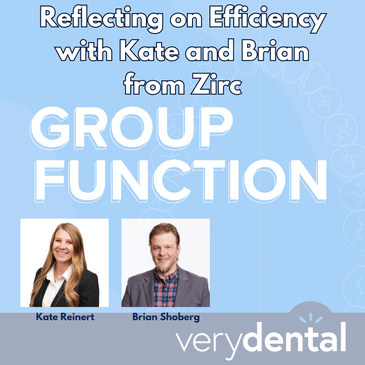
Recorded live at the Chicago Midwinter Meeting,Alan is joined by Kate Reinert and Brian Shoberg from Zirc Dental Products to the podcast lounge. The trio discusses the evolving landscape of dental trade shows in the digital age and the enduring value of hands-on continuing education. Brian and Kate introduce Zirc's latest innovation: a double-sided, one-piece soft grip mirror designed to improve visualization, ergonomics, and dental assistant workflow. Kate delves into her specialty of dental office organization and efficiency, sharing "origin stories" from her days as an assistant and offering crucial advice for startups: design your workflow and organizational systems before you build to prevent future bottlenecks and "closets full of unused technology."
Some links from the show:
Join the Very Dental Facebook Group using one of these passwords: Timmerman, Paul, Bioclear, Hornbrook, Gary, McWethy, Papa Randy, Frank or Lipscomb!
The Very Dental Podcast network is and will remain free to download. If you'd like to support the shows you love at Very Dental then show a little love to the people that support us!
We're proud to be supported by the folks at Net32!
I'm a big fan of the Bioclear Method! I think you should give it a try and I've got a great offer to help you get on board! Use the exclusive Very Dental Podcast code VERYDENTAL8TON for 15% OFF your total Bioclear purchase, including Core Anterior and Posterior Four day courses, Black Triangle Certification, and all Bioclear products.
Are you a practice owner who feels like the bottleneck in your own business? If you're tired of being the hardest-working person in your office, I've got something you need to hear. Dr. Paul Etchison, is hosting a virtual event that is a total game-changer. Paul is honestly one of the most brilliant minds in dental leadership today, and he's hosting the 3-Day Freedom Practice Workshop from February 19th through the 21st. He's going to show you exactly how to break through that two-million-dollar revenue ceiling while actually compressing your clinical week. It's about building a leadership team that takes ownership so you can finally step into the CEO role you deserve. Head over to DentalPracticeHeroes.com/freedom to grab your spot. And do me a favor—mention the Very Dental podcast when you sign up. It's 100% guaranteed, so you've got nothing to lose but the stress.
Crazy Dental has everything you need from cotton rolls to equipment and everything in between and the best prices you'll find anywhere! If you head over to verydentalpodcast.com/crazy and use coupon code "VERYSHIP" you'll get free shipping on your order! Go save yourself some money and support the show all at the same time!
The Wonderist Agency is basically a one stop shop for marketing your practice and your brand. From logo redesign to a full service marketing plan, the folks at Wonderist have you covered! Go check them out at verydentalpodcast.com/wonderist!
Enova Illumination makes the very best in loupes and headlights, including their new ergonomic angled prism loupes! They also distribute loupe mounted cameras and even the amazing line of Zumax microscopes! If you want to help out the podcast while upping your magnification and headlight game, you need to head over to verydentalpodcast.com/enova to see their whole line of products!
CAD-Ray offers the best service on a wide variety of digital scanners, printers, mills and even their very own browser based design software, Clinux! CAD-Ray has been a huge supporter of the Very Dental Podcast Network and I can tell you that you'll get no better service on everything digital dentistry than the folks from CAD-Ray. Go check them out at verydentalpodcast.com/CADRay!
[00:00:00] A lot of practices don't realize how much uncertainty plays into supply ordering. When you don't see all your options, it's easy to overpay or second-guess decisions. That's exactly why Net32 was built with dentists for dentists, to give practices clear choices without the sales pressure. You see the full picture before you buy. No hidden markups, no surprises. When things are clear, decisions feel easier and smarter. Pricing and vendors are side-by-side in one place. If you want more clarity in how you buy supplies, Net32 is worth checking out.
[00:00:28] If you want clearer choices before you buy, Net32 makes it easy. Save time, avoid overpaying and try it risk-free with a 30-day money-back guarantee at net32.com slash verydental. This is a production of the Very Dental Podcast Network.
[00:00:53] First, you take a group of verydental people. Then you add some interesting topics and a few microphones. Finally, add some laughs and collegial good cheer and you get the Group Function Podcast. Very Dental people, welcome to another episode of the Group Function Podcast. This is a podcast where I have more than one person on at once. And I'm sitting here in the podcast lounge press area at the Chicago Midwinter Meeting. Again, this is live to tape.
[00:01:20] I'm looking out. There's literally an escalator about 10 feet away from us. It's open air. It's pretty cool here. This is an upgrade, even though it's not right on the exhibit floor. It's an upgrade and I'm liking it. Joining me, my friends from Zerk, we have Brian Schoberg and Kate Reiner. Did I pronounce that correctly? Yes, that's correct. Okay, I was pretty sure I got that one. Sorry, Brian. I didn't use your name on the podcast as often. That's true, yeah. From Zerk, my friends from Zerk. How are you guys doing? Great. Having a great show. Happy to be here. I'm glad to hear that. There's a lot of energy here. Yeah.
[00:01:54] I go, this might be one of the biggest meeting day because I think maybe either people don't work on Fridays or they don't. Probably Thursday is a little slower because a lot of people are working. For instance, me. I worked yesterday and then came today. I drove last night and came in today. There's a lot of people like us probably. Was it slower yesterday? Yeah, less traffic for sure. Yeah, you can definitely feel the difference in the air today at Friday. A lot of people coming by.
[00:02:22] And Saturday is always a weird thing because I feel like everyone is itching to break down the booth at about noon. Yeah, for sure. Because Friday killed them. Catch flights. Yeah, exactly. I get that. It's a weird thing because I'm sure the people at CDS are like, no, no, stay till 5. But I remember I took a surgical course here. Actually, an electrosurgery course here. God, I was a kid. Probably 20 years ago. I think we were the last course going on a Saturday. I'm like, no one was here.
[00:02:52] It's all done. We were all in there doing electrosurgery on a pig jaw. It smelled like burning bacon in there. And then I came out and the place was empty. I'm like, wow, what time is it? What happened? Where did everyone go? It was crazy. What do you think is the best value for shows these days? Is it the continuing education? I haven't taken a CE course here in 100 years, but it's because I podcast here all the time.
[00:03:14] So I probably, I mean, if you're coming here and, okay, the draw for Chicago, there's a lot of CE, a big variety of CE. And there is some hands-on CE. They roll out a lot of new stuff on the exhibit floor in Chicago. That happens a lot. Maybe even more than the ADA meeting, which doesn't even exist anymore. We should talk a little bit about that. You guys see a lot of meetings. And how does Chicago measure up to the rest of them? I mean, a lot of them are getting smaller and smaller.
[00:03:44] Michigan's is a joke at this point. I'm sad to say. Well, unfortunately, I mean, the Internet is at scale now. You know, meetings used to be the way to communicate and the way to learn about new products and the way to buy products. And, you know, the Internet is so, you know, far beyond what we ever thought it was going to be that shows are just less needed in the buying cycle. So, you know, for us as a manufacturer, we've shifted that. Kate, when did you start in dentistry? 2005. Okay.
[00:04:12] So when did you get into dentistry, Brian? Four years ago. Four years ago. Okay. So here's the thing. I graduated in 1997. I was already coming to the Chicago Midwinter Meeting because my dad would bring me here when I was in dental school and stuff like that. So what you did in the good old days, you didn't know anything that was going on in the dental world. Even if you looked in throwaway magazines and stuff, you'd come to Chicago and there'd be all this amazing stuff you had never seen before. And someone with poor restraint would just buy a bunch of stuff. And then you'd get back to the office.
[00:04:41] You didn't even remember what you bought. Stuff would show up. And you're like, oh, yeah, this seemed like a good idea at the time. As you said, internet at scale. Now, if you come to Chicago, you're coming to see what you already know is being released. Yeah. Or you want to put your hands on something. You can see the Mr. Thirsty on the website. But maybe they'll give you one that you could jam in your mouth to see if it would fit. Yeah. That sort of thing. Yeah. I'm sure that that's the draw. But there's a lot, maybe a lot less draw because there's not for that stuff.
[00:05:11] I love it. I love the floor. There's a lot of energy there and stuff. So CE makes sense. A lot of CE you can get online now. Yeah. So with our meeting, the Voice of Dentistry meeting, it's very hard to get people to show up anymore. Yeah. So that's a tough. So best value, probably, at least for locals, probably the CE can't be beat. I mean, that's a great deal. And seeing all the new stuff roll out. Now, you know, the ADA is not happening anymore. Yeah. So I think Chicago is probably vying to be that meeting at this point. Don't you think? Yeah.
[00:05:40] I would say so. Yeah. I think meetings still have a place. They're still like a good place to congregate and meet. And like, we wouldn't see you in person unless we, you know, connected at one spot. It is. Unless it came out to the Star of the North, right? That's right. Star of the North. They're looking for people, so. Yeah. Is Star of the North doing okay, or is it hurting too? I think it's similar. You know, the regional ones struggle too because it's like, you know, people get better offers too. Yeah. Like, just psychology is playing a factor in it. Yeah. It's Thursday morning, and you're like, sure, I could go to that show. Yeah.
[00:06:09] Or I could stay in my pajamas and watch Netflix after, you know? Yeah. Yeah. I mean, as a sales pitch, I'm here for it. I mean, it's like, that's funny. It's true. It's all true. I think the internet has changed stuff. But, so, you guys are, you guys did roll out, I don't know if you rolled it out in Chicago, but you have a new product that I've seen quite a bit on social media. Tell me about it. Yeah. Last week, we launched a double-sided one-piece soft grip mirror.
[00:06:35] So, you're a big fan of Zerk Crystal HD, and you use, you know, screw-on heads. Yep. But the most iconic mirrors are soft grip mirror, which is a one-piece resin, fully constructed. If someone was going to get a tattoo of a Zerk mirror, it'd probably be that one. Yeah. It probably wouldn't be the cone socket less exciting. I often joke it's the Stanley Cup of dental mirrors. It is. I agree. I agree for sure. Because people pose for pictures with it. They're very pretty. Yeah. And we just recently- Come in all the different Zerk colors. You can get all that.
[00:07:05] I mean, like, I think hygienists probably are down with the color-coded mirrors. They are so excited. Like, match their scrubs and stuff. Yeah. It's on. Yeah. And we see all the time, like, even with, you know, doctors, when they see and compare their old mirror to a Zerk mirror, if we can get, especially mid-procedure or a stainless mirror right next to a Zerk mirror, everyone says, oh, wow. Yeah. You know? And that's- What you need to do is you need to get a microscope, a dental microscope in your booth
[00:07:33] and let them look at something in a Zerk mirror and a regular mirror, and they're going, ooh, there is a difference here. Like, and mind you, I don't even know what other mirrors look like anymore. It's been so long since I've used one. But I did do a Mission of Mercy a few years back. Didn't think to bring my own mirrors. I'm like, what is this? This is ridiculous. So, yeah. I mean, I've had to experience the pain and suffering of non-Zerk mirrors. It's happened. Yeah. Yeah. Those poor patients, I don't even know how that worked out.
[00:08:03] I hope they're okay. The new soft grip fills the need because people have been asking for it. Double-sided, we had it in heads before, but now it's in the one-piece soft grip and the iconic look. So, people are very- Okay. So, this is a really stupid question. I've never used a double-sided mirror. What's a double-sided mirror for? Is it more for the light to reflect light onto a surface if you're retracting? Absolutely. Okay. They, like, I think of that class five on number two, that class five on number 15.
[00:08:30] They are going to be able to have, like, the right angle of retraction plus the visualization. Yeah. As a dental assistant, I was thinking through it. I was talking about it yesterday where, you know, I could see nothing when my doctor was working on the opposite side on that buckle. And they're going to- I never thought of that. Yeah.
[00:09:14] Yes. Worth. Like, it's hard. Like, my wrist feels it. My hand feels it. Yeah. My fingers feel it. And when he went to a double-sided, he's like, that fatigue started to dissipate. Interesting. Yeah. I love that. Okay. So, I need to try it. I've never tried one. I don't really know. Yeah. Interesting. We'll get you a package. Okay. Yes. Okay. We'll give it a try. I mean, we should probably get- I should probably pick some wild and crazy colors, too, just because I can. Yeah. And listen to you. You say you should try it. You know, teach a new old dog new tricks. Yeah. Yeah. That's right.
[00:09:44] I can learn. What if it turns out that I can't live without double-sided? Then I got all these mirror heads that are unused because I'm like, I'm not using this crap. I need two heads, two-sided. I don't know. I think we'll make do. We'll make it work. Send them to Mission to Mercy. Yeah, exactly. That's right. Donate them out there. That's right. Donate them out there. Give them what we have here in the state. Do you guys have Mission to Mercy in Minnesota? Have you guys had them? I think probably you do at some point. I don't know. I don't know. Michigan, it's been a little while. I don't know what to answer to that. It's been a little while.
[00:10:10] Maybe I'm going to sprinkle some mirror heads at the next Mission to Mercy and just see what people do. Yeah, I think we do. I don't ever do them. I can't. Yeah. It's a lot. It's a lot. It's been some years since we had one in Michigan. They're an interesting thing, but it is funny because this will be a good segue into what we're going to talk about. When you're used to using your stuff and then you've got to go use whatever they've got, oh my God, is that hard. It's enlightening to realize I spoiled myself so much with knowing.
[00:10:40] Exactly what I want and where I want it. And now you're forced to- The mirror is a perfect example. Yes. I'll go in there and they don't have electric hand pieces and I've been using electric hand pieces of all kinds for years and years. I'm like, how am I? This is a toy. How do I even use this? It is a funny thing. But on the other hand, we were talking about this before we started. So Kate has been on multiple times. We used to talk all about the different systems of organization and efficiency, probably the most important to me, efficiency.
[00:11:07] And we were laughing like, you were talking about someone starting a new office and they were going to bring you in right off the bat. And I thought, I said to myself, that would be the way to do it. Because people like me are just a big pile of bad habits that we either got from the last doc or we might have invented them on our own, which is very possible as well. But the funny thing is, I think the bad habit people have a harder time changing to a better
[00:11:33] system because they've had a system that has worked okay for a while. So imagine if you're doing a startup and you ask Kate to come in and say, okay, I mean, I have to buy all this stuff anyhow. I got to have a system. Can you help me make a system that's good and efficient right off the bat? Tell me about that. Yeah. And the first place to start is by just educating them. You know, if you're going to do a startup, they need to understand how are they going to
[00:12:02] operate in this new space? What type of procedures are you going to have? What type of equipment? What is the volume you're projecting when you're running at optimal speed? And it's hard for them to have that conversation because they're already in a growth phase. But if we peel it back and help them understand that you need to future-proof your practice. And that starts before you even purchase land, before you find that place that you're going to lease. And then once that education piece is done, we help them understand like, what will that
[00:12:31] process look like? What will the workflow of materials and instruments throughout the practice be? And then we talk through, now you need the space to house all this stuff and intentional space. We need to make sure that it's the most efficient placement for your instruments, for your scanner, for your microscope, for all of these things that you have in the practice. I worked at a practice in Michigan actually.
[00:12:56] And they built a brand new beautiful practice, 16 treatment rooms, two surgical suites. They had multiple scanners. They had microscopes. They had all this equipment. And they looked at me and they're like, where should we put this? Wow. And it ended up in like the main hallway that patients like walk through. Yeah. So it was just like, you know, it sounds, it looks like the, you know, in the movies you see the, at the hospitals, they have all the gurneys. The gurneys in the hall. Yeah. Like it's just where they just go to sit.
[00:13:23] And it was so unattractive like aesthetically because they had all this equipment right in the main hallway. When in reality, if they would have thought through how to purposefully store things on the front end, they could have had a really awesome like nook or alcove that would house all that stuff, be efficiently placed. So they're, they're just, they're, the insight wasn't there on the front end and that's what they need to do. It's really funny. You guys probably could tell stories too about, about companies that design offices that,
[00:13:52] that design for, probably for magazine layouts and stuff like that instead of actually functional spaces. Yeah. Cause you see this, the classic Patterson or their, their magazine where they have some dentists that they help design an office where it's a beautiful office and, and, and you can even see in the, in the magazine how you're like, maybe wouldn't have chosen that. I mean, it's beautiful. It's beautiful. It's all brand new. It's all that stuff.
[00:14:17] So like, I mean, you, you probably work with architects and stuff like that. Yeah. I mean like, so that's, that's interesting. Like the architects can make the building, but you got to, you're, you're trying to help them figure out the workflow before they ever do it. Exactly. And you don't want to fix a workflow. You want to have a workflow that's going to work from the start. Right. And it's, it's expensive to fix. It's either expensive in fixing it or it's expensive in inefficiencies that you have. You know, going back to that practice that they had the, the stuff in the hallway,
[00:14:46] like it was on the exact opposite of where the hygienists were. So they had to walk all the way around the perimeter of the, the hallway essentially to get the microscope, to bring it into the treatment room. So, you know, when we're working with these architects and these designers, they, they do a great job putting the footprint together. Right. Just like the basics. That's a perfect example. The footprint is at their end of it. Yeah. Which is great. Like they need to understand like coding and electrical and plumbing, et cetera. They need to have all of those check boxes. Right.
[00:15:12] Where I get to come in and help them understand is now we need to make it a functional space. We need to talk through what are the requirements of the space so that they can operate and actually pay you guys as the architects, as the construction, as the designers. So they, they're, we're getting more traction with the architects and them understanding that they can't just power through and say, you're going to figure it out. You're going to, where do you want to store things? Yeah. You'll just figure it out because it's not happening anymore. We need them to think about it on the forefront.
[00:15:41] It's more valuable for them as architects and designers too, when they can do less change orders, get the project moving faster. I mean, there's, there was a practice I worked with that two years it took them to just design the practice because they would come at them with a plan and nope, we need to change this. So, I mean, I can't even imagine what the cost of those change orders were. When I, when I plumbed my office, they quoted me X by the end, it was two X, two and a half X.
[00:16:12] And there were no apologies made on their end. They just handed me the bill. I'm like, what the hell happened here? Yeah. Right. Yeah. It was real, real, I was real happy with that. That would have been nice to know on the front end, buddy. Exactly. It's like, why do I even get a quote? Right. Let's just do it. Crazy Dental already has the lowest prices on dental supplies anywhere. But when you use the coupon VeryShip, you'll get free shipping on every single order. It's the easiest way to keep your overhead low while supporting the Very Dental Podcast Network.
[00:16:40] Head over to CrazyDentalPrices.com and use the code VeryShip at checkout. That's CrazyDentalPrices.com using coupon code VeryShip. CrazyDentalPrices.com Okay, interesting. So you talked about them moving them. This is not necessarily a Zerk thing, but I use microscopes a lot. I really like them. And what I've found, and this could probably apply to a lot of different things, like the reality of the hassle of moving a microscope from one place to another was such that I built them into all my operatories.
[00:17:09] And of course, it's very expensive. That's an expensive wise. But the reality is, if you want to use that technology, it has to be deployable like that. You can't, because if it's going to take three minutes to do it, you're like, I'm not doing that. I'm not doing it. I mean, I think there's, I'm thinking there's probably lots of smaller versions that you deal with that. I mean, the deployment thing, as soon as you have an assistant walk out the room to get something, you just, first, I mean, yeah, you've lost time.
[00:17:39] But also, the dentist is steaming. You know, you're just sitting there waiting to, you know, I just, I feel like that's where someone who's studying that, which is you guys, comes in and can really help. Yeah. And as soon as you put up the slightest bit of barrier, people are going to start to cut corners. Yep. And that's what we want to avoid. That's a good point. On the front end, we want them to be able to deploy every piece of equipment, have everything at their fingertips, right when and where they need it. Yeah.
[00:18:08] But like I said, that barrier, it's crazy the domino effect that happens once there's the slightest bit of resistance because then it becomes a norm. Yeah. Well, if I can't get it fast enough, we're not going to use it. So I'm not even going to bring it up or we're just going to avoid it altogether. And then that becomes the legacy error throughout the entire practice. Well, doctor only needs it when he really needs it. That's the message that is sent, literally. So you get a new team member in there and they're like, why do we have this microscope?
[00:18:33] Well, you know, he's, that's a, that's horrifying because that is real. That's real in every, I'll bet the, I'll bet every practice has a version of that. Well, and the most expensive tool you have is the one that you never use. Yeah. And if that's sitting in the corner waiting to be used. Every dentist has a closet full of that stuff. Now, some of it, some of it was, was a technology that promised to do something that it didn't do, but some of it, some of it, some of it is the, is the microscope that doc really wants
[00:19:02] to use, but I don't want to wait for two and a half minutes for you to roll down the hall. Yeah, exactly. So knowing that you, I mean, Kate, clearly you are, you are, this is in your wheelhouse. You see this stuff. What, tell me about the trauma that happened to you as a dental assistant that turned you into the Kate that we know now. How does, like, cause the reality is a lot of, I mean, dental assistants are, are nothing if not adaptable. Yes, for sure. You had, you had to see that, that you use the term barrier. You had to be able to identify those and figure out.
[00:19:32] So how did you become Kate? I want the origin story. Um, I, I said this last night at dinner. I had an excellent mentor. First job I ever had. Um, great mentor taught me everything I know as far as like the clinical side and then the business side, and then putting the two of them together to make a really valuable dental assistant. That's something I'm really passionate about. Um, but as, as a dental assistant, I always wanted what was best for myself, for my team and for my patients.
[00:20:00] And I recognized that in order to give us what we wanted best for our patients, we had to improve our own systems and processes. And, you know, as a dental assistant, we don't always have the loudest voice in a practice. So it has to be brought up over and over and over again. But you also have to prove that the system that you're putting into place is going to benefit everybody, not just yourself. Um, so when, and when a problem came up and we needed to fix it, like the quickest thing to show them was what are you losing?
[00:20:27] Uh, so, you know, implementing CEREC at a practice, for example, one assistant couldn't figure out how just simply how to like twist the screw so that it would lock in every time. Um, so she, she wouldn't take those patients. So she would just like, such a classic example of, of dental offices just kind of working around whatever. Yeah. So true. So, so it created like points of tension throughout the entire practice, like among staff members, because then it was known like, well, if, if. Well, she's not going to do the CEREC. So we need to, exactly. Exactly. Yeah.
[00:20:56] So then it's like, Hey Kate, will you step in and do this for her? Not only is it disrupting my day, but it's disrupting the patient flow because their expectation is that they were going to get Christy and then all of a sudden Kate comes in and then that disrupts that. So, you know, the, the frequent barriers helped me get to the point where I was always solution oriented. Okay. Let's take a step back and talk through Christy. Why can't you figure this out? What is the barrier for you? Let me show you, give me more training and education.
[00:21:22] And that's something that I find like going forward, you know, where I'm at today is people misunderstand because they don't have the full story. They don't have all the education. So we spend a lot of time and energy in that education space. If you don't understand it, they're not going to be able to execute it properly. And those are more barriers that happen. So just talking through all of those, you know, small little things that add up over time and being that solution oriented person, always looking to better things.
[00:21:52] Even if my voice wasn't heard on like a higher level, at least it was small improvements that I knew that I was working towards, you know, the bigger picture for the greater good. But yeah, I think that that's a good point for how, how I went from point A to point Z. Yeah. And I feel like dentists are artists, you know, and an artist doesn't like always think of all of the things that need to happen in order for the art to run really well. They just want to paint the picture. I know there's other dentists that are business people as well, but when you get, it feels
[00:22:20] like there's like a missing piece for how the instruments and materials and clinic move, especially at the startup level. It's the, it's the systematizing that a lot of times, you know, the execution happens better when it's systematized. And in the reality is honestly, even when you're, if you have a big enough team or whatever, everyone has to be able to do the same, the same thing, you know, there's not. Yeah, repeatable processes. And that, that's, that is something that as a dentist, I'm like, I don't, I just want to, I just want to fix teeth, you know, I just want to, but it's, it's, it's important.
[00:22:50] I know it's important and it's, it's hard to execute on the realities. And I think there are some dentists who are really super into that stuff, but most of us would rather spend less time. And that's probably why, why the, why the workarounds are so durable in some ways, because it just, you don't, you literally, you don't take the time. And I will say that the, when you talk about the training, you're right. We need to do more time training this stuff. And honestly, worse than that, we need to retrain on the regular stuff. For sure. Like, right. The regular.
[00:23:20] So we don't even do that. We do that all the time. I'm like, yeah, but are we really, are we really checking out our processes? And, and the answer a lot of times, like, you know what? No. Cause I want to go home. You know, it's like, it's, it's a, it's a hard thing. Yeah. It's a hard thing. How do you guys, I mean, you, you probably run into practices where part of the practice wants to do that. The other part is like, why are you here? Yes. Yes. And that's, you know, we talk about getting buy-in from the top down. And when I say buy-in, I don't mean like you're going to buy our products and our system and,
[00:23:50] and put it in. Like, I mean, buy-in, like you truly understand the benefits and the why behind what we're doing. When we run into those team members that do have resistance and they are questioning what we're doing, you know, I, I will sit down and have a conversation and ask like, why tell me what you don't understand. Cause that's almost always what it comes down to. Yeah. And then I redirect the conversation to, this is why it's going to make your day better. Think of your, have your entire tray set up for the entire day. You don't have to do all this preparation.
[00:24:19] Um, it's going to be more efficient for you. You can take, you know, hygienists, they value that 60 minutes that they get with every patient. And if part of that is room tear down, room set up, if we can simplify that and streamline it, I'm giving them back time so that they can put it into their patients. Cause we know that they don't have the time for it. So, you know, when it comes to those, those team members that are asking what the heck are you doing here? It's really, it's, this isn't for me. This is for you. This is for you as a team member. You're going to operate better.
[00:24:48] You're going to have a, an easier day. You're going to be able to get those chart notes done. You're going to get to have a full launch for once because we've streamlined it. Um, so they, sometimes it's just, it's, they just don't get it. They don't hear it. And as soon as you bring change in, a lot of people just shut down. They don't, they don't want to hear about the processes. So just got to take some time and meet them where they're at. Which is, which is an easier office to work with a relative, like kind of a small office or a big, like a big team, which is, which is easier to work with, with the change.
[00:25:17] Um, that's all relative. Honestly, um, the easiest team to work with is when we have a leadership from the top down. Okay. So I don't think size wise makes a difference. It's truly, if you have a leader that is taking the charge and holding people accountable and holding people in accountable is like, Hey, remember we talked yesterday that we're going to start doing it this way. Let's just stay the course. Um, those are the easiest practices to work with.
[00:25:42] So if we have leaders, doctor, office manager, lead clinical team members who are in it to win it, those are the practices that are easiest to work with. No, that makes perfect sense. You think about a high performing, like Olympic athlete or a high performing championship team. And there's so many bits and pieces that go into creating that high performance. And I like to think of it as like, you know, uh, how do dental teams, you know, compare to a high performing football team? For example, there's gotta be a head coach. There's probably gotta be a GM. There's gotta be individual contributors on the team.
[00:26:12] Um, and Zerk brings the playbook to, uh, the clinical processes. And so I think, you know, it's not for everybody. High performance is not for everybody, but the, the teams who want to perform at a high level, they need that structure and the different bits and pieces and the different roles. And then ultimately a playbook in order to execute every single day. Yeah. Yeah. So, um, when, when I think about Zerk has a lot, like a wide variety of products or lots of organizational stuff.
[00:26:41] And then it's interesting because you've got, you've got a lot of people think of Zerk as like, okay, the tubs and the trays and the, and the, and the organizational stuff. And, and, and honestly, probably sterilization in a lot of cases, but then you've got like out of, out of left field, you got these, the best mirrors in dental industry. And then, and then also you added a, uh, like a really good, uh, isolation system that there's a newer product compared to it is. It's funny how Zerk has Zerk hits a lot of different areas.
[00:27:10] Brian, you are relatively new to dentistry. What is the most interesting product in Zerk that you think? Well, I know there's a lot of products, but like as an outsider coming in, what, what grabbed your attention the most? Well, I think it's hard to ignore the mirrors. They're the best mirrors in dental. Um, so that's what grabbed my attention. But I think the thing that I liked the most is Mr. Thirsty because of how simple it is. And you see its competitors on the market and like Mr. Thirsty is a brilliant product. It is.
[00:27:36] Uh, you know, uh, one use bite block, uh, tongue retraction and the whole works in a one time use disposable product with no extra attachments. It's like, you got, you got a high volume suction. You can use Mr. Thirsty. That is there. That's some brilliance there. That's some brilliance. I'll say this. Okay. So I'm, I've been, I, I did, I cleaned a buddy of mine's teeth with, uh, um, an aqua care, which is, which is, uh, uh, it's, it's a powder, powder and water.
[00:28:06] Uh, it's, it's kind of like the EMS or whatever it's, it's, it's a, in, um, they're messy. They're, I mean, I love them. They do a really excellent job. They're messy. And so the, the solution is, is probably some combination of isolation involving the Mr. Thirsty, but the Mr. Thirsty, um, the downside is not the Mr. Thirsty. It's a regular high volume suction tube is heavy. It turns out there's light ones out there. You can get that. I didn't know that. So now I'm thinking to myself, okay.
[00:28:35] And I will say the thing worked brilliantly for, for what I was doing. It's, it's just, it's, uh, I use a lot of rubber dam stuff too, but, but it is a really, I love the fact that I know a lot of people are like, wow, there's so much in medicine and dentistry of single use means you're throwing stuff away. I'm like, you know what though? I don't want to sterilize that crap. That's disgusting. And, and, and Mr. Thirsty literally like, well, it's almost like Zerk, Zerk has these things. You can walk out of a dental meeting with one of these in your pocket and you can try it
[00:29:03] at your office without, you don't need anything else. It just works. I agree. That's no trial kit. Yeah. You just get it and you put it on and start using it. I mean, the airway armor is kind of the same way too. Yeah. I mean, there's no, there's no, but, but the reality is that, that Mr. Thirsty is kind of a, and it's, it's a whole, you, I remember when they first came out, it was like, you could get the isolate and actually the isolate. Remember they, they were selling the isolate, the light part of the isolate big. And of course that's the least important part of it. Like half the, I had the original one. It was horrible.
[00:29:32] Like, like the, like the actual light part. So half the time it'd work, half the time. And of course, by that time, everyone's wearing a headlamp anyhow. So you didn't really need it. So the isolate as interesting, it's got light in the title. Of course they don't even, it doesn't exist now. Now it's a different company. Yeah. And, and the reality is what, what everyone realized the magic of is, is having the retractors with the suction, but you still had to have all the, the hardware. I remember multiple variations of the hardware to get that light there.
[00:30:01] And then I think they finally said, why are we doing this? And you don't need it. Like you don't like lighting isn't the problem. The problem is the isolation. And that's what the Mr. Thirsty is beautiful because it's like a, it's like a one piece deal and you're done. I don't want to sterilize any of that crap. And I, and I don't want to have to have a funny piece to add to it. I agree. Brian, good answer. And that's, that's a common denominator across all the products that Zerk makes. I mean, Jim, our founder and Nicole now that just have a enormous passion for dental pros. And the common denominator is efficiency across the board.
[00:30:30] So everything that we make is making your day better in the clinic. That's a good point. That's a good point. So, I mean, this seems like a, an unfair question, but what's the most compelling product to you? If you had to pick one Zerk product, Kate. Can't say mirrors. You gotta be kidding. Yeah. He already said mirrors. My, my full on favorite. And I mean this from the bottom of my heart is the RelaxFit Instadam. As a dental assistant, it, I use it as a sample in my practice. True story here. Use it in practice.
[00:30:59] I'm like, hey doc, we're going to try this sample. I just want to see how it's going to work out. It has a really flexible frame. Like the actual rubber dam itself, it's, isolates really well, but it's relaxed. So it's really comfortable for the patient. When it came time for my x-ray, I was able to just fold the frame down. This is so funny. I was not expecting you to go here. It is a great piece of equipment. Yeah. Put my, put my x-ray sensor in there and take it. If you're not familiar, the Instadam is a, is a pre-punched. It's, it's basically, it's an endo.
[00:31:28] It's, I mean, you could use it for restorative, I guess, to punch more. But the reality is like most, most rubber dam use in a lot of cases is a single tooth for endo. And this, this is the frame and the dam all in one piece. Easy to place, easy to get out of the way for the x-rays. Cause that's every assistant will tell you the worst part about endo is trying to get the x-rays. Which is true. That's a real, that's an, and they have, the relaxed is, is the new. It's a newer version, right?
[00:31:56] And it's not, all of it is non-latex, correct? Or is there a latex version? They're all non-latex. They're all non-latex. That's what I thought. So I thought, interesting. Good, good catch. Yeah. I was not, I didn't see that one coming. Nope. Left field. That's the one that I'll take to my grave. It is, it is the best rubber dam one there. I love it. You guys probably just need to go to the website for the catalog. Cause like I said, there's a bunch of products that, that it makes sense when you look at it, but you wouldn't necessarily be thinking of it. They got a lot of stuff at Zerk. So, and, and of course the organization is where it's really at.
[00:32:24] And honestly, that's where, you know, for 20 years ago, I started using the mirrors, but then you realize it's kind of all about the organization and the people, your people that are there to kind of help. So if there's any message you're taking away, if you're starting up, uh, don't buy your land or plan your building, talk to Kate first and she can, she can, which sounds like actually a really smart idea. And, uh, remember bad habits are really hard to break. So maybe just don't start them in the first place. I mean, if you can do it, that's the way.
[00:32:54] Wouldn't that be great? Yeah, I know it would be. So, uh, this is, you guys are here till Saturday. You're not going to, you're not going to bust the, the, the, no, we'll follow the rules. You're going to follow the rules. Yep. Yeah. Okay. I know. Do you get to drive the forklift, Brian? No, I don't think so. Maybe back at Zerk, they'd let me do it, but I don't think here. That's okay. If we do, I'll make sure we'll put on Instagram. Yeah. I'd like to see that. I'd like to see that. Poke a hole right through the wall. I'm kidding. This was awesome. You guys, I'll put, I'll put, uh, links in the show notes to all these things we're talking
[00:33:22] about and, and to the process and making sure that you can get in touch with Kate if you're looking for changing your, your process. Thanks for having us, Alan. You bet. Thanks a ton, guys. Yeah. Yeah.