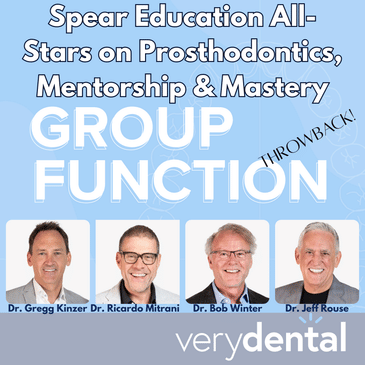
This throwback episode of the Group Function Podcast captures a candid roundtable originally recorded in August 2021 during a Spear Education virtual summit. Host Dr. Alan Mead is joined by an all-star lineup of Spear resident faculty to explore the origins of their careers, their transition into prosthodontics, the philosophy behind master-level dental education, and the evolution of modern clinical practice.
Featured Guests
-
Dr. Gregg Kinzer – Resident Faculty at Spear Education
-
Dr. Bob Winter – Resident Faculty at Spear Education, master ceramist, and prosthodontist
-
Dr. Jeff Rouse – Resident Faculty at Spear Education and pioneer in airway prosthodontics
-
Dr. Ricardo Mitrani – Resident Faculty at Spear Education and international lecturer
Key Topics Covered
-
Origin Stories & Mentorship: How childhood experiences, early misadventures, and influential mentors (like Dr. Bill Robbins) steered each panelist into dentistry.
-
Choosing Prosthodontics: The catalyst for pursuing advanced prosthodontic specialty training, from grueling residency wax-ups to learning from early clinical hurdles.
-
Laboratory Dynamics & Materials: Dr. Bob Winter's background as a master ceramist, the critical nature of lab communication, and navigating clinical science versus marketing trends in materials like translucent zirconia.
-
The Spear Educational Philosophy: Why workshops and continuous auditing matter, evolving curriculum based on literature and clinical reality, and transitioning from ego-driven lecturing to empowering the next generation of clinicians.
-
The Hybrid Future of CE: Balancing in-person, hands-on workshop immersion with the accessibility of virtual study clubs and digital summits.
Some links from the show:
Join the Very Clinical Facebook group!
Join the Very Dental Facebook Group using one of these passwords: Timmerman, Paul, Bioclear, Hornbrook, Gary, McWethy, Papa Randy, or Lipscomb!
The Very Dental Podcast network is and will remain free to download. If you'd like to support the shows you love at Very Dental then show a little love to the people that support us!
We're proud to be supported by the folks at Net32!
I'm a big fan of the Bioclear Method! I think you should give it a try and I've got a great offer to help you get on board! Use the exclusive Very Dental Podcast code VERYDENTAL8TON for 15% OFF your total Bioclear purchase, including Core Anterior and Posterior Four day courses, Black Triangle Certification, and all Bioclear products.
Crazy Dental has everything you need from cotton rolls to equipment and everything in between and the best prices you'll find anywhere! If you head over to verydentalpodcast.com/crazy and use coupon code "VERYSHIP" you'll get free shipping on your order! Go save yourself some money and support the show all at the same time!
The Wonderist Agency is basically a one stop shop for marketing your practice and your brand. From logo redesign to a full service marketing plan, the folks at Wonderist have you covered! Go check them out at verydentalpodcast.com/wonderist!
Enova Illumination makes the very best in loupes and headlights, including their new ergonomic angled prism loupes! They also distribute loupe mounted cameras and even the amazing line of Zumax microscopes! If you want to help out the podcast while upping your magnification and headlight game, you need to head over to verydentalpodcast.com/enova to see their whole line of products!
CAD-Ray offers the best service on a wide variety of digital scanners, printers, mills and even their very own browser based design software, Clinux! CAD-Ray has been a huge supporter of the Very Dental Podcast Network and I can tell you that you'll get no better service on everything digital dentistry than the folks from CAD-Ray. Go check them out at verydentalpodcast.com/CADRay!
[00:00:00] [SPEAKER_05] Ordering dental supplies shouldn't be a full-time job, and it definitely shouldn't feel like a guessing game. That's exactly why Net32 was created. By a practicing dentist who got sick of inflated prices, opaque markups, and hours of wasted time, Net32 puts you back in the driver's seat. In just a few clicks, you can compare top brands, trusted distributors, and live pricing side by side. No middlemen, no awkward sales pitches or locked-in contracts. Just upfront pricing, verified peer reviews, and the supplies you need on your schedule.
[00:00:28] [SPEAKER_05] Even if you're convinced your current vendor is cutting you a deal, take a look. You might be shocked at what you're actually paying. Thousands of practices switch to Net32 and immediately start trimming down overhead. Those savings stay where they belong, invested right back into your staff, better equipment, and patient care. Plus, you have nothing to lose. Every single purchase comes with a 30-day money-back guarantee. Give it a test run on your next order, even for a single item, and see the difference for yourself. Stop overpaying and streamline your ordering today at net32.com slash verydental.
[00:00:56] [SPEAKER_05] Head to net32.com slash verydental and see what your practice could be saving. This is a production of the Very Dental Podcast Network. First, you take a group of very dental people. Then you add some interesting topics and a few microphones. Finally, add some laughs and collegial good cheer, and you get the Group Function Podcast.
[00:01:27] [SPEAKER_05] Very Dental People. Welcome to another episode of the Group Function Podcast, the podcast where I'm joined by others to have a roundtable. This one is really special. Last week, Spear had a virtual summit, if you will. They invited me to be the host of a roundtable featuring a bunch of their amazing instructors.
[00:01:49] [SPEAKER_05] I had a chance to basically be part of a conversation with Dr. Jeff Rouse, Dr. Bob Winter, Dr. Ricardo Mitrani, and Dr. Greg Kinzer. It was really fun. It was a little bit off the cuff. It was basically, I started with asking them how they got into dentistry, moved into how they kind of moved into prosthodontics, and then we kind of went all over the place. It was really exciting. They had some questions for themselves. I just feel like it's a really good, fun roundtable.
[00:02:17] [SPEAKER_05] If you didn't have a chance to see it live, I think you're really going to enjoy it. So one quick thing, I want you to go to the Very Dental Podcast Facebook group. I want you to, if you haven't joined already, I would like you to ask for an invitation. Use the password Timmerman, who is the last name of the first guest I had on the Very Dental Podcast. I'll let you in. There's a lot of good stuff going on in there. And so sit back and take a listen to a roundtable with all the spear guys.
[00:02:48] [SPEAKER_05] Well, hello there. My name is Dr. Alan Mead. I'm the host of the Very Dental Podcast, and it is my distinct honor to host this amazing roundtable. I'll introduce our guest panel in a moment, but I'd like to encourage you to send in questions for this panel, focusing on the past, present, and future of dentistry. And I'm assuming that there's a place for you to do that in the software out there. So this is truly an all-star panel. None of the guests really need much of an introduction from me, as they're all very well known to you.
[00:03:17] [SPEAKER_05] Joining me for our conversation is Dr. Greg Kinzer, Dr. Bob Winter, Dr. Jeff Rouse, and we think Dr. Riccardo Mitrani will be here in a minute. How are you guys all doing?
[00:03:27] [SPEAKER_02] Good, Alan. It's funny you introduce yourself as doctor. When people walk in and do that, it's like they have a PhD in psychology or something.
[00:03:38] [SPEAKER_05] You probably didn't know that I actually do. It's a funny thing that you say that. My psychology degree just came through online. Yeah, I know. That's what I was doing. So anyhow, I would like to start off our conversation with a question that I'm curious about. I'd like to know what brought each of you to dentistry. Why in the world did you start dentistry? You have to go way back in your life. Greg, tell me what about how did you get to dentistry and what brought you to it?
[00:04:05] [SPEAKER_04] When I was when I was a kid, we had a big oak tree. And from this oak tree, we had a tree like a rope swing. Right. And had a wood disc on this. And it was fun to like swing on it. But pretty soon that that wasn't fun. So then you throw it like you just threw the rope swing. And it was like a like a ballistic missile. Well, I got hit by that wooden disc. Deciduous central and it turned dark.
[00:04:32] [SPEAKER_04] OK, so my dad, who has no ties whatsoever in dentistry, decided that since it was dark, dark tooth needed to come out. So he's going to take it out himself again. No dentistry knowledge whatsoever. And so he gets he gets a pair of pliers. Now, they were he says they were new. I don't think they were new, but at least he said they were clean. And he starts to pull this tooth out.
[00:04:58] [SPEAKER_04] So you all know that a tooth that's not ready to come out does not come out easily. Right. So I he's I'm on the couch. I think he's got a knee on my chest to hold me down.
[00:05:09] [SPEAKER_05] And he's going after the story came from. That's where that story came from.
[00:05:13] [SPEAKER_04] The knee on the chest. So he got he you know, once you start, you can't stop. And he actually took this tooth out. And I think that the the negative imprinting that that had on me, the effect that that had was I'm not going to let that happen to somebody. So that was my probably my earliest memory that maybe dentistry is is where I should focus.
[00:05:35] [SPEAKER_05] Wow. I didn't see it going that way. So you're saying a horrendous experience with your father brought you to dentistry. Is that right?
[00:05:42] [SPEAKER_04] He's a good guy, too. I mean, don't listen to the story and think otherwise.
[00:05:48] [SPEAKER_05] Wow. So, OK, so from there, you just kind of figured dentistry was where you're going or was there ever anything else from from there?
[00:05:57] [SPEAKER_04] So I grew up in Walla Walla and on the half block where I lived, my next door neighbor was a dentist. Another guy halfway down the block was a dentist. And then at the very end of the block was an orthodontist. So I saw actually I took care of lawns. So I took care of the orthodontist's lawn and that guy was killing it. He had a beautiful home, beautiful yard, little stream rolling through it. And I'm like, what does that guy do? Dentistry? Yep, I'm in.
[00:06:23] [SPEAKER_04] OK, so I got to see the profession very early on. And so then I started hanging out with my next door neighbor going into his office. So, yeah, there's a lot of iterations of when it became important. And it started to just compound when I got older and actually started to look at what other people did.
[00:06:42] [SPEAKER_05] Interesting. Interesting. OK, Jeff, I want to hear your story. I want to hear how did you get to dentistry?
[00:06:49] [SPEAKER_02] Uh, because I couldn't do anything else. It was I I was.
[00:06:59] [SPEAKER_01] He had problems breathing when he was a kid.
[00:07:02] [SPEAKER_02] Exactly. Had an airway problem. No, I was I grew up with a mom that said, you're going to be a physician. You're going to be a physician. You're going to be a physician. Actually, she said, you're going to be a doctor. Kind of like you introduced yourself. Not psychology, though. And so my dad was an electrical engineer, Ph.D. That's why it was funny to me. So she said, you're going to be a doctor. And so when I went to college, I wrote down pre-med and went through all the courses.
[00:07:32] [SPEAKER_02] And about my maybe the summer of my junior year or sophomore year or something like that, I went out and shadowed physicians and said, I don't want to do that. Um, and so tell me. OK, tell me, tell me a little more about that. What about shadowing a physician was was not good for you? Um, they don't get to talk to people. They just go from room to room to room and do procedures. And they hadn't. It was just boring as all get out.
[00:08:02] [SPEAKER_05] Interesting.
[00:08:02] [SPEAKER_02] Um, so the lack of it just and I went. I wasn't smart enough, probably. I mean, not probably. I wasn't smart enough. Uh, my grades were horrid. I had to work through college. So I was right. We talked about this on your podcast that I was a newscaster until from like three thirty to six. And then from seven to eleven, I was a disc jockey. And every weekend I was on the debate team traveling. That's how I paid my way through college.
[00:08:31] [SPEAKER_02] So my grades sucked. Um, I would occasionally just not show up for exams, um, just because I was too tired or too busy or I didn't get a chance to study. I was working. So my grades were horrible. Um, so I probably couldn't have gotten in. And when it came around to, I don't like this and I probably can't get in. Then I said, all right, what else do I do?
[00:08:56] [SPEAKER_02] And I was walking through campus one day at Texas A&M and I looked in a window at a guy doing in a lab going. And I said, that's not what I want to be. I don't want to be in the basement of a building doing experiments. And then I thought, well, I could be a high school biology teacher. And then that sucked. And I just so happened that weekend. I had a friend that already knew he wanted to be a dentist said, Hey, I'm going to Houston to take the DAT.
[00:09:26] [SPEAKER_02] You want to do it? And I was like, yeah, I don't have anything else to do this weekend. I'm off. So we got in a car. He threw a book that like a pant. I don't know what it was, some sort of book about how to study for the DAT. He threw it over to me and said, you might want to look at this and took the exam because it was cheap and had a good time in Houston. And apparently I must've done really well because I got into every dental school I applied to. And then when I got to dental school, they said C equals DDS.
[00:09:55] [SPEAKER_02] And I went, I can do C. I got C easy. I mean, we used to drink before gross anatomy tests and we would, we would do shots. Like if you missed some cranial nerve or whatever, you had to do a shot. And so we'd go in hammered the next morning to take the exams. So, um, so I got into dentistry in a very circuitous route.
[00:10:20] [SPEAKER_05] Yeah.
[00:10:20] [SPEAKER_02] It was lucky. I met Bill Robbins my senior year and I, they had like a, I don't know what they call it. Gifted and talented program. Let's call it at our school where they took the top 10 students and put them in their own bay. And, um, and those people got to work with Bill directly. And I learned that they were doing research or they were doing presentations on literature.
[00:10:47] [SPEAKER_02] And so I said, well, I love doing that. That's what I did. I did. You know, I debated, I was in the library. I researched topics. I can, I do that. And he said, well, no one's ever asked. Let me check. And everyone agreed to let me in. And that, that allowed me to see a vision of dentistry that I had never heard of before. In fact, I didn't know what a dentist did. Yeah. I was in my senior year. Not, not a clue. Didn't know what was going to happen. Never had visited a dental office.
[00:11:15] [SPEAKER_02] My mom hates Dennis still does. And, uh, and so I never went into a dental office. I had probably been in a dental office maybe four or five times my whole life. So not a clue what I was about to do with my world. And then all of a sudden I was open enough because of the things in my life to ask for an opportunity and ask for a mentor and everything else changed after that. So I found a passion. Interesting.
[00:11:46] [SPEAKER_02] Bob, what's your story? Yeah. There was no pain involved in that story. Yeah. Didn't have any blood.
[00:11:51] [SPEAKER_05] Your dad didn't do surgery on you. Yeah. Bob, what's your story? How did you get to dentistry?
[00:12:00] [SPEAKER_01] Yeah, this is going to sound, uh, pretty boring, uh, after that one, but going after Greg's too. Um, I went, uh, um, into, uh, undergrad, uh, thinking I wanted to be a physician. I wanted to be an ophthalmologist. I want to do eye surgery. I just, uh, intrigued me the precision of, of working on someone's eyes and making sure I didn't.
[00:12:27] [SPEAKER_01] You know, and so, um, going through undergrad, um, and then my brother entered dental school. He was two years older than I, I am. Um, and I started doing the math and how many years in medical school and then in the residencies and internships and so forth. And I figured I'd be out of school when I was like 35 or something.
[00:12:52] [SPEAKER_01] And I thought about dental school and in four years, got into dental school after three years of college. I could be done in four years. Um, it shortened that timeline significantly and I could still work with my hands and be creative. So, uh, I've, I went into dental school, um, and as Jeff said, it was kind of after that,
[00:13:14] [SPEAKER_01] it was, uh, um, you know, uh, progressed through dental school and then my grad cross training and, you know, the practice and here we are. How'd you know to go to Prost right away? Um, I actually, I was invited into the program. I never applied. Um, they called me up and wanted me to enter the program. So I decided to do that. I didn't get one of those calls.
[00:13:46] [SPEAKER_05] Riccardo, I'm glad you're here by the way. Welcome. Thank you. As you can hear, I I've been asking each of the guys kind of what brought them to dentistry. How did they get to dentistry? So Ricardo, what is your, how you got to dentistry story?
[00:13:59] [SPEAKER_00] You know, I'm going to emulate Bob's initial line. It wasn't a very exciting, um, intro into dentistry. You know, it was actually, I would say a process of elimination. You know, I come from a family of, of, uh, science oriented people. My dad was an immunologist. My older brother's a dentist. Then the next brother is a physician. So I knew it had to be somewhere along those lines. Um, and it was, as I said, a process of elimination.
[00:14:26] [SPEAKER_00] I, I, I thought that my brother who went to dental school, you know, very smart guy, by the way, didn't, didn't have a very rough time through dentistry. And I saw on the other hand, my brother, the physician really going through, you know, uh, night calls and stuff. So I said, I might as well pick dentistry. But in fairness, I had no idea what I was going into. No idea whatsoever. Uh, finished dentistry, worked with my brother for a few years. And then I realized I had no clue what I was doing.
[00:14:54] [SPEAKER_00] And I didn't get a call, um, from a program director either at Jeff. I actually applied to a bunch of schools and, uh, luckily, luckily I was accepted, uh, at the university of Washington. And I had, uh, Greg as my, um, bench neighbor in the lab as, uh, a mentor back then, a mentor still today. Um, and you know, we went through PROS together and it's been an incredible ride ever since.
[00:15:23] [SPEAKER_05] Okay. This, this brings to another question. So each one of you is a prosthodontist and I mean, Bob kind of told us how he got into that, but like Greg, how early in dental school did you know that PROS was going to be your thing?
[00:15:36] [SPEAKER_04] I didn't. Uh, I, I told you about the orthodontist home that I took care of. I was going to be an orthodontist. Like there we go. Yeah, exactly. That was my whole role of going into dentistry. And that's, that's why I went to dental school and up until third year of dental school, that was still, that was still my focus. Um, so then it gets to the point where you, you have to start applying to programs and out of my class of 50, I believe there was probably six or seven that were going
[00:16:05] [SPEAKER_04] to go through ortho. Uh, and I, I don't, I don't want to follow the masses. And so then I looked, you know, deeper at it and I said, you know, really what I like to do is I like to do restorative dentistry. Um, I had finished. So Jeff had a couple of humble brags in there as well. Humble brag a little bit too. Uh, I, I finished requirements very early. Um, I really enjoyed it. So I started to get bigger cases, um, cases that weren't being distributed to other students.
[00:16:34] [SPEAKER_04] And with that, then I, I got a prosthodontist, uh, Tim Butson. He was my, my clinical faculty. So when I was in clinic, that's who I had to manage some of these bigger cases. And, uh, Tim was fantastic. He, uh, he, he was a Navy guy and he used to just sit in the assistance chair, not helping me, but just telling me stories of the debauchery that happened while he was in the Navy. So it was entertaining.
[00:17:03] [SPEAKER_04] Uh, but he kept putting in this little bug in my ear that like, you should do PROS. Have you thought about PROS? I'm like, no, I'm going to ortho. And the more he kind of brought it up, the more I actually looked into that aspect of it. Um, but it was, it was tough because at the university of Washington and Ricardo knows this, you can see the PROS residents were in there at all hours.
[00:17:30] [SPEAKER_04] You, midnight, the lights were on in the PROS lab and there were students in there working five o'clock, the ortho, you couldn't even get into the ortho building. It was, it's black. And so I'm like, club ortho. Uh, so it was like, well, that's, it's going to be a hard jump, but in reality, I really do enjoy that aspect. I like the immediacy of the changes that we can provide.
[00:17:56] [SPEAKER_04] I can come in and do something in one appointment and it's night and day. Um, and in the treatment planning aspect, it's, it just, it's challenging at every level. Not saying that ortho isn't, but if there's a lot of things that I really do enjoy about, uh, about choosing PROS.
[00:18:13] [SPEAKER_00] If I just may say something real quick about Greg, he would, he wouldn't say this, but, uh, you know, our program back then, I guess still now was a very international program. In fact, Greg was the only, uh, at the time being the only U S uh, grad students back then he was the only one whose native tongue was English. But, um, there are a few very, very funny stories there, but, but what I wanted to say
[00:18:37] [SPEAKER_00] is that all, most if not all of the, um, faculty that Greg had in the undergrad knew Greg very well. And many of them who happened to teach also in the program, Dr. Brodvick, um, and many, many of the, you know, Colonel Brodvick, by the way, because a lot of these guys were, were military guys always felt they already, they always, everybody knew Greg was going to end up being the top notch UW prostitologist.
[00:19:04] [SPEAKER_00] Greg didn't know it back then, but everybody else knew that. So I had to say that.
[00:19:10] [SPEAKER_05] Nice. Nice. Jeff, would they say the same things about you? No.
[00:19:18] Okay.
[00:19:18] [SPEAKER_05] I think, I think, I think I know when you were saying, when, when did you choose PROS, Jeff?
[00:19:24] [SPEAKER_02] All right. So mine was a different, mine is a different deal. Um, I went out, I finished dental school. And I told you, I met Bill Robbins and that gave me a vision of something better than what I had or what I was going to do. And what that led me to was a two, two year GPR in Connecticut. And the fortuitous thing about that was the residency was in 1988 through 1990, 1984 endosius implants were introduced into the States.
[00:19:52] [SPEAKER_02] And with Brandon Mark being the key system at the time, they set up centers around the country and they could only be placed by oral surgeons. And they can only be restored by PROS. Connecticut happened to be one of the surgical centers and they did not have a PROS program. So, um, Harold Lowe, the cariology guy actually had set up a two year cariology residency in Connecticut, and they took it over and made a
[00:20:19] [SPEAKER_02] process on his Danny Ponintera was a process from the Mayo Clinic. He took over there and he turned it into a pseudo PROS program, even though it was a two year GPR. So we still did general anesthesia and hospital stuff, but it was just a, it was honestly a two year PROS program with very little lit review, just all hands-on stuff. So I came out with a pretty good background in PROS.
[00:20:49] [SPEAKER_02] I worked for a year and a half as an associate for a periodontist that only did implants and advertised it and did a ton. So I came straight out doing big rehabs every day and we would do subperiosteals. We do blades. We do, I designed two implant systems, prosthetic parts. I mean, I was for a guy straight out of school to be able to do that was amazing. I designed parts for blades.
[00:21:19] [SPEAKER_02] I mean, it was just a cool experience. And then I went out and bought a practice and started on my own. So I was out 14 years before I went back and did PROS.
[00:21:29] [SPEAKER_05] Oh, wow. Okay.
[00:21:31] [SPEAKER_02] And so by the end of the 14 years, I had written in textbooks. I had, I had, I had some standing, you know, I had been, I'm, I was doing all right, but I had, I had gotten divorced and I had a vision that the way I wanted to retire. I had, it was like two things that led me to it. Cause I was lecturing as well.
[00:21:56] [SPEAKER_02] It was, if you're a prosthodontist and you stand in front of a group, you have automatic credibility. So that was part of it. The second was that I had this vision because in Auckland, New Zealand, there's a PROS program. And I had this vision of going and running the PROS program there and retiring to New Zealand. So it was like this dream I wanted. And so I had to be a prosthodontist to do that.
[00:22:21] [SPEAKER_02] And the last part was I started dating a prosthodontist and she would say, we would talk about cases and I'd tell her, well, really, you ought to probably do it this way. And she would routinely say, that's the way a general dentist would handle it. But prosthodontist would do it a different way, which just pissed me off every time. So that's why I went back to PROS. I like that. So I went back, I actually went back as a part-time.
[00:22:51] [SPEAKER_02] So I ran my practice. So I would go to PROS to the lectures at seven in the morning. I'd be done by noon. I'd start my practice at one. I'd finish my practice at five. I'd pick up my kids and mess around with them until eight 30. I go back in the lab and work until I finished. And then they'd start the next day. And I did it for four years.
[00:23:10] Wow.
[00:23:12] [SPEAKER_05] Wow. That's a story. I like that. All right, Bob, I want to ask you this because you were invited into the PROS program. But I also know that you are a master ceramicist. And I feel like, when did that start? When did you go in for that kind of aspect? Was that during PROS? Was that outside? I'm curious to know how that goes.
[00:23:31] [SPEAKER_01] It actually started in dental school. So our sophomore year in dental school was on Tuesday, it was an eight-hour crown and bridge lab. So we were taught out of prep teeth, but we were taught on all of the technical steps in fabrication. And my brother, two years ahead of me, and now his wife, she was a year ahead of me. They both paid for dental school by doing technical work for a general dentist. And so I did the same.
[00:24:00] [SPEAKER_01] So once I learned the basics in dental technology, then I started working for a general dentist and made money and put myself through dental school. So in grad PROS, we were required to do all our own technical work. So fortunately for me, my program chair was a brilliant person. He finished his grad PROS program a few years before and photographic memory.
[00:24:28] [SPEAKER_01] So he knew all the literature. But he also was a dental technician, and he ran a commercial laboratory. And that's how he put himself through school and so forth. So he had a really strong technical background. So then he and I started taking courses, ceramic courses, from the top dental technicians in the world when I was in my PROS program. So it all started there.
[00:24:53] [SPEAKER_01] And then I continued to take courses from the top technicians around the world. And that's how I got into it. And when I wanted to be a clinical dentist coming out of PROS, and I had no aspirations for teaching, although we were required to do some teaching in our program. But I wanted to be a wet finger dentist.
[00:25:18] [SPEAKER_01] And so when I went in practice, eight hours a day, five days a week, I was doing clinical dentistry and then ate dinner and then another eight, 10 hours a day. I'm doing lab work. So it all grew from that. But a little aside on this, because we're going back into dental school, and I wouldn't change anything.
[00:25:42] [SPEAKER_01] But if I look retrospectively at when I was a senior dental student, I finished my requirements early. And so I did a one-month externship with a pedodontist in Brookfield, Wisconsin, Jim Rolson. And he opened my eyes to interceptive orthodontic treatment, frankel appliances, palatal expansion, and all that stuff. This is back in 1981.
[00:26:09] [SPEAKER_01] And today, I look at the way we're thinking. And I was exposed to that 40 years ago. It's really cool. And like I said, I don't think I'd change what I did. But if I hadn't gone the cross route, the interceptive ortho route, treating young kids super early, not traditional, moving teeth around when they're 12, 13. I was really fortunate to be exposed to that.
[00:26:38] [SPEAKER_01] And it would be a great experience to do that today, I think. You could have had a house with a stream running by it and all kinds of stuff. Yeah, it's funny. When I said I got an invitation to go into grad process, as I'm saying that, and I commonly say in my next life, I want to be a periodontist. I was maybe wishing that call would have come from the perio program, not process. Because little did I know, I'd spend, you know, how many hours a day doing clinical work?
[00:27:08] [SPEAKER_01] And then the creative side. I mean, I love it to do it. I still do a lot of it. And fortunately, I can share those experiences with not only the people that we're working with clinically at Spear, you know, in workshops, but with the dental technicians that are working in our labs. So I love it. I wouldn't change anything.
[00:27:26] [SPEAKER_02] Alan, I always say that process and honest take a vow of poverty.
[00:27:30] That's right.
[00:27:32] [SPEAKER_02] Except for Ricardo.
[00:27:36] [SPEAKER_05] Ricardo, I want to know. Okay. So you worked with your brother for a few years out of dental school. And you felt like you just know what you're doing. Tell me how you got to process.
[00:27:47] [SPEAKER_00] Okay. I'm going to try to summarize the little tragic story here. I actually used to be an assistant to the undergrad process. One of the classes. This was one of my mentors that I really loved the way that he taught. So he took me under his wing and I was teaching with him. But so I thought my hands were pretty much obeying what my head told them to do.
[00:28:15] [SPEAKER_00] And I worked in a lab for a while. So I learned to wax here and there. At least back then, I thought I did. And so my quick story, horror story is, you know, when I send a patient to a periodontist because my patient had periodontal disease. And this is, I'm going to say, in the early 90s. Okay. And patient comes back to me, super excited, saying, hey, thank you for the referral. I'm going to get implants. And I'm like, wow, that's so cool.
[00:28:45] [SPEAKER_00] And back then, I had taken, you know, a couple of hands-on workshops on the ITI system from ITI that came down in Mexico. That was kind of like my whole exposure to implants. Long story short, this patient, very nice guy, you know, sure enough, gets the implants. You know, I took some impressions. We fabricated some immediate dentures for him. And patient gets the implants.
[00:29:13] [SPEAKER_00] This is a two-stage approach. When the patient goes to the periodontist, and by the way, I spoke to the periodontist, and I said, listen, I have never restored a case of this nature. He says, oh, don't worry about it. This is very simple. I'm going to walk you through the steps. And, you know, back in the day, I was, like, so excited I was going to be mentored by this guy who was placing the implants. He must know what he's doing.
[00:29:37] [SPEAKER_00] So, sure enough, and this, by the way, is a periodontist that trained under one of the most prestigious periodontists that everybody in this roundtable and in the audience knows. Very, very, very sharp guy and a great program. Anyhow, he says, I'm going to walk you through the steps. So, he's replacing four implants, and you can either do a clinical pickup of the O-rings that we're doing here, or you can do it indirectly.
[00:30:04] [SPEAKER_00] So, sure enough, you know, I fabricated the denture, and the day of the pickup, I get to, you know, remove the healing abutments and place, you know, the O-rings. And, of course, the implants were placed, you know, one towards the south, the other one towards the north, the other one towards the east, the other one towards the west. And I'm supposed to be doing a pickup of that, you know, of those O-rings, of those housings, rather.
[00:30:32] [SPEAKER_00] And, like, intuitively, I'm saying, this doesn't seem right. But, so, sure enough, I mix the acrylic, I put it in the intaglio, I seat the denture. But this part of me saying, uh-uh, take it out, take it out. So, I take it out. And I call the periodontist, you know, this is not working. He says, well, of course it's not working. You've got to let the acrylic set all the way. He says, are you sure?
[00:31:02] [SPEAKER_00] He says, yes, I'm sure. So, of course, I let the acrylic set. And then, this is a Friday afternoon, okay? It had to be a Friday afternoon. And, you know, it sets. And the patient sees me struggling. And he goes, what? He says, Mr. Bornstein, I just gave you a fixed prosthesis. He says, what do you mean? He says, I can't remove it.
[00:31:28] [SPEAKER_00] So, you know, some of you have gone through a similar experience. To me, that was the first experience. And trying to retrieve a denture from a locked-in scenario where you're drilling through the pink acrylic. And your only limiting factor to know when to stop the drill is when the patient jumps because you hit the tissue. It's a pretty, pretty scary appointment. So, lo and behold, I was able to – it was four of them.
[00:31:57] [SPEAKER_00] So, I had to dissect one by one. I went home that night and I told Santa and my wife, either, hey, I go and learn this stuff or I close shop. I will never touch a patient again.
[00:32:09] [SPEAKER_05] You already know Crazy Dental has practically unbeatable prices on everyday dental supplies. But how do we make that deal even sweeter? Free shipping. Jump over to crazydentalprices.com, fill your cart and enter promo code VERYSHIP, all one word, at checkout. That's VERYSHIP, all one word, to wipe out shipping costs on every single order. Even better, using that code directly supports the Very Dental Podcast Network. Stock up, pocket the savings, get free delivery, and help back the show.
[00:32:37] [SPEAKER_05] Use VERYSHIP, all one word, today.
[00:32:40] [SPEAKER_00] And that's when my application process started. And lo and behold, I got accepted to PROS. So, that's my PROS story. Did you tell that story in your interview? Just curious. I probably did. Yeah. I probably did. Yes.
[00:33:00] [SPEAKER_05] I like that. I like that.
[00:33:01] [SPEAKER_00] And by the way, just real quickly about the interview. I mean, in Washington, it was the most intimidating process. It was a two-day deal or a three-day deal in which they made us, number one, do a wax-up exam. So, we had to wax up an anterior and a posterior bridge. Number two, we had to design RPD frameworks on casts. Okay.
[00:33:25] [SPEAKER_00] Number three, they gave us some radiographs and casts for us to, you know, design a treatment plan, comprehensive treatment plan for a patient. Number three, there was a written exam, 150 questions, I guess, from the PROS board. And the only thing I know I got right was my name. And lastly, there was our interview with five poker players, Dr. Brad, Vic, Rafi, Dalyz, Warren Litton, all these guys looking at you.
[00:33:54] [SPEAKER_00] And you're, like, answering questions. So, I'm going to let Greg take over because he went through the interview process as well, although slightly different with Greg.
[00:34:03] [SPEAKER_01] I like the phone call approach better. But what I probably wasn't told is their first choice backed out and they had no one else to fill in.
[00:34:16] [SPEAKER_05] That's a detail. That's a little detail.
[00:34:19] [SPEAKER_04] I think the thing about a PROS residency that we probably all experienced was the fact that you don't feel like you're learning anything. As you're going through it, you're with upperclassmen. So, as Jeff said in his story that he had this prosthodontist who kept saying, well, that's the way the GP would do it. Well, when you're in a grad program, the senior classmen will say, well, that's the way the first years would do it. So, you're always comparing yourself to the upperclassmen.
[00:34:49] [SPEAKER_04] So, it feels like you're going nowhere. And it's only when you start to meet up with your classmates that you know you went to dental school with that you start to see that I actually am learning something. I'm thinking differently than I was. And one of the nice things about the interview process at Washington was that when you were all done with your program,
[00:35:13] [SPEAKER_04] they showed you like your wax up that you did as part of the process. You got to see it. Now, I remember leaving the interview thinking, I just nailed that wax up. It's beautiful. They're going to use it as they're like, this is what you should be doing. It was trash. It was awful. But I thought at the time, man, that was beautiful. So, it's interesting. How do you measure your growth?
[00:35:40] [SPEAKER_04] It's hard to do when you're around people that are also in the growth process because you compare yourself directly to them.
[00:35:47] [SPEAKER_01] That reminds me a little bit, Greg, when you took the ceramic course from me.
[00:35:54] [SPEAKER_00] Yeah, you know. We all took it, Bob.
[00:35:59] [SPEAKER_02] But Alan, imagine being out of dental school 14 years and having a lab technician in your office and then going back to Prost and having to do those wax ups. It was brutal. I actually had to spend time back in the lab. I went up to Seattle and sat in the lab and stacked ceramic and waxed again. It was a brutal time. Yeah.
[00:36:23] [SPEAKER_05] What I remember about the Prost residents when I was in dental school is that they were always there. If you needed them to check your wax up, you knew where they were. They were in the lab. If they weren't in their operatory, they were in their lab. It was kind of a lifestyle for sure. Bob, you're nodding your head. So, that's true. Yeah.
[00:36:40] [SPEAKER_01] I mean, 24-7. I mean, no joke. I mean, it's great.
[00:36:44] [SPEAKER_02] So, here it brings up an interesting point, though, Alan. It was a couple of things that were said earlier. And I actually was texting to Greg and Bob. Frank said this morning in his first lecture, you have to take your foot off the brake. And then the last thing that was said in the last deal in the little award they gave was something about balance.
[00:37:07] [SPEAKER_02] And what I texted them is, great people don't have balance, but great people take their foot off the brake. And the stories you just heard are people that could have been comfortable doing anything, but chose the hardest thing to do at the hardest time in their lives and stuff like that in order to be great.
[00:37:29] [SPEAKER_02] And so, for people sitting there saying, well, I don't know, you know, I don't know how my patients that are on Delta are going to react if I say I can't take it or whatever. I mean, just people have taken bigger risks than that and done quite well when they've done it. It's, you have to take a risk to be great.
[00:37:55] [SPEAKER_01] Yeah, to build on that a bit, Jeff, which I'm sure you'll agree, none of us did what we did to be great. We did what we did because we loved what we were doing. And we invested the time and energy to be not great to be recognized, but great at what we were doing. Right. And I think that that is so true. Right.
[00:38:24] [SPEAKER_01] And it wasn't Megan, Monty, you may refer to that. Right. It was you love doing what we're doing. And that's why I continue to love teaching and continue to love doing what I do clinically in the lab. If I lose that passion, then it's time to retire.
[00:38:43] [SPEAKER_02] Right. Well, yeah. And Frank always talks about confidence and competence. And I think those are good words to use. Absolutely. And I think all of us, knowing all of us, we're all too scared to not be the best. Every one of us is like, we are like, I can't, I can't not be the best because I'm too scared of the possibility of that, of somebody calling me out on that. Right.
[00:39:12] [SPEAKER_01] Well, it's like, it's like playing any sport. You know, you can have a bad game and you'll still be the quarterback that again, next game, unless you have enough bad games, they realize they need to make a change. It's almost doing what we do, exposing ourselves in teaching. You have one bad game. You're probably done. Right.
[00:39:34] [SPEAKER_01] So the pressure to push ourselves to achieve the best way to communicate and most effective way to reach more people is, again, the fun, challenging thing. And we're just trying to be the best we can be and not slip up because if we do, we're gone.
[00:39:58] [SPEAKER_04] The fear of incompetence pushes you to a great level.
[00:40:01] [SPEAKER_00] Yeah. You know what I really enjoyed about today's program was when Amy Morgan started saying, I'm going to talk to you guys about the other side of dentistry. You know, and she gives us this other perspective that we all need to embrace because at the end of the day, being clinicians that are working in patients day to day, we got to know how to lead a clinic. We got to know how to lead and to communicate with people. And, you know, she spoke about the resilient leader.
[00:40:29] [SPEAKER_00] And as I'm hearing you all, I'm thinking of us being also resilient clinicians, you know, the so-called learning curve. You know, we at Spear, of course, we foster, we push ourselves to be better and better clinicians, which means that we also need to see ourselves as resilient clinicians.
[00:40:47] [SPEAKER_00] You know, as, you know, rethinking when Greg talks about his wax up, you know, from the admission exam and then seeing it three years later, it still holds true today. I mean, we look at our clinical work today. We should see it, you know, in three years as man, today I can improve. And that's why it's such a wonderful opportunity that we have at Spear to see so many people growing.
[00:41:17] [SPEAKER_00] When Bob and his program said, I designed this workshop, I've taught it to a thousand dentists. How cool is it for you, Bob, to see many of these dentists that you taught, you know, playing a totally different game today as you saw them when you taught them when they did the workshop a few years back, right?
[00:41:33] [SPEAKER_01] Yeah, and that's one of the beauties about the Spear community and people coming back for the next workshop and getting the feedback. And not only are they more confident and competent, but yet they're faster, more efficient, and they're having more fun. And it creates time for them to have the balance that Jeff referred to, right?
[00:41:59] [SPEAKER_01] So, yeah, and I just said it last week in the restorative design workshop that the fun part of this whole experience is, yeah, I love doing clinical dentistry. I continue to do it, but I treat a handful of people. And you have 36 people in the room now that are treating, let's say, 2,000 patients that they have in their practice.
[00:42:25] [SPEAKER_01] The outreach that we can expose people to, that is, like, truly exciting, right? So we are making a huge impact on, you know, helping people grow and evolve. And they're all super passionate, and that's why we're all engaged in the Spear community, right? We're not teaching undergrad in the dental school that someone just wants their check, right?
[00:42:53] [SPEAKER_01] These people want to become better and want to grow and want to do all the things. So that's why I continue to do what I do.
[00:43:03] [SPEAKER_05] So I'm curious, because each one of you guys kind of teaches several parts in Spear and several courses and, I mean, seminars and workshops and all this stuff. And I know that, like, from the beginning of you teaching, say, your workshop to now, it's changed a lot. How do you guys incorporate the changes? How do you know when you need to do something? I'm curious about that, because obviously you all have been teaching multiple classes. And I think, I'm curious, how often does it change? And how do you know when you're going to change something?
[00:43:32] [SPEAKER_05] Greg, tell me about that.
[00:43:36] [SPEAKER_04] That's a really good question. And I think it's something that we do very well. We are constantly changing our content. And we're constantly changing it as we experience the change happening in dentistry. We do it because it's the newest way to think. But we're not on the bleeding edge, right? We're on the leading edge of it.
[00:44:04] [SPEAKER_04] So we want there to be enough research that's backing it up. So we're looking at what's happening in the dental world. What does the literature say about what's happening in the dental world? And what's our clinical experience? Like, what are we actually seeing? And I think we do a very nice job of keeping things fresh. We've had numerous people come back into workshops and say, you know, I took it. I took it three years ago, but it's completely different now. It's different, but it's the same, right?
[00:44:31] [SPEAKER_04] A lot of the basic concepts of what we do, treatment planning and occlusion, in a sense, really haven't changed with the idea of airway. They have changed in the treatment planning idea. The etiology of why patients look the way they do has influenced our treatment planning. But it's different cases because we get bored of the same case, right? So we want to put in something new. We want to put in something different. That keeps us energized. But it also keeps everything fresh.
[00:45:00] [SPEAKER_04] We don't want you to come back and you see the same case you saw, you know, 20 years ago. We haven't moved forward if that's the case. But I will have one caveat with that. Not all cases are the best to teach from. So there are certain issues in dentistry where you have a case that illustrates your treatment planning pieces very, very well. And maybe it illustrates a few of them.
[00:45:28] [SPEAKER_04] And so we do keep cases in because of that. Because it's like I can't find a good enough replacement case. So when you do see cases over and over again, there are points. It's like we're not talking about the same things all the time. There might be a different way. But it's one case that illustrates it very nicely. But I think all of us have that same desire to keep things new and exciting for the attendees, but also for ourselves.
[00:45:56] [SPEAKER_01] So let me chime in on that one because I just experienced that putting this program together. So Greg asked me to do this a number of months ago, right? And he chatted a little bit and he said he wanted a little focus on materials and lab communication and so forth. And so I'm trying to think about, okay, what can I say differently than I'm teaching in the workshops and so forth?
[00:46:21] [SPEAKER_01] And so I tried to narrow the topic down and look at the functional aspect and communication with the lab and so forth and tie a little bit materials in. So and this relates to restorative design. And we all know that translucent zirconias are the newest, hottest things since sliced bread. And when I survey my workshops, who's used Emacs in the past? 100% of the hands go up.
[00:46:48] [SPEAKER_01] Who's now transitioning to translucent zirconia? And almost 100% of the hands go up. And I say, why? Right? What clinical research do we have on using that? Essentially zero. Right? And are we just changing because it's the manufacturers are telling us there's something new and so forth. So then for this program, it's like, okay, let's dive into the literature and look at translucent zirconias.
[00:47:16] [SPEAKER_01] And I go into it and go into it deeper, go into it deeper, doing the PubMed search. And after I had like 85 articles, and that was the tip of the iceberg, I'm thinking, holy shit, I don't know anything about translucent zirconias. And most of them are science-based, right? Nothing that a clinical dentist wants to know about when they restore a tooth.
[00:47:45] [SPEAKER_01] But yet, a lot of that information we need to know, people lean on us to expect us to know a lot of that stuff, to distill it down to what's clinically relevant. Right? And so part of my thought was in this 30-minute session, I was going to dive into that a little bit. And then I realized I don't have time to dive into all those articles, read them, distill them down. And then, because once you do that, then you get into it deeper and you look at the next article and so forth.
[00:48:15] [SPEAKER_01] So that honestly creates the discomfort in me to become better and drive into it a little bit more so I can be more effective in evolving the workshops and teaching as you just asked, right? So when it comes to things like that, it's, I'll say, forcing us to know more than we know.
[00:48:40] [SPEAKER_01] And it's funny, the more I do that, the more I realize I don't know a hell of a lot on what we do. No, seriously, it's scary. Right? And yet, we've been successful. For me, I guess maybe I'm the oldest one on this panel. We've been really successful. But we take calculated risks. We do well everything that we do. And therefore, clinical outcomes can be successful.
[00:49:10] [SPEAKER_01] But it's all what I tried to message, main message I try to get across today. It's all about the occlusal design. It's not about materials. It's not about anything else. It's the basic restorative tenets we've known for 30, 40, 50, 60 years. Right? And as Greg said, that's not going to change a whole lot.
[00:49:32] [SPEAKER_02] So I'll take a different angle, Alan. You ask how often does it change? It changes every time. There's not a time we go out that we don't change it somewhat. The changes may not come out in, oh, I produced 27 new slides. The changes really come from the fact that we all respect each other and like each other and share with each other.
[00:50:02] [SPEAKER_02] And so every time we do a lecture, one of us is hearing it. The main example I give you is FGTP. Greg and I treatment plan a case every day three morning. We at least do one and we can do multiples. And so we hear each other talking every time. And Gary is in with me for the other lectures we do on day one and day two.
[00:50:31] [SPEAKER_02] And so he's hearing me every time. And so every time we lecture, somebody says something that triggers a response. And we all eat lunch together and we all talk about things and we all share things. And so it's every time it's like, you know, Greg will say something. And the next time we're together, I'm saying it. If I may say. I'm saying it better than him.
[00:51:01] [SPEAKER_02] I'm mentioning that Jeff thing. It sounds sexier when you're asking.
[00:51:09] [SPEAKER_04] No, that was a good point though, Jeff. And again, not to, you know, pat you guys too heavily on the backs, but it really is a pleasure to be around such great forward thinking people who strive for the best because I am influenced by all of you. And it pushes me and it makes me think differently. And it's, I mean, it's great. And we each learn from each other and we carry that forward to everybody that we encounter.
[00:51:36] [SPEAKER_02] And, and by the way, the biggest difference between spear and anywhere else you're going to be is Frank's leadership. And this is he was open enough to say, I don't know everything. And if it can be better than what I started with, it doesn't have to be what I would do. It can, it can evolve from me and it should evolve from me. And he was open to that. And, and airway was a perfect example of how that happened.
[00:52:01] [SPEAKER_00] And the other thing I would add is, aside from being inspired by each one of you, it's incredible to be inspired by incredible questions by our community. You know, whether we're doing a seminar or a workshop, I was just doing a virtual study club a couple of days ago and we had our Q&A, which went on and on. And man, to hear, you know, clinicians that are out there, you know, in the battlefield that they know so much about dentistry.
[00:52:31] [SPEAKER_00] And once again, they challenge us with questions and the way they do it, which goes back to what Jeff just said. Our material changes every single time based on how we give ourselves feedback, but also in the feedback we get from the actual, you know, the team, the members of the study clubs or whatever.
[00:52:52] [SPEAKER_05] That's interesting. What I'm hearing though, is that it's funny because I know that there's enough courses and enough seminars and workshops and everything. A lot of people are working their way through them. And what I'm hearing is probably taking them again, taking them multiple times. You're going to get a different experience each time and maybe more. And that, that evolution is probably what.
[00:53:10] [SPEAKER_02] And they're, and they're going to be a different dentist. Absolutely. I mean, they're going to hear the lecture differently than they heard it the first time because they'll be different. Not only in the material, but they will be in a different place in the world. So yeah, absolutely.
[00:53:23] [SPEAKER_04] It's one of the benefits I think of the way we have our membership tiers is that you do have the ability to go back and audit a workshop that you've already taken. And Jeff's a hundred percent right that you can only accept so much information because of your previous knowledge or previous bias. When you now hear it and you get out into practice and you see it, when you come back, you're going to hear things differently because your experiences have changed.
[00:53:49] [SPEAKER_04] And now your learning is going to be layered at a different position and you're going to get more out of it.
[00:53:55] [SPEAKER_03] Mm-hmm.
[00:53:56] [SPEAKER_00] So when Greg and I were classmates at Washington, Frank was nice enough to invite us to his hotel series lectures. We would go every year to see his art of treatment planning seminar, et cetera. And, you know, as you evolve as a grad student, you start picking up more and more stuff. And then there were people that were taking that course in class.
[00:54:16] [SPEAKER_00] You know, I'm going to, you know, fast forward 15, 20 years, you know, and people that have taken that class for all these years still come back and learn based on exactly what Jeff and Greg just said. We change as clinicians. We change also as educators. So it's a totally different experience now being exposed to concepts that we didn't grasp before.
[00:54:40] [SPEAKER_05] I'm curious about, like, from the stories you guys told, no one said, well, I wanted to do this so I could get up in front of people and teach them these concepts and workshops. I'm curious, like, so as an educator, as a teacher, you guys kind of came into that later on the deal. And, like, how do you see your role as a teacher? It's funny. I think about it as when you were, say, in your PROS residency, that was probably the last thing you wanted to do. You said so much other stuff to do. But, I mean, how important is the teaching to you in all this thing?
[00:55:08] [SPEAKER_05] Greg, how important is it to be the educator as well as everything else?
[00:55:12] [SPEAKER_04] That's a huge piece for me. Jeff knows this. I hate being in front of people. I'm great if I'm talking about something I'm passionate about, which is dentistry and helping dentists. But outside of that, like, if you ask me to go to a big, let's say I do a big academy lecture, right? All sorts of people in the audience and a lot of them are mentors and I've read their papers.
[00:55:40] [SPEAKER_04] I am terrified for the first three minutes because I'm not talking about dentistry. I'm talking about me. It's like the intro piece is the hardest for me to get into. Once I get into the clinical, then I'm great because now I'm doing something that I enjoy. So it's never been about me. It's been about the ability to help people move to a different position. And so then I'm good. Then I'm comfortable.
[00:56:07] [SPEAKER_04] But outside of that, yeah, I'm really introverted.
[00:56:11] [SPEAKER_05] I think that's probably pretty typical. Bob, is the teaching similar to you or is there a different take? Did you see me? Yeah, I'm sorry. Yes.
[00:56:22] [SPEAKER_01] Yeah. It's funny. I occasionally tell a story that I was probably 20 before I could look at someone and say hello without blushing. So the way we were raised as kids and so forth, incredibly introverted. I remember doing my first paper in grad process and we had to read it.
[00:56:47] [SPEAKER_01] In my program, there was one resident each year. Mark was down the road and there was two or three residents in their program. We get together with the faculty and we had to read our papers. I freaking couldn't read the paper. Right. I was so nervous. Right. And so the last thing in the world I thought I'd ever do is stand before one person, let alone a group of people and talk. Right.
[00:57:18] [SPEAKER_01] And fortunately, as Greg just said, if you become confident and competent and what you know when you're doing, it became relatively easy. Not that I enjoyed it because I did my first American Dental Association annual meeting program when I was a senior resident. So I'm now on the main stage as a senior resident.
[00:57:43] [SPEAKER_01] And it was a lecture with a workshop component. And from there, people saw what I was doing. And the next year I was lecturing in England on an international stage. So it was like you've thrown into the fire. You better freaking be good at what you're doing because, trust me, as a speaker, I'm sure I was rough. Right.
[00:58:12] [SPEAKER_01] And so as the years go on, you develop more confidence and confident in standing in front of people.
[00:58:19] [SPEAKER_03] Yeah.
[00:58:19] [SPEAKER_01] And honestly, that's why I love doing workshops today because, excuse the language, but I feel I can stand up there and shoot the shit with people. Right. And you're talking the real deal. You're interacting, asking questions and so forth. You know, I can stand on the main stage today. I have almost no interest in doing that because I don't I feel like I'm talking to the walls and I'm not sure if I'm making an impact when they go home today.
[00:58:45] [SPEAKER_01] I want to change people's I don't say lives because that's too big picture, but I want to help them grow in what they are choosing to grow on at that moment. And that's why I love doing workshops. Yeah.
[00:59:00] [SPEAKER_02] Helen, the for me, it was the speaking part was easy, but actually Greg and Bob and I had dinner one night with a bunch of other people, and we actually had a competition to who was most introverted. And so we all have fought the same battle. But I just came with the speaking part because that's how I put myself through college.
[00:59:25] [SPEAKER_02] The thing that that to your question about teaching, the thing that all of us want that has changed is we've all gone through the phase where we're lecturing for ourselves.
[00:59:43] [SPEAKER_02] Like it became, you know, so and so invited me and I'm in Europe now and I'm wherever and it became I'm important kind of thing. Like this is how I'm going to grow my career. This I'm being recognized.
[00:59:59] [SPEAKER_02] And I think for all of us now, it's actually shifted where we're looking to make the next person important to create a legacy for what we've done. Because we did put in a lot of hard work and we did have a lot of nights that were late and we have worked really hard at what we do for spear. And the it has and I can tell you because I'm with these guys all the time.
[01:00:29] [SPEAKER_02] There's not one person at spear that is doing it for them. Not one, not not a single person is about the glory of them. It is about how can I make the person that's here better and how can maybe I make them into the next us, the next person you get to interview.
[01:00:53] [SPEAKER_02] That is changing dentistry and is is becoming the next big teacher for the next generation of dentists. So we're all working really hard and making that effort. Not it honestly has nothing to do with us anymore.
[01:01:13] [SPEAKER_02] It's all about how can we make you better and how can we maybe turn you into the next superstar in dentistry and light that fire for you. That was good. That was real. Did anyone write that down so I could say it again later?
[01:01:31] [SPEAKER_05] I feel like that should be on a plaque or something. Maybe that ought to be in the interest.
[01:01:35] [SPEAKER_01] I think this is recorded. You're lucky. Because I'm sure I'm not going to remember it.
[01:01:42] [SPEAKER_05] So we're kind of wrapping up this panel. But I think I think a lot of people listening to this, of course, they're probably sitting in their pajamas or whatever, watching this. And the question is, so spear is up and running. I was at a workshop just not that a month or so ago. And it was fantastic. I'm curious, like, what's the schedule for for fully open, Greg? What's what's like when? And and we you and I talked about what's going to change and what's not going to change. Our seminar is going to be back live at some point or is it going to stay mostly online to start with?
[01:02:12] [SPEAKER_05] Where's that going?
[01:02:13] [SPEAKER_04] That's a great question. So workshops are all all open, all live.
[01:02:17] [SPEAKER_05] Fantastic, too. Now is a great time to take them. Holy cow.
[01:02:20] [SPEAKER_04] Yeah. And it's it's interesting because we opened them in September. And in September, there was still a lot of trepidation that people had about traveling. And so we opened. It was almost like a soft opening. We had smaller workshops, even though there was a big influx of people who couldn't take them because of when everything was shut down. Now we're back in the full swing. And it's fantastic talking to to people and interacting with people, people that have this energy and passion.
[01:02:49] [SPEAKER_04] I mean, it's for us, it it will drive us to have that interaction. So all workshops are open and they're they're full. So it's fantastic. The one piece that is not open yet is the the seminars, the live large person seminar is still not not happening yet.
[01:03:16] [SPEAKER_04] And I don't I don't have any idea of when that will come back. I know that all of our faculty, myself included, are keeping our fingers crossed that it will come back shortly because that helps our reach. I mean, you heard everybody on this panel say that it's about helping the dentists. Well, we can help 36 people at once or we can actually influence 300 people. So it allows us to get a bigger reach.
[01:03:44] [SPEAKER_04] But at this point, we don't have that scheduled as to when that will occur.
[01:03:50] [SPEAKER_05] But you and I've talked on a podcast before about how you feel kind of like the virtual seminars have been a like a really it might change the way you do it moving forward, even when they have access to the.
[01:04:02] [SPEAKER_04] Yeah, absolutely. You know, it's it's interesting that there's a lot of things that came out of this whole covid that created some more innovation in our way to think and some out of necessity we had to do. And I'm going to say that a lot of what we did, we pivoted very well and very quickly. And there's a fair number of things that were developed during that time that we will keep.
[01:04:26] [SPEAKER_04] So Ricardo mentioned, you know, a live study club where you can interact not just off of a DVD, but you can interact with the speaker and we do polling. So it's it's almost it's almost like a live person. I do believe that the virtual seminars will stay. And I think that for certain people, it's it's a blessing because your life's busy. You have family, you have children, you have other things that require your attention.
[01:04:55] [SPEAKER_04] Well, if you can get the information and not have to leave your home, that's that's a high priority for a lot of people. So having a mixture of live person and virtual, I think, will continue into the future because it fills a void for people that don't have the ability to get on an airplane, don't have the time, whatever it might be. So, again, if our goal is to reach and influence dentists, this is a way we can influence many more dentists.
[01:05:22] [SPEAKER_05] Yeah, it's going to make the workshop even more valuable if you're not able to do the seminar first, be able to do the seminar virtually or online. Because the workshops are there's nothing, nothing like it. The interaction, as Bob said, you know, there's just like they really are. You get so much face to face interaction with the instructor and it's it's a much more personable thing. But having the seminar, you know, first is really valuable. So I think that's I think that the combination is still really good.
[01:05:48] [SPEAKER_04] Yeah. Workshops are crucial for implementation. I mean, Bob can talk about how to prep a tooth, but that doesn't really move the needle for you until you actually use the burrs that he's designed and see how much more efficient and how better your preps can be. And so the workshops have a huge component about how do you take it back and make it make it happen in your practice?
[01:06:10] [SPEAKER_05] Absolutely. Absolutely. Well, this was a this was spectacular. I was hoping it would go like this. It really did. I thank you guys for sitting down with me. And I'm quite sure the people listening really, really got a lot out of this. Thank you a ton, guys. And I'm supposed to hand it over to Greg now. Greg, well, you're on.
[01:06:27] [SPEAKER_04] Yeah. Thank you, Alan. Thanks for spending the time with us and your influence in the dental world with your podcast that you and Jason do. And it's it's it's fantastic. It's enjoyable. It helps a ton of people. So thanks for all your time and sacrifice and energy that's going in to help. Of course. Dennis as well. If you if you haven't checked out his podcast, I would suggest you do so. It's I mean, I know we've all been on it and we're always open to going on it, Alan.
[01:06:56] [SPEAKER_04] So whenever you need us and want us.
[01:06:58] [SPEAKER_05] This is an episode, by the way.
[01:07:01] [SPEAKER_04] There you go. You could have spinoff series.
[01:07:05] [SPEAKER_02] You renamed it, Alan. What is it called now? It's called the very dental podcast now. Yes.
[01:07:10] [SPEAKER_04] Very. And it and the name was changed because maybe maybe people don't need to know the old name.
[01:07:16] [SPEAKER_05] I think the old name is the dental hacks podcast. And Jason, I kind of went separate ways. I took the podcast and he took the Facebook group. So I'm doing the podcast alone now.
[01:07:25] [SPEAKER_04] Oh, you are. Well, fantastic. I did not know.
[01:07:27] [SPEAKER_05] Yeah.
[01:07:29] [SPEAKER_04] All right. Well, thank you again. Thanks to everybody that put the time and energy in to present. So Bob and Jason, Frank and Amy, Jeff and Ricardo, thank you for joining us on this. It has been an enjoyable day for me. It's nice where I can actually tune out the rest of the world and actually just be a participant and listen to what everybody has to say. It makes me better. It energizes me going forward.
[01:07:59] [SPEAKER_04] So I hope that you have enjoyed this day. We do have our regularly scheduled summit, albeit virtual, that is occurring October 30th. And with that one, we have our international crowd. So it's fun for us to be able to look at who do we want to learn from and pick a lot of international people that maybe people here in the States don't know about. So we have that to look forward to.
[01:08:26] [SPEAKER_04] But I encourage everybody to, you know, look at the campus schedule, come back to campus, make a point of coming up and saying hello to us. We always encourage that. We'd love to see you on campus. So, fellas, anything to close with? Jeff, you always have something to say.
[01:08:49] [SPEAKER_02] No, I just know. Actually, I didn't expect to have to hear from you again. I was so happy to be done with you. I always enjoy being with you. You and I were talking earlier that probably one of a really good session would be sort of an outtakes version of this whole thing.
[01:09:14] [SPEAKER_02] Let us get on and have a more blue version of this.
[01:09:20] [SPEAKER_04] Behind the scenes, wine-inspired version would sell, I think, really well.
[01:09:25] [SPEAKER_05] More cursing and nudity. That's what I'm saying.
[01:09:27] [SPEAKER_04] Only on after 10 o'clock.
[01:09:29] [SPEAKER_01] It's always great to see you, all you guys, but in particular, the spirit community that's been involved with today. So, thanks to everybody, and we'll see you soon on campus.
[01:09:47] [SPEAKER_00] Ricky? I will add that, again, this was a pleasure. And if I may say, regarding the virtual frequency, you know, as educators, and Bob said, you know, he must have a closed environment with the workshop because there's this one-on-one. You know, when we lecture at our seminar live, you have a bunch of people. But when we lecture virtually, we cannot see people.
[01:10:12] [SPEAKER_00] And so, what's been incredible, and I, just like Jeff said, I get to see Greg when he's doing a virtual seminar or Jeff. And I normally will give them feedback, and I will always see improvement in the way they're delivering virtually as well. We've developed this incredibly challenging skill of, you know, being incredibly careful as to how to convey information.
[01:10:40] [SPEAKER_00] And I will never forget, you know, every time that Greg has feedback, he says it very, very succinctly. He says, just teach. We are teaching. And when we believe that we can teach, you know, magic happens. And I cannot thank enough, you know, our spirit community for allowing us to come to you and to teach what we feel will make you better dentists. So, that's my two cents for it.
[01:11:10] [SPEAKER_04] Wonderful. Well, thanks, everybody, for sharing your Friday with us. We truly appreciate you being here, and hopefully it's been beneficial. And with that, have an enjoyable weekend. Take care. Bye, guys.