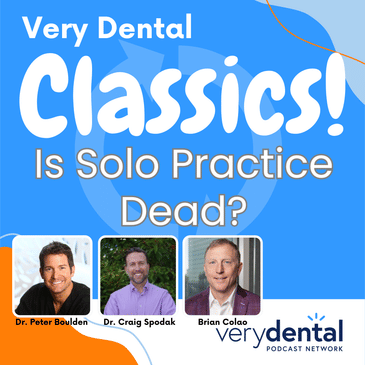
In this Very Dental (Dental Hacks) Classic throwback from the 2018 Voices of Dentistry meeting, Alan captures an impromptu, high-energy conversation right from the after-party. Dr. Peter Boulden and Dr. Craig Spodak (hosts of the Bulletproof Dental Practice Podcast) sit down with DSO attorney Brian Colao of Dykema for a candid debate on the shifting landscape of dentistry.
Brian lays out a blunt reality check on consolidation, private equity, and the mechanics of DSOs, explaining why traditional practice transitions are facing unprecedented disruption. Together, they break down EBITDA multiples, rollover equity, and what the rapid rise of multi-specialty group practices means for solo practitioners navigating the future of the profession. Plus, Alan and Jason cover their favorite hacks of the week, ranging from live streaming software to dental photography essentials.
Some links from the show:
Join the Very Clinical Facebook group!
Join the Very Dental Facebook Group using one of these passwords: Timmerman, Paul, Bioclear, Hornbrook, Gary, McWethy, Papa Randy, or Lipscomb!
The Very Dental Podcast network is and will remain free to download. If you'd like to support the shows you love at Very Dental then show a little love to the people that support us!
We're proud to be supported by the folks at Net32!
I'm a big fan of the Bioclear Method! I think you should give it a try and I've got a great offer to help you get on board! Use the exclusive Very Dental Podcast code VERYDENTAL8TON for 15% OFF your total Bioclear purchase, including Core Anterior and Posterior Four day courses, Black Triangle Certification, and all Bioclear products.
Crazy Dental has everything you need from cotton rolls to equipment and everything in between and the best prices you'll find anywhere! If you head over to verydentalpodcast.com/crazy and use coupon code "VERYSHIP" you'll get free shipping on your order! Go save yourself some money and support the show all at the same time!
The Wonderist Agency is basically a one stop shop for marketing your practice and your brand. From logo redesign to a full service marketing plan, the folks at Wonderist have you covered! Go check them out at verydentalpodcast.com/wonderist!
Enova Illumination makes the very best in loupes and headlights, including their new ergonomic angled prism loupes! They also distribute loupe mounted cameras and even the amazing line of Zumax microscopes! If you want to help out the podcast while upping your magnification and headlight game, you need to head over to verydentalpodcast.com/enova to see their whole line of products!
CAD-Ray offers the best service on a wide variety of digital scanners, printers, mills and even their very own browser based design software, Clinux! CAD-Ray has been a huge supporter of the Very Dental Podcast Network and I can tell you that you'll get no better service on everything digital dentistry than the folks from CAD-Ray. Go check them out at verydentalpodcast.com/CADRay!
[00:00:00] [SPEAKER_06] Ordering dental supplies shouldn't be a full-time job, and it definitely shouldn't feel like a guessing game. That's exactly why Net32 was created. By a practicing dentist who got sick of inflated prices, opaque markups, and hours of wasted time, Net32 puts you back in the driver's seat. In just a few clicks, you can compare top brands, trusted distributors, and live pricing side by side. No middlemen, no awkward sales pitches or locked-in contracts. Just upfront pricing, verified peer reviews, and the supplies you need on your schedule.
[00:00:28] [SPEAKER_06] Even if you're convinced your current vendor is cutting you a deal, take a look. You might be shocked at what you're actually paying. Thousands of practices switch to Net32 and immediately start trimming down overhead. Those savings stay where they belong, invested right back into your staff, better equipment, and patient care. Plus, you have nothing to lose. Every single purchase comes with a 30-day money-back guarantee. Give it a test run on your next order, even for a single item, and see the difference for yourself. Stop overpaying and streamline your ordering today at Net32.com slash verydental.
[00:00:56] [SPEAKER_06] Head to net32.com slash verydental and see what your practice could be saving. This is a production of the Very Dental Podcast Network.
[00:01:08] [SPEAKER_06] Very Dental people welcome to... This is kind of a cool episode. I'm calling it a dental hacks classic because it kind of is. We had... I had Richard Lowe on last Friday, and we were talking about a conversation that I'd had a long time ago about DSO. It's really fascinating, actually, because Okay, at the original Voices of Dentistry... It's not the original. The second one. It was in 2018.
[00:01:35] [SPEAKER_06] I was literally... We had these goofy stand-up tables that we were recording at, and by chance, I had my recorder and headsets right there. And a couple of really interesting people that you definitely know about were at the meeting, and they were having like... It was like literally the... You'll hear. It was like the party after the CE part of the meeting, and everyone was... There's loud music, and people were drinking and having... And eating.
[00:02:01] [SPEAKER_06] And it turned out that these three guys that I didn't know real well at the time were kind of having a heated argument. It was kind of great. It was Brian Kaleo. You might know. He works with Dykema. He's actually an attorney. And then Dr. Peter Bolden and Dr. Craig Spodak, the guys who do the Bulletproof Dentist Podcast. They were all kind of... They were having sort of a heated conversation. It was kind of great.
[00:02:28] [SPEAKER_06] And so I... Instead of... I threw headsets on them and just recorded them. And it was really kind of cool. And somehow this got mentioned in last Friday's Very Dental podcast. I'm like, you know what? We need to plumb back into this. So I looked at the... And it turned out the original episode was a combination episode of interviews that we got from Voices of Dentistry back then. But I just thought... I got to tell you. It's very interesting.
[00:02:55] [SPEAKER_06] This was 2018. So it was like eight, nine years ago. The way we were kind of talking about multiple practice ownership and DSOs and all this stuff. And I think that it's an interesting time capsule. It's one of the reasons I wanted to put it out there. So I guess I'm not going to talk anymore. I'm just going to throw the episode right in here. It's got Jason and I doing our banter back and forth and all that stuff. It's kind of fun to hear that. But also, this is a really interesting interview. So I hope you guys get a kick out of it. Let me know what you think. And we'll catch you next episode.
[00:03:34] [SPEAKER_07] This is the Dental Hacks Podcast. A podcast created by dentists for dentists. Now, sit back, relax. You're about to be hacked.
[00:03:44] [SPEAKER_06] Hello, Dental Hacks Nation. And welcome to episode number 186 of the Dental Hacks Podcast. My name is Alan Mead. My name is J-Lev. Eating lunch. And his name is Lunch. His name is the best name of all. I don't stop eating for nobody. Do you have any peeps in your lunch, just out of curiosity, since it is just the day after Easter?
[00:04:06] [SPEAKER_00] Not today, at least. I'm on a no-peep diet.
[00:04:09] [SPEAKER_06] You're on a peep-less diet? I don't know. It's probably a good diet to have. Although, I know people who love their peeps. Love them some peeps.
[00:04:16] [SPEAKER_00] Cadbury eggs. I never could do those.
[00:04:17] [SPEAKER_06] Oh, man. I can eat all that stuff.
[00:04:19] [SPEAKER_00] I can eat everything.
[00:04:20] [SPEAKER_06] See, I am happy to eat whatever you put in front of me.
[00:04:24] [SPEAKER_00] I'm doing no sugar for the past couple months.
[00:04:27] [SPEAKER_06] Yeah, so probably peeps and Cadbury eggs and jelly beans are probably not on here. No sugar is a brilliant way to be, and a difficult way to be, in my opinion. But it is a smart way to be. I've lost the most weight doing that, exactly.
[00:04:43] [SPEAKER_00] It's a little stressful this time of year.
[00:04:46] [SPEAKER_06] Yeah, I wrote Halloween is tough, too. So right now, we are doing spring break. This is our spring break edition, 2018. I'm about to leave tomorrow for places unknown north of where I am. And you are working for your spring break. Is that what I understand?
[00:05:02] [SPEAKER_00] Yes. My kids are in preschool, so not that big of a deal.
[00:05:06] [SPEAKER_06] I don't know, man. Spring break is, I don't know. I'm glad to not be working. This is a luxury. And the other thing is, I was out a couple days last week because I was sick, so I've been missing work a ton. I feel like I'm playing hooky. It's a good thing.
[00:05:18] [SPEAKER_00] I wouldn't say I've been missing it, Bob.
[00:05:20] [SPEAKER_06] I'm not missing nothing. So we have an interesting episode today. I want to talk a little bit about what we're doing. We're putting together. We have a ton of recordings from the fabled Voices of Dentistry meeting, as well as the Chicago Midwinter that we haven't used yet. And so we're going to put a couple of those together in sort of an odd combination. We have a little for everyone today. So the first conversation we're going to play,
[00:05:49] [SPEAKER_06] and this was when everyone was drinking alcohol at the reception at Voices of Dentistry. This was kind of cool. So Dr. Peter Bolden and Dr. Craig Spodak have a podcast called The Bulletproof Dental Practice. It's a good podcast. I like both of them a lot. They were having a heated argument with a guy by the name of Brian Kaleo, who is like the head guy of Dykema, which is a law firm that helps put DSOs together.
[00:06:18] [SPEAKER_06] It's sort of a – I argue – I don't know that you could call them a DSO law firm, but that's a lot of what he does. He helps arrange DSOs, puts them together, and administer them. Really smart guy. His brain is going 100 miles an hour. Really interesting. Well, so they were having a bit of a heated argument like right next to our recording table, and I happened to be over there during the reception. And I said, hey, stop. We should record this. And so that's what we did. Like you should have been the person on that conversation because you are more knowledgeable about it than I am.
[00:06:46] [SPEAKER_06] And you'll see if you listen to this that I'm not really that up on what they were talking about. So tell me – here's something that a lot of listeners might not know what it is, and you do know what it is. What is EBITDA? EBITDA. EBITDA. EBITDA. You know what I'm talking about, though. It's some kind of a DSO measure. It must be some kind of a multiplier. What is that? Tell our listeners what the heck that means. EBITDA.
[00:07:13] [SPEAKER_00] It's earnings, but just depreciation, taxes, and insurance. Yeah, okay. And basically, it's just a stripped-down way of saying how much your earnings are. So right now, people get into dental practices, and they say, oh, here's my earnings. Man, I'm not really making that much. But it's a different way to kind of put it back into depreciation and things to really figure out what the true earnings of business are.
[00:07:39] [SPEAKER_06] Okay.
[00:07:39] [SPEAKER_00] And then people who buy these practices or put them together use different multiples. Say, dentistry has a certain multiple of 3% up to like 7%. So depending on what you're putting out there, your practice may be three to five times what?
[00:07:57] [SPEAKER_06] Your earnings.
[00:07:58] [SPEAKER_00] So if your EBITDA is $5,000, then your practice is worth $15,000 to $25,000.
[00:08:06] [SPEAKER_06] Okay. And they do talk about that a fair amount. They talk about that number and the multiplier of that number. And what I'm assuming is that by using that number, that gives them sort of a standard to judge all practices. Because clearly, the depreciation and the taxes and all this stuff would be different from place to place. So they're looking for a number to compare apples to apples. Is that what they're talking about?
[00:08:28] [SPEAKER_00] Yeah. So basically, when you're figuring out your earnings, you're doing it on a tax basis. So you've got all this depreciation and everything taken off, and you're presenting those earnings to the IRS. And that's your taxable basis. Right. And you're really, in a business standpoint, it's a little bit different. And then different things will make your practice more valuable. I know you hear about Scott Luna and people grouping practices together. And they get higher multiples on their EBITDA, different multiples.
[00:08:57] [SPEAKER_00] So some other industries may have a one or two times multiple. Some may have a ten times multiple on their EBITDA. So it kind of varies across the board.
[00:09:06] [SPEAKER_06] Got it. Okay. So that's the first conversation that we had. And actually, if you listen to the Bulletproof Dental Practice podcast, they actually put this out there, I think, in February or something. So it might be a repeat. Because it was kind of their podcast, and I sort of sat in on it. But I thought it was interesting, and the point being is that the lawyer who puts together DSOs is essentially saying there's not going to be much oxygen in the room for solo private practice in 10 to 12 years. I'm not sure I agree with him on it.
[00:09:35] [SPEAKER_06] But after listening to these guys, it was a very interesting conversation. I think people get a kick out of it. All right. So why don't we sit back, relax, take a listen to one interview with Dr. Craig Spodak, Dr. Peter Bolden, and Brian Kaleo. And now it's time for the Dental Hacks interview.
[00:10:00] [SPEAKER_05] Well, we had a little miscommunication before we put on the gear here. I thought I was going to have to break it up. But the miscommunication is a good one. It bears repeating. First of all, thanks for having us on here.
[00:10:10] [SPEAKER_06] Let me just bring us in, and we'll do this. We'll do this for real. Dental Hacks Nation, welcome. This is the first interview we've done during the actual – okay, we have the alcohol here, basically. So this is the reception afterwards, and I want to welcome basically the people that made it happen. I want to see your name right. Brian Kaleo from Dykema. Thank you so much. Dykema has paid for all of the food and drink here. Now, my first question before I introduce our other guests.
[00:10:38] [SPEAKER_06] It seems ironic to me that there is a lawyer paying for our alcohol. I'm wondering if there's some kind of an ulterior motive here.
[00:10:44] [SPEAKER_05] You know, the only thing it is is we love Mark Costas at our firm. We're the leading law firm in dental services. I've spoken at Mark's conferences a number of times. He speaks at our industry-leading DSO conference. Mark's been a great partner, and he told me he had an opportunity to sponsor the happy hour. So that's kind of what we're doing.
[00:11:06] [SPEAKER_06] It's important that you're around dentists while they're drinking. That's what I really want to know.
[00:11:11] [SPEAKER_05] I mean, it makes for some very interesting conversation. I honestly don't know if applying dentists with alcohol results in additional engagements. I don't know that it really does.
[00:11:22] [SPEAKER_02] It does because we're introverts at heart. Except Craig. He's not. I'm an extrovert. It definitely makes for some fun conversations.
[00:11:29] [SPEAKER_06] So Craig Spodak and Peter Bolden of the Bulletproof Dental Practice Podcast. Welcome to the show, guys. Thanks, man. Glad you're here. I had him. Okay, so here's the thing. You are basically a legal firm that works with DSOs. You guys are into the DSO thing. I'm a guy with a bunch of headphones. So please pick up where you left off.
[00:11:47] [SPEAKER_02] Yes, I think you can talk about the genesis of how this happened. Literally, we were having a side conversation, and then Alan comes up. I was like, holy shit, this is good. Do you want to borrow our equipment? And so we were diving deep into the minutiae of why we should have a DSO. I was explaining to Brian that I already had a DSO. It was probably shit. And Craig was wondering, does he need one? And then we got into the thing of, Brian was saying how, essentially, if we were looking at any kind of exit,
[00:12:13] [SPEAKER_02] at the magnitude of the practices we have, it was almost imperative to have one. Did I understand that?
[00:12:18] [SPEAKER_05] No, that's exactly right. We got into a little bit of a discussion where one of those you can't handle the truth type conversations. I love it. I said, if you don't do a DSO and you're a doctor-owned dental practice, who can you sell to? And we kind of beat around the bush. I didn't get a straight answer. No, no.
[00:12:36] [SPEAKER_01] There wasn't any beating around the bush. I said four words, and you're like, just tell me the freaking truth.
[00:12:41] [SPEAKER_05] Yeah, I mean, maybe I cut him off a little bit, but the point is still a good one. If you don't have a DSO, you can only sell to licensed dentists in your state. And that's a very narrow market, and it's a deflated market.
[00:12:55] [SPEAKER_06] It's a market that's getting smaller day to day.
[00:12:57] [SPEAKER_05] But if you create a DSO, your market is the world. And that's why you're getting multiples up to 18 times EBITDA in the marketplace. And that's kind of the discussion you walked up. And that was my question. A good rabbit.
[00:13:10] [SPEAKER_02] Basically, I had disclosed to Brian, and I said, hey, I had an offer from a private equity. I thought it was pretty good. And that was prior to a DSO in place. And he was like, and I actually like this. He was like, it was kind of a weak offer, the multiple, which I dig because obviously I see there being more upside now in terms of doing this and going through the process. Because it's probably a pain in the ass to do a DSO.
[00:13:32] [SPEAKER_05] Yeah, I mean, you don't want to pay a lower multiple for a private equity deal because here's the thing. A DSO deal with an established DSO might pay anywhere from five to seven times EBITDA. But it's a low-risk deal, lower return, like a bond versus stock. You know, they know what they're doing. If the DSO has 500 offices or 400 offices, your one office that they buy isn't going to make or break them one way or the other. They're going to pay.
[00:13:59] [SPEAKER_05] They're going to require like a reasonable transition period, maybe a year or two, make sure everything gets transitioned. And if you want to leave, you can leave at that point and just take the money and go, but the multiple is lower. A private equity deal is going to be, it's going to require your ongoing involvement. They're going to require a rollover.
[00:14:19] [SPEAKER_05] So if they buy, you know, if they pay, I'm just using silly numbers, you know, $5 million, you're going to have to roll over 40% of that amount or more. And then you're going to have to stay involved and continue to grow the organization and participate in a second equity, you know, transaction.
[00:14:41] [SPEAKER_02] Is that the holdback money that you heard of? Is that the holdback that you heard of?
[00:14:44] [SPEAKER_05] No, no, no, no. So don't misunderstand. A holdback is for regulatory issues or problems or to make sure you're a good corporate citizen and you transition the practice and don't do anything to hurt the business. Okay, there's escrow, there's holdbacks, and then there's rollover. A rollover is if they pay you a million dollars, you only get $600,000 and 40% buy shares in the new entity and you roll it over and then participate in the second equity transaction.
[00:15:14] [SPEAKER_05] So I want to make sure we got our terms down here. These are really good. I'm glad you asked. These are really good terms and I want to make sure we got them correct. But anyway, for a private equity deal that you can't exit and you have to stay involved for another five years, you know, five or six times is too low of a multiple as far as I'm concerned. Those things will typically pay double digits or very high single digits.
[00:15:37] [SPEAKER_01] Okay. Well, that's what our friend was, by the way. That was a PE deal. We met with somebody recently and they were talking about that with us, these same terms.
[00:15:46] [SPEAKER_02] And it was predicated on staying on board, right?
[00:15:49] [SPEAKER_05] Yeah, you are now. I mean, this is the thing. If you do a DSO deal, very little is asked of you. It's like behave yourself for two years, transition everything, don't do anything stupid and you'll get your hold back and then you can leave. I mean, you could probably stay if you want to and be an employee or you can leave and move on and that's the way it is.
[00:16:07] [SPEAKER_05] But on a PE deal, the fate of the second equity transaction and the fate of the organization is on your shoulders because you've got to hang around for up to five years and make this happen. I mean, it's a lot of pressure. I mean, people have made a killing and a ton of money, but it's a lot of pressure because you have to hang out versus a DSO comes in. It's a whole different feeling.
[00:16:30] [SPEAKER_06] That's right.
[00:16:30] [SPEAKER_02] And it's performance based, no?
[00:16:32] [SPEAKER_05] That's right. Okay. So you might not get that whole realization. That's right. A lot of folks, it looks great on paper, but then it doesn't turn out as anticipated and you've spent five years of your life and you don't get the return.
[00:16:45] [SPEAKER_02] Something you said when you were on stage and we got the chance to hear Brian talk a little bit. And you said that the way dentistry has obviously changed from the way that the traditional buy-in model has changed and it's kind of dead in the water. And you said it a little bit more eloquently, but it got my damn attention real quick.
[00:17:01] [SPEAKER_05] Yeah. I mean, there was an evolution and consolidation in the marketplace right now. The evolution is from doctor-owned single practices or group practices to DSOs. And the evolution is occurring because the market is being flooded with billions of dollars of private equity funds because by creating a DSO, it allows for the participation of non-dentists to invest into the space. And that's what's going on.
[00:17:25] [SPEAKER_05] I mean, there's still thousands of solo practitioners out there, but they're being bought up and consolidated. And I think in the next five to ten years, it's going to be very, very difficult to function as a solo practitioner.
[00:17:43] [SPEAKER_01] Well, they said right now, I think dermatology is about, I think, 50% or 60% consolidated. Right.
[00:17:49] [SPEAKER_05] It is. Now, interestingly enough, I'm glad you mentioned that, Craig, because the market saturation of DSOs right now is right around 10%. Yeah. So there's a lot of runway. A lot of runway.
[00:18:00] [SPEAKER_02] It's the most fragmented industry. Yes, it is.
[00:18:03] [SPEAKER_01] It's a lot bigger than Durham as well. So Durham is a fraction of what we are. Correct. So there's a lot of runway, meaning that most are not consolidated and there's tons of value. There's billions or hundreds of billions of dollars. There is. There is. Or 1.5 billion, correct?
[00:18:18] [SPEAKER_05] It's more than that. It is. It's more than 1.5 billion. I mean, 90% of the market is unconsolidated. I don't have it with me, but it's way above 1.5 billion. I promise you that.
[00:18:30] [SPEAKER_02] So it's kind of a daunting proposal, or I should say statistics that you give. And when you hear that, you're like, holy ****. Dan, I'm just going to give you from a dentist perspective. We're already so fearful of this corporate takeover and the powers that are coming. I hear this conversation all the time. Not in the context of, I want to get out, but like, holy ****, I'm going to get beaten up. By the monster that's rolling in town. So what advice do you have from the single practitioner ground game that can still prosper from your perspective?
[00:19:00] [SPEAKER_02] I have education is all I can do, okay?
[00:19:02] [SPEAKER_05] I tell people, you know, I can't, like, make the sky be green instead of blue. But what I can do is I can educate people. And I liken this to, you know, people were rather unhappy that all of the mom and pop shops closed down and Walmarts moved into community. People don't like to hear that. And, you know, on a human level, I can appreciate that and understand it. But on a just pragmatic level, well, it's happened. Sorry.
[00:19:30] [SPEAKER_05] And I say the same thing with respect to dentistry. You don't have to like it. I don't want to make somebody like something. I mean, you can shed a tear and say it's a shame and it's unfortunate. But make no mistake about it. It is happening. And you need to understand the forces in the marketplace so you can react and best position your organization. And, you know, the sad thing that I, you know, I feel like I'm compelled to say it on this podcast,
[00:19:57] [SPEAKER_05] even though some folks might not want to hear it, is 10 years from now, there's not going to be very much opportunity for a solo practitioner. I mean, I'm sorry. I didn't make the rules. I'm not causing it. But I feel like I have to be truthful in my evaluation and assessment of the market. So if you are a solo practitioner right now or you're graduating dental school and you have eyes on maybe buying or acquiring or opening up a practice, you need to understand the transformation that's going on in the marketplace.
[00:20:26] [SPEAKER_05] And you need to have a plan that, you know, that fits with what's going on right now. If your plan is, oh, I just opened up this office and I'm going to keep it for 30 years, then I'm going to get an associate and he's going to buy it. No, that will not work anymore. There is. That is not an opportunity.
[00:20:43] [SPEAKER_06] You already know Crazy Dental has practically unbeatable prices on everyday dental supplies. But how do we make that deal even sweeter? Free shipping. Jump over to crazydentalprices.com, fill your cart and enter promo code VERYSHIP, all one word, at checkout. That's VERYSHIP, all one word, to wipe out shipping costs on every single order. Even better, using that code directly supports the Very Dental Podcast Network. Stock up, pocket the savings, get free delivery, and help back the show. Use VERYSHIP, all one word, today.
[00:21:14] [SPEAKER_01] Brian, I want to challenge you on one thing. Go ahead. So there is room for this iconic solo practitioner to exist in the market, but he's got to be freaking amazing. Like the celebrity dentist out there. There is 1% of the market that will be unaffected.
[00:21:29] [SPEAKER_05] It's awesome that you said that, because I spoke last week in Florida, and you know what I said? I said, if you're the dentist to the stars, or you're the dentist on the military base, and everybody goes to you, there will be. I mean, it's not going to be zero. There will be an opportunity for that standout solo practitioner. I mean, I'm so glad you said that. That you've got to be a rock star. Because I'm right on the same page with you, but it's going to be 1%.
[00:21:53] [SPEAKER_01] Yeah, that's the problem. No, I'm talking about there are real dental rock stars. No, no, but it's got to be a really unique situation.
[00:22:00] [SPEAKER_05] You're just an awesome run-of-the-mill regular dentist. No, no, no, that's not going to work.
[00:22:05] [SPEAKER_06] But the problem is dentists have a real hard time understanding that they aren't that person. Right.
[00:22:08] [SPEAKER_01] Right, right. But, you know, one of the unfortunate things is that for the last 20 years, people have been saying what you're saying, Brian, that it's the end of the solo practice. For 20 years, I get it. It's so true. But I believe it. I actually believe it.
[00:22:23] [SPEAKER_02] And you're a fourth-generation dentist, so you've seen it, heard it, and talked to it.
[00:22:26] [SPEAKER_01] Well, I'm a third-generation dentist, but thank you. Coachman's a fourth-generation dentist. Oh, sorry. Yeah, he got me confused with greatness. So what happens is that we become so sensitized to this. That's exactly right. It's the Carey's vaccine. 20 years now.
[00:22:41] [SPEAKER_06] It's the thing they've been saying forever.
[00:22:42] [SPEAKER_05] It's almost like one of those global warming things. You've been hearing global warming for 20 years now. They're certain it's happening, but you hear it over and over again.
[00:22:51] [SPEAKER_01] But you've got to understand there's dentists that are probably more like Alan in my age that have heard this for 20 years. Like it's all, this shitstorm is coming. There's a tidal wave of corporate. You're going to be out of business. So there is a very strong shift. And it will, I do agree with you, that the solo practitioner that is not a true rock star will have a very tough go. But we've heard it for so long. When is it actually going? When do you believe this prophecy will come?
[00:23:14] [SPEAKER_06] I think he just said 10 years.
[00:23:15] [SPEAKER_05] No, no, I do. It has happened. I mean, the statistics bear out that it's happening. Now, something good for the dental industry. I mean, if you're a fan of solo practitioners and many of us are. No, no. I'm not. I'm just saying I don't pass judgment on anything. I'm just saying if you are a big fan of the solo practitioner model, the good news is there's so many of them. It's going to take 10 years to buy them up. So when I speak nationally, I don't ever, I'm not here to panic people. The sky is not falling.
[00:23:43] [SPEAKER_05] If you love being a solo practitioner, you've got several years left. I mean, don't panic, but it's happening. And I feel like it's going to be, you know, 10 years now. Is it going to be 12 and a half? I mean, I don't have an exact crystal ball, but that's what we're looking at.
[00:23:58] [SPEAKER_01] Interesting. The funny thing is, is you're looking at it from a Rola perspective and the PE and the corporate. I look at it from a patient convenience perspective. Patients are demanding, or at least they're educated. They want same day dentistry. They want a specialist on site. So it's really the age of the consumer now. We have Amazon drop shipping stuff to your house. Exactly. You got it.
[00:24:22] [SPEAKER_02] You've got direct to consumer model. Right. But they don't care. The patient doesn't care if it's a corporate entity or not.
[00:24:29] [SPEAKER_01] So it's going to be the patient that drives this. I would argue the patient might not even know. They won't know.
[00:24:34] [SPEAKER_05] They won't know. They certainly won't care. They won't care. They probably won't even know. So we got to realize. Something that's just fascinating to me, Alan, that I learned maybe a year ago, I wasn't fully aware of this, is dentistry is one of the few fields where they really don't care, the consumer, about the dentist. It's like with your orthopedic surgeon that's doing your knee or your family practitioner. You're kind of hiring that human being.
[00:24:57] [SPEAKER_05] But with a dentist, most folks, unless they've had just an extraordinary amount of dental work done and they've bonded with their dentist, if they're normal, they show up and this is what they need. They want the right location. They want it to take their insurance plan. Convenience. They want the right hours. And if the convenience are there, I've seen it. You can change the owner four times in a year and they don't care. The dentist is the guy that comes in and tells a joke and gives you a lollipop and leaves. And if it's a different guy, they don't care. It's unfortunate, but it's true. It is.
[00:25:26] [SPEAKER_01] But what I'm interested in is right now, the corporate models that are out there are the first or second generation of corporate. I believe there's a Ritz-Carlton DSO coming. No, no. I believe there's a Nike DSO coming. Did you hear?
[00:25:40] [SPEAKER_05] When I spoke at my firm's DSO conference in New Orleans back in June of 2017, I said we're in the third generation. This is awesome, Craig, that you're talking about this stuff. You and I are really on a really close wavelength here because, one, first generation were what people called chain offices, lower end, catered to Medicaid, other things.
[00:26:07] [SPEAKER_05] If you were a higher end person, you probably wouldn't go to those locations. The second generation were a little improvement over that. The first ones were all single branded. They all had the same name. The second one might not have been single branded but was still run-of-the-mill, middle class sort of experience, a little bigger audience. The third generation, all bets are off. Weekend hours, evening hours.
[00:26:34] [SPEAKER_01] The fourth generation is like Ritz-Carlton where they know everybody's name.
[00:26:38] [SPEAKER_05] Where I go right now, it's a DSO. It's private equity backed in Dallas. I probably shouldn't mention the name. But where I go, basically you walk in there and it's Mrs. Fields Cookies. Now, how are you going to treat cavities with Mrs. Fields Cookies? I never figured that out. But Mrs. Fields Cookies, Gatorade in the refrigerator. Gatorade, nice. The PlayStation room for the kids. You know, just a super, super high-end office. And you would never know it was private equity backed except I set it up.
[00:27:08] [SPEAKER_05] So, of course, I know. But the people that go there would have no idea. It's ultra high-end. That's why I said Greg, you mentioned it. Is it mint dentistry? It's not. Is it what? It's a big thing. My niece works there, as a matter of fact. I'm very familiar with mint dentistry. Sexy Teeth is their bulletin. Oh, yeah. That's not what I'm – it's not. I don't go there. But, look, it's super, super high-end. And you would never suspect that it was a DSO. But it absolutely is. And that's what's going on. And it's locally branded.
[00:27:37] [SPEAKER_05] That particular private equity group has 15 locations.
[00:27:40] [SPEAKER_01] Oh, wait. I think I know who this is. We'll talk afterwards. In Dallas? It is. Yeah, awesome guy.
[00:27:45] [SPEAKER_05] But that particular one has got, you know, Uptown Dental, Galleria Dental, Downtown Dental. Oh, I know who this is. They're all different names. It's not like a single brand.
[00:27:54] [SPEAKER_01] Yeah, we'll talk offline. That's where I go. That's where I go. But that's an iconic DSO. Yeah. I think that was one of the highest valuations ever, though, right? Wasn't it one of the highest?
[00:28:03] [SPEAKER_05] I don't go there. The highest valuation ever is a client of mine, and that's not what I'm talking about. But you know who I'm talking about. I know exactly who you're talking about. That's a buddy of mine. Wait, I'm curious. That's a client of mine, too.
[00:28:11] [SPEAKER_02] I'm curious. What was the highest valuation?
[00:28:13] [SPEAKER_05] Highest valuation in the DSO industry. This is public. I mean, it really is. It's Decadental. Yeah. Suleman. Suleman Ahmed and Rodney Owls, two clients of mine, really good guys. They got – it's widely accepted. I've seen them speak. They've gotten 18.2 times. They've talked about it. I mean, that's public.
[00:28:32] [SPEAKER_01] Yeah, but that's a wonderful DSO. I mean, from the outside of the –
[00:28:36] [SPEAKER_05] That's not my personal Dennis, but they are wonderful.
[00:28:38] [SPEAKER_02] That's who I was thinking it was.
[00:28:39] [SPEAKER_05] Absolutely wonderful.
[00:28:40] [SPEAKER_02] So, Brian, I have a question for you then, coming off full circle from massive size you guys are talking about. What – is there a critical mass to when someone should be looking at a DSO? You know, that's been a moving target, right?
[00:28:54] [SPEAKER_05] Today, you'll see it with two offices today because the goal is to grow it and roll it up. I mean, if you really – I was talking to some gentlemen earlier before Craig and Peter walked up, Alan, that basically were telling me they had a single practice and that's all they ever wanted to do. And I said, you know, if that's really all you want to do, just operate your single office as efficiently and profitably as you can. And someday you're going to sell it to a DSO or something. But you don't need to mess with this.
[00:29:24] [SPEAKER_05] Just do the best you can.
[00:29:25] [SPEAKER_04] Sure.
[00:29:25] [SPEAKER_05] But if you're going to expand beyond a single office, that's when you've got to think about a DSO.
[00:29:31] [SPEAKER_01] Well, just you told me – I told you my one. You said I have to get a DSO.
[00:29:35] [SPEAKER_05] Well, because yours now – I mean, I don't know how much of your personal information we want to talk about on the podcast, but suffice it to say, yours was very large. Yeah, it's like seven to ten dental practices. I mean, something like that where you've got what I call a super practice, a super location, you should do a DSO. Got it. Because somebody will buy that as a freestanding entity and the only way they can do that is if it's a DSO. But if you have a standard solo practice, you don't have to necessarily do that.
[00:30:05] [SPEAKER_01] Got it.
[00:30:05] [SPEAKER_05] But I've seen it, Peter, as two offices, three offices. I mean, that's the time to start thinking about this. But it's an office thing, not an aggregate revenue. No, no. What they buy is aggregate revenue. That's a great point that you make because if you've got three offices but they're all super, super mediocre, you're not doing yourself any favors by having three instead of one. I'd rather take one super profitable office than three mediocre ones.
[00:30:32] [SPEAKER_05] But all things being equal, when I use these terms, let's say you have each unit is a million-dollar practice and profitable. Two or three would be where I would start doing a DSO.
[00:30:45] [SPEAKER_01] Do you think, just out of curiosity, obviously selfish reasons you're asking this question, but do you think the future holds much promise for the dental hospital? I mean, Walmart sells milk because consumers want convenience. Do you think I'm being overly optimistic about the dental hospital, or do you think there's merit there in that valuation, that model?
[00:31:07] [SPEAKER_05] You mean the surgery sector? No, no.
[00:31:10] [SPEAKER_01] Multi-specialty, one-stop shop, 10 dentists in one box. I know they're not out there. I mean, they're very rare.
[00:31:18] [SPEAKER_05] Well, I mean, what the DSOs are trying to do is they're trying to implement one-stop shopping. I mean, what they'll do is if you're a large DSO and you've got, you know, you're in DF Dallas-Fort Worth, where I am, DFW area, you'll have an office and you'll have an orthodontist on site. It might only be a day or two a week, but they'll be there. You'll have an oral surgeon that comes one day a week. You'll have an endodontist. And they might be independent contractors, but they're not stupid. They don't want to refer anything out.
[00:31:48] [SPEAKER_05] If you present yourself at that DSO office and you need your wisdom teeth extracted, they want an oral surgeon or somebody for that. If you need a root canal, they want an endodontist. If you need braces of some nature, they want to have an orthodontist there. I mean, they don't want to, if they're private equity back, to send any services out.
[00:32:07] [SPEAKER_06] But what's interesting, too, is as a general dentist, that's a great practice to practice in.
[00:32:12] [SPEAKER_01] Yeah, it is. Like, seriously. It's more like school. That's why I built mine. I love the academic nature of it.
[00:32:16] [SPEAKER_06] It is like that. But, like, the other thing is, is, like, I mean, you can, I think there's a lot of efficiencies you gain there. I mean, obviously not referring people out, but, I mean, like, as a general dentist, this is a great place to be. It's a great place to be. No, absolutely. So, I mean, what I guess what I'm saying, there's an appeal to actually being a dentist in that place.
[00:32:34] [SPEAKER_05] Well, the appeal, Alan, is, I mean, there might be a professional appeal just to be among those colleagues. I was talking about the bottom line appeal. So, clearly, there's advantages on all sides. If you're getting some type of bonus based on the economic performance of that practice, and you ain't got to refer nothing out, everything stays there, the financial benchmarks are going to be higher, and you're personally going to be compensated higher. There's a lot of upside there. I know you were talking about professional. I was, but I was talking about financial. I can see all the sides of it.
[00:33:00] [SPEAKER_02] It's pretty cool, actually. Alan, don't you think that the cottage industry is kind of under attack for a number of reasons? We talked about Amazon just for a second, and Amazon and the Ubers make it super easy in our life. But in dentistry, we have this cottage industry who's like, hey, I'm the general dentist. You need to get in your car, drive over to see my buddy, the endodontist, and then have him come back over. We make it so damn difficult. We do make it hard. People are not going to tolerate that in the air of that. And I've talked about this a lot. I know I beat that point.
[00:33:24] [SPEAKER_02] But it scares the shit out of me because I think that's the ground game that corporate is saying, hey, we're going to become Amazon and Uber-ish, so people will hit the easy button and choose us over the cottage industry.
[00:33:32] [SPEAKER_01] Peter, never mind corporate. Invisalign's opening up storefronts. Just come and get scammed. You don't even need dentists there. Yeah, you don't even need dentists. They're going in high retail.
[00:33:39] [SPEAKER_05] Now, what you're referring to, I mean, let's be clear because there's a lot of misinformation in the marketplace, and some of these folks are my clients, so I want to be clear about it. You're talking about a direct-to-consumer, doctor-directed clear-aligner program.
[00:33:55] [SPEAKER_01] No, I'm talking about Invisalign actually has a pilot store in San Francisco right now, a scanning center, and they're opening up many more, and that's from Invisalign. It's public-directed.
[00:34:04] [SPEAKER_06] But it's still the doctor-directed, but it's directed. Invisalign is doing it, but doesn't Invisalign own a bunch of them? I forget the brand. Smile Direct. Smile Direct. So they're like that's sort of the same.
[00:34:16] [SPEAKER_01] Well, what Invisalign was finding is that they have their doctor-locator program, and they spend millions of dollars a year on advertising. Patients call, prospective patients call Invisalign. They farm them out to dentists. Dentists are fumbling to get them in in time, and the experience in the call is so bad. Invisalign says, you know what we'll just do? We'll open up a scanning center. We'll send you directly to our scanning center. We'll scan it. We'll do everything. And then when they're committed and they're financed and everything's good, then we'll hand it off because the dentists are so incompetent.
[00:34:45] [SPEAKER_01] They can't even give them the leads.
[00:34:47] [SPEAKER_08] I'm only laughing because it's true. But it's true. I know. I get it. It's true. It's actually true. It's horrible.
[00:34:53] [SPEAKER_01] But it's a testament to what we do. We can't manage our own inflow. We make it so hard. Yep. FMX, and we have to do all this stuff. There's another way to make it easier for patients to engage in the dentistry that they want to get without having the traditional model, in my humble opinion.
[00:35:08] [SPEAKER_05] No, I mean, you know, there are a lot of revolutionary models out there that are direct-to-consumer doctor-directed aligners. And I think if you do it correctly in a regulatory-compliant way, we've assisted some folks in the marketplace with that. And if you do it correctly, there's nothing wrong with it. I mean, I think it's going to change the face of dentistry, and that's a really good thing.
[00:35:29] [SPEAKER_06] What's funny, and I'm just – dentists are very emotional about that. And it's not – I love it. I mean, the American Association of Orthodontics. It's not a business decision that way. It's like there's a lot of emotion.
[00:35:39] [SPEAKER_02] I would have gone into dentistry and said, hey, you're going to have to go work for someone in a big-time entity. I would have been like, I'm good. I'm not going to do dentistry.
[00:35:44] [SPEAKER_01] Well, no, because the big-time entity that you have to work with now is not that sexy because we're only on second or third generation. There is a fifth-generation corporate that's so freaking sexy, you and I would sign up. We really would. And, I mean, all the headaches that we have to deal with – You would sign up. Yeah, there is a compelling future. But I wanted to touch on what Alan said because the multi-specialty thing, I thought – There's a book called The Cleveland Clinic Way. I don't know if you've ever read it.
[00:36:08] [SPEAKER_06] Sure, I've heard of it. I have not read it, but I've heard of it.
[00:36:10] [SPEAKER_01] But that was like the impetus for why I wanted to have a multi-specialty center because there is – Peer pressure with doctors makes them better. And there is a learning – It does. There's a learning effect like that. We only had two years of clinic in our schools or dental schools. But there's something special that goes on, especially with you, with your superstar dentist, the 3D printers. You're like, what is he doing? You know, oh, I could use that 3D printer for this or we could do that.
[00:36:33] [SPEAKER_01] So there's an academic nature that winds up, I think, guiding to a more multi-disciplinary center versus the itinerant specialty model. Which is – I mean, what you're dealing with is really about the profitability and we're the artists here trying to figure out how to survive.
[00:36:46] [SPEAKER_06] It is funny too because it's – you work with dentists, you know we're all a bunch up in our heads and our hearts and stuff like that. But it's very real. I totally agree with you. The other thing is I would tell you I would love to practice with more dentists. Because, okay, this meeting is a testament to the fact that we're social creatures. This is the kind of interaction that we have. And I mean, like, having that within your own practice, can you imagine? I mean, like, I know it's not important that it's fun, but as a social creature, how great would it be to go to work and like working with people?
[00:37:14] [SPEAKER_01] That's what Peter says to me. It's like, I understand why you love going to work. I high-five people.
[00:37:19] [SPEAKER_06] Lawyers about to kick us in the nuts. I know.
[00:37:21] [SPEAKER_05] No. I mean, I think it's critical that you enjoy what you do. I enjoy coming to these conferences.
[00:37:26] [SPEAKER_06] Well, your longevity there is better. That's correct.
[00:37:30] [SPEAKER_02] Yeah. And at the end of the day, it's a relationship-based practice. And my stigma with corporate dentistry is, oh, you're going to see someone different every time. And I don't like that. You know, dentistry already has a bad enough rap. Kind of like lawyers, right? Yeah.
[00:37:41] [SPEAKER_01] No, we're not that bad, Peter. I say we're fine. We're not that bad. Yeah, but I'm buying the drinks tonight. Yeah. The lawyers are great. Yeah. Exactly. And the koozies, by the way. That's right. I wish they could see these Dykema koozies. That's right. Nice.
[00:37:53] [SPEAKER_05] So at least for tonight, don't say anything bad about, I guess, my firm. If you want to say bad things. Oh, God. No.
[00:37:58] [SPEAKER_01] It's the other guys. God, those other guys are awful. All kidding aside, Brian, I've heard unbelievable things from everybody. Like, everybody says the only firm to go to is Daigama for DSOs, for partnerships, for everything dental.
[00:38:10] [SPEAKER_02] That's why we sought you out on this big crowd.
[00:38:12] [SPEAKER_01] We're literally hunting you down to come down to you.
[00:38:14] [SPEAKER_05] Well, no, this is awesome. I'm really glad we're all able to chat right now. I'm having fun. But like I said, like Alan said, I mean, you have to enjoy what you do. And when I started practicing law, you know, I had to go to court and try lawsuits and deal with angry judges and clients. And it was just not that fun. It wasn't your deal. You just couldn't see yourself doing that decade after decade. But since I've gotten into, you know, dentistry and we're doing all of these mergers and acquisitions
[00:38:42] [SPEAKER_05] and roll-ups and I see the value and everybody's happy when it closes. I mean, it's a new lease on life. That is pretty cool. You feel like you can do this for a long time doing this.
[00:38:51] [SPEAKER_01] Well, you're helping people, which is awesome. Yes, exactly right. And when you're helping people, you get fulfillment and it fuels you for passion.
[00:38:57] [SPEAKER_02] An interesting thing, though, I think that happens is our goal is always to, well, a lot of dentists want to grow and expand, right, and just keep growing and look at my revenues. I'm raising revenues. And then you ask the question to Craig, who's going to buy you at that point? So the goal is grow so big, but then you limit your opportunity for exiting from the conventional standpoint of, right? So it's this opposite. Do you see the dichotomy of my thought process?
[00:39:22] [SPEAKER_01] I always see the dichotomy in your thought process.
[00:39:24] [SPEAKER_05] Well, I guess, Peter, if you structure as a DSO, then you can create a bidding war potentially for a highly profitable office as long as you're a DSO and non-dentists are allowed to participate in the transaction. If you create a highly successful super dental office and you don't create a DSO and the only people that can buy it are licensed dentists, you're going to artificially deflate your value. Yeah, your pool is a lot smaller.
[00:39:53] [SPEAKER_05] You're going to do yourself a terrible disservice.
[00:39:56] [SPEAKER_01] Imagine that conversation with one of your junior partners like, hey, my buddy's a lawyer. He actually wants to buy it. He's willing to pay me 11 times. But that's kind of, yeah.
[00:40:03] [SPEAKER_02] And I have a problem with that. I mean, personally, because it's like handing the baton over to someone who really doesn't have the vested interest.
[00:40:08] [SPEAKER_01] No, but he may bring a different skill set, a complimentary skill set.
[00:40:10] [SPEAKER_02] But I'm not saying from an attorney. I'm just saying like an investor, anyone. Like, I personally have a problem with it because maybe that's just me being emotional. I love it.
[00:40:17] [SPEAKER_06] But it's super funny, though. That's a dental thing. And it isn't bad or good. It kind of is.
[00:40:22] [SPEAKER_01] I love it because it drives values higher for all of us.
[00:40:25] [SPEAKER_05] No, economically, you can't even debate it. It's better. Peter makes a good point, though, emotionally and as a stickler for professionalism. I mean, what is the quality of dentistry?
[00:40:34] [SPEAKER_06] It's the first time I've ever talked about emotions with a lawyer. Just going to be.
[00:40:37] [SPEAKER_05] Well, no, because I deal with it. Maybe not, Alan, but I deal with it every day. No, I know. You must see it. That's right. Yeah.
[00:40:43] [SPEAKER_06] And the struggle must be real for you.
[00:40:46] [SPEAKER_05] I mean, economically, there's no debate. Yeah. It's better this way. Yes. But from a professional standpoint, Peter's point is one that I hear every day of the week, you know, is the quality. What's going to happen to the quality if we do this? But I think if the organization is structured appropriately, think about this for a second. You guys didn't. You went to dental school. You did not go to business school. So you didn't. I mean, every now and then, you got a rare person that went to both. But you did. Nobody taught you how to negotiate a lease.
[00:41:15] [SPEAKER_05] Nobody taught you how to be in charge of HR. Nobody taught you, you know, how to negotiate supplier contracts and buy equipment. They taught you clinically how to treat patients. Now, if a DSO is done correctly and all of a sudden you introduce skilled business folks, Wharton business folks, Harvard business folks, and all they do all day long is we'll handle HR. We'll handle legal. We'll handle negotiation. We want to negotiate these contracts. We don't know anything about filling cavities.
[00:41:43] [SPEAKER_05] But we want to dive in and lower overhead and do all these things. So all you've got to do with your life, Peter and Craig, is come up with clinical innovations. Like when you're trying to operate your office, typically you're like, well, I'm trying to do clinically, but I've got to negotiate this lease. I've got to hire this person. I've got to fire this person. We always say the dentist is crazy. I can't do this stuff, right?
[00:42:05] [SPEAKER_05] But if somebody says you are relieved of everything but clinical, now all of a sudden you're saying, wow, why are we scheduling patients that way? We should do it this way. We can see twice as many patients. Oh, my God. Who came up with this clinical protocol? I mean, it's not wrong, but it takes all day to do this procedure. If we do it this way, we can see four people in a day or whatever it is.
[00:42:30] [SPEAKER_05] So now the clinicians focus on what they do best, and you start to achieve clinical innovations. The business people, some of them are really sick and demented. They're like, I want to negotiate that lease. I can't wait to jump into the middle of this thing. But that's what they do, so you get the best of both worlds. From a business standpoint, you've achieved operational efficiencies, and now from a clinical standpoint, you've really been able to focus just on building a better mousetrap. So that's the other side. Your bandwidth opens up. That's the third generation deal.
[00:43:00] [SPEAKER_05] The third generation. It was not present in one and two, but third and fourth as we move on.
[00:43:05] [SPEAKER_01] Zappos gives you a 365-day return policy. They will be 10-year guarantee. Like the DSOs of the future, this third generation will give you a 15-year guarantee. Lifetime warranty. Whatever. I mean, they'll have it all. I mean, it won't be a quality issue. I think they'll be able to treat the dentist well enough.
[00:43:20] [SPEAKER_02] We're doing that. We're doing with some of our clients warranties and guarantees. Yeah, because it'll be so easy. It'll be digital. Just print again. It's like, okay, print, print, print one more crown. Print, print, print.
[00:43:29] [SPEAKER_01] Here's one in a box.
[00:43:30] [SPEAKER_06] If it breaks, just take this one. There's a spare. Here's a spare I got for you. You have a denture for each room of the house. Right. Exactly. Really? We did a podcast with the digital denture people. They're like, it's that cheap. You could totally do that. So, yeah. It's crazy.
[00:43:41] [SPEAKER_05] By achieving operational efficiencies in their labs. Some of them have in-house labs. Absolutely it is.
[00:43:48] [SPEAKER_06] It's a brave new world. It is. It's a little scary. It's a brave new world. This is really cool that you guys, like, I'm glad. I'm glad that you're into it.
[00:43:54] [SPEAKER_05] Hey, some of the best stuff happens impromptu. It sort of does. No, this has been an awesome, as far as I'm concerned, an awesome session here.
[00:44:00] [SPEAKER_02] You can tell I'm not a seasoned podcaster because, literally, we're having that conversation and nothing in my head or probably yours, Greg, was saying, like, hey, we should record this. This is probably going to be awesome.
[00:44:09] [SPEAKER_06] Listen, it happens all the time. But what's funny, I'm curious what you think of this meeting. Like, this is a different, this is like a super weird, different kind of meeting. What do you think?
[00:44:16] [SPEAKER_05] Yeah, I like this meeting. I mean, I really, really do. I got to be honest. I don't know, you know, from the standpoint of just selfishly, the meetings where I get the biggest, you know, amount of business. Oh, yeah. A lot more group practices, but one where I just enjoy coming here and exchanging ideas because, like you said, there is even an element among lawyers of how hard it is to believe of professionalism. It's not all about the money.
[00:44:42] [SPEAKER_05] And this conference, to come here and share, you know, best practices and ideas, even on this podcast to do it, is really a treat for me. So I love this conference. I mean, I don't know if it's going to be as lucrative as some of the others just from the standpoint of people that need, you know, a DSO lawyer. But from the standpoint of really enjoying myself and exchanging ideas on where the space is headed, this is a wonderful conference. I love it. I think that's what's cool about it. Absolutely love it.
[00:45:07] [SPEAKER_06] The podcasting space is a lot about ideas.
[00:45:10] [SPEAKER_02] And creating awareness is what you've done. That's what I, for sure.
[00:45:14] [SPEAKER_06] This is really cool. It's really cool. And thank you so much for supporting it, man. It's great. No, my pleasure. We're new at this. I think it's going to continue to get bigger, but this is very cool.
[00:45:23] [SPEAKER_02] Well, it looks like at 5X from last year. Yeah. Seriously.
[00:45:26] [SPEAKER_06] I mean, the venue is a lot better, but it's just like, there's a lot of people. And I mean, it's almost 8 o'clock and everyone is still here. If people can see this, it is packed here.
[00:45:35] [SPEAKER_02] Yeah, it never happens at dental stuff, for sure. Craig actually asked me on the phone, he said, when he was flying, he's like, how is it? I said, man, the energy is pretty good. And usually the energy is not good. I mean, all the time at dental stuff because it's like, oh.
[00:45:45] [SPEAKER_06] Yeah, totally. When can I go to the pool? Last year's was good. The energy is the same as last year. This is the second year, right? Yeah. It's bigger, venues much better. And honestly, I just feel like we're in the right direction. But I really appreciate your support. It's great. Yeah, that was awesome, Brian. This was awesome. Thank you, Brian. Thanks so much for being on, guys. All right.
[00:46:01] [SPEAKER_05] Terrific. Thanks.
[00:46:02] [SPEAKER_06] All right.
[00:46:08] [SPEAKER_00] Hey, folks. We're back from our interviews that we've used from the Voices of Dentistry several months ago and only a couple more months away until sunny Scottsdale, Arizona. I know. It will also be near the Dental Success Institute, Dental Success Network. That's exactly right.
[00:46:29] [SPEAKER_06] You know what? I want to say, too, that I think the Dental Success Network's Arizona CE venue is opening. If it hasn't already, I think maybe it is. It might be this weekend that it's opening. I think Mark is cutting the ribbon on it.
[00:46:46] [SPEAKER_00] It should be open up pretty soon. And be ready for you folks to come out and hang with us and get some nice CE credits.
[00:46:52] [SPEAKER_06] Oh, yeah. Once this thing gets ramped up and going, it's going to be the CE destination for sure. Go check that out at Dental Success Network and join right now while it's still cheap. Use the coupon code DHN, as in Dental Hacks Nation. So we can let them know that we sent you. And that's very cool stuff. We'll have lots to talk about. Hopefully, maybe we'll talk with Mark about that in the next couple of weeks about how excited he is about it because they've been building that out really quickly.
[00:47:21] [SPEAKER_06] And I think it is now ready to go. So that's pretty exciting.
[00:47:23] [SPEAKER_00] And also, they just signed on with people that are going to be offering some IV sedation and sedation training. So they've got some good deals coming up for that. They just signed on. So if you want to get in, get over there and be part of this.
[00:47:37] [SPEAKER_06] Honestly, the sedation thing, sedation has always been something where I've been like, eh. And I'm looking at it going, man, the pricing on it is good enough. Like, you could make an argument to join the Dental Success Network for this pricing alone. Actually, it's pretty great. But we can, you know, if you have any questions or comments, why don't you email us at info at dentalhacks.com. If you have any questions for our interviews, which would be the Bulletproof guys in Brian
[00:48:03] [SPEAKER_06] Kaleo or Gil Hagi, give us an email, info at dentalhacks.com. And we'll get the info to those guys as well. So now's the time of the show when we give Premier a little bit of love. And we'll do the Premier Dental Hack of the Week. Jason, what is your hack of the week?
[00:48:20] [SPEAKER_00] My hack of the week? I'm always looking for some way to do Facebook Live. And I've been on Facebook and our group live a couple of times. But I've been trying to figure out a good way to do interviews and get other people on. It's called BeLive TV. Oh, wow. BeLive. And it's a good way to bring in multiple people on a Facebook Live and hop on your group on your page. And really, General Dentist should be using something like this, especially on your own Facebook page.
[00:48:49] [SPEAKER_00] So hop on there and do a Facebook Live every once in a while. Just kind of do some cool stuff. It really notifies all the people that like your page that you're doing something and draws their attention to you.
[00:49:03] [SPEAKER_06] That's really cool. So it's a third-party software?
[00:49:07] [SPEAKER_00] Yep. They've got a free trial period, so you can give it a try. And you sign on, and you can bring up to three other people on there. And you can put your branding on there and your logo. So it's pretty cool.
[00:49:21] [SPEAKER_06] That sounds great, actually. It sounds like it's made some things that were difficult where you can only do it with your phone. Like now you can do it with a webcam, it sounds like, huh?
[00:49:30] [SPEAKER_00] Yeah. That's what I've been looking for, something easy to put out there. Make it look nice.
[00:49:35] [SPEAKER_06] Yeah, definitely. That kind of has been the weakness of Facebook Live. I sort of love that. Okay. So my hack of the week is a photography. It's a book, or you can get it on a DVD as well, where you get it as a PDF and stuff like that. It's by a guy on Facebook called Milodinov Milos. And the actual software or the book is called Dental Photography, and his branding is Shoot Like a Pro. I got both of them, actually. You would probably only need one of them.
[00:50:05] [SPEAKER_06] But I got both of them because I like having it on my computer, too. Really good. I mean, he's... It was kind of funny because I don't know exactly where it came from. I think it comes from Romania. But this dude shoots... He has the most amazing dental photography ever. And enough people said that they thought it was really great. So I got it. I'm really enjoying it. And what's nice is he gives you a lot of step-by-step. He frames up how you do the lighting. And then he also... He gives you the shortcuts, the setting shortcuts, which are always the thing for me, right? Like as soon as...
[00:50:35] [SPEAKER_06] I don't remember them very well. So if I change them ever, I'm like, I don't even know where to... So he's literally got this little card in there that it's like the shortcuts, which is exactly what I need. I'm really happy that I got this stuff. So you should... I'll put his website up on the show notes. Very, very good stuff. So I would highly recommend that if you're trying to figure out how to shoot. I'm not a photographer. I don't know anything about photography. But I have good photography gear. And I just want to learn how to use it better than I can. So this has been just about right for me. You just want to shoot like a pro? I do.
[00:51:04] [SPEAKER_06] That's all I want is to shoot like a pro. So all right, my friend. We have spring break to do. So I'm going to let you get back to your lunch. I'm going to run off and take my children to places. And...
[00:51:20] [SPEAKER_00] That's a place to go.
[00:51:21] [SPEAKER_06] Exactly. If you guys have any questions or comments for us, email us, info at dentalhacks.com. Thank you as always for listening. Thank you for the reviews you put on iTunes. And tell a friend. And I'll tell you what. This was fun. And we'll be back from spring break next week. And we'll be rocking and rolling. So thanks for listening. And we'll talk to you guys later.
[00:51:41] Bye. Bye. Bye. Bye. Bye. Bye. Bye. Bye. Bye. Bye. Bye. Bye.