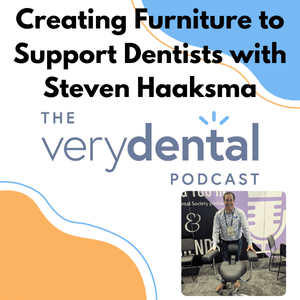
Alan is joined at the Chicago Midwinter meeting by Steven Haaksma of BQE or "Back Quality Ergonomics." Alan has used a bunch of their stools over the years and is a big fan of the ergonomic products that Steven's company has created.
Key Takeaways:
- 3:73">BQE = Back Quality Ergonomics: The meaning behind the company name.
- 4:92">Dutch Roots, American Story: Steven's background and how BQE started in the US.
- 5:97">PT-Founded: BQE's origins with Steven's father, a physical therapist focused on back pain.
- 6:108">Dental Professionals' Back Pain: The high prevalence of back issues in dentistry inspired BQE's focus.
- 7:85">Challenging Traditional Stools: The problems with round and flat dental chairs.
- 8:90">Ergonomic Design Principles: Getting closer to the patient and preventing slouching.
- 9:102">The Original ErgoDynamic: The unique chair where the backrest automatically adjusts to the user.
- 10:103">Convex Backrest: BQE's signature design for optimal lumbar support, available in different sizes.
- 11:73">Beyond Dentistry: BQE also serves veterinary and optometry markets.
- 12:108">Alan's Back Story: Dr. Mead's personal experience with a back injury and the importance of prevention.
- 13:80">The "Chair Museum": Alan's journey to finding the right ergonomic seating.
- 14:96">Armrest Benefits: Supporting arm weight reduces strain (arms are ~5% of body weight each).
- 15:106">Saddle & Alternative Seats: Options for different preferences while maintaining good ergonomics.
- 16:77">European vs. US Saddle Popularity: Interesting differences in adoption.
- 17:94">Educating Dentists: Raising awareness about the long-term benefits of ergonomic seating.
- 18:88">The Science of Slouching: How the ErgoDynamic chair actively combats poor posture.
- 19:81">Proper Positioning: The importance of both dentist and patient positioning.
- 20:79">Investment, Not Expense: BQE chairs are durable and competitively priced.
- 21:71">30-Day Trial: Confidence in their product with a low return rate.
Some links from the show:
Join the Very Dental Facebook group using the password "Timmerman," Hornbrook" or "McWethy," "Papa Randy" or "Lipscomb!"
The Very Dental Podcast network is and will remain free to download. If you'd like to support the shows you love at Very Dental then show a little love to the people that support us!
--
Crazy Dental has everything you need from cotton rolls to equipment and everything in between and the best prices you'll find anywhere! If you head over to verydentalpodcast.com/crazy and use coupon code "VERYDENTAL10" you'll get another 10% off your order! Go save yourself some money and support the show all at the same time!
--
The Wonderist Agency is basically a one stop shop for marketing your practice and your brand. From logo redesign to a full service marketing plan, the folks at Wonderist have you covered! Go check them out at verydentalpodcast.com/wonderist!
--
Enova Illumination makes the very best in loupes and headlights, including their new ergonomic angled prism loupes! They also distribute loupe mounted cameras and even the amazing line of Zumax microscopes! If you want to help out the podcast while upping your magnification and headlight game, you need to head over to verydentalpodcast.com/enova to see their whole line of products!
--
CAD-Ray offers the best service on a wide variety of digital scanners, printers, mills and even their very own browser based design software, Clinux! CAD-Ray has been a huge supporter of the Very Dental Podcast Network and I can tell you that you'll get no better service on everything digital dentistry than the folks from CAD-Ray. Go check them out at verydentalpodcast.com/CADRay!
[00:00:00] Okay, let's talk about one of the most underrated tools in your practice, the dental mirror. It's in your hand all day, every day. But have you ever thought about how much it actually impacts your work? If your mirrors aren't giving you a crystal clear view, you're working harder than you need to. That's where Zerk comes in with their Crystal HD Dental Mirrors. I love these mirrors. I keep two in every single setup just in case I drop one. These aren't your average mirrors. They're so much brighter than the standard ones. That means better visibility, reduced eye strain, and more confidence during every procedure.
[00:00:28] And they're durable and lightweight, designed to reduce hand fatigue and improve ergonomics, so you can work comfortably even during those long demanding days. Plus, your patients will love them too. Available in a variety of vibrant colors, these mirrors are made with durable resin to prevent galvanic shock and eliminate the unpleasant clanking against teeth, ensuring a more comfortable experience for everyone. Upgrade one of the most important tools in your kit with Crystal HD Dental Mirrors from Zerk. The moment you bring one into the oral cavity, you'll be amazed at the clarity and brightness. It's like seeing your procedures in a whole day.
[00:00:58] Whole new light. Maintaining optimal ergonomics is essential for a long and healthy dental career. That's where BQE comes in. BQE stands for Back Quality Ergonomics. I swear by a BQE model called the Ergodynamic, but they have a variety of styles that can fit you and your whole team. Keep listening to Very Dental to hear a conversation I recently had with Stephen Hoxma of BQE about their commitment to creating the best seating for dental teams. If you're looking to improve your workspace and well-being, check them out at bqe-usa.com.
[00:01:30] This is a production of the Very Dental Podcast Network. This is the Very Dental Podcast. Welcome to the Very Dental Podcast, where you'll find entertaining and relevant conversations with visionaries, clinicians, and your friends in the dental space. Now, here's your host, Dr. Alan Mead.
[00:01:58] Very Dental people, welcome to another episode of the Very Dental Podcast coming to you from the Chicago Dental Society Midwinter Meeting. It is the last day, Saturday. Things are winding down. Joining me today is a guy I've known for several years. His name is Stephen Hoxma, and he sells chairs. His company is BQE, and I was very embarrassed because I bought several chairs from him, and I didn't really know what BQE is. Stephen, welcome to the show.
[00:02:27] Thank you, Alan. Thank you. It's so nice to see you again. It's been a while. So BQE stands for? Back Quality Ergonomics. Okay. And especially being from Kansas City, they'll sometimes say BBQ Ergonomics. Add a little B, and it fits. I like that. I can see that. So people are hearing your voice and saying, well, his accent doesn't sound like Kansas City. No, not really. So Stephen, tell me a little bit. I'm working on it. I'm working on it. Yeah, that's right. I mean, if you're there long enough, you'll probably get it.
[00:02:57] Yeah, yeah. So where are you from originally? I'm originally from the Netherlands in a town called De Haeg. Okay. And yeah, it's like the third largest city in the Netherlands. Okay. And born and raised there. Lived there for 29 years. Okay. I'm 45 now. Okay. I've been here already 16 years as well. Okay. And originally moved to Denver, Colorado. Okay. March 2009. Okay. And we started the business there. Okay. We worked actually together with Steve Knight for a little bit. Okay.
[00:03:27] And then, let's see. Then I met my now wife there. Okay. Okay. Kristen. Yes. She does everything for us. Okay. So glad I met her in my life. And then we had all of a sudden four kids. Yeah. Ta-da! So I'll sometimes joke about it when I say it's like the real American dream. It's like you'll see a picture of me because our company is doing great. My family has been great. It is. That is the American dream. I really love living here.
[00:03:56] So we go back every year still for a month in the summer. Okay. We try to visit my parents and my brother and sister and so on. And then friends. But yeah, so back in, let's see, 14, we had the first two kind of back-to-back. Uh-huh. And my wife's twin sister lives in Kansas City. Okay. And she's from St. Louis originally. Okay. So a little bit closer to her parents' house and stuff. Okay. Yeah. That's all. I do love that. And that really is, that's sort of like the American story.
[00:04:22] So you came here to start the business before you knew her. Yes. Yes. Exactly. Oh, that's interesting. You are, that's like the American story. I love it. Yeah. Okay. No, we started, well, so with Steve Knight and Crown, they were actually a distributor of one of our chairs. Okay. Actually, which is your favorite chair. Okay. Okay. And so we've, we have about 40% of all the dentists in the Netherlands sitting on this particular model. Okay. Okay. The ergonomic chair. And so. Oh, I never knew I was so European. I like that. Yeah.
[00:04:50] So my, let's see, my dad back in the day. So my dad started the company, but yeah, he met with Steve a long time ago. I believe it was the ideas in Germany one time and then, so it's a lot of people. And then he started this, this story is the one that I can't wait to hear actually. So your dad started the company and then was working with the U S distributor at some point. You then decided that you were going to come distribute them yourself here in the United States. Yeah. Yeah. Exactly. Yeah. So I'm on my, maybe I should go back to the start. Yeah. That's makes more sense. Yeah. Yeah. Let's hear it.
[00:05:20] So, yeah. So my dad's a physical therapist. Yeah. It's been a physical therapist for his whole life. He's a 78 now. He's been retired for a few years, but yeah, I was always, had his PT office and, but he was always really intrigued with people with, with back pain mostly actually. And a lot of his patients had back pain too. And then he was the first one to start a back school in the Netherlands. Okay.
[00:05:47] And it was kind of after the Swedish Volvo, they had their own back school for the car manufacturing. Yeah. Yeah. Cause I guess a lot of the workers had that. Yeah. Yeah. Um, anyway. And, uh, so he, um, started his back school. He had about 300 people a week doing kind of like physical exercises too, but also teaching them best way to sit, the lift and so on. And it was kind of like a fun thing too, to do for people through groups of 10 and they would, you know, exercise together. It's kind of like a workout and like a lot of them are still friends. Yeah. Even though they, you know, that's really, okay.
[00:06:16] That's really, that's fascinating. I have to tell you that it's like the most Scandinavian thing ever too, because there is this, this fascination with ergonomics and all that, but yeah. And, and backs, we probably need those here. Let's just be perfectly honest. We probably need those here too. It's obviously great that it worked really well. And, and besides that, like I said, there was the friendship came out of it too, because then they would do the exercise. And then later they had, there was like a whole like steaming and a sauna and bubble baths that he had. And so people hang out and then sometimes we'd go out to dinners together. Sure. Long, long friendship. Make it an evening.
[00:06:46] I like it. Yeah. It was real fun. And, but yeah, then, so he noticed that a lot of this, a lot of the people that came there were actually in the dental field. So he was like, well, okay, why is that? So he was kind of doing some research on what people were sitting on. And this was back in the mid eighties. And he, yeah, he noticed that, you know, it was usually, and what you unfortunately still see a lot of days round or kind of square seats. Yes. And I'll get back into that later.
[00:07:14] Why we think that could be done better. But so, yeah, so he was like, well, I can keep treating people, but if, right, if you don't fight the cost, then yeah, they keep paying me. But how about you just invest in something, good furniture, something that you don't have to keep coming back. You just have a better quality of life. And yeah, so that's kind of how it started. And it took him literally like two years. He had this technical engineer, which is a really smart guy, makes stuff for really big companies.
[00:07:43] And then his own dentist and with, for feedback. Yeah. And so it took him two years and he had this concept of, he wants something to help you get closer to the patient, not having to bend your back and neck, but also something that protects you when you, when the moment you start to slouch. Yeah. And so you don't overload the disc and so on. And yeah, like I said, it took him about two years. And then he was ready. The dentist said like, this is amazing. He had the feedback. He went to one trade show and he had 60 people that wanted to buy the chair. Okay.
[00:08:12] And so he had one. So then he's like, oh, I have to manufacture these now. He's like, oh shoot. No, no, I got to work harder. Yeah. No, it was great. So he was like, literally, you know, I will say like on his Saturdays in his garage, right, making the chairs. I mean, obviously it was a lot more built to that, but that's kind of how it started. And then it was like, oh, this is cool. You know, and it's just really the feedback and dentists telling their friends and like, oh my God, this has worked so well for me. Which design was the first one? It was actually the Ergodynamic chair. Okay.
[00:08:42] Yeah. Okay. That's the one that I'm obsessed with. The full automatic chair. Yeah. And so, and then let's see. And then, yeah. So then it got kind of busy with that. And he was like, okay, well, I'll start taking the Fridays off basically. Just do the PT. Yeah. You know. And yeah. And it started slowly started shifting. And I just, he was a PT for 25 or 30 years. And he was like, you know, at a certain time he kind of seen it too. Yeah. And so he's like, you know what? At a certain time he sold the business there and started BQ Ergonomics. Okay. Okay.
[00:09:11] And that's, that's like, I love that story. Because first off, yeah. I mean, you, you fit dentists in there. If you're, if you're treating back pain, dentists are going to come in. Back and neck pain. That's what, that's, that's our problem. Yeah. In some cases that is a, a career ending problem for some dentists. And the point being that, you know, we can do some preventive things, not the least of which is like, I talked to Katrina Klein. I know you know Katrina. She's about, she does a lot of ergonomic. Yeah. She does all kinds of ergonomic stuff.
[00:09:39] And so in one plank of the ergonomic thing is the seating because you're, you're, that's, you spend your time. Right. You know, seeing patients, this sort of thing. And it's, it's like creating the, the furniture that supports you. So that's, that's kind of where your dad started with the company. And he, he always told me like, so yeah, I started with him literally in the warehouse and then come into trade shows. And then I did something else for a couple of years too. And then, and then, but I was like, I just love the way we, you know, the feedback goes as well.
[00:10:06] So I moved back and ever since I've been, you know, working together with him, he still comes over once in a while. Okay. It's getting a little less after COVID, he's getting older, but he still enjoys it. Where's, where are they, where's the warehouse? Where's the manufacturing? So we're in Overland Park, Kansas, which is just south of Kansas City. Okay. Okay. So they're, so they're all done there. I love that. Yeah. Done there. My upholster is still in Colorado, working with a great guy who's just does phenomenal job. And I want to keep supporting him and also because he just does an excellent job.
[00:10:35] I love working with him. So that like the story just keeps getting better for me. So I, I've had multiple of your chairs. I, the, my favorite one. And I finally, I've been using the ergonomic one. I have, I've had saddle chairs for years. Right. I, I mean, my, my, my office is full of, yeah. Apparently this is something that's been a problem for me because I've been trying stuff for a long time. It's funny you mentioned this because I, you know, we do what, like 40, 50 trade shows a year. Yeah. Just in dentistry. We do veterinary and optometry.
[00:11:05] Everybody that sits really. And I talked to dentists and they're like, oh, you have a whole museum of chairs. We do. Literally. That's exactly right. My office. I mean, I'll try and take a picture of the museum at some point. I'll pose them. But I, like I've, I've had, and, and I'm a microscope user. And so in all of the cases, microscope, they, they, you know, all the companies have their own stool or whatever that they think. And, and, and one of the reasons that, that I like the chairs is they have arm support as
[00:11:34] well as, I mean, a lot. We really customize it. I mean, we're really known for our convex backrest. Yes. And to be honest, it's really simple. I mean, if you, if you put your hand in your lower back, you feel there's a very concave part right above the belt where all the pain comes from. I'll take a picture. I'll have a picture of this particular chair. I only say this. You have a bunch of models that people can try, but, but this is, this has been my favorite. But I mean, like I know a friend of mine, Russell was here last year. He got, I think he got one of the backups.
[00:12:04] I can't remember what he got, but it was, it was a, which is just a, it's a good chair to different model. How, how, so how do you know what works for anybody? Yeah. In person. Good question. I mean, like I said, we have, we're really known for our convex backrest. We have actually three sizes. We call small, medium and large. I would say our medium is the most popular probably, but it's also be bring that the most. We've got really good feedback on that. Yep. The little bit smaller one works really actually also really efficient.
[00:12:33] If somebody almost has the herniated disc, which you can exactly put it on that this, it's kind of tends to bilge more. Mm-hmm. And then large is, it's just, I don't know, a little comfortable. Sometimes it could be an older person that doesn't want too much change. Or, or a little bit more of a lab situation, front desk, we make chairs for that. Sure. I don't know if I told you, I had a really big order for Bausch & Lomb. Oh, okay. Interesting. 70 chairs. I brought them over last week to St. Louis. Wow. It was a really nice order. Yeah. And it was for their manufacturing plant. Okay. And they're all sitting there working on the eye instruments.
[00:13:03] And so that's the funny part with chairs. I think it's so wide. We can really, basically anybody sits, right? Yeah. Especially if you do computer chairs too. Oh, yeah. We can go anywhere. Oh, yeah. Industry is a great market because people, yeah, work in harder angles and they have just more to suffer, I think. And so we got just good results. So I got a story. I've told this story multiple times this weekend in Chicago. So podcast listeners are going to hear me tell it again.
[00:13:28] So in 2020, in June, I got hit by a truck on my bicycle. Was it? Yeah. So, yeah. And I actually broke my back. It was- I remember this story. I didn't know it was already five years ago. I mean, yeah, it was five years ago. It's crazy. But the story was like, it was not, I didn't need surgery. It was as far as broken backs go, it's the way to break your back for sure. But I was in a brace for a while. But, and of course, I know you've been using your chairs for a while. It wasn't, I wasn't having back. And I still don't really have big back problems.
[00:13:57] But the neurosurgeon, when he looked at my, when he looked at my MRI, he said, you know, you're going to use, wear this brace, you'll be fine. And I'll see you in 15 years for your neck is what he said. Like he saw the MRI and he knows I'm a dentist and he sees lots of it. Like, like this is a problem in our, in our profession. Yeah. Neck and back stuff is really a problem. And so it's a matter of, you know, whether I've been super conscious of it or not. Clearly I've been, I've been trying to deal with that. You know, it's.
[00:14:24] No, I mean, and here's the, the, you know, I don't know how to say that funny part, but like my dad always told me, you know, there's people that have back pain and there's people that, right. Don't necessarily have pain yet or right. Right. Not nothing. Well, somebody who has back pain, I mean, I could tell you this chair is $10,000, but save your career, right? You would still buy it. Yeah, exactly. No problem. Yeah. You want to change. You're in pain. Nobody wants to be in pain. Yes, exactly. Like, uh, what was this? Kennedy was in a rocking chair because he was, he noticed that when you move, usually the pain goes away.
[00:14:54] Yes. Uh, one of my dad's slogans was always like the best position is the next position. Meaning you don't want to sit static. Yeah, exactly. So, um, yeah. So, and people who are not in pain or, you know, um, I always tell them and I'm like, just because you're not in pain now and you're 30, 40 or 50 doesn't mean, you know, when you're 60 or whatever, um, are there. And so to, yeah, you have to kind of educate that. And I think dentists understand it a lot though.
[00:15:19] And hygienist and dental assistants, because, uh, I would say if you, um, you tell me to brush my teeth and floss, so don't get cavities, right? Yeah. Yeah. Yeah. Preventative. And fixing something always costs more. If you cannot work a day, costs a lot of money too. And just the quality of life, you know, like I know plenty of people that they come home from work and they just got to lay down for an hour cause they're in pain or discomfort. Yeah. Um, yeah, there's stuff you can do about that. Okay. So what's, what, one of the reasons that I, I, I'm literally looking at one of the ergo
[00:15:49] dynamics. I, I had Steven bring me one so I could bring it home with me. Yeah. Cause I drove here and I, I have what's my team is driving my team crazy. Cause I'll move it from, I have two operatories that I work out of. Yeah. And so I'm moving this chair back and forth now. I have other chairs and I don't want, I want this chair. Right. And so they all think I'm crazy, which I probably am. I'm like, well, that clearly tells me I need to get another one. So I have to do that. You know, it's like a, I know that plenty of dentists also that told me like, look, I'm running an office is, I have a lot of things on my hat.
[00:16:18] So the last thing I want is to have my favorite op and then get annoyed when it's taken or something like that. It's crazy. And it's an expensive way to do things, but I have a microscope in every operator because I like using the microscope and you're just like, if you put one on wheels, it will always be in the wrong operator for whatever, you know what, wherever that patient is seated. It's very true. So it makes sense to have, and it's not, I mean, honestly, the seating is not an expensive thing to do for these stools are fantastic, but they're not any more expensive than, than the seating for many.
[00:16:46] It's not like, it's not like this is some kind of special, but you know, it's a very special seat, but it's not, it's not priced much differently from any other, like they're not giving these things away, but it's also that it's not, it's not any different than, you know, if you bought something from one of the, you know, companies that you bought your dental chair. Oh no, I actually, most of them are actually a lot more expensive to be honest. Yeah. And they'll sometimes tell you it's free when you buy a patient chair. Exactly. It's, it's, it's in quotes free, but it's also their generic. Yeah.
[00:17:12] If you say, give me this estimate again without the stool, it stays, you know, yeah, it stays the same almost. Yeah. Yeah. No, it's great. It's kind of free. But also like a lot of their stools are relatively generic. They're not, they're, they're more worried about patient seating than maybe, I don't know what I'm saying. No, but no, I mean, yeah, most people won't say that. I mean, everybody says it's ergonomic. Yeah. But if you asked them what makes it ergonomic, they'd no one always know exactly. Exactly. Exactly. Why? But yeah, that's a, that's a hybrid.
[00:17:39] So how did, how did dentistry, like right now, if you go into most places and you're looking for a dentist stool or a dentist chair, they haven't changed a whole lot over the years. Yeah. And they're kind of like round and flat. Round and flat. Where the heck did that come from and why would we do that? Well, I think part of it is because back in the day and it's better now, some schools still say unfortunately, but they really recommend to work with your legs parallel to the floor. Okay.
[00:18:06] And there's many studies that have shown that actually when you keep your knees lower than your hips, so you sit a little bit taller, how much better it is. I mean, I could literally name eight advantages, but I think one of the most important ones is that you kind of open your hip angle. Yep. And there's any time when you sit at 90 and your hips are closed and this is, maybe people should go to our website one time and see, watch the video. Yeah. You can see this stuff. It's kind of hard to, obviously in the podcast. I'll show you what I'm doing. Yeah. Podcasts are sort of like that, but I get it. But you get to, yeah.
[00:18:35] And then you just don't have room to move your hips. So all you can do is just literally bend your spine, lean forward. Yeah. Yeah. Well, and then my dad always says, your spine works like a crowbar. So think about all the pressure comes on usually L4, L5. Yep. And it's easy. You ask a hundred dentists, well, where's your pain? It's lower back. It's right there. Yeah. Right in that curve. Yeah. And so, yeah. But to, so, and then what I told you earlier about the curve, you want to make sure that your back was just really round, convex. It's like a lumber roll we use literally.
[00:19:05] And then you get to the seating part. And that's where it gets a little bit different for everybody. I mean, in general, that's the same. That's why saddle chairs are real popular. You want to be able to sit higher, taller. Yep. And so, saddle chair allows you to do that because it slopes down. But, yeah, there's different sizes. There, you know, some are wider, some are harder, some are smaller, softer, and so on. And, and then there's men and male and female. Yep. And with our saddle, we have, yeah, it's like a mold injected foam with a layer of memory foam on top. Yep. Yep.
[00:19:35] And then we use a special upholstery, like this premium upholstery there. You don't feel like you're sliding. Yeah. So you can get in any angle you want to be. And, but we do that memory foam too to kind of fill up that gap. So you don't have that big horn in the front. So actually a lot of men are very comfortable on a chair. Yes, it is. There's plenty of men that are still like, I'm not sitting on a chair. Yeah. I'm going to have a saddle. Yep. Yep. And that's okay. Sometimes I think they already say even before giving it a chance, but no, and that's okay. And it's still with women. Like not everybody wants to sit on a horse saddle the whole day.
[00:20:01] So we have about three different seats where you can still sit taller. Yep. But that maybe have a little bit more flat on the top, but still slopes down on the side and you can sit higher. And yeah, that feel almost a little bit more traditional on your bottom, but it gets you the same ergonomics as a saddle. And that's, we see that that does really well. I mean, saddles are still most popular, especially with women, but there's also always a lot of buzz around it. There is. I agree. I agree. Because that's been, that's been, that buzz has been around for five, 10 years in the United States, I think. I would say so.
[00:20:30] It's kind of, it's kind of way more than in Europe. Yeah. I think. Is that right? Interesting. Because I always thought of it as a, as sort of a European innovation, honestly. Interesting. And maybe, I don't know if I'm, I'm not even sure if I'm a hundred percent right here, but BQE in the Netherlands, we still have a company there as well. They are also more a little bit with the flat seats and then still, you know, triangular or bicycle shaped seats sometimes. Yeah. And that you get, again, that gets you taller because of the cutout of the legs. And then.
[00:20:58] And that is one of the things I've noticed in, in all the chairs that I like better. You've got to cut out for your legs a little bit instead of the flat, like, you know, waterfall thing or whatever. It's a, I much prefer that. And if, you know, there are dentists that haven't given this any thought and, and they're probably younger dentists who have just used whatever has been given to them or whatever and not realizing that. Yeah. And again, you get to that point where, what I told you, like some people have worked, for example, on an ADAC chair their whole life, right?
[00:21:25] And like, again, somebody who's not in pain there. Yeah. You got to tell them like, well, look, maybe what you have is not bad, but I think there's better ways to support your body. Yeah. And, you know, and yeah, that, that sometimes takes a little more time, but it's really interesting because yeah, people sit down and literally when I adjust the lumbar, their mouths literally fall open. They're like, oh, oh my God, I've never felt this. Yeah. And it's, yeah, that's kind of weird to say for yourself, but it's really true. It's true. I get it. I get it. I wish I could film that. Yeah.
[00:21:55] I don't know if you're in the background, just the reactions of people because you'd be surprised. Yeah. That's really nice. I think that's legitimate. The other thing that's interesting is the armrests. Yeah. So this chair that I'm looking at, it has armrests that, and I use the armrests sometimes and I don't use the armrests sometimes and they can just fold right out of the way. It's kind of nice. But when I started using microscope stuff, you'd see, I mean, when you're in close in a microscope, any movement is really noticeable if the mirror moves or whatever. So it's nice to rest.
[00:22:24] You can kind of control that movement. But I have to tell you, I use it when I'm not in the scope too. I use the armrests when I'm just in my loops too. I've gotten so used to it. It's just more comfortable. There's less shoulder stress. I mean, it's terrific. Well, let me put you on the spot here. Do you know how much your arm weighs? I don't. I don't. I mean, I can imagine. I can imagine that it's a lot. I always ask this to people because, yeah, most people obviously don't know that. But it's about 5% of your body weight. Oh, wow. Okay. So two arms, 10%. Yeah, yeah. So you think about that, right?
[00:22:54] I will say, let's say it's 10 pounds, whatever. You hold your arm straight down and you hold 10 pounds. It's not that hard in the gym or whatever, right? Hold it in front of you, 10 pounds. Yeah. You can do that for so long when it gets sore, right? But that gets people thinking like, oh, yeah, that makes sense. And it pulls on all your muscles. And then you show them like, well, the natural position of your arm is here in the socket. So it's not too high, not too low, not too wide. Because a lot of people are like, well, lean on my cabinet. Yeah. But yeah. Yeah. And again, maybe better than nothing, but you want to do it the right way. You want to support in a straight line. Yeah. And yeah.
[00:23:23] And then I'll, but then there's a couple other things. I'll tell them like, look, the concept of the arms is you support as much as you can. Your arms will come off. You're doing something. And that's fine. Yeah. Like I know one dentist, he was out for work actually completely. And he's back to work. He uses about 40 to 45% he said of the day. And it got rid of almost all his pain and discomfort. And so he's back to work. And yeah, I got this really nice letter of him. And then sometimes they'd get in the way. You have a super small operatory.
[00:23:52] So, you know, it's just like a chair. We always give everybody 30 days so you don't end up with a museum if for some reason you're not happy. I get it. It comes back. Less than 3% comes back. And that's okay. I'm really happy with that. That's a pretty good number. That's a pretty good. I would have had three come back. Yeah. That's not too bad. That's not too bad. I laugh because I'm the guy who, I always go way longer than 30 days before I think, is this for me? You know, so it's not to say that I've enjoyed the saddle chairs I have. But I've gotten to a point now with me, I'm like, okay, I know this is the one. I've tried them all.
[00:24:22] I've tried them all. This is the one I like. Yeah. But I got to say that it's nice that you've got several options. Right. So that it's not like this is the chair you're going to use for ergonomics. There's a bunch of different options. Everybody, like, yeah, I say that myself, but I think loves our backrest. You've just got to find the right seat for the right bottom. And that's all it comes down to. So the all have in common, again, that you can sit taller. So we have something for everybody, really. And you'd be surprised. It could be the same size of person that likes this better and that likes that better.
[00:24:52] It's not necessarily, oh, they're small and petite. They like this. And they're, yeah, maybe a little bit more, but not always. So we have that, you know, that backup chair, which is pretty interesting. It's one of our latest chairs, too. It's like flat on the top, kind of like a normal. Think about a normal stool. But, and then besides tilting the seat, there's other companies that make a tilt. You can literally manipulate the front part of the seat. So there's like a... It's literally, you know, this chair has so many places you can adjust it.
[00:25:21] It's like you have to think about it for a little while. Because... But it's essentially, you can make the... It's like a waterfall. The waterfall, yeah. Where your knees bend and stuff, you can actually kind of bend this down to your comfort level. And then you pick your favorite angle where you can get the maximum of leg support, but you'll never cut off that circulation on the blood flow. And that's going to be the closest probably we'll have to like a traditional feel of a seat. So anybody says like, no, I just want a traditional feel, but just still better ergonomic by sitting taller. I think that's a really good option. Yeah. I have... Okay.
[00:25:50] So I had that. That might've been the first one I tried from you. And I have it. It was good. I must've seen you at a meeting and tried the ergodynamic. I'm like, oh, this is what I need. And so... Yeah. The ergodynamic is so special. Yeah. It's my dad's baby. Yeah. It's the original. It's the original. And what's interesting about as a chair, how do you describe the mechanism? It literally brings the backrest up to you. It's wild. We call it a scissor mechanism. And so it's really true.
[00:26:19] It's the only chair in the world. It kind of sounds weird, but it's really true. It's the only chair in the world where the backrest actually comes to you. As soon as you sit down, it comes forward without touching any levers. So it's a completely hands-free mechanism, which is nice, obviously, because you don't have to pull any levers because not everybody does those adjustments, right? And that makes it very unique. And not only unique, it makes it very effective. And the way I compare it all, it's like, let's say you're working and at a certain time, right, your muscles fatigue. Yeah. So we've done a big study.
[00:26:48] And it shows that after about eight to 10 minutes, we lose about 30% of our curvature just because our muscles get fatigue. Sure. And again, it's all on the website I can show you. But so then what do you do? Well, now you start your hips rotate backwards. Your shoulders drop, right? In fact, you're breathing and everything. And you're looking for that backrest to lean against. But yeah, you can see it. Even though I'm leaning against something, I'm not supported. I'm still actually sitting completely slouched. That's exactly right. So there's a difference in that. You can slouch against the backrest, which is, yeah, you don't think about that. Yeah. And especially when you make the backrest also this way, you do it even more.
[00:27:19] And I'm making a curve opposite how we make it. Exactly. Exactly. And so what the unique thing with the dynamic is that as soon as you start the slide, which we still will do, it's basically what happens is your center of gravity goes backwards. And then at that same time, the system starts to automatically work where that seat sinks in and that backwards comes forward. I've experienced that as I'm using it. It's funny. It's like the backrest kind of self-adjusts. It's completely, yeah. Depending on where your position. And so as you said, the best position is the next position.
[00:27:48] This lets you move within a range. So, yeah. And then, yeah, exactly. So then when you lean forward, let's say you're looking more in the mouth of the patient. And there's two ways to use it. And the chair automatically lifts you up and that back goes away because you go past your horizontal. You can't lean against something so you don't need it and it lifts you up. But it's funny. I think at the end, about eight out of ten people just sit in that, we call it more passive position because it costs no energy. And the body always uses less energy as possible. Sure. Absolutely.
[00:28:17] And because they just love that feel of that support. It's right there. It supports right where it's needed. That's why we don't make them too big and certain shapes. And that works really effective. But, yeah, when that back comes forward, the best way to describe it, I feel like, is think about if you put your finger in somebody's spine and they don't see it coming, what do you do? You stretch. It's a reflex. Yeah. And so you automatically get you in an upright position and posture. Yeah.
[00:28:42] Something that I think about too is, and I need to be conscious of this, particularly with a microscope, but even when I'm not in the microscope. You need to, when you're sitting down to see a patient, you need to give yourself time to settle in and get the correct where you need to be and then put the patient where they need to be in reference to you. So this is not, like, I know over the years a lot of times I'm like sliding in to do something quick or something.
[00:29:09] And you're just like, I'm just going to get in and, you know, and you find yourself sitting in a weird position. Not positioning the patient where they really should be or whatever, because you're just going to do something cool. It's never like that. Then you're like, oh, no, I need to do more. You need to take the five seconds or whatever to position yourself and position the patient where they need to be. And for your, okay, and the other thing you always tell the patient is like, the patient, oh, I don't like to lean back. I'm like, here's the deal. I'm here nine hours a day all week long.
[00:29:38] You're here every once in a while. I understand. I'm going to make this as comfortable for you as I can. But I can't keep working on you if my back goes out. It's one of those things where, and I don't, I have a hard time saying that to patients. But I think we kind of need to because on some level, they're here for an hour every few months, you know, every six months. We're here all the time, you know, and this is, we can't, we got to be able to keep working.
[00:30:00] You know, it's funny because I will say it too with the chairs, like, you know, if you feel better, you get more productive, right? Right. And, but then I'm not the person that is very salesy. I'm more trained by a PT. This is like, well, this is how we make it. This is why we think it's better, you know, and test everything there is to feel free. And I think eight or nine out of 10 come back to us, but I'm not really like, okay, well, you know, how many you want to buy? Yeah. Because people come back. They do. Look at me.
[00:30:30] I mean, like, look at me. I'm literally like, okay, are you going to be in Chicago? Let's work this out. It's awesome. But when I say like, you know, I think it helps you. It makes you more productive, right? Because to me, that sounds a little like, oh, you know, this is. Yeah. Sales. I get it. Sales. I get it. Yeah. So I turn it around always. I said like, look, I think everybody knows that if you're in pain, you get less productive. And I'll leave it at that. Yeah. And that's for everybody, you know, to decide. Yeah. So. The other thing that's worth mentioning is that, okay, you look at this as an investment. They're kind of built like a tank. They're not there.
[00:30:59] They last. I've had these for a long time. I got to tell you, the backup that I have is now my office chair. Yeah. So I use that in my office. It's a computer chair for me. Absolutely. And I've had these for, I don't know. I feel like I've had them for 10 years. I know I've had them for a long time and they look brand new. They hold up really well. So it's an investment. I mean, and when you think about it, they're not even that expensive for credit. They're no more expensive than any other store you're going to buy. But it's something you'll be glad you have.
[00:31:26] If you're, I mean, I would say we're at the mid range to, yeah, actually mid range. I wouldn't say not lower, but definitely not higher. Dynamic is our most expensive one. And that's still a lot lower than, you know, a new, yeah. It is. It is. It makes a ton of sense. Yeah.