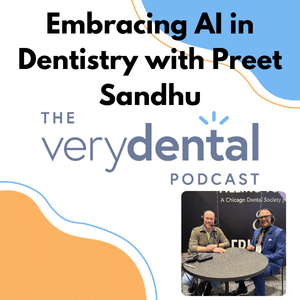
AI is rapidly transforming the dental industry, offering numerous opportunities for efficiency and improved patient care.
Alan talked with Preet Sandhu at the recent Chicago Midwinter Dental meeting about some used of AI in dentistry that you may not have thought of.
Preet is the CEO of ViralKraft (an honest marketing company) as well as StafGo Health, which focuses on the revenue cycle in the dental office. Preet has extensive background in finance and marketing, including 18 years in corporate finance and experience with healthcare finance. The conversation is a deep dive into how AI is revolutionizing dental practices, from marketing and revenue cycle management to patient care and diagnosis.
9:23">Key Takeaways:
- 17:62">The Integration of Marketing and Revenue Cycle Management:
- 17:62">
- 16:68">How these two aspects of a dental practice are interconnected.
- 17:62">The benefits of separating them into distinct companies.
- 21:69">Marketing in Modern Dentistry:
- 21:69">
- 19:86">The shift from traditional family practices to more specialized dental services.
- 20:89">The importance of tailored marketing strategies based on demographics and location.
- 21:69">The increasing role of AI in personalizing marketing campaigns.
- 27:54">AI Applications in Dentistry:
- 27:54">
- 23:55">Content creation, including blogs and show notes.
- 24:70">Analysis of patient data to personalize treatment and marketing.
- 25:64">Streamlining billing and insurance verification processes.
- 26:90">Assisting in diagnosis through the analysis of radiographs and other medical images.
- 27:54">AI tools for note taking, and meeting summaries.
- 30:103">Ethical Considerations of AI in Healthcare:
- 30:103">
- 29:137">The importance of transparency and patient consent when using AI tools, especially for recording patient interactions.
- 30:103">The balance between leveraging AI for efficiency and maintaining the human touch in patient care.
Some links from the show:
Join the Very Dental Facebook group using the password "Timmerman," Hornbrook" or "McWethy," "Papa Randy" or "Lipscomb!"
The Very Dental Podcast network is and will remain free to download. If you'd like to support the shows you love at Very Dental then show a little love to the people that support us!
--
Crazy Dental has everything you need from cotton rolls to equipment and everything in between and the best prices you'll find anywhere! If you head over to verydentalpodcast.com/crazy and use coupon code "VERYDENTAL10" you'll get another 10% off your order! Go save yourself some money and support the show all at the same time!
--
The Wonderist Agency is basically a one stop shop for marketing your practice and your brand. From logo redesign to a full service marketing plan, the folks at Wonderist have you covered! Go check them out at verydentalpodcast.com/wonderist!
--
Enova Illumination makes the very best in loupes and headlights, including their new ergonomic angled prism loupes! They also distribute loupe mounted cameras and even the amazing line of Zumax microscopes! If you want to help out the podcast while upping your magnification and headlight game, you need to head over to verydentalpodcast.com/enova to see their whole line of products!
--
CAD-Ray offers the best service on a wide variety of digital scanners, printers, mills and even their very own browser based design software, Clinux! CAD-Ray has been a huge supporter of the Very Dental Podcast Network and I can tell you that you'll get no better service on everything digital dentistry than the folks from CAD-Ray. Go check them out at verydentalpodcast.com/CADRay!
[00:00:00] Okay, let's talk about one of the most underrated tools in your practice, the dental mirror. It's in your hand all day, every day. But have you ever thought about how much it actually impacts your work? If your mirrors aren't giving you a crystal clear view, you're working harder than you need to. That's where Zerk comes in with their Crystal HD Dental Mirrors. I love these mirrors. I keep two in every single setup just in case I drop one. These aren't your average mirrors. They're so much brighter than the standard ones. That means better visibility, reduced eye strain, and more confidence during every procedure.
[00:00:28] And they're durable and lightweight, designed to reduce hand fatigue and improve ergonomics, so you can work comfortably even during those long demanding days. Plus, your patients will love them too. Available in a variety of vibrant colors, these mirrors are made with durable resin to prevent galvanic shock and eliminate the unpleasant clanking against teeth, ensuring a more comfortable experience for everyone. Upgrade one of the most important tools in your kit with Crystal HD Dental Mirrors from Zerk. The moment you bring one into the oral cavity, you'll be amazed at the clarity and brightness. It's like seeing your procedures in a whole
[00:00:58] new light. Maintaining optimal ergonomics is essential for a long and healthy dental career. That's where BQE comes in. BQE stands for Back Quality Ergonomics. I swear by a BQE model called the Ergodynamic, but they have a variety of styles that can fit you and your whole team. Keep listening to Very Dental to hear a conversation I recently had with Stephen Hoxma of BQE about their commitment to creating the best seating for dental teams. If you're looking to improve your workspace and well-being, check them out at BQE-USA.com.
[00:01:30] This is a production of the Very Dental Podcast Network. This is the Very Dental Podcast. Welcome to the Very Dental Podcast, where you'll find entertaining and relevant conversations with visionaries, clinicians, and your friends in the dental space. Now, here's your host, Dr. Alan Mead.
[00:01:59] Very Dental people, welcome to another episode of the Very Dental Podcast. I'm your host, Dr. Alan Mead, coming to you live. It's not live. It's pre-recorded, but it's in person, which is a really nice feature. Actually, my next guest convinced me that we needed to do one live for that very reason. A new friend of mine, Preet Sandhu. Preet, how are you doing? Very good, Alan. Thank you for this. Great to meet you. So, I want to know a little bit about Preet. Preet, where'd you come from? What's your story? So, originally, I am from India. Okay.
[00:02:26] And I came to UK in year 2000. I did my master's. I did MBA in finance and marketing. Okay. So, that is what I came to UK for, basically. So, first I had a master's in business economics, and then I went on to do an MBA in finance and marketing. I was in sales and then in marketing. Okay. And then, after my MBA, I transitioned into corporate finance. Okay.
[00:02:51] So, I worked in corporate finance for like probably 18 years. Okay. Rolling up P&Ls worth $75 billion U.S. dollars for big name companies. Okay. Okay. Wow. Okay. So, I really enjoyed both finance and marketing. Okay. And like sales is something, I guess, that was quite natural at the time. So, how did you come into the healthcare dental space? So, first, when I first started the career, it was mostly in insurance sector. Okay.
[00:03:21] And then, I transitioned into healthcare finance. Got it. And then, I worked for a few pharma companies. There was a time when I was working for Obamacare implementation in the state of Massachusetts. Okay. You've seen some stuff, I'm telling you. You've definitely seen some stuff. I believe it. Yeah. So, yeah.
[00:03:43] So, like it has been a kind of a natural progression for me when I kind of started and thought about these two businesses, which are helping and supporting dental and medical practices. Yeah. Both for revenue cycle management. Yeah. And for marketing. Okay. And they're quite integrated if you think about it. Like first, you have to go and seek some patients out there. You need to have a really well-designed website.
[00:04:14] Put a nice face out there. Like have a nice holistic effort going on. Mm-hmm. And thereafter, like obviously, the RCM process starts. Mm-hmm. Like right from billing and then collecting cash and all that. Yep. Yep. So, it was quite integrated. But then, we thought about it and we thought it is a good idea to keep them as two separate entities. Okay. Okay. So, give us the name of the... So, people can look you up. What are the... You've got two different companies. One company is called...
[00:04:43] The revenue cycle company would be... It is StaffGo. StaffGo. Okay. It is StaffGo Health. Staff is S-T-A-F with a single F. Yep. StaffGo Health. Okay. And Viral Craft is the marketing company. Yep. So, it is viral because we like to make things viral. Yep. Yep. Being a marketing company. So, it is Viral Craft with a K. Okay. And I'll make sure all your stuff is in the show notes so people can look up what you're talking about. Yeah. So, two different companies.
[00:05:09] One of them is more focused on kind of... I'm assuming probably office... Office... The way the office works. Revenue. All... You know... Insurance. Collections. That sort of thing. Is that right? StaffGo? Exactly. Okay. Exactly. So, we... So, for example, if a new dentist is coming right off the school or a physician, we start with credentialing. Okay. Our credentialing timeline is at least 25% less than others out there. Okay.
[00:05:39] Because we have put in the processes in place. Yeah, yeah. Based on our experience and all. We have all these already pre-filled and populated forms and everything for most of the insurances. Sure. So, that is where we cut down on the time because that is the initial biggest hurdle. Sure. And then comes the website. Yeah. And we can have a website up and running within 8 to 10 days. Okay. Which most companies, I don't believe, can. That's really fast. That's good. Yeah. Yeah. So, we get these two things going right away.
[00:06:05] And then as we are doing this, at the same time, we start our marketing efforts. Like if a new dentist is coming in, they want that initial influx of patients. Yep. Yep. We make sure they get it, whether it is from Google Ads or Meta, Instagram, Facebook, whatever it is. Okay. Okay. So, we help out there as well. I mean, that integration does make a lot of sense to me. So, one of the things that I... I mean, I wanted to make sure people knew where you're coming from, but now I want to dig in a little bit. Because first off, marketing is a funny thing. There are dentists who market a ton.
[00:06:36] And I've been thinking about it. In a lot of cases, for dentists who are doing a very... There's like a lot of different kinds of ways to practice dentistry. I bought a practice back in 1998 from a family guy who just had had... And I was in an area that had General Motors. So, like so many of the clientele had General Motors. At the time, it was considered just cherry top-notch. Yeah. Insurance, they didn't... You didn't have to market very hard. People came in. They had great insurance. They did treatment.
[00:07:06] And it was like... I look at that now, because it's not really like that now. And it's not like that in many places. And you're just like, okay, we didn't know how good we had it. Yes. We didn't realize that, you know, effective marketing was practically unnecessary at the time, because it just was sort of... It just was happening. Yes. Well, clearly, it's not like that in a lot of places. But also, there's people who have a specialized skill set, or they want to do a certain kind of dentistry. They want to do smile design. They want to do implants. They want to do...
[00:07:35] And honestly, it's great to have a family practice that probably has some of that stuff in there. But the reality is, a lot of times, you have to generate your own needs. You have to generate your own... You want people to be seeking you out because of what you want to do. Now, I don't do a lot of marketing, to be honest, because I'm kind of happy with my little family model. But the reality is, I think dentistry may be going towards more of those people wanting to do more specialized things. And so, we need to look at what our marketing efforts are.
[00:08:01] And so, on some level, that has changed over my career in the last 27 years or whatever like that. Have you noticed that? Have you noticed that kind of change? Yes, definitely. And I'm going to say, big changes are coming because of AI as well. Yeah. All what you described, it resonates a lot with a lot of dentists and a lot of physicians out there.
[00:08:25] One of the issues is, especially in dentistry, that there are quite a few dental practices out there. Yep. The old school family dental business model may work in some areas, but then I would say most of the areas, if dentists want to really grow and not really do bread and butter cases, get into more specialized areas like implants or Invisalign and all that, so that they are
[00:08:53] working less hours and generating more production and revenue. So, that is where marketing is very important. It is. Yes, there are practices out there who do not do that, but then every practice can gain a lot by doing some marketing. I think that's right. I do think it's an interesting thing you just said because a little marketing can change a practice that doesn't want to change hugely. A little marketing still makes some sense.
[00:09:20] And a little, you know, there are so many different ways to go out and seek these patients. Whether you're, you know, like, shoot, I know people that still do mailers that just kill it. And then I know people who've tried it and they don't work at all. So, you kind of have to know what's going to work in your area, right? I mean, that's essentially what you're trying to do. What types of marketing are going to work best for you? Exactly. It needs to be really tailored. A company need to understand the demographics. What is the patient base there?
[00:09:48] What are the skill sets of this particular dentist? Yeah. And what they need to target in this geographic location based on the population mix? Yeah. So, is it a young population? Is Meta, Facebook, Instagram going to work well? Right. Or TikTok? Right. Or is it going to be Google Ads? Yeah. Are there, like, some older folks out there who may be going on Bing? Mm-hmm. Although, very few Bing searches out there. Sure, sure. But then there are leads that come from there as well. Sure, sure.
[00:10:17] And, like, with AI, eventually what is going to happen is AI will get all this data and learn from all this and tailor the marketing campaigns based on the demographics and everything in that particular location. It is. Demographics, it's such a funny thing. Again, over my career, it's changed so much the way that we, how much information we're able to know.
[00:10:43] So, okay, so it used to be address, zip code, maybe if you knew a little more. But, I mean, there wasn't that much information out there. When you think about it, we are feeding Google and Meta all of our information constantly, which is in some ways slightly horrifying because it's one of these things where we're not really thinking about the fact that we're giving this information out, but we are. So, the reality is, is like, when you say AI is going to, I get it because it is a lot
[00:11:10] of information and maybe more than a human being is going to be able to get their brain around. But AI is literally, this is what they're good at. This is what it's going to be good for. Oh, yes. Like, if you think about it, like, for example, dental billing. Yep. And then marketing. Now, if, say, there are patients out there in a dental practice who we know have a certain kind of insurance. Uh-huh.
[00:11:36] So, now the AI model knows that this patient had this history. Okay. And the insurance company covers all these procedures. Interesting. We can send individual targeted emails and other marketing efforts and campaigns tailored just for that. Very specific. Very specific. Yes. Wow. So, that is how, like, the both billing and marketing piece integrates together and AI helps resolve all these problems. That actually makes sense.
[00:12:06] It makes sense. I wouldn't have thought about it that way, but it makes sense. Literally, you know, yeah, you're looking for people that have interest in a particular service that you might offer, but you're also literally, I mean, it's a little gross, but on the inside, you know, that patients with this kind of insurance have often followed through with this. Yes. That's interesting. I hadn't thought about it that way. It's almost a little reverse engineering or something like that. It is. It is. And it is really fascinating. Like, AI helps with content creation. It can help with blogs and all.
[00:12:36] Yep. But then, you know, like, when there are companies out there who overkill it and overdo it and it loses the touch. Yep. So, you need to have a human touch in there as well. Yeah. It doesn't matter what AI model you're using. Yeah. There need to be a human touch. I agree. Yeah. I agree. But what's really, okay, it's really interesting. So, I started content creation in dentistry. I think it was like 2008. I had a blog. And it turned out, I had a blog that did really well.
[00:13:05] It wasn't for patients. It was towards dentists. So, I blogged about dentistry a bunch. Yeah. And this was a long time ago. The stuff is still up on my website. But, I mean, some of that stuff is almost 20 years old. It's wild to think that. And so, I kind of got to be known for my blog. And then, honestly, it sort of rolled into the podcasting in 2014 or whatever. But the reality is, is content creation is a time hog. Like when you're a human being creating content, it takes a long time. It takes a lot of creative energy in a lot of cases.
[00:13:34] I will say, I'd argue that one of the reasons I switch mostly to podcasting is because it's easier to talk into a microphone than it is to type on some level. Like, I mean, there's still a very creative part of it. But it's also, it's a little smoother. Here's the thing. I've, for the last, not quite a year, one of the worst parts about podcasting is generating the show notes. Like, the links that I want to put in there. Like, I'm going to put links of your companies and some of these things. That's easy. Because I know what I want to put in there.
[00:14:04] But to make interesting copy about what we talked about, I always feel like it's like, pardon the pun, it's like pulling teeth. It's hard to make that a good outline. And you can look at the old stuff compared to the new stuff. So now, I get a transcript of the podcast. And, of course, using AI to create content, it's all about how you prompt. It's all about how you prompt it. Exactly. You can get a very generic, long-form answer for something with a short prompt without
[00:14:34] much. But it's not as good as if you give it a lot of information. You know, it's much better if you give it names, places, dates, what you need, what you want. Well, okay. A transcript of a conversation that you and I are having, it doesn't get any more specific than that. That's a fantastic prompt. And I can feed that entire transcript into an AI. Yes. And I'm going to tell you, Google Gemini, I use one thing to transcribe. And then I'll throw it into Gemini. I'm like, this is so good. I could never have come up with this on my own.
[00:15:02] Even though we created the content together. Yes. And it outlines better than I ever could. It's amazing. It's a little creepy. But it's also, the nice thing is, is it's so much better than starting with a blank page. I always edit it. I always go through and make sure I like it and word it and all that stuff. But like, the blank page is really daunting. And I mean, Gemini will generate way more than I'll ever need for the show notes. It's huge.
[00:15:27] And I do think that I wouldn't want a blog written by an AI, but I would be interested in seeing what it comes up with when I give it a really good prompt and then I can edit it all of a sudden. Content creation becomes more of a refining thing rather than the, just the blunt force of writing the whole thing. Oh yeah. And AI is helping everybody out there. It is.
[00:15:51] So if you think about it, recently I read there are 20% less software jobs now compared to a few years ago. Interesting. Because AI is writing a lot of programs. Yeah. Now, every professional need to adapt. Yeah. And change. Yeah. If nobody is or anybody is not getting on this AI bandwagon, they're going to be left behind. Yeah. I agree.
[00:16:17] The sooner everybody adapts it and start using it in their daily routine and be open about it. Yeah. It is, and accept it. Yeah. Tell, okay, stop. Tell me what, tell me more what you mean about be open about it. That's, I think that's a really important point. So a lot of folks use AI on a daily basis. I've seen physicians use it. I've seen dentists use it. I've seen professionals use it. And we use it ourselves in our companies. Because as you mentioned, it is such a helpful tool.
[00:16:46] It's a productivity tool. Yes. Yeah, exactly. Exactly. So if anybody is not using it and holding it back thinking, oh, so for example, back in the day, somebody will say, oh, I know this store corner of my street. Yep. I'm going to go and buy something from there. I don't need to look up any other store or I'm not going to go on Amazon because I prefer to go to these two, three local stores. Sure. Yeah.
[00:17:14] What happened in the last five or seven or 10 years? Those stores are gone. Yeah, they are. You cannot go there anymore. Yeah. So same thing. Like what Google did, what Amazon did, AI is going to do the same thing. The sooner people adapt to it and be open about it and accept it, the better it is. When you mean be open about it, tell me what you mean by that. So open to accepting it. Oh, I see. Okay. I'm going to say this. I think it's important that particularly for a dentist or a physician.
[00:17:44] Okay. So I had a conversation with someone yesterday. I'm going to adapt one of the, there are software, pieces of AI software that basically help a dentist or a doctor create chart notes. And it literally records, it's a HIPAA compliant thing, but it records kind of what goes on in the conversation. That is not something you want to do. The patient needs to know that it's being recorded and that AI is going to help me generate my note. It's not something that they're going to go, oh my God. But I think literally getting an explicit permission for that.
[00:18:14] In other words, you're not hiding the ball that this is something that you're using. This is the AI is a tool. It's not replacing me. It is a tool that I'm using to make what I'm doing better and more efficient. I think that's a really important point. And I think that, don't you feel that way? Oh, it is really important. I've seen AI tools helping hygienists. I've seen AI tools helping dentists and physicians as well to write their notes. Like everything is so much more efficient and it helps so much.
[00:18:41] But as a patient, I would, there's a part of me that goes, I'd be glad to know that they're doing that. And I'd also like, I'd be okay with it. But I also think it's part of the, it's part of, I think is an ethical thing. It's important that they know that this is a tool I'm using. Is that okay? Of course. And I think that when you said open about it, I kind of thought about it that way. Because I think it's going to almost be assumed within the next five years that everyone's using AI on some level. I mean, like literally you can't even go into Gmail or Facebook note without meta saying,
[00:19:10] hey, you want to use the AI to make this a little better? And frankly, it works that way. It does make it a little better. Oh, yeah. Yeah. It checks your grammar. It checks everything. It does. It is a great tool. Like rather than spending so long on reading few emails, you can quickly ask AI to summarize your five or six or seven emails, whatever you got. And you got your main points. Like every morning, like for both the companies I have, I have calls every day. So we have AI note-taking tools and apps.
[00:19:40] Yeah, yeah. So what it does is it takes our, like the meeting sometime last hour and a half, two hours. So rather than somebody taking minutes, everything is being recorded. End of the call, the whole team gets a summary of the call. And they're good notes too. They're really good notes. They're probably better than what a human being could do. Nobody else can do that. I know. It's nuts. It's nuts. I mean, when you were first using that, didn't it shock you? Yeah. Like, I mean, it's like with my show notes, but I'm thinking to myself, you know, like
[00:20:10] if I were a student in college right now, I mean, I used to sometimes record stuff or we would, you know, when I was in dental school, we had a note co-op where someone recorded and then the person would sort of make the notes from the recording. Yes. Now, literally, AI can do that with like no effort on your part, but also the worst, it can do it so much better than I ever could. Because I don't understand how it works, but in what it can summarize is like, oh my gosh.
[00:20:36] So, like, and I think just people need to know, it's a little creepy on some ways, but I think people need to know moving forward, probably everything's just going to be recorded because AI is so good at summarizing stuff. Everything is already being recorded. Yeah. And it's going, for example, like when I was in UK back in the day in the university, there is a camera everywhere. It is the most watched country probably on earth. That's what they say. That's what they say, yeah. So, everything was already being recorded. Yeah, yeah.
[00:21:04] It is just another layer to it. Yeah. It's interesting though because it's like, on some level, I personally feel like explicit consent is important here. Maybe it's just going to become, everyone sort of knows that they're being recorded, but I like the idea of just being really open about it with people. And you don't get much pushback from it anymore. You know, I don't probably have a lot of patience in the witness protection program or anything like that, but I do feel like it's important to do it ethically. But I also feel like you do it better when you have this kind of a tool. It's really cool.
[00:21:34] It is amazing and it helps a lot. Yeah, yeah. Like your marketing campaigns, whether you're billing, RCM, revenue cycle management, or your note taking in your practice, whatever it is. It is everywhere. Like even in diagnosis as well. Mm-hmm. Like there are certain tools out there. Well, yeah, there's, I'm sure there's 10 booths with different software solutions for reading x-rays and that sort of thing. Yeah. Exactly. And I know in medicine, honestly, medicine, it's been happening way before dentistry was.
[00:22:01] I mean like radiologists, they're not going to be replaced, but let's be honest. Yes. Computers, okay. If I have to have my x-rays being read by a radiologist who, and this is the 70th case that they've read that day. Yeah. I want them using AI because you know what? When it's my last patient of the day, I might be a little more tired. I might be, I might not have the same attitude that I did when I came in fresh, whatever, because we're humans. AI didn't care about that. They don't need a lunch break, nothing like that.
[00:22:31] So there's, there's something to be said about having that tool as well, I think. Oh yeah. It's a perfect example, radiology. You have all, all these hundreds of thousands of x-rays or CT scans or MRIs or whatever. Now you have a huge database of this knowledge and the diagnosis based on those pictures or x-rays or whatever they are.
[00:22:56] And AI can really, really like come out, I would say with accuracy of over 99% to what it is. Yes. There need to be a human above it. Yep. Who's going to watch it, look at it, look at the findings and then say, okay, yeah, I signed. Yeah. And that is, that is where it is going to go. Well, and I think to myself, okay, so it makes one radiologist be able to do so much more work, maybe better. And also the fatigue level is lower.
[00:23:25] Like radiology is like when it comes to AI, that's might be one of the perfect analogies in healthcare. Like it really can spread. It can, it can make one person's skillset be able to go so much further. Exactly. Um, I do feel like radiologists better be what better be like your point was they can never be replaced, but they sure can. And there could be less of them potentially because they can do so much more work with this tool. And, and that is why I said, be open about it and adapt. Yep. Yep. And accept. Yep. Yep.
[00:23:53] Because the sooner you do it, the farther you will go with it. I agree. I agree. I think it's a really good point. It's a really good point. So let me see. Okay. So this has been fantastic. We should probably do this again sometime. This was really cool. I'd love to dig into, I'd love to dig into, to some more AI applications. And frankly, if we talked in six months, you'll probably have a whole bunch more because you got it. It's moving pretty quickly. Like stuff is changing really fast. It is, it is happening. Like within a week, I find something new. Yes. Yes.
[00:24:22] And like from my team or others, or like I, I, I read about it and, uh, it is evolving a lot. But when you come to like these conventions and trade shows and conferences and all that, and, and there are a lot of really cool AI things out there and to learn about it, like, and obviously like adapt to it and start using it. And it'll be so much helpful for everybody. Yep. I, I gotta laugh. I'm like, okay, so what does it look like when you're in dental school 10 years from now?
[00:24:49] Just, I can only imagine like, I mean, everything in dentistry has changed since I started 27 years ago, but like this, this feels like it's moving even faster. And you're just sort of like, okay. So when I, when I was in dental school, we took, we took a full mouth set of x-rays and it was all, it was, you know, hand dipped, uh, radiographs, you know, we developed the x-rays ourselves and we had to put them in the little, I'm thinking to myself, are there any dental schools that are doing films? I can't imagine there aren't. Yeah.
[00:25:15] And now you've got, I'm sure that dental school is going to be learning to interpret the, the radiographs for, with this software tool or something like that. I can only imagine it's such a huge change. And I mean, like you said, I think you do need to be open to it. It isn't that we don't need to have the original skillset, but, but I mean, we're not using the same tools we were 20 years ago. It's just not, it's just not the state of the art anymore. Oh yeah. And, and, and a dentist with, so, so if, if we think about it in a dental practice scenario,
[00:25:41] um, AI can help with marketing efforts, bring in more patients, streamline the billing process, the insurance verification process, be efficient about it. And then your other staff in the office, hygienist and all may start checking and doing more than what they normally do. Sure. Sure. And a dentist end of the day, instead of, uh, like, uh, looking after maybe 20 patients a day
[00:26:10] can do probably 30 patients. It's an interesting thing because you're like, first off, okay, so they, it takes a lot of the AI is particularly good at doing the stuff. That's a grind. That's like the, you know, the, the long form writing, all that stuff. It's particularly good at that. So it could then make it, the other thing is, is that if you, if you want to look at it this way, it can also mean your team can give a much better patient experience because they're not doing a bunch of the hoop jumping stuff that the AI can kind of take care of for them. I do like that. I like that concept too. Exactly. There's a lot here. Preet, this was fun.
[00:26:40] I really appreciate it. I loved it. I'm, I'm really glad you came to seek me out. Let's be in touch. I'll, like I said, I'll get, I'm going to make sure that I get all the stuff we need to do for people to check out your links. We'll do this again sometime. Thank you. Thank you, Alan. It was amazing. Thank you very much. Thanks. That was fun.