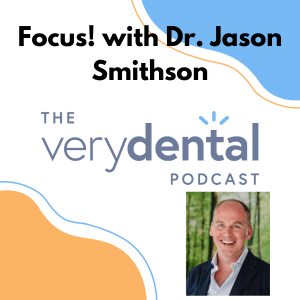
Dr. Jason Smithson returns to the Very Dental podcast to talk about an important topic in 2024: focus.
Jason suggests that one of the reasons we might not get the clinical results is that we've lost our ability to focus! This actually applies more widely in our lives.
It will come as no surprise what he believes is the cause.
- Smartphones are a tool and not a friend
- Jason's "safe room" (no internet)
- The noise in the background and how we react to it
- The "comprehensive reply" to avoid
- Default Zoom meeting times are an HOUR!
- The automatic move to smartphone whenever you have to wait for anything (when your brain goes in to neutral)
- iPhone = one of the most useful tools ever created and one of the worst addictions we face
- Look at your phone on a schedule, look at emails/messages on a computer vs. phone
- Turn the ringer off/notifications off so you can choose when you're going to interact
- It's difficult (but important) to be intentional
- Look at your activity on your phone
Some links from the show:
Join the Very Dental Facebook group using the password "Timmerman," Hornbrook" or "McWethy," "Papa Randy" or "Lipscomb!"
The Very Dental Podcast network is and will remain free to download. If you'd like to support the shows you love at Very Dental then show a little love to the people that support us!
--
Crazy Dental has everything you need from cotton rolls to equipment and everything in between and the best prices you'll find anywhere! If you head over to verydentalpodcast.com/crazy and use coupon code "VERYDENTAL10" you'll get another 10% off your order! Go save yourself some money and support the show all at the same time!
--
The Wonderist Agency is basically a one stop shop for marketing your practice and your brand. From logo redesign to a full service marketing plan, the folks at Wonderist have you covered! Go check them out at verydentalpodcast.com/wonderist!
--
Enova Illumination makes the very best in loupes and headlights, including their new ergonomic angled prism loupes! They also distribute loupe mounted cameras and even the amazing line of Zumax microscopes! If you want to help out the podcast while upping your magnification and headlight game, you need to head over to verydentalpodcast.com/enova to see their whole line of products!
--
CAD-Ray offers the best service on a wide variety of digital scanners, printers, mills and even their very own browser based design software, Clinux! CAD-Ray has been a huge supporter of the Very Dental Podcast Network and I can tell you that you'll get no better service on everything digital dentistry than the folks from CAD-Ray. Go check them out at verydentalpodcast.com/CADRay!
[00:00:01] This is a production of The Very Dental Podcast Network. This is The Very Dental Podcast. Welcome to The Very Dental Podcast, where you'll find entertaining and relevant conversations with visionaries, clinicians, and your friends in the dental space. Now, here's your host, Dr. Alan Mead.
[00:00:56] He's in Cornwall, England, and I'm in Michigan. And so there's a five hour gap and it's convenient often for him to be, you know, in the morning.
[00:01:06] So we started at about five this morning, which actually is that's when I have to get up to go to work anyhow. So it's not that big of a deal, but it's a Friday and I typically don't on Friday. So I screwed it. I have to be functional.
[00:01:19] Yeah, I have to be functional on Fridays or at five o'clock in the morning because I do. I've moved to a three day clinical week where I do nine hour days.
[00:01:29] And it's funny because nine hour days seem very long to me, but I can't really complain because I literally have nurse patients coming. Oh, yeah. I got a 12 hour shift. I'm like, I don't know how you do it. I don't know how you do it.
[00:01:41] Yeah, I definitely am feeling my age. Let's just say that. But I am awake and I'm here. So that's all we can ask. So how's everything over there? Across the pond, as they say. We're good. The weather's not great.
[00:01:54] We've got like sunny followed by lots of rain, followed by sunny, followed by lots of rain, which is really weird. Screwing with my coffee, which is my hobby, which is annoying me. And on a more serious note, like the US, we've got an election coming up.
[00:02:07] They called an election early. We were supposed to have an election probably in November. But because our politics are in such a great shape, not. They find that they're about in the best position they ever could be.
[00:02:22] So they called the they called the election in July, but they're not. They're not really in the best position they ever could be. They're more like it can only get worse. So we're having a good fun. So, yeah.
[00:02:40] Just for just for context, for the for the American listeners, today is the early morning after Trump was convicted. Just to give you time zone. See, our politics aren't doing so red hot either. So here we are.
[00:02:54] So we've got similar things going on in the UK, but but they haven't come out of the woodwork yet. But they're slowly coming out. But yeah. Yeah. So and as people people know, Jason is still still gets over here now and again. He teaches for Spear.
[00:03:10] I think I think the Spear summit is coming up to isn't it? Isn't it a couple of weeks or something like that? Well, yeah. Yeah. Just over two weeks time, which will be really cool. Some great speakers there. That's going to be really good. Yeah.
[00:03:21] Always, always good speakers. It's a I found that the older my kid, I thought the older my kids got, the more freedom I would have to to like do stuff, travel. And I was wrong. Yeah, I have. My life is kind of their stuff.
[00:03:39] My life is my work, like going to work and fixing teeth and then doing stuff, concerts and activities and all that. I kind of like it for me. Oh, I do too. I do too. I like it.
[00:03:54] It's just there's a lot less of what I was doing before than then. Then with these activities, it'll change. A lot of people have been telling me, oh yeah, they go off to university and then you've got your freedom back.
[00:04:04] I'm actually, if I'm very honest, I'm actually terrified of that because I love spending time with them. So. Yeah, that's that's where it's kind of a reason to be. I it's this is terrible.
[00:04:18] When I went to school, I chose where I wanted to go because of, I don't know, because of the school. And at that time it wasn't that weird to go far away or far ish away.
[00:04:29] And now I'm hoping that they choose the university that they can commute to. Exactly. It's kind of, I like being around them. So yeah, I agree.
[00:04:37] I don't, I mean, they have to choose what's best for them, but the reality is, is it'd be nice to have them around. So that's, I could think of worse things, right? Yeah. My daughter's, my daughter's already chosen hers. It's like a three and a half hour drive.
[00:04:48] So she's not commuting. Okay. And my son, okay. Okay. My son's only 16. So he's way off, but, um, he's kind of the adventurer type. So it wouldn't surprise me if he, and we live in the country, so it wouldn't surprise me. He chose somewhere city ish.
[00:05:06] So I don't think I'm going to get that. So we'll see. We'll see how it goes. Same here. Our, my guys are a little younger, so we got a little, a little time for that. But yeah. So Jason has a topic. I think it's a timely one.
[00:05:19] I think that, I think that we're going to appreciate this. So I'm just literally going to give you the floor. I want you to bring in your topic and we'll kick it around a little bit. Yeah. So normally I talk about clinical stuff and, and that's cool.
[00:05:32] Um, but, um, I'm gonna talk a little bit, uh, it's allied to clinical actually. Um, but it's focus. Um, and, um, I, I've, I'm, I'm kind of fortunate and unfortunate in a way because I, I, as you know, I have a clinical diagnosis of, of high functioning autism.
[00:05:58] So as part of that highly focused, um, and what I, what I've, and that gives me to some degree, a bit of an advantage in some ways, a significant disadvantage in other ways, for example, I can't program cable TV.
[00:06:15] Um, but what I've noticed around me is, um, a lot of people struggle to get the clinical dentistry done to the standard that they perhaps want. And a lot of people struggle to do the reading around that, that they perhaps
[00:06:36] want, and a lot of people struggle to have time to do other things. For example, spend time as we just talked about doing, doing their own stuff and doing stuff with their family. Um, and mainly my, my, um, diagnosis, if you will, of that is, is, is really
[00:06:56] down to, to lack of focus. And I think, I think lack of, it's not a disease as such, but it's, it's, it's almost endemic throughout the world, not just in dentists in, I find that most people generally are fairly unfocused and they waste, waste a lot of time.
[00:07:22] That they spend things that are much more productive. And, um, I meant to some, uh, dentists and I've talked about it with them and some of the things I've talked about have been fairly helpful for them.
[00:07:37] And I just thought, I thought it might be quite useful to talk about this, um, in the podcast. So. I think, I think that's a good idea. Interestingly, I, the, the idea of focus, um, has been, it's really interesting
[00:07:54] to me because, uh, for one thing, um, when you and I, I don't know if you noticed this, but like early on in the dental town days, like the early two thousands and stuff like that.
[00:08:06] I think one of the, one of the things that, that was talked about a lot, sort of the, the decathlon dentist, the dentist or the, or the super GP or the person who, who is just excellent at everything, you know, literally in, you
[00:08:18] know, in one operatory, you've got, you've got a perio surgery going and then the other operatory you've got, you've you're prepping four crowns in a quadrant and then another operatory you've got, you know, you're setting up for an all on four and this is normal.
[00:08:31] This is the normal and reasonable for regular dentists to be doing. And, you know, this is how you make a great business. And if you're not a decathlon dentist, you're missing out.
[00:08:41] You need to be able to, you need to be, I Howard for Ann was his, his, uh, his focus was you need to be everything for everyone. And he didn't say it that way. And he would probably deny that.
[00:08:52] But that's kind of how I heard it back then. It's like, you know, look, if you, you know, you shouldn't be sending out all your molar endo, but you should be, you should be doing all your molar endo. It's not that hard. You should be.
[00:09:02] And so the idea is every general dentist should be good at everything and should be everything to their patients. And then that way you get more revenue because you treat all of their conditions and you keep everything in house.
[00:09:14] And frankly, I think there are some people that, that are potentially able to do that or closer to able to do that. But I think most people, that's a big ask. And I have fallen victim to it a bit. There's the classic thing is okay.
[00:09:31] So I don't do a ton of endo and I would argue that to be really good at endo, you should be doing a ton of endo like, like endo is a skill set. Yeah. I mean, anything, but endo is a really good example of it because it's such
[00:09:47] special, like, you don't use files in any other part of dentistry. You don't, you don't use there's, there's so much of endo that, that is, is not, that isn't applied in any other parts of dentistry.
[00:09:58] So if you get that kid out every, every couple times a month it's fine, but I probably wouldn't, if I had an upper second molar that was abscessed and I needed, I probably wouldn't want the guy who does it a couple times a month to be
[00:10:14] dinking around with my tooth. Even if they did a good job, they probably wouldn't do it super efficiently. They probably, you know, like, so on some level I look at that as a bit of an
[00:10:24] analogy on focus, because I think that can kind of apply widely in life as well. So is that, is that kind of what you mean by focus as far as just there's too many things? That's one aspect of it.
[00:10:35] And we could probably come to that toward the end of the podcast in so much as dentists are unfocused on, on the procedures they're doing in their office. But my main thing is actually people, not just dentists, are generally unfocused in their life.
[00:10:54] So what I would say to you is for those who are listening, take a look at your iPhone and take a look at your activity. Right now I'm seeing younger people and my kids are a good example where their activity is literally like 10, 15 hours a day of iPhone.
[00:11:23] Right. And that detracts massively from your life in general because the time is spent on on the iPhone. And yeah, I think, and please bear in mind here, I'm not coming at this by saying the iPhone is a bad thing. Right.
[00:11:44] Because I think the iPhone and IT generally is really a positive thing. It's connected the world and that's really cool. It's made a lot of the tasks we do a lot more efficient, significantly more efficient. And that's really cool.
[00:11:59] But we got to remember it's a tool and not a friend. So what's happening? And a good example, I went out for dinner last night, right? With my two kids and my wife, we had tapas was pretty good.
[00:12:19] But across from us in the rest, and we had no phones across from us in the restaurant was a similar family, but they weren't talking. They were all on their iPhones. So actually, why would you go out for dinner as a family of four and sit talking
[00:12:39] to people you barely know, or in fact, oftentimes don't even know on your iPhone? You might as well just get a takeaway on boat or go to your separate rooms and eat it all separately because you've lost that time with your family, which you'll never get back.
[00:12:58] Um, and actually, I find that people's people's ability to be productive is now being affected by that. And because people are now being less productive, they're taking more time to do fairly simple tasks. And therefore, they have less time to do dentistry and be productive, and they have
[00:13:23] less time to do outside tasks and be, for example, financially productive, and they have less time to spend on their own hobbies and it's and their family and have less enjoyable time. Um, one example of this is, um, like, well, not an example.
[00:13:45] Let what I've done, what I've done for the last four years is I've made a room in my house that has no internet access at all. All right. So for example, if I'm going to write an academic paper, I'm going to write a
[00:14:02] lecture or I'm going to do do something I need to spend time on. I go in that room and I have no disruption from the internet whatsoever. Even if I wanted to log onto the internet, I cannot, I'd have to physically get up and
[00:14:19] go into a different room. And what I find now, because I'm more focused, because I don't have the internet, I get work that would typically take me two or three days to do done in that one morning. Right. Why?
[00:14:35] Well, if you sit down, let's take the example of me writing a lecture. It could be a, it could be somebody in their office doing their numbers or doing staffing stuff or doing ordering or whatever.
[00:14:47] You start doing the task you're planning to do, and then suddenly you get a ping. And that might be something from, I don't know, WhatsApp might be Instagram, might be Facebook Messenger, might be an email or whatever. And what you do is what everybody does.
[00:15:08] And I include myself if I don't deprive myself of it by going in this padded cell padded cell with no internet. Um, what you do is you instantly go over to, let's call it Instagram. You instantly go over to Instagram and look, cause you're curious, you're a human
[00:15:27] being and your brain is disconnected from the task you were doing and you instantly go to Instagram and you look and there might be a message from a friend and we can come to that in a minute. Um, and it's not really urgent.
[00:15:48] And you, you look at a message, you think about it and you reply to it and then you go back, but you don't go straight back to your task. You would start maybe scrolling. No, you don't.
[00:15:58] You scroll Instagram for a bit and then you might find some advertising on Instagram because that's how it's set up. It's set up to pick you and to draw you in. And then you might go across to, I don't know, looking at a holiday or looking at a
[00:16:13] car or looking at some luxury thing you don't really need. Uh, or, or, or shopping or whatever. You might do a bit of that. And then before you know it, you've wasted like 20 minutes and then you go back to
[00:16:27] your task, but not only do you go back to your task, but you have to readjust and think, Oh damn, where was I then? So it probably takes you five or 10 minutes to readjust and get back to your task.
[00:16:37] So you lost like half an hour from one ping. And we're incredibly distracted as a society now. And I find, I find that you cannot get things done with all of this noise going
[00:16:50] on in the background and also it also, um, there's also an impact on how you answer this noise. Like I started, um, answering emails and messages in a fairly specific way a couple of years ago.
[00:17:12] And I found this really helpful for an, the example I use is of, let's say you have a little WhatsApp or a Facebook messenger from a friend who you haven't seen for a while and you want to meet up for a beer or a coffee or whatever.
[00:17:29] And you get a message and it says something like, uh, Hey, haven't seen you for a while. Would be good to catch up. And you ping them back and you go, yeah, that would be great. Catch up sometime.
[00:17:41] And then they ping you back and say, maybe we could meet some for coffee sometime. And then you ping back saying, yeah, that would be great. And then you ping back saying when would work for you?
[00:17:50] And you ping back for them and they say, when would work for you? And you ping back and say, Oh, sometime next week. And you ping back and say what day works for you?
[00:18:00] And a back and forth you go before you know it, you've got about 50 ping back and forths with space in between them as well. That's the other thing with space in between that dead time space, which is typically about one to two minutes.
[00:18:18] Because they're doing something else because they're distracted as well. That simple meetup for coffee has taken probably 15 minutes out of your day. If you analyze it, I don't do that anymore. And when I first started doing this, I thought people might think I'm weird,
[00:18:34] but it's actually worked out really well. So what I do is if somebody pings me a message like that, haven't seen you for a while, I will rather than just take a split second in my mind to reply, I will
[00:18:50] actually think about it for two or three minutes and then reply, but I will reply more comprehensively. So what I will do, I will say something like, yeah, really haven't seen you for a long time, missed you would be really good to catch up.
[00:19:05] I think it would be good if we went and had a coffee, I don't know, a coffee. I'm free on this date, this date and this date at this time giving options. Would you like to do that? If yes, which date would suit you best? Let me know.
[00:19:26] You've just saved yourself time just by just going exactly where you knew where it was going to go. When I first, I learned there's a book by a guy called Cal Newport called deep work. You may have seen this.
[00:19:42] I learned this from by reading this book, but I thought I read that and I thought, do you know what? That looks a little bit robotic and it looks a little bit, you can make it friendly, but it looks almost unfriendly.
[00:19:55] And I'm going to look, I'm going to like a weirdo for writing a message like that back. Honestly, the response from that has been really positive. Typically most people will ping back to me and say, oh, that's really great.
[00:20:10] We'd love to see you on this day at this time. Let's meet up. And my, my, my ping back will be great. See you there. Done. Right. What's, what's funny about that is, is that it's probably well received because
[00:20:27] it's uncommon and the cool yet, because I'm not as distracted as the general population now I've worked on myself to be less distracted. Um, and the cool thing about it is because it saves me more time, I've got more time to meet up with other people.
[00:20:44] So I've, I can do these things more. It saves me an enormous amount of time. The other thing post COVID that's become very common and. I don't know if this is applicable for most dentists, but maybe it's the zoom meeting, right?
[00:21:01] So somebody says we want to have a meeting about something. Let's meet up on zoom. So if you look at zoom, the default on zoom is for an hour meeting. Right. If you're lazy, if you're lazy, click on zoom, set up the meeting and click
[00:21:19] on, on organize the meeting. It will instantly set up a one hour meeting unless you organize it right now. If you've scheduled time in your day to have this, say you're the recipient of the recipient of that zoom, you look at it and you say, oh, okay.
[00:21:40] It's a one hour meeting. So I need to schedule, I don't know, between 10 and 11 AM in the morning for that one hour meeting. So that screwed my productivity between 10 and 11. Because if the meeting ends early, I've now got to fill it in with things I didn't
[00:21:58] plan to do because I planned to have a meeting. So what I do now when people send me a meeting, um, meeting invitation for zoom. And again, this comes off as a bit weird, but it works very well.
[00:22:13] I'll say to them, can I have an agenda for this meeting? Because, um, oftentimes there's more often than not 99% of the time, there's no agenda. It's just a simple question. Yep.
[00:22:28] And, and this is a little unfair for me to say this, but this is, this is a fact. People in employed positions are very happy to schedule a one hour zoom because they're employed, they're being paid. So that's an hour's time I'm being paid for.
[00:22:46] If you're self-employed as most dentists are, that's one hour of your time. You're freaking not getting paid for in your work day or it's one day or it's one out of time, one hour of time out of your leisure time or family in the evening.
[00:23:03] So I say, can you send me agenda and agenda? And do you know what the reply most of the time is? Oh, I just wanted to ask you about this and I can reply with an email and I give them an answer done.
[00:23:16] I've got an hour out of my life back or another thing they might say is, let me, let me, let me stop you. The other thing about that hour zoom meeting is that first off, it's literally a default in the software.
[00:23:32] I mean, like if imagine if, if the default had been 20 minutes, but on top of that, if you've got an hour scheduled for a meeting, there are people in the world, not me, because I would rather, there's so many things that I would, there's
[00:23:47] unpleasant things I would rather do than a zoom meeting, to be honest. And I have to say, I have done the number of actual zoom meetings I've done since COVID probably can be counted on two hands. Cause I just won't, I just don't do it.
[00:23:58] But cause I can't, which is funny because you and I are on a software that's very much like zoom right now doing this, but yeah, this still feels more like a phone call or something that, you know, we might've done in the mid
[00:24:10] eighties, just not with video, but the, but a zoom meeting is a zoom meeting and it has its own feel and people feel the need to fill that time. What with words, I mean, even, even in-person meetings are kind of like that.
[00:24:28] In other words, you know, I would, I used to be on committees for the Michigan Dental Association and the meetings were long. And like you said, how long does this meeting have to be versus the default that it is, this is how long the meeting's going to be.
[00:24:45] I just think that that is a huge thing that no one really talks about. Small talk, which is not pleasant. It's human and we have interaction with people obviously, but this is a business meeting, right?
[00:24:59] So generally, so if they come back with an agenda, then we can structure the meeting, you can look at it and a very friendly email back would be, can we cover this in 20 minutes? And invariably the answer is yes.
[00:25:17] So I'll be like, okay, then it might still be scheduled for an hour, but my working day schedule for that meeting is 20 minutes. But when I come on the zoom, let's say it's a 10 o'clock. My first statement would be, hi, how are you? Is everything all right?
[00:25:36] And my second statement would be, I have another meeting at 10 30, whether I have, or I haven't, is another thing. That basically says in a polite way, we organized 20 minutes. We've allowed half an hour, so we should get this done.
[00:25:50] And, and it just, it's just a bit more focus on getting stuff done. Otherwise you lose, you lose a lot of time. A hundred percent. I have a couple of comments. Okay. So I was literally talking with a good friend of mine on my way to the hospital.
[00:26:08] And he was literally talking with a good friend of mine on my way home from work yesterday. And he had gone to a doctor's appointment and he had not brought his phone. He forgot his phone and he got there early.
[00:26:20] And we were sort of, we were sort of laughing because this particular doctor's office has not put magazines or reading material out since COVID because apparently magazines were, were a deadly COVID threat. So they, they don't have magazines there anymore.
[00:26:36] He said there was a TV, but it was like angled in the wrong way and had like infomercials on. And he said he was probably there for 40 minutes. And he's like, I didn't even know what to do with myself because I didn't have my phone.
[00:26:49] He's like, we're so used to waiting when, when any, any waiting time at all. I mean, okay. You and I are both old men. We grew up with, with a time when we didn't have the most like the entire world
[00:27:08] at our fingertips, like that we could fall into when we're in a waiting room or if waiting in line in the grocery store or whatever we, there was a time where our brain had to manage downtime without, without feeding it, you know, a constant dopamine hit, you know?
[00:27:23] And he's like, he's like, and this is someone, he really is kind of anti-phones anyhow. It drives him much like you're saying he, it drives him crazy to see people, you know, at dinner on a phone, but he's like, even I didn't have it.
[00:27:37] And I'm as bad as anyone when there's, there's time that's not being filled. But on the other hand, I'm so I understand that. And I'm like, yeah, I'm glad to have the phone when I'm in the waiting room.
[00:27:50] But on the other hand, I have, I like to talk about how I'm, I'm an introvert, except I don't think I actually am an introvert. Okay. So I had a long story short. My son was in a I was telling you about it.
[00:28:07] He's in a mid Michigan brass band is what's called an, and they had their end of year picnic and he really wanted to go to the picnic. And of course I didn't, I wasn't, I'm not a member of the mid Michigan brass band.
[00:28:18] I'm just a dad of a kid in this. So we went to the picnic and Sean is an, he's social, but he's social kind of on his own terms. But I was, you know, I, I'm not even a member of the band, but I sat down and
[00:28:31] my phone was in my pocket. It never came out. I was, I was having conversation with a bunch of band people. And to be honest, even though I didn't play brass instruments, I have lots, I'm a bando from way back.
[00:28:41] And so I had lots to talk about with these essentially strangers that were very friendly. And I, and time was lost. I don't even know how long I was there. I was having such good conversations there. And, and frankly, I look back and I'm like, that was fantastic.
[00:28:55] And I'm like, that's how life used to be. Like, like that phone literally just being in your pocket can actually draw your attention just because you're, there's a fear of missing out on what's going on in the, in the, in your
[00:29:10] phone, which is so dumb, but I think we've sort of the way that it's, it's so salient. It's, it's just, it sort of just takes up our time. It wants, it's, it's, it's screaming for time. Let me say something that might be a little controversial now.
[00:29:25] I think the iPhone is one of the most useful tools that's been invented in the 20th century, 21st century, 20th century, whatever. Right? So that's my first statement. I also think it's probably one of the most destructive drugs on earth currently,
[00:29:40] including the pollen drug and narcotics or whatever. And it most definitely meets all the criteria of addiction. But the vast majority, and not only does it meet the criteria for addiction, it is socially acceptable now. So we have an addiction problem, which is socially acceptable.
[00:30:04] So my strategy is I'm not prepared to be addicted to a, to an iPhone. So I'm not anti iPhone, but typically my iPhone is not turned on. And if it isn't, if it is turned on, I commonly will not answer it.
[00:30:24] In fact, you know, when I'm in conversation with people and my phone goes off, this happened to me at a Congress in January, my phone was going off in my pocket. And the person I was talking to said, uh, your phone's ringing. And I was like, yep.
[00:30:39] And I carried on talking to him and he said, but your phone's ringing. And I said, yeah, but I'm talking to you. And he looked at me like I was slightly crazy, but really? So what I do now is I schedule time.
[00:30:58] So my workday looks like workday looks like this. Um, I don't turn my, my iPhone is not in my bedroom and it's turned off charging somewhere else in the house. Get up and I use a conventional alarm clock. I do not use my iPhone for the alarm clock.
[00:31:16] So when I wake up, the first thing I do is not look at my iPhone, which I understand is a majority of people is that that's what they do. I then get up, have a shower, go and have breakfast while I do breakfast.
[00:31:29] I get up before the rest of my family, before I do breakfast, I look at my emails on my laptop in the kitchen and I basically delete anything, which is BS of which 99%. And then I look at the emails and I'm like, okay.
[00:31:50] That needs to be answered like today. Very rare. I mean, you very rarely will get an email or a phone call that's like somebody passed away or your house is burning down this kind of urgency. You do have things that need to be done in the day.
[00:32:04] So I will mentally put that into my schedule some part of the day and then some need to be answered relatively urgently over the next couple of days. And then some are not that urgent at all. And I'll try and answer the urgent ones with some thought.
[00:32:23] While I'm eating breakfast before my kids and wife get up and I'll do the same. I also limit my social media channels. So I only have my emails, my Instagram, my Facebook and my WhatsApp. I don't have TikTok or anything else like that because there's another distraction.
[00:32:47] And I do the same for all the other channels. I do the same for all the other channels. Typically, the Instagram ones are just pretty much all deleted. And I still haven't turned my phone on yet. And then I'll have breakfast with my wife and kids.
[00:33:07] They'll have breakfast and I'll talk to them. So I've actually got some active time of talking to my wife and kids without having my head in a device. So I connect with my family. And then I go to work. And obviously, I got a drive to work.
[00:33:21] It's not a big drive. It's about 20 minutes, half an hour. So I'll either listen to a podcast or if I've got a phone call to make, I'll make it in the car because that's kind of dead time. I can't do anything else. It is. It is.
[00:33:37] And then I still haven't turned my phone on. And then we have a practice meeting. And then I go to work, do my work. Don't turn my phone on while I'm doing work. Why? Because I'm working in dentistry. And then I turn my phone on at lunchtime.
[00:33:56] So basically, but I'll turn it on at lunchtime and I'll answer all the messages in the way I described earlier. I'll answer usually any voicemails which I've got because obviously, I haven't been able to contact me with a message.
[00:34:12] The reason why I answer it with a message rather than a phone call is because then it's on my terms and I can dictate the amount of email I'm using or an email. And I'll also deal with all the urgent emails.
[00:34:25] And if I've got time left, I'll deal with the non-urgent emails and messages. And also the way I divide my time up in terms of admin, like I have admin days on Thursday morning and Friday morning. I divide my time up into tasks.
[00:34:42] Like I don't just have a list of things I need to do and just pile in at them. I have a list of like less than five-minute tasks. Tasks that take between five minutes and half an hour and tasks that take over half an hour.
[00:34:59] The less than five-minute tasks you can dot into anywhere in the day, you actually get space. The five minutes to half an hour, I tend to cover either at lunchtime because I have an
[00:35:13] hour lunch and personally, my assistant needs an hour lunch and they have an hour lunch by law but I don't need an hour. I just need 10 minutes and then I'm good. So I use the other 50 minutes to answer those half-hour tasks.
[00:35:28] And then anything that's over half an hour is going to take a little bit more thought so it goes into my Thursday or Friday morning and it has a lot of time. And it also is done in the environment with no internet so it's going to get done.
[00:35:46] So I found personally just by being more focused in this way, I'm a more productive and get a ton more work done but I also have more time for myself and I don't seem to have ticked anybody off by doing it.
[00:36:04] So I'm just putting it out there as an option for people who are struggling with, a lot of people are struggling with their mental health because they don't have time. 100%. I got two things I would add. I got two things I would add. That's all really good.
[00:36:21] Your level of discipline is higher than mine on some level but I will say this. The ringer on my phone is always off and I have a watch that I'm always wearing that vibrates when my phone rings.
[00:36:34] First off, I don't know where in the world a ringing phone out in public became more important than the person that's sitting in front of you but you're right. I mean like people will just answer their phone because their phone apparently is top
[00:36:47] level so I don't like phone calls. If I can avoid a phone call, I will. I'm not a big phone guy. I mean that's not really true because I talk with a couple of my friends on the phone quite
[00:36:57] often but when someone calls me, it's 99% of the time it's not even a call that I want to take anyhow. So my ringer is always off and my rings on my watch. I think phone calls are really good but really if you're organized, they have to be scheduled.
[00:37:15] I mean obviously your house is on fire as a phone call or your office is flooded. That's a phone call you need to take right but that's once, twice in your lifetime maybe. Yeah.
[00:37:29] But you can use the phone but like I use it on my drive to work. It's efficient. I'm sitting in my own but what else am I going to do?
[00:37:39] I take the cue from messaging in that I can do it on my own terms so the reality is I never have the ringer on. It does never interrupt. It'll ring on my watch. I can hear it, feel it vibrate.
[00:37:50] I know when it's there and I can check to see if it's someone I really need to do it. That's fine. The other thing I've done, I have no notifications on my phone. Not a one.
[00:38:01] I just don't turn the notifications on because if I was constantly being notified, if you have notifications from any social media, they'll notify you about anything and it's just not worth it so I just turn them all off and if it's important, I can
[00:38:17] check it which is good but the other thing that you said that I think is really important is if you're going to use these things, use them on a browser, on a computer if you possibly
[00:38:27] can because then you're again, I think you have to be a little more intentional. You're in front of a computer and you've made the choice to do this versus your phone budding into your life a little bit.
[00:38:39] I think that there's something to that and I know a lot of people like my wife will compose emails on her phone and I don't know how she could do it. I can't.
[00:38:51] I've been typing on a phone as long as anyone and I can't type three words without an error. It's not an efficient way for me to communicate so what I'm doing, I have to be in front of a browser. I don't know.
[00:39:02] I mean we have to, my kids, I think that's a function of our age actually. My kids can compose stuff on the phone so I'm not averse to doing it on the phone or the laptop.
[00:39:13] Personally, it works for me on the laptop better because I'm geriatric but my main point is where you fit it into your life and what's happening currently, particularly amongst dentists is their life and their work is all being blended into one and the trouble is,
[00:39:36] and that's good in a way but the negative of it is the work bit is taking over because it's so inefficient. That's the problem. So you end up working, I found to be honest, I spend, when I used to have my, in inverted
[00:40:02] commas, work mornings which are four hours on Thursday and Friday mornings, admin if you call it, most dentists will call it admin mornings I guess. I used to be only productive for 90 minutes to two hours of the time and now I can be
[00:40:21] as productive on a Thursday as I was on a Thursday and a Friday which actually gives me the option of working the Friday as well and being more productive or just actually taking the Friday off and doing something else which is no bad thing.
[00:40:35] You were talking about earlier just standing and staring into space. There can be a beauty in that if you're in nature or somewhere pleasant or with your family or friends, there's nothing wrong with just sitting and watching your child play
[00:40:55] baseball or standing and looking at a beautiful view or something like that but if you've made time for it but if you're watching your child play baseball and thinking, oh shit, I've got to do, there's a shit ton of admin I've got to do that I haven't done
[00:41:09] the day before, that's not so pleasurable. Yeah. Now when we got those things on our mind, that's very true. Being intentional about all that stuff is important and it's also difficult because kind of the way that we've set things up makes it harder to be intentional.
[00:41:32] All the different things tugging at your attention would love you to not be intentional about it, would love to just be able to drag you in whenever you have a second. The other thing is not doing anything, you don't have to be productive all the time.
[00:41:49] You need to choose when you are trying to be productive, you need to be intentional of being productive but to be honest, if I've got time to ride a mountain bike, I'm
[00:41:58] not going to feel bad about the fact that I'm not doing my admin work because I would rather be riding a mountain bike than anything. Exactly. So like being intentional is really important in this area and I will say that it's difficult to be intentional.
[00:42:13] I think for people who've managed to listen to the whole of this podcast, I would go back to one of my original statements which is go and have a look at the activity on your phone.
[00:42:27] And if it's stuff like messages and phone calls, that's probably okay as long as they were admin based but if it's looking like you're spending hours and hours and hours on social media, that might be a problem. That's where I'm at.
[00:42:45] I mean, oftentimes you'll go into a room and like, well, even with my staff room, everybody in the staff room is just sitting there just surfing through Instagram and Facebook and TikTok and whatever and you just think, okay, well that's an hour of your life, you're
[00:43:07] not going to get back. And it doesn't have to be that you were using that time to split the atom or anything like that but you could use it for something more productive than looking at some unfunny video made by somebody you don't know. Yeah, that's so true.
[00:43:25] Or look at somebody's crazy political world view that's just off the scale. You know? It's a thought. Yeah. It's like you get sucked into that and if you look back on that, you're like, yeah, I have regrets. I'll never get that time back.
[00:43:40] And had I been a little more intentional about it, I probably could have done something good. You know? I probably could have done something better. It doesn't even have to be good. It could be a ride on a mountain bike. Yeah. But it was good in a way.
[00:43:51] Yep. Yep. Yep. Yep. It's not the world but it's just something more for you. I have a feeling that depending on the age of the listener, this may be taken differently. Children of the 70s like you and I, it's not hard to see how what demands our attention
[00:44:15] has changed over the years. But if you grew up with a smartphone, if you're a young dentist and you've not known anything but the internet and a smartphone, this stuff might sound, I'm sure it sounds very fuddy
[00:44:26] duddy, but I think it's actually super valuable if you can put your brain on it. Well, it might do. But if you're a young dentist and you want to learn to do, as you said right at the beginning,
[00:44:35] really good endo, you're not going to learn it by looking at TikTok videos at lunchtime. Right? So if you've got more time on your hands, you can maybe do some practice. You could maybe do some reading or maybe even watch some videos that are actually useful.
[00:44:51] There's tons of that out there if you choose it. You could use your iPad. You could use your iPad. You could use your iPad. There's tons of that out there if you choose it. You could use your iPhone for a lot of that.
[00:45:01] So it's not to say the iPhone is a bad thing. It's just the channels we look at and how we use it as a tool and how it's become almost a friend for some people, which is a little bit odd. But there we go.
[00:45:18] Now, there's a lot there. So I think we should wrap this up. But I think probably we're going to probably have stuff to come back to. If people have any questions or comments, you can go to the VeryDental Facebook group and we can talk about it.
[00:45:30] I think that this topic has been covered in a lot of places in a lot of ways, but I'm not sure that it was covered in... We were pretty specific about the idea of focus. And I really like that. I like the...
[00:45:47] Because I think that it's, again, being intentional about thinking about focus is important because everyone can look at their day to day and go, oof, I'm not so sure I was so great about that.
[00:46:00] And understand when your brain goes into neutral, when you don't have something you specifically have to do, where do you go? Where do you go? And that's a dangerous place for me some days.
[00:46:13] It's like, yeah, I mean, I will find myself doom scrolling without having chosen to doom scroll. Once I notice, because it's almost a default. And that's, again, it's fine if that's your choice. But if you're not even making the choice, then you got to think about that.
[00:46:30] The downtime is not a bad thing. It's allowing you time to recharge. And that sounds a little bit hippie, but it is. You can't have your brain working 100 miles an hour all day, every day. You just implode. Yeah, it's exactly right.
[00:46:45] Jason, thank you a ton for being on again. This was great. I figured your topic was more timely than anything else, I think, at this point. There's a lot going on out there. So being intentional and understanding focus is a good topic. So thanks again for being on.
[00:47:02] And we'll do this again very soon. Thank you very much. See you soon.