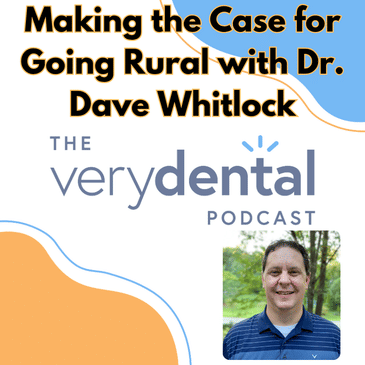
This throwback episode features a great conversation with Dr. Dave Whitlock! They discuss the unique opportunities, lifestyle perks, and financial benefits of practicing dentistry in rural communities. Having transitioned from high-competition, high-cost metro markets like Phoenix and Dallas to rural Eastern Kentucky, Dr. Whitlock shares how moving away from urban saturation allowed him to lower his living costs, reduce practice overhead, and secure an overwhelming demand for dental care. Together, they break down common misconceptions surrounding rural dentistry, discuss the overwhelming student debt burden facing new graduates, and highlight how stepping off the beaten path can offer clinicians better schedule flexibility, greater practice profitability, and an improved quality of life.
Some links from the show:
Join the Very Dental Facebook Group using one of these passwords: Timmerman, Paul, Bioclear, Hornbrook, Gary, McWethy, Papa Randy, Frank or Lipscomb!
The Very Dental Podcast network is and will remain free to download. If you'd like to support the shows you love at Very Dental then show a little love to the people that support us!
We're proud to be supported by the folks at Net32!
I'm a big fan of the Bioclear Method! I think you should give it a try and I've got a great offer to help you get on board! Use the exclusive Very Dental Podcast code VERYDENTAL8TON for 15% OFF your total Bioclear purchase, including Core Anterior and Posterior Four day courses, Black Triangle Certification, and all Bioclear products.
Crazy Dental has everything you need from cotton rolls to equipment and everything in between and the best prices you'll find anywhere! If you head over to verydentalpodcast.com/crazy and use coupon code "VERYSHIP" you'll get free shipping on your order! Go save yourself some money and support the show all at the same time!
The Wonderist Agency is basically a one stop shop for marketing your practice and your brand. From logo redesign to a full service marketing plan, the folks at Wonderist have you covered! Go check them out at verydentalpodcast.com/wonderist!
Enova Illumination makes the very best in loupes and headlights, including their new ergonomic angled prism loupes! They also distribute loupe mounted cameras and even the amazing line of Zumax microscopes! If you want to help out the podcast while upping your magnification and headlight game, you need to head over to verydentalpodcast.com/enova to see their whole line of products!
CAD-Ray offers the best service on a wide variety of digital scanners, printers, mills and even their very own browser based design software, Clinux! CAD-Ray has been a huge supporter of the Very Dental Podcast Network and I can tell you that you'll get no better service on everything digital dentistry than the folks from CAD-Ray. Go check them out at verydentalpodcast.com/CADRay!
[00:00:00] [SPEAKER_03] Did you know Net32 was actually started by a dentist? Someone who is just fed up with how broken and expensive the supply process had become. This isn't some generic medical site. It was built specifically for dental practices. Thousands of dentists use it every day to save time and money. You'll find all the big brands you already know and trust just at better prices. Instead of calling reps or chasing down quotes, you can compare products and pricing in seconds. It's completely transparent and you're in control of what you spend. Same products, same vendors, less hassle and lower prices.
[00:00:30] [SPEAKER_03] The next time you need supplies, check Net32. Built by a dentist for dentists like you. Check them out at Net32.com.
[00:00:40] [SPEAKER_01] This is a production of the Very Dental Podcast Network. This is the Very Dental Podcast.
[00:00:56] [SPEAKER_03] Welcome to the Very Dental Podcast, where you'll find entertaining and relevant conversations with visionaries, clinicians and your friends in the dental space. Now here's your host, Dr. Alan Mead. Very Dental people, welcome to another episode of the Very Dental Podcast. I'm your host, Dr. Alan Mead, co-hosting with me today. Someone, a new friend of mine, I've met him online, a guy by the name of Dr. Dave Whitlock. Dave, how are you doing? I'm wonderful. How are you?
[00:01:23] [SPEAKER_03] I can't complain. And I have to say, the topic that Dave brought to my attention is one that I've thought about a lot of times. And I think much like the military option for, like, getting dental school paid for, I think it's oftentimes not thought of as strongly as it should have been. Dave is a guy who knows a bit about practicing dentistry in rural areas. Dave, I literally know almost nothing about you.
[00:01:52] [SPEAKER_03] This is like the first time we've met. So tell me a little bit about you. Where do you practice and where did you come from? Where'd you go to school? All that stuff.
[00:01:58] [SPEAKER_00] You got it. So I originally grew up in Southern California. So I'm a Southern California guy. Not rural. I spent most of my growing up. No, not rural. In fact, yeah, this is a, this has been a very huge paradigm shift for me.
[00:02:12] [SPEAKER_02] Okay.
[00:02:13] [SPEAKER_00] Most everywhere that I've lived throughout my life and throughout my practicing life has been in big cities. Um, like I said, grew up in Southern California. I've lived in Phoenix, Dallas, uh, Fort Collins, Colorado, uh, Raleigh, North Carolina. These are all the places that I've practiced throughout my career. Um, I went to dental school at Virginia Commonwealth University in Richmond, Virginia. Okay. I graduated in 2007. So I've been out for about 16 years.
[00:02:37] [SPEAKER_02] Okay.
[00:02:37] [SPEAKER_00] Um, and again, you know, the bulk of my practice has been in big cities and, you know, if I'm being honest, that beat me up for a solid decade before I figured out that I needed to do something different. So that being said, I've now settled in Eastern Kentucky. Okay. Um, a place that is a hotbed for most people, you know, people love, uh, you know, a hotbed for dentistry. At least for me, it has been.
[00:03:02] [SPEAKER_03] Interesting. So where, where, where, where in East Kentucky, what town are you in?
[00:03:07] [SPEAKER_00] So I, my first practice where I live is in Ashland, Kentucky. Okay, sure. So I'm about as far East in Kentucky as you can get without being in Ohio or West Virginia.
[00:03:17] [SPEAKER_03] Well, I went to, I went to, um, I went to undergrad at Miami of Ohio. So I, I know a little bit about East Kentucky. So it's, it's not that, it's not that far from, but, but I, that I appreciate that.
[00:03:28] [SPEAKER_00] So, yeah, so I've been out here, uh, since 2019. So I've been practicing here for just over four years.
[00:03:34] [SPEAKER_03] Okay. Okay. So, okay. I, I am curious. You, you, uh, you said something to the effect of that working in the city has beat you up. I'm curious about, so you get out in 2007. Where did you start practicing?
[00:03:47] [SPEAKER_00] Uh, I went back to Phoenix. So my wife had grew up in the Phoenix area. We both went to Arizona state university for undergrad. And so we were lock, stock and barrel going back to Phoenix after we were done with dental school.
[00:03:58] [SPEAKER_03] Okay. Okay. So Phoenix, which I mean, I've, I've spent a fair amount of time in Phoenix for, for continuing education and meetings and stuff like that. But like, I'm, my suspicion is I don't know what it's like to practice in Phoenix. What I do know is when I've traveled there, there's a dentist on every corner. That's, that's the only thing I know about practicing in Phoenix or so it seems.
[00:04:18] [SPEAKER_00] Oh, that's being kind. It would be, it'd be generous to say there was only one on every corner. I feel like there's five on every corner.
[00:04:24] [SPEAKER_02] Okay. Okay.
[00:04:25] [SPEAKER_00] Um, and you know, Phoenix is set up on a grid. So, I mean, you hit a stoplight every half mile and you can't stop at that stoplight and not turn, you know, left, right. And not see a dentist that. Yeah. Like you said, a dentist on every corner, if not multiple dentists on every corner. Okay. Um, and I of course was super naive, uh, paid zero attention to that fact and thought, you know what?
[00:04:47] [SPEAKER_00] I'm going to go and practice wherever I want to live because that's what I was told in school, you know, go, go, uh, you know, be a good dentist, go wherever you want to go. And, you know, there'll be work there. And that is absolutely not true. And I have come to that out the hard way. It is 100% not true.
[00:05:06] [SPEAKER_03] Well, tell me, tell me a little bit about that. So how did, so what did practice look like there that, that you decided that it was the hard way? Because I have to say, I, I have, this has some appeal to me. This has some, for, I, I'm not, I don't know that you'd call where I work rural, but in Michigan, um, many people go to dental school in Ann Arbor. And many of those people want to stay in Ann Arbor. And honestly, then the other half go to the university of Detroit. So this is a Detroit metro area.
[00:05:32] [SPEAKER_03] Like a huge proportion of the dentists in Michigan are probably, you know, in the Southern, maybe Southeastern part of the state, or at least the Southern part of the state, including Grand Rapids. And I'm, I'm midway up the lower peninsula and, you know, there's plenty of dentists around me. Don't get me wrong, but it's, it isn't, it isn't, I think it's, I think it's more, more close to a rural setup than what, what you're talking about.
[00:05:57] [SPEAKER_03] So you got to Phoenix, you started practicing and you found the competition to be tough. I don't even know what competition looks like in that. I don't know what that means.
[00:06:04] [SPEAKER_00] You know, for me, it's, I mean, it's purely a numbers game. I mean, it's, you know, how many dentists are there per capita? You know, I, so I'm on a text thread with, you know, 11 buddies that I went to dental school with. And, you know, I, at one point in time, once I kind of decided that I needed to, to go smaller, I needed to find less dentists and more people. And I've been, I'd been doing the opposite. Like I said, for a decade, Phoenix, I mean, again, dentists on every corner, dentists everywhere.
[00:06:33] [SPEAKER_00] So I had the bright idea to say, well, this isn't working for me. So I'll go to Dallas because you know, there's no dentist there. And there's a ton of people there. And lo and behold, a year later, I turned around and thought, oh good, I'm doing the exact same thing I just got away from. But it's a, you know, it's that idea that, you know, for every, I'll use some examples of the practices that I'm currently, so I own three practices here in Eastern Kentucky.
[00:06:58] [SPEAKER_00] Okay. And my ratios of dentists per population are, you know, in one of my practices, it's one for every 2,500 people. Okay. In one of my other practices, it's one dentist for every 5,000 people.
[00:07:14] [SPEAKER_02] Wow. Okay.
[00:07:14] [SPEAKER_00] In my third practice, it's one dentist for every 3,600 people.
[00:07:18] [SPEAKER_02] Okay. Okay.
[00:07:19] [SPEAKER_00] If I look back on my career and the other places I practiced, I was closer to one to 900 people, one to 1,200 people. And if we're going to believe the truth that, or some say it's true that, you know, half the people only go to the dentist anyway. Right. Then go ahead and cut that number in half. And that's who you have to work on. That's where you have to make a living from. Nevermind the fact that living in urban living is more expensive than rural living. Sure it is. I mean, no two ways about it. Yep.
[00:07:47] [SPEAKER_00] I, before I came here to Eastern Kentucky, I had been in Northern Colorado, Fort Collins, Colorado. I practiced there for seven years. Okay. When I moved, I, when I moved to Eastern Kentucky, I pretty much bought the same size house for half the price.
[00:08:02] [SPEAKER_06] Yeah. Oh yeah.
[00:08:03] [SPEAKER_00] Oh yeah. So I cut my mortgage in half.
[00:08:05] [SPEAKER_06] Yeah.
[00:08:06] [SPEAKER_00] Which is, you know, I mean, that's thousands of dollars a month that I can A, either save and put somewhere else or B, I don't have to make as much money to live here now. I can work less or do less dentistry.
[00:08:18] [SPEAKER_03] You just said something that I find interesting too, because like, that's the assumption that everyone makes is that you have to make X amount no matter where you are. I'm like, no, no, you don't. You do not. Like, like, like if you, if you watch.
[00:08:33] [SPEAKER_00] That could not be further from the truth.
[00:08:34] [SPEAKER_03] Exactly. If you watch HGTV and we do all day long in my office, that is, that is the best channel to have dental televisions on because it's such a low investment of concentration for the patient. They can come in in the middle. No big deal. So we, we watch a lot of HGTV and some of the, and of course I don't, I suspect there's probably politics involved with HGTV too, but some of the numbers they throw around for what, what it costs to buy a house in certain places and everything are so outside my understanding.
[00:09:03] [SPEAKER_03] So outside, like, like, like you can around here, you can get, you can get a pretty luxurious posh house for $600,000. Like that's a, that's a huge house around here. That's a big deal. If you're, if you're talking about a million dollar house here, that's like a, that's like a frigging mansion. That's like something crazy. And then, I mean, like in Phoenix, you've got, you've got a lot that you probably knock the house down on for that. From what I understand. Like, and I, so I'm just like, you, those numbers for people around where I live don't, they don't even mean anything.
[00:09:32] [SPEAKER_03] It's like, it's like play money. It's not real. So that's the thing I, and everyone always says, oh no, it's just, uh, you know, these things, there's certain things that cost the same, no matter. Like if you're using a national lab, Glidewell is going to charge you the same, whether you're coming from Phoenix or coming from Saginaw, Michigan. So there's some things that are going to cost the same, but there's a lot of things that do not cost the same. Not the least of which is real estate.
[00:09:56] [SPEAKER_03] Um, actually what you're paying your help like is, is different than, you know, like I, I complain about what I'm paying my hygienists. Let's just say, if I'm, if I, if I'm complaining about that, if I actually say the numbers out loud amongst my friends who, who work in the city, they all laugh at me. They all think it's hysterical that I would complain about such a low number. So it's that stuff is real.
[00:10:18] [SPEAKER_00] Well, it's not, not only is it real, but I'll, I'll take it one step further because this is the part that to me is scary. Um, I've spoken at, so I have university of Louisville, university of Kentucky, right here on two dental schools here in town at the end of September. I spent a Friday at each of those schools lecturing. And I asked him, I said, are any of you brave enough to tell me how much debt you're coming out with right now?
[00:10:43] [SPEAKER_02] Yeah.
[00:10:43] [SPEAKER_00] And I got a number anywhere between three 50 and 500 K.
[00:10:48] [SPEAKER_06] Yeah.
[00:10:48] [SPEAKER_00] All right. And so I said, listen, guys, I said, I don't mean to be the get off my lawn guy, but I'm just going to be honest. With you. I said, you guys are coming out with more debt than Dennis ever have. I said, and tuition's just going to keep going up. It's not going away. I said, when I got into dental school, there were no dental schools in Arizona. There were no dental schools in Utah. There were no dental schools in Nevada. Arizona now has two. Utah has two. Nevada has one.
[00:11:15] [SPEAKER_06] Yeah.
[00:11:16] [SPEAKER_00] Kentucky's getting its third dental school in 2025. And almost every class size has increased. They're taking more kids.
[00:11:24] [SPEAKER_06] Yep.
[00:11:25] [SPEAKER_00] So you guys are graduating with more dentists than ever, more debt than ever. And you're all running to the same places to practice. It just, it doesn't work, man. It doesn't work. When you've talked to those students. And not only are you all practicing on top of each other. Yeah.
[00:11:39] [SPEAKER_03] When you've talked to those students, when you've talked to those students, where do they want to practice?
[00:11:43] [SPEAKER_00] Well, if I'm using, I mean, I'll use the local examples here. I mean, they want to stay in Lexington. They want to stay in Louisville. And listen, we're not even talking major cities here. I mean, these are big time for Kentucky. Sure. But, you know, we're not talking Phoenix. We're not talking Dallas, Denver. You know, Raleigh's a bigger city than that.
[00:12:00] [SPEAKER_05] Yeah. Yeah.
[00:12:00] [SPEAKER_00] So even then, these cities, you know, have become so saturated with dentists. They have a huge debt load that they've got to cover. And what's their alternative? What's their choice? And really what it comes down to is you can go the DSO route. Yeah. Listen, I'm not going to come on here and trash DSOs, but I've lived that. I've ridden that rodeo too.
[00:12:22] [SPEAKER_02] Okay.
[00:12:22] [SPEAKER_00] So you can work your 12 hour days. You can work the weekends to try to make ends meet, to try to pay back your debt load. Or again, go somewhere that is a cheaper place to live, make more money. Your money goes further there. Yeah, it does. And you might have a hope of paying that debt off because I mean, that is an astronomical amount of money to do what we do. It is.
[00:12:47] [SPEAKER_03] And part of it, you said something. Practice ownership is not impossible. I know plenty of people that are leaning towards practice ownership as new dentists. But to be honest, they're – how can I say this? Like at some point, the level of debt that they're just going to be in, even if they can get a bank to loan them money to start a practice or buy a practice or whatever, they're literally just looking at that. That debt's just going to be forever.
[00:13:16] [SPEAKER_03] Like on some level. You almost can't practice enough to knock that debt down. I mean, you can, but it's just – it takes – it's kind of a one in a million person that's able to necessarily do that, I think. It's – especially living in the – I don't know, living in a place where the cost of living is so high.
[00:13:37] [SPEAKER_00] I couldn't agree with you more. And that's – after I get – after these presentations, some of these kids will come up to talk to me. And I said, listen, I said, I don't mean to burst your bubble here. I said, but you're probably not the 1%.
[00:13:49] [SPEAKER_06] Yeah.
[00:13:50] [SPEAKER_00] I said, I'm not.
[00:13:51] [SPEAKER_06] Yeah.
[00:13:51] [SPEAKER_00] I'm not that 1% of guy that's going to be able to outproduce my debt.
[00:13:56] [SPEAKER_06] Yeah. Yeah.
[00:13:56] [SPEAKER_00] So, what are my alternatives here? You know, you can – you know, again, your best bet, in my opinion, is to find a rural practice where you can live for cheaper. You don't have to work – I mean, all my practices are open four days a week. You know, I – I mean, listen, right now, between the three practices I have, I'm one of two providers.
[00:14:16] [SPEAKER_05] Okay.
[00:14:16] [SPEAKER_00] That's it. So, I work in one practice three days a week. I work in another one two days a week. And I thankfully have an associate, the gentleman that I bought my third practice from who has agreed to stay on for a year at work, or I'd have three practices with just myself as a provider. So, part of this is super self-serving because I need help in the worst way. Sure. I can't handle the workload that I have. Yeah. It's overwhelming.
[00:14:41] [SPEAKER_06] Yeah.
[00:14:42] [SPEAKER_00] But it really is, to me, the only alternative to what these kids are coming out of school with as far as an ability to get reps, get practice. I mean, again, you can go to a big city. How many reps are you going to get? How many crowns are you going to do? Do you have enough patients to work on? And I can make the case that you don't. So, what's the alternative? What are you going to do?
[00:15:07] [SPEAKER_03] You've got three practices. You've got more work to do than you can do, basically, is what you're saying. Why is that? Is it that there's no dentists around? I mean, what's the dentist situation in, you know, these are smaller towns, obviously. Is it just that you've got more people than you've got dentists to handle them? I know you, I'm sorry. I know you talked about the demographics, but I'm just curious. What does that look like on the ground? What does that look like on the ground?
[00:15:34] [SPEAKER_00] Okay. So, my, so when I, what drew me to this area, and listen, I'm not from Kentucky. I think I might've driven through Kentucky once. That's the extent of what I know about Kentucky. On my way to dental school from Arizona to Richmond.
[00:15:50] [SPEAKER_02] Sure.
[00:15:50] [SPEAKER_00] I think I cruised through this part of the country.
[00:15:52] [SPEAKER_02] Okay.
[00:15:52] [SPEAKER_00] So, what was the most appealing to me about this was, A, I knew coming in by doing a little bit of research that I was going to be the youngest dentist in town. And it wasn't close. I'm still a decade younger than anybody else that practices here. And I could name you right now, five dentists off the top of my head that practice in this, in my Ashland area who are pushing late sixties, early seventies.
[00:16:18] [SPEAKER_02] Okay.
[00:16:19] [SPEAKER_00] So, they're, you know, they can't do this forever because dentistry is mentally and physically difficult.
[00:16:25] [SPEAKER_06] Yeah.
[00:16:25] [SPEAKER_00] So, you know, they are going to, they're going to have to retire. And if history is any sort of teacher, there's not a million kids running out to buy these practices here. So, all these patients are going to have to go somewhere.
[00:16:37] [SPEAKER_02] That's right. That's right.
[00:16:38] [SPEAKER_00] The, the second and third offices that I purchased, they are both the only open dental offices in their counties.
[00:16:46] [SPEAKER_02] Oh my gosh.
[00:16:47] [SPEAKER_00] Not just in their towns, in their entire county. Okay. It's just me.
[00:16:51] [SPEAKER_02] Okay.
[00:16:55] [SPEAKER_00] Now, listen, I'm nothing special. I'm not a unicorn. I, I honestly believe that these types of situations exist all over our country. It is not just a tiny pocket of Easter Kentucky that you can come and have this situation. I think it's everywhere.
[00:17:11] [SPEAKER_02] I do too.
[00:17:11] [SPEAKER_00] But nobody's looking for it. They're not looking for it. They don't, they don't want any part of it because I think there's two huge misconceptions. A rural people can't pay for dentistry, which is absolutely not true. And you know how I know it's not true because if it's cheaper for me to live here, it's cheaper for them to live here too.
[00:17:29] [SPEAKER_01] Sure it is.
[00:17:29] [SPEAKER_00] So they have expendable money. I think the other misconception is that if you're in a rural practice that you're basically a Medicaid clinic, you're just seeing state assistance. You, you know, you're not seeing anybody with insurance. You're not seeing anybody who's paying cash in all three of my practices. I'm a provider for Delta dental. That's it. My bill, everybody else's insurance, but I'm not in network and I don't take Medicaid. So everybody else is paying cash. Um, and plenty do.
[00:17:57] [SPEAKER_00] I, in the four years that I've practiced here, I've placed more implants probably by double than what I placed the previous seven years when I worked in Colorado.
[00:18:07] [SPEAKER_02] Okay.
[00:18:09] [SPEAKER_00] So there's a need, you know, it's not just fillings and extractions. That's the other thing. It's like, oh, you're just pulling teeth and doing huge fillings. I do a ton of implants. I do a ton of, you know, bridges, partials, dentures. I mean, you do everything in a rural community. Okay.
[00:18:24] [SPEAKER_03] Crazy Dental already has some of the lowest prices on dental supplies anywhere, but you know what's even crazier? Free shipping. Head over to crazydentalprices.com, load up your cart and use coupon code very ship. That's very ship for free shipping on every single order. Plus, every time you use that code, crazy dental kicks back support to the very dental podcast network, save money, get free shipping and support the show. Use code very ship today.
[00:18:48] [SPEAKER_00] Um, so it's a, it's such a stark contrast from every, from where I've practiced everywhere else in the country, because it was all big city. You know, it was all high competition. So that, that's what low competition looks like. I mean, my phones ring off the hook every day. Um, I can't, I, I'm booked out two months, you know, in most of my offices.
[00:19:12] [SPEAKER_03] So you're in reality, you have, you have just way more to do than you, than you can even do. Basically is what it comes down to.
[00:19:17] [SPEAKER_00] Oh, a hundred percent. And not only that, but this is easily the most expensive way to practice the way I'm doing it right now. It is. It is. Because I've got multiple, I've got multiple locations and it's just me. Yeah. You know, so it's like I pay rent everywhere, but I'm not there every day.
[00:19:33] [SPEAKER_03] You've got, you've got, you've got three overheads. You've got literally, if you just got more people in there, you would cover your overhead so much more easily. But so what's.
[00:19:42] [SPEAKER_00] Oh, I'd probably cut it in half.
[00:19:44] [SPEAKER_03] Exactly. Yeah. It's, it's, and the other thing is, of course, you know, let's be perfectly honest. Access to care in these places is, is a real struggle for people. If you're the only game in town and you're, you can't even be there for more than two days a week. Like there's people that are not getting care or that are having to travel really a long ways to go. What do people do that can't get in with you? Where do they go?
[00:20:04] [SPEAKER_00] Great question. Don't know. I mean, you know, I'll give, I'll give you a, I mean, the, the, the best example I could use of this is, is a specialty. For example, we don't have an endodontist in any of these areas that I practice in.
[00:20:17] [SPEAKER_02] Okay.
[00:20:17] [SPEAKER_00] None. So if somebody in any of the three of my practices, if I, and I, I'm not a molar endo guy, I hate it. No good at it. Sure. Won't do it. Stop doing it.
[00:20:27] [SPEAKER_06] Yep.
[00:20:27] [SPEAKER_00] So anybody that's coming in that needs molar endo, they're driving an hour and a half to Lexington. Okay. Or they're driving about 45 minutes into West Virginia. Okay. To the closest special.
[00:20:38] [SPEAKER_02] Okay. Okay. What town is closest to you in West Virginia?
[00:20:43] [SPEAKER_03] Huntington, West Virginia. Huntington. Okay. Just across the river. My, my mother grew up in Charleston, West Virginia. So I'm also familiar with like, like, I kind of know the area that you're, that's about an hour from me. And I always, I will tell you that I always kind of thought of that as a place that they, where people wouldn't pay for good dentistry. That's just in my brain. I'm like, God, it'd be great to live here. Cause what a nice place, but people. So you're telling me that I'm just flat wrong about that. How do you tell me about that?
[00:21:09] [SPEAKER_00] Yeah. I mean, you know, I may never want to tell anybody they're wrong, but again, if I'm going to use the, you know, the implant example, I mean, I do a ton of denture stabilization with implants.
[00:21:18] [SPEAKER_06] Sure.
[00:21:18] [SPEAKER_00] And I'm, I'm not twisting people's arms.
[00:21:21] [SPEAKER_06] Yeah.
[00:21:21] [SPEAKER_00] You know, I mean, this isn't a, listen, you should really consider this as you should do this. You should do that. I am. I'm so non salesman-y about this stuff because I don't have to be. I mean, it's, it's, it's a, it's a cut and dried. Like, listen, here are your options with this tooth. You can do this, this, or this. Don't even tell me what you want to do today. You go up front. You tell, they'll tell you the prices, whatever you want to do. I'm good with. They'll put you on the schedule and I walk away.
[00:21:49] [SPEAKER_00] Um, so there are, again, there's plenty of people that pull teeth cause you know, it's, Oh, just get rid of it. No problem. Sure. They're your teeth. They're not my teeth. Sure. I got no problems pulling teeth. Um, but yes, there absolutely is our people that can, at least again, that's been my experience in all, and these are all, all three of my practices are within a half an hour to 45 minutes of each other. It's like a little triangle. Okay. Um, you know, they, they all do it.
[00:22:16] [SPEAKER_00] I mean, I went to, so on my, in my third practice where I have the associate, I go there on Fridays and I pick up the deposits. That's all I have time to do. I don't, I don't even work in there yet.
[00:22:26] [SPEAKER_06] Yep.
[00:22:27] [SPEAKER_00] And I mean, just this past Friday, I went and picked up the deposits and there was a check in there from somebody for 10 grand.
[00:22:32] [SPEAKER_02] Okay.
[00:22:33] [SPEAKER_00] One person.
[00:22:34] [SPEAKER_02] Yep.
[00:22:34] [SPEAKER_00] It's like, Oh, awesome. Yeah. I'll gladly go deposit this bad boy. Sure. This is, this is money. I don't even have to work for or do the work on.
[00:22:41] [SPEAKER_06] Yeah.
[00:22:41] [SPEAKER_00] Um, so there, I mean, it's, there's absolutely work to do. I mean, again, there's a, it's a total numbers game. There are, when you have such a huge population to work on, the odds are that there are a lot of people that can afford treatment that, you know, they want to do. It's not even a, you got to twist their arm. It's no, I don't want to lose my teeth.
[00:23:02] [SPEAKER_03] Yeah.
[00:23:02] [SPEAKER_00] Okay. Well then here's your option for not losing your teeth. They're like, okay, I'll do it.
[00:23:06] [SPEAKER_03] That's, that's it. I mean, okay. So here's the thing. A lot of people struggle with, with being able to, you know, the talk is, you know, you have to be able to be good at case presentation. You have to be, you have to be good at having patients value the work. And I'm thinking to myself in your practice, you kind of don't have time probably to, to worry about that because people that show up, I mean, you're the only game in town. So if they came in the door, they already value it. I'm assuming. Right. I mean, like that's kind of, you've, you're sort of, it's sort of preloaded for you there a little.
[00:23:35] [SPEAKER_00] Not only that, but you know, listen, I, I show up, I mean, I show up to work in jeans, usually Jordans and a polo shirt. That's what I wear to work every day. I'm not a suit and tie. I don't have to, I don't know. I'm not there to impress anybody. You know what I mean? Like I'm not there to sell you treatment. So I'm there to tell you what your options are and you do whatever you think is best for you. I don't tell people how to spend their money. You know, I don't tell people what to do with their teeth. They're your teeth.
[00:24:04] [SPEAKER_00] It's your money. I mean, I can't count the number of times I tell people, listen, it's more expensive to save teeth than it is to take them out, but then you're down another two. So you decide where you want to go with this. So yes, the idea of, yeah, you've got to hone your case presentation. You've got to use these buzzwords. You've got to, you know, have a call to action. You know, we've heard all of this stuff. And yeah, guess what? You probably do have to do that song and dance if you're in the middle of Phoenix. If you're in the middle of Denver, you probably do have to walk that tightrope.
[00:24:34] [SPEAKER_00] The other thing that I find hysterical is the idea of, well, you know, of patients who complain or I'm afraid of getting a bad review.
[00:24:44] [SPEAKER_02] Yeah.
[00:24:44] [SPEAKER_00] Okay. I mean, yeah, that might sink you if, you know, if you're living on getting patients coming in based on reviews, like, listen, I don't want a bad review. Don't get me wrong. But we also know that sometimes patients are crazy and unreasonable and you're going to get a bad review.
[00:24:59] [SPEAKER_06] Yep.
[00:25:00] [SPEAKER_00] But is a bad review going to tank my practice? Absolutely not. Because again, where else are they going to go? Okay, go drive an hour to see somebody else who's, you know, so much better, but they're
[00:25:12] [SPEAKER_03] not. We're all the same. So Dave, I mean, what's interesting, you have a website that I looked at. What's the website that people can go check out?
[00:25:21] [SPEAKER_00] It's ruralpractices.com.
[00:25:23] [SPEAKER_02] Okay.
[00:25:24] [SPEAKER_00] These are just kind of my, let me just say, let me put it this way. I've figured out fairly quickly being out here that, A, I was going to need help. You know, it became very obvious that, A, I was not going to be able to handle this by myself. Well, if I'm being honest, I didn't come out to this area looking to be a multi-practice guy. Yeah. I was far from my idea here, but these two ladder practices kind of fell into my lap.
[00:25:53] [SPEAKER_00] I mean, one guy was going to close the door and just walk away. I thought, dude, you're the only game in town. What are you talking about? I mean, he was two years older than me. So he wasn't a retiree guy. He just didn't want to own a practice anymore. So I thought, you've got to be kidding me. You're just going to close the door to this joint and all the staff and patients just have to go somewhere else. That's crazy talk. I'd never lived anywhere where a guy would just say, I'm retired. Click, close the door and walk away. That was super foreign to me.
[00:26:21] [SPEAKER_00] But, and so, you know, I ended up with a couple extra practices. And as I've gotten through recruiters and brokers and things like that, it quickly became evident to me that nobody was going to find anybody for me. So I was going to have to start to make some noise. I was going to have to start, you know, preaching the rural gospel, if you will, to make these opportunities. No, that's what I'm doing here. And again, I'll tell you right now, I appreciate you giving me the platform.
[00:26:47] [SPEAKER_03] I love that because here's the thing. My listenership is a bunch of normal dentists. They're like normal people. They're not crazy people. Now, don't let me down, listeners. Don't let me down here. But there, for the most part, I think your message will hit home for at least some people. And, you know, there's some people like, look, I make a living in a city and I do great. I don't have to worry. Good for you. But there might be people that have some thoughts on, you know, here's my take on what you're saying.
[00:27:15] [SPEAKER_03] If you'd like to do a bunch of dentistry and get paid pretty well and have a really low cost of living, Dave may have something to offer. Or frankly, you know, there's lots of rural, Dave's not the only rural place in the country, but Dave's reaching out. And basically, I'm looking at the website. It's a pretty website. It's got a blog, but here's the deal. It's a place for you to contact Dave if you have any interest whatsoever in what he's doing. And I think, I think you'll probably get some people to, to contact you because, um, I mean, it sounds like they could work about as much as they wanted to.
[00:27:45] [SPEAKER_03] Is that, is that about right?
[00:27:47] [SPEAKER_00] Or as little as they want to. Yeah, exactly. I mean, listen, if I had somebody that came to me and said, Hey, I can give you two days a week. I'd say done, done, let's do this because, you know, that's, guess what? That might be two less days that I either have to work here or I can go work, you know, in one of my other offices and start to, you know, kind of get, get us all on the same page here.
[00:28:07] [SPEAKER_06] Yeah. Yeah.
[00:28:07] [SPEAKER_00] It's a, you know, it's like drinking from a fire hose, man. I mean, it is a, it's a wild scene out here.
[00:28:13] [SPEAKER_03] It's crazy because the funny thing is, is you're talking Eastern Kentucky, but I mean, like, it's not like the only rural place in the world. There's a lot of, there's probably some dentists in these rural areas that don't want to announce their situation at all for the fact that they don't, they like what they've got. They're the only game in town. That's the story. You've, you know, you're in a position where you'd like someone to come help and be a part of this deal. And you're, you're also saying that it's a pretty good way to live. Like what's, what are you doing your time off there? What's, what's your, what's your, what does Dave do when he's got time to himself?
[00:28:44] [SPEAKER_00] So I'm a family man. I mean, I've got five kids. Okay. I don't even have to ask you.
[00:28:49] [SPEAKER_03] I already know what you do.
[00:28:51] [SPEAKER_00] Well, and that's a huge, that's a huge piece to this puzzle too, that I think people don't, don't think about. And listen, like I said, I grew up big city. My wife grew up big city and that's all we've done up until four years ago. When we moved here, my oldest daughter was going into her sophomore year of high school.
[00:29:08] [SPEAKER_02] Okay.
[00:29:08] [SPEAKER_00] Okay. And they were pretty upset with me. Uh, all of my children, you know, they were at that point, 15 down to five years old.
[00:29:16] [SPEAKER_02] Okay.
[00:29:17] [SPEAKER_00] Um, my daughter oldest now is 19. Uh, my oldest son is 17. He's a senior in high school. And I've got a sophomore daughter, seventh grade daughter, uh, fourth grade son. Got it. When my daughter finished her freshman year of college, she went to Brigham Young university Utah.
[00:29:33] [SPEAKER_02] Okay.
[00:29:33] [SPEAKER_00] When she came back, uh, this past summer, her and my oldest son had expressed that they were jealous of my youngest son, my nine, my now nine year old, because he is going to, he is going to start and finish his schooling career here in Eastern Kentucky in a small town.
[00:29:50] [SPEAKER_06] Yep.
[00:29:51] [SPEAKER_00] And they were, they were jealous of him. You know what? This, this type of lifestyle has offered my children opportunities that they would not have had anywhere else that we've ever lived.
[00:30:01] [SPEAKER_02] Okay.
[00:30:01] [SPEAKER_00] My, you know, if you want to participate in sports, you know, unless you've been playing that sport since you were a fetus, you're not going to play in high school unless you're a phenom. My kids aren't phenoms. They're regular kids. Um, but you know what? We, my, my oldest daughter played soccer her last two years here, never played soccer before made some friends. They said, show up and play soccer. And she said, okay. And she showed up and played soccer. Oh my gosh. That's not, you know, my daughters, my other two daughters, they swim, they're in the orchestra, they're in the choir.
[00:30:30] [SPEAKER_00] My little guy plays football, baseball, and basketball that my oldest son is a tennis player. He's played tennis in the state tennis meet here in Kentucky the last two years. My oldest daughter was a swimmer. She swam at the state meet here in Kentucky, the, the, her three years of high school here. They get jobs, you know, they can work. They, you know, and they, they goof around. I mean, the other night my son was out driving around and he and his buddies went and drove their car on the track at school. Now, not that I would condone this behavior, but these are the kind of.
[00:31:00] [SPEAKER_00] You know, these are the kinds of shenanigans that you get into when you live in a small town. Like it's, it's been, it's been invaluable for my kids and it's been invaluable for my family. Cause truth be told, we moved here, not knowing anybody. We didn't have any family here. We didn't know anybody. We showed up. I mean, my wife and kids showed up. We drove here, moved into our house and we started living here. So, you know, we, we were all we had family. We've become real tight, which has been wonderful.
[00:31:29] [SPEAKER_00] But again, they have friends now and, and, you know, they have opportunities to do things. We have, to be honest, we have opportunities to do things because I have extra money. I'm a dentist that lived for, for a decade of my career, paycheck to paycheck. I mean, we, we would vacation very frugally. I mean, we would, you know, it was places where we could drive to whatever. Um, in the four years that I've lived here, we've been able to go on cruises. We've been able to go, you know, on trips to places that we, you know, we hadn't been
[00:31:57] [SPEAKER_00] to before because a, again, it's cheaper to live here and B I make more money here than I've made anywhere else.
[00:32:04] [SPEAKER_02] Okay.
[00:32:04] [SPEAKER_00] So it's a really nice little combo. It's a nice combo deal, if you will. Whereas right now, I feel like the majority of dentists are doing the opposite. They're living in expensive places and the competition is so heavy that they're making less money. And that's a rough way to go, man. And I know it cause I did it. I did it for a decade. It sucks. It was awful.
[00:32:23] [SPEAKER_06] Man.
[00:32:24] [SPEAKER_00] Uh, you know, part of, you mentioned, you mentioned the website, part of what I would love to do in the future, and it's not something I'm doing right now, but I would love to be able to, I don't know, I guess you could call it play matchmaker. Maybe that's the best way to put it.
[00:32:38] [SPEAKER_03] Or at least create a community.
[00:32:39] [SPEAKER_00] I hate to see these. Well, I hate to see these doctors who dedicate 30 to 40 years of their, you know, their livelihood in a community to have to lock the door and walk away because they can't find a buyer. They can't find somebody who's, who's willing to look at that opportunity. Yeah. This happens all. I mean, again, this was super foreign to me before I moved here, but this is a reality for a lot of these dudes that it's just, you know, lock the door and you're done. I can't wrap my brain around that.
[00:33:07] [SPEAKER_06] I can't either.
[00:33:08] [SPEAKER_00] And so again, as the costs of living increase, as the cost of tuition increases, these are, again, if you want a private practice setting, if you want an opportunity to possibly buy into a practice, these opportunities are all over the place. And I would love it. You know, again, I'd love to make enough noise to where this becomes a reality for some people, but also for, you know, to be able to put people together and say, listen, this is a great opportunity. Young Dennis, you should be all over this. And here's why.
[00:33:37] [SPEAKER_00] And then, you know, retiree gets to walk away with a little money in their pocket, but they get to walk away knowing that their patients have somewhere to go. Their staff have somewhere to work. They could rest a lot easier doing that than, you know, the stress of, I don't know what everybody's going to do because they, they do, they take it personally and they should take it personally. Yeah, they should.
[00:33:55] [SPEAKER_03] Yeah.
[00:33:56] [SPEAKER_00] You know, for sure.
[00:33:57] [SPEAKER_03] I agree. Dave, I love your story. I think this is great. So, uh, well, uh, I don't know, I don't know if you're on Facebook or not, Dave, but we'll get you in, we'll get you in the, uh, the Facebook group so we can connect you with some people. I'll make sure we get, if you're, if you have any interest at all, like I said, you need to go to rural practices.com. Dave's got a contact form there so you can get in touch with him. And, uh, that, that way, I feel like, I feel like there's an opportunity here for, for some listener or listeners. I'm telling you, it almost has to be because, cause it's, this is, this is very real.
[00:34:26] [SPEAKER_03] And honestly, it's not the stuff that gets talked about. It really isn't like there's, there's huge swaths of our country that are not well served. There's not that many dentists that want to go, go in a rural place, except like, you know, it's not so horrible. It's not, it's, it's, it's kind of, it's pretty, pretty easy to get to when you make as much money as you'll make in a rural place, you can travel anywhere you want to go to any city you want to spend some time, do whatever, you know, um, you're serving patients, but you also, it's an easier way to live when you've got patients coming out of your ears,
[00:34:56] [SPEAKER_03] you have more work to do than you know what to do with.
[00:34:58] [SPEAKER_00] Yeah. And again, I've had the opposite problem. And while I'm exhausted, I mean, you know, and listen, don't cry for me. You know, I work five days a week. That's fine. I know most people do. Most people work way harder than I do, but it's, it's exhausting. Dentistry is physically and mentally difficult. It absolutely is. Um, so there, there's no getting around that. So yes, I would love, I would love a day off. It would, it would feel awesome.
[00:35:22] [SPEAKER_03] Come give Dave a day off people. That's all we're asking.
[00:35:24] [SPEAKER_00] Give me a day off. You know, yeah, make your, make your stuff some money and give me a day off. That's really what I'm looking for here. That's fantastic.
[00:35:31] [SPEAKER_03] Dave, you knocked this one out of the park. I mean, I kind of wanted to talk about rural stuff anyhow. And is this, I love this. So this is Dave not only knows about it. He's looking to, he's looking to bring some people into, to, to enjoy this lifestyle. I don't know. I feel like this is the start of something pretty cool. So Dave, thank you a ton for being on the very dental podcast and listeners reach out, reach out because this is real stuff. There's real patients that need to be seen that are, that are not getting seen. And Dave knows where they are. He can connect you with them. I appreciate it, Alan.
[00:36:00] [SPEAKER_00] Thank you.
[00:36:00] [SPEAKER_03] You bet. Thanks a lot, Dave. Bye-bye.