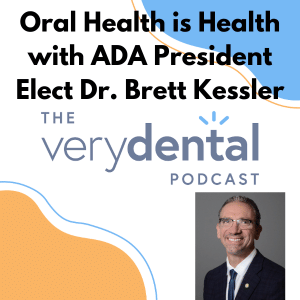
Alan is joined by a very special guest, the ADA President Elect, Dr. Brett Kessler!
Brett has been a good friend for a lot of years and the conversation is even more interesting now that he's serving as the ADA President Elect! Buckle up...we cover a lot of ground in this one!
- What is life as the ADA President Elect?
- What are his goals for his presidency?
- What does he mean when he says that he wants to blow up the entire dental reimbursement model?
- Why can't we offer the very best dentistry has to offer to EVERYONE?
- We need to change the way dentistry stays relevant. We can no longer only get paid when we spin the drill.
- What does Brett do with a magic wand to fix everything?
- FQHC-->medical and dental under the same roof
- How will technology help us moving forward?
- How will DSOs affect the future?
- The ADA and young dentists
- Creating value for ADA membership...also reducing dues?
- The ADA on license portability
- Future-proofing dentistry
Join the Very Dental Facebook group using the password "Timmerman," Hornbrook" or "McWethy," "Papa Randy" or "Lipscomb!"
The Very Dental Podcast network is and will remain free to download. If you'd like to support the shows you love at Very Dental then show a little love to the people that support us!
--
Crazy Dental has everything you need from cotton rolls to equipment and everything in between and the best prices you'll find anywhere! If you head over to verydentalpodcast.com/crazy and use coupon code "VERYDENTAL10" you'll get another 10% off your order! Go save yourself some money and support the show all at the same time!
--
The Wonderist Agency is basically a one stop shop for marketing your practice and your brand. From logo redesign to a full service marketing plan, the folks at Wonderist have you covered! Go check them out at verydentalpodcast.com/wonderist!
--
Enova Illumination makes the very best in loupes and headlights, including their new ergonomic angled prism loupes! They also distribute loupe mounted cameras and even the amazing line of Zumax microscopes! If you want to help out the podcast while upping your magnification and headlight game, you need to head over to verydentalpodcast.com/enova to see their whole line of products!
--
CAD-Ray offers the best service on a wide variety of digital scanners, printers, mills and even their very own browser based design software, Clinux! CAD-Ray has been a huge supporter of the Very Dental Podcast Network and I can tell you that you'll get no better service on everything digital dentistry than the folks from CAD-Ray. Go check them out at verydentalpodcast.com/CADRay!
[00:00:01] This is a production of The Very Dental Podcast Network. This is The Very Dental Podcast. Welcome to The Very Dental Podcast, where you'll find entertaining and relevant conversations with visionaries, clinicians, and your friends in the dental space. Now here's your host, Dr. Alan Mead.
[00:00:30] Very dental people, welcome to another episode of The Very Dental Podcast. My co-host today has been on the show several times. He is a dentist, a triathlete, and just so happens, the president-elect of the American Dental Association. I like to welcome back my friend, Dr. Brett Kessler.
[00:00:47] Brett, how you doing? Hey, Alan. Good to see you. Great. It's been a long time. I'm really excited to have this conversation. Hope all's well. It is. I will say that you are having conversations all the time, constantly.
[00:01:04] My suspicion is if I looked at your schedule, it would cause me to panic. So just for the background, Brett is sitting in a convention center. I don't know where it is.
[00:01:15] And frankly, I'm not sure he knows where it is because he had a moment between calls and presentations and all that stuff. Because as the ADA president-elect, he's a busy guy. So what's been happening, Brett?
[00:01:27] So yeah, I did the math recently and I've been averaging about 22 days on the road every month. And I'm very time zone challenged right now. And I always have to take pictures of my hotel room number so I remember where I am. And it's just crazy.
[00:01:49] But the role is everything I had hoped it would be. And I'm making the impact I wanted to make. I'm having amazing conversations across the country. And I'm in Toronto right now, so now I'm Canada too. And I did have, I've got my Google translator on.
[00:02:05] I hope that I'm coming through okay. I am speaking Canadian right now. Okay, good. I didn't know you were fluent in Canadian. Yeah, yeah. Yeah. I had a part of the job. So yeah. Okay then. Yeah. That's cool. So you are, when did your president-elect status start?
[00:02:25] I know, I mean, I've been watching you on social media for a while, but when did that actually start? The election was in October of, fall of last year, October at our annual meeting, House of Delegates. Okay, so you were president-elect from then on, huh?
[00:02:41] Yeah, about seven months in. And how I understand it, president-elect, when an organization has president-elect, president-elect is maybe busier than actual the presidency. Is that true with the ADA or not so much? In this particular time, both Dr.
[00:02:57] Linda Edgar, the current president and I divided up the country. We feel, we felt that it was really important that we get out there and just put a face to the ADA entity that's out there and repersonalize it.
[00:03:14] So we're acting both in ambassador roles, when she's got goals and objectives that she wants to accomplish and stuff, as do I, and very much synergy around that. The only difference when we're together, she leads the meetings and I'm glad to have her be in the
[00:03:35] spotlight during her year. And I'll, you know, I don't think I can be any busier than I am now. And I don't think she could be any busier than she is now. So basically you sign up for two years of this stuff, basically. Yeah. Yeah.
[00:03:49] But it's, and I'm not complaining. It's the, you know, the most amazing opportunity that I've ever had in my life to really talk about the things that are most important to me and what I think most important to our members and most importantly for the profession.
[00:04:04] And, you know, and I am fully aware that the, you know, the sands in this hourglass are going to run out in October of 2025. And I promise you, I will leave that, leave the office that day really satisfied that I gave it everything.
[00:04:21] And so I'm trying to maximize my potential. Then you'll take a nap for like a month probably. Well, you know, it's funny. I bought an adventure van last year as a potential consolation prize.
[00:04:33] And if I didn't win the election, I was just going to just travel the country in this big blue conversion van, you know, and figure things out. And so I have a feeling. ADA president or homeless guy, one of the others. I get it.
[00:04:47] So I have a feeling that will be part of my post-presidency plan. That's fantastic. So do ADA presidents oftentimes have like, okay. So in particular, like, let's say the well, so you remember Barack Obama has his presidency
[00:05:08] and Michelle Obama has the let's move and the garden and anti-obesity campaign. And Laura Bush had like the reading thing. Do ADA presidents have their particular thing that they are trying to, I mean, obviously they have to promote all of dentistry because they're the president.
[00:05:26] But the reality is I'm wondering if, you know, knowing your history and background, I wonder what your focus is going to be. What are things that the Brett Kessler presidency is going to leave with us? Great.
[00:05:40] I thought you were going to ask what my wife's platform was going to be. Yeah, what's your wife's platform? Let's get to the real thing. Yeah, exactly. Let's keep a roof over our house. Our presidents generally don't get to pick a particular platform, I don't think, because
[00:05:52] they're the president. They've got to do everything. So I'm wondering if it's the same in the ADA or not. No, I absolutely have things that I want to accomplish. You know me well enough to know I'm going to dance with the date that got me to the ball
[00:06:05] and wellness is 100% first and foremost. You know, my own personal story, the things that I've overcome. I want to make sure that we can elevate the conversation so that our colleagues, you know, take care of themselves first. You are your most valuable asset.
[00:06:23] Take care of yourself as such. And, you know, you'll hear a lot about that from me. A lot of our colleagues are suffering. Suicide is way up again within our profession and we need to be there to help our colleagues
[00:06:36] get help with dignity and not shoot our wounded. So that's first and foremost. Second, after that, now that we're all well and happy, you know, benefit reform, real benefit reform, both in the private benefit space as well as the public benefit space.
[00:06:57] And so we've got some great, great plans with that. And a lot of things are looking like they're coming to fruition right now. The current climate, political climate. When you mean benefit reform, you mean basically dental benefit payers paying more because
[00:07:14] honestly, anyone who deals with insurance, you know, knows that they, you know, everything, everything is more expensive now. Team materials, rent, everything. And the one thing that hasn't changed at all or has gotten worse has been reimbursements from benefits. I'm assuming that's what you're talking about.
[00:07:33] Is that right? Yeah, but I'm talking about blowing up the entire model. I'm here for it. Okay. I will happily light the fuse for you. So I'll just start by saying, how do I want to start?
[00:07:49] So why has it been culturally accepted in medicine that I can place a titanium post here in my leg, but I can't place a titanium post here in my mouth? Right, right. If I'm, why is it paid?
[00:08:04] Why is it paid for in medical where literally the person receiving said titanium post in their leg probably has no idea what any of it costs at all. And they may or may not get a bill or for a couple thousand dollars five months down
[00:08:18] the road and that's that. Yeah. Yeah. But I, you know, in medicine, if I had degenerative joint disease, if I can get the best that medicine has to offer, it doesn't matter if I'm male, I'm female, I'm young, I'm old. I'm rich, I'm poor, I'm black, I'm white.
[00:08:35] I'm in shape or I'm not in shape. If I have any kind of benefits, I can get the finest medicine has to offer. No true. It's a really good, really. And if we were to translate the dental benefit model over to you, if you had degenerative
[00:08:48] joint disease, we'd say, oh, that's too bad. Here are some crutches. Yeah. Because if you're missing a tooth, a flipper is a used crutches probably used crutches probably poorly. Yeah. Right. And, and, but, but a flipper is a crutch. Yeah. Yeah.
[00:09:04] Why aren't we demanding that we get to offer the absolute finest technology and care that dentistry has to offer? Like medicine does. Why are we. You're talking within the benefit, within the benefit space, because obviously. No, I'm talking about blowing it up, Alan, blowing it up.
[00:09:25] It's oral health is health. Mm-hmm. And with medicine, with medicine, the only reason that they're offering this stuff, most all those wonderful people that have needs in medicine, they only get that because there's some kind of benefit someone else paying for it.
[00:09:44] Most people couldn't walk in and have a surgery and have that hip replacement if they're paying cash. Right. So there is a benefit aspect to it. So literally one of the most frustrating things to me has been.
[00:09:57] But I think dental patients think that their dental benefits work like medical benefits. I, I do. Yeah. Because why, why wouldn't they? Why wouldn't they think? Right. But then of course, who gets to explain to them that it's nothing like that at all? We do every single day.
[00:10:13] Every day. Exactly. Our dental team gets to have that conversation every single day. Yeah. Yeah. You know, imagine if medicine, you know, we hear about, you know, I'm not saying we need to be in Medicare, but we need to find some kind of benefit for our seniors. Okay.
[00:10:26] And you know, and our, our. Who frankly have the most need of, of, I mean, for the, I mean, on, but on the averages, they have the most need for a lot of different reasons. And, and a lot of times they get passed over in some ways. Yeah.
[00:10:41] Yeah. And, and we have essential health benefits for dentistry and kids, but not for adults. Although President Biden just say that it's, it's going to be essential and it's encouraging, he's encouraging the states to provide an essential health benefit for all seniors or all adults basically.
[00:10:58] But, but our, our, you know, we're our own worst enemies with this within our profession. And, you know, and they say, you know, our physician friends say, stay out of Medicare, stay out of it.
[00:11:09] But if, if our physicians had the dental benefit model, they'd run to Medicare as the best thing ever, you know, imagine, you know, Oh, Mrs. Jones, you need two heart valves replaced. Good news is you've got insurance and, you know, and, and, and we're getting close to
[00:11:25] the end of the year and it's, you know, we will maximize your insurance. And Oh, by the way, here's our care credit application for the other 48,500 that it's going to cost. And because it's at the end of the year, we're going to do the second valve in January
[00:11:39] and your insurance will be maximized again. Yeah. And, and, and, and care credit will be there for you for the other 48,500. And so, you know, you've got the best benefits possible and they're going to pay 3000. You're going to pay 97,000. Can we get started today? Yeah. Okay.
[00:11:56] Well, I mean, who doesn't sign up for that? And so, you know, so, so I, I'm a firm believer in, you know, the data's there, oral health is health and, and, you know, and, and, you know, we're, we're expanding it in the medical necessity realm in Medicare.
[00:12:11] And because we know there'll be better outcomes for this valve type scenario if, if there's no dental infection and, and, and pre-radiation and stuff like that. But we also see it in diabetes that there's, you know, strong, you know, evidence that
[00:12:25] if we can get periodontal disease and lower the level of inflammation in the body, the diabetic care is much easier and much less costly on the system. And, and frankly, we've been against that is because, you know, too many people would
[00:12:38] get benefits basically is what the problem is and it's not funded correctly. And so what I'm talking about, you know, it sounds crazy and way out of the box. Yeah. But we, we've got this opportunity to be at the table to shape it.
[00:12:50] So it is equitable, not only so we can provide the best care for our patients, but we get a fair fee for our services that we deserve with our level of expertise and our own special niche in medicine.
[00:13:05] And so, and then with a kicker, you know, it's, you know, we, we, we've already kind of delved into the realm of medical dental integration with the sleep medicine, you know, niche and airway medicine, airway dentistry.
[00:13:20] And it's exploding because we found a way to get it paid for through medical insurance. Yeah. And, you know, it's funny about that too, is if we don't get a hold of it the way that
[00:13:33] you're talking about that explosion medical insurance companies will find a way to stop paying for it. They'll, they'll figure a way to do it. Like, like on some level that might be a really good place to go with it.
[00:13:45] Cause I've always said, you know, they're not going to keep doing this forever. They're not, you're not going to be able to take advantage of this as a dentist forever. It's just not going to happen because they, they, they won't allow it.
[00:13:53] And, you know, and then in medicine, most people go to the, go to their physician for sick care. Something's wrong. Less than 10% will go for their annual physical women, much better than men, obviously with, you know, they're, they're, they're trained that, you know, from, you know, with, with
[00:14:13] their pap smears and things like that, but men don't go. And yet most of our practices are proactive health related. People are coming much closer to it, much closer to it for sure. And so we can be that arbiter of, you know, having those conversations about
[00:14:32] improving overall health. And we've seen cases in our own practices where, you know, we did the scaling and root planing and we bring them back six weeks later to check on their gums.
[00:14:41] And yet their gums are still as inflamed as they were before we did the scaling and root planning and their hygiene is impeccable. You know, there's something else going on beyond poor bacteria management.
[00:14:52] And, um, and so we, we have this opportunity to have these conversations in a big way, and, but we need to be compensated for it, for our expertise, just like they do in medicine.
[00:15:01] The kicker with this, you know, our, our, our bread and butter in the general dentistry realm is, you know, replacing old stuff on seniors, you know, the baby boomers. And, you know, my, my dad's, my mom's and dad's generation, they got every tooth filled
[00:15:16] when they were kids and we spent the rest of their lifetime managing, you know, those fillings, re, you know, redoing them, putting the crowns, maybe root canals and new crowns. Then, you know, they crack.
[00:15:28] So we, then we do implants and that's the lifespan of a tooth in the baby boomer generation 20 years from now, they're not going to be in our practices. Yeah. And I don't know about you, but you know, I've got about, you know, much less dentistry
[00:15:42] than my parents had in my mouth. I'm 56 years old and the generation below us, there's even less dentistry in their mouth. And so we need to find a way to redesign the dental practices of the future, because right
[00:15:55] now, the only way we get paid is by spinning a drill. Yeah. We're scraping things. And so we need to find a way to be, to, you know, establish our niche in, in the medical world, primary care.
[00:16:08] And, you know, and, you know, we, we've declared ourselves essential during COVID and now that COVID's over, does that mean we're not essential anymore? No, essential is essential. It's not convenient, essential, it's essential, essential.
[00:16:21] And so, and for our future and for all the dentists that are practicing now and just getting started you know, we need to find ways to, to make it relevant, make dentistry relevant. So they have the kind of careers we've had.
[00:16:35] And as a bonus, the communities that we're serving are going to be better served because we're there doing what we're doing. I'm with you on all that. So, you know, we talk about, you know, there's a lot of, a lot of noise right now in, in
[00:16:49] like MLR, you know, and non-covered services and things like that. And, you know, I say if, you know, the, the, the, the quote by Henry Ford, if he were to ask his customers what they wanted, they would have said, I want a faster horse.
[00:17:05] MLR, non-covered services, leasing of benefits, that's a faster horse. I'm talking about blow it up. Okay. And imagine the opportunities of what we can do for our, the care of our patients. If we were, if we treat dentistry the way that it should be treated. That's interesting.
[00:17:25] So, okay, I'm going to give Brett Kessler, you, you are already going to be the president of the ADA, but I'm also going to give you a magic wand.
[00:17:32] So you are king of the world and I want you to, I want you to just lay out for me what what life as a dentist and what dentistry overall would look like if you could wave a magic wand and just fix everything. Okay.
[00:17:48] You can't do that as the ADA president, it's not going to work, but I'm giving you the opportunity right now. How about that? Okay. So I, I joke around about, you know, Facebook being the land of make believe. So we're going back to the land of make believe.
[00:17:59] Okay. So, you know, when I had my practice, you know, it was an adult restorative practice that we focused on health. We focused on function, we focused on aesthetics and we had a very fulfilling practice. I had a very fulfilling practice.
[00:18:18] I sold it in 2018 and, but we delved into that. Okay. And, you know, and the patients didn't get better. We had referring concierge type docs that would send us patients and we'd send them patients, you know, it was a fee for service practice now, no benefits whatsoever.
[00:18:36] I wasn't participating in anything. So the people that were coming to see me were already health focused and were willing to pay for it. They were committed to it. And so, so I had that, you know, and, you know, so the patients were, you know, ready
[00:18:51] to do things about it. And we had these, these medical and dental integrations. It was amazing. And so, but it's happening in the FQHC world right now, in the public health world where, you know, the they've got medicine and dentistry under the same roof.
[00:19:06] And if you are diagnosed in the medical side with diabetes, you're automatically integrated in their system to get a dental exam and whatever treatment is necessary to help with the diabetes. And they've got the data that shows the, that it benefits the patient by, you know, treating it.
[00:19:24] You know, and we're starting to see it in the middle markets now as well. There are some DSOs that are going all in on health related dentistry and having physicians and dentists working under the same roof, oral health is health. So I see that happening. It's happening organically.
[00:19:47] And, but I feel like we need to be at the table. So with that, you know, I see that as one big part of it. I see technology taking a big part in how we practice as well.
[00:19:59] You know, I know when I started practicing, we had the dip tanks for our radiographs and then we had the little rollers for our radiographs. And, you know, then we had these, these intraoral cameras that started to come and we all bought them and it was really cool.
[00:20:14] And then we had, you know, these digital radiographs and they were super expensive. You know, so I mean, dentistry has evolved over time in the 25 years or 29 years I've been in practice. And I see technology taking it and accelerated it even more.
[00:20:31] The, you know, the, you know, CAD CAM with milling is huge. Prices are going to come way down on that. Printing is taking a large niche. And I think we're just on the beginning phases of what we can do in house.
[00:20:48] And as a result of this lab shortage that's going on out there, you know, the technology is taking over the lab industry. There will always be a need for that custom lab tech who can, who's the master artist and master ceramist. Absolutely.
[00:21:04] But for the masses, you know, a lot of this can be done, you know, through in-house, through milling and 3D printing. Artificial intelligence, augmented intelligence. Imagine this is like the Star Trek type of model that you've got a computer that you
[00:21:19] can talk to and you're, you've got your little earphone in. And as right before you walk into this, this next patient's appointment, it's whispering to you, you know, last time you were, last time this patient was here, we did a filling on number 14.
[00:21:34] She had some sensitivity with it. You called her a few days later, she said it was getting better. Make sure you ask her about that. Her kids are in college here, here, and here. They just went to Disney. They've got a dog named Spot.
[00:21:44] And then you can walk right in and start, you know, having that conversation, building the trust that's necessary. That the best part about our practices is the relationships we have with our patients. And then as we're talking to our patients, the AI is listening and it's taking notes
[00:22:01] as well and integrating, you know, the next report for when that patient comes next time. And it records everything we're doing. I see it, you know, that's happening, you know, right now. You know, we've got AI in the radiograph world, you know, where it's showing, you know,
[00:22:20] highlighting potential carious areas and, you know, and it's really good for patient education and it's really good to help us diagnose better. It's been working in the radiology field of medicine for a decade now.
[00:22:33] You know, it's going to really improve our diagnostic skills and grow our ability to basically do more dentistry and catch things quicker. I feel there's going to be the management of, you know, right now we're surgeons.
[00:22:48] You know, we see a disease, we cut it out, okay, or we scrape it out. And there's going to be a lot more medical management of disease, oral diseases that we'll be playing a part in.
[00:23:00] You know, SDF is going to play a bigger role where they're going to find some kind of SDF that's not going to turn the tooth black. But, you know, and amalgam is politically it's going away. So we're looking at, you know, what's the replacement going to be?
[00:23:17] Composites are a good replacement, but it's very technique sensitive. And you don't have the longevity. So I like all that. Yeah, we're seeing a consolidation in the private practice world as well. The DSO world is, I think, pulling back from their growth strategies
[00:23:40] because private equity can make more money elsewhere. But I still think they'll always be looming around the fringes. Tell me more about that. Tell me more about that. OK, you know, I see the private practices. Out of necessity, gaining leverage by consolidating with other practices.
[00:23:59] OK, you know, the economies of scale will be is only available with scale. And so we have to do that. And, you know, the management systems that we have in our private practices,
[00:24:10] as good as we think we are, you know, we're nowhere near as good as we need to be. And so, you know, with the larger groups that we can create these management systems that will provide a much more efficient practice and it'll be a better.
[00:24:27] Because we're so drowned with administrative burden that we can't, again, focus on that doctor patient relationship or that practice patient relationship. And so, you know, the economy of scale will help us be a lot more efficient
[00:24:40] so we can focus on what's most important, and that's delivery of care. So 10 years ago, maybe even less than that, DSOs in conversations after meetings at dinner or whatever were sort of a bad word.
[00:24:55] And I feel like DSOs are becoming less and less of a bad word and more and more of a potential for practice owners to actually be able to sell their practice. Is that what you're seeing as well? Yes. You know, as far as practice owners selling their practice,
[00:25:10] but I think it's more folding them into a larger group, you know, and not just selling it and selling out and walking away. I think a lot of them are. That doesn't happen anymore. It doesn't happen anymore at all. Yeah.
[00:25:24] So tell me this, how does that affect younger dentists? Well, I was just going to go there is that, you know, we've been pretty bad as far as creating our successors, our next level of dentists in the private practice world.
[00:25:39] And if I were to have an associate work in my practice and they needed $100,000 in salary, I'd have to have $400,000 with the dentistry lying around. Okay. And I didn't have that. And I had associates and they had to build their own,
[00:25:53] you know, their own practice within the practice. And, you know, and I was very nurturing and, you know, supportive of them building their relationships with their patients, but not everyone's like that. You know, right now in the private practice world, I see, you know,
[00:26:07] hearing it from the dental students who are looking for jobs, you know, they're getting offers of, you know, no sign on bonus. They're getting offers of 28% collections. And, you know, they want them to work, you know, five days a week.
[00:26:22] And, you know, we have this, I hate to say it, but inflated self-worth of how good we are in our little kingdoms. And we don't really embrace the mentorship role that is necessary for any young dentist to grow.
[00:26:40] It's a no, you'll put your time in and, you know, and, you know, just like I did and, you know, blah, blah, blah. And then maybe we'll sell it to you. Okay. And it's so they're going to the more sure things where they're getting sign on bonuses,
[00:26:56] where they're getting the structured mentorship and some of the, you know, better run DSOs. And, and many of them are really enjoying it. Many of them are staying there. And, you know, they like the fact that they have a defined, you know,
[00:27:11] time when they start and a defined time when they end and a defined days of the week. And, you know, and they've got other people, you know, scheduled to do call, you know, the benefits that they're being offered, you know, in the private practice world.
[00:27:26] I sold my practice in 2018 and the new owners immediately cut out all the benefits that I gave myself immediately cut them out, including, you know, so it's like most of them left soon after. Yeah.
[00:27:38] And, you know, and so, but, but as a private practice owner, we don't have that leverage to get the get the benefit packages that the bigger groups can. And so we've been behind the eight ball for a while.
[00:27:51] And then as an organization, we've, we've ignored this group or, you know, or, you know, you, you said it, it was a bad word. And you know, and so when Dennis joined the DSO, our, you know, organized dentists,
[00:28:06] we kind of turned our back on them as, and thought they were lesser dentists because of that. And the same thing happened in the public health realm, you know, and, and, and, you know, why did we do that?
[00:28:19] You know, I never understood that, you know there are really, really good DSOs out there. And they're really, there's some that aren't so good. There's some really good private practices and there's some that are not so good. Yeah.
[00:28:31] And, and so in the meantime, you know, the, the membership the ADA has been dwindling over time and, you know, we've been, we've been, we've been dwindling over time and, you know, but, but it's dwindling mostly in the young dentist demographics where they fit into these categories.
[00:28:53] The DSOs are diverse, diverse, diverse, you know, diversity of thought, diversity of color, diversity, sexual orientation, whatever. They don't feel welcome. And as a result, they're just kind of doing their own thing. And so we need to elevate that conversation too. So that's interesting.
[00:29:12] Because I think a lot of, I think a lot of dental organizations from, you know, from the ADA on down are seeing that like we have, I, my study club, that's a big Michigan thing, the better society. I know you're familiar with it anyhow.
[00:29:26] We have more life members than we have members at this point. And it's really in, in honestly marketing to the younger dentist. And even, even when we have a really good value proposition is kind of hard.
[00:29:39] I wonder how does, how does the ADA and you as the president, how do you, how do you work on that? Well, we, let's look at, you know, when we purchase something, you know, if you look at the psychology of making a purchase or belonging to something,
[00:29:54] the value has to be there. The value has to be either at a fair cost or the value has to be higher than the cost. You know, I'm getting a good deal. And so the last 25 years, we've been trying to bring the value proposition up and, you know,
[00:30:09] it's important to be a member of organized dentistry. And we've been very, very diligent about that. And everybody has at every level, at the street corner level component, the state level at the national level,
[00:30:19] but it hasn't been compelling enough to offset the cost of what membership has been. And so we have to continue like crazy to, to improve the value statement and, and, but we need to lower the cost of dues. Though it just has to be that way.
[00:30:34] As a, as an organization, you know, organizational management, you know, technology, we've been, you know, had an outdated system to, to run our organization. We've had a, we've had an outdated system with our contact relationship management. And so we're in the process of redesigning our entire
[00:30:58] technical foundation, IT foundation to make it relevant. And so, you know, with, with, again, the latest technology, including AI, every member will be directed messaging in ways that is important to that member. Okay. What's important to you is different than what's important to me.
[00:31:21] My value statement is different than your value statement. Sure. And we've been shot gunning this blanketed value statement that hasn't been compelling enough for people to, you know, to, to join at the, at the level that we're joining.
[00:31:37] So we'll be able to increase the member value experience and at the same time, be lowering the cost with efficiencies. Cause technically we've got about five, 6,000 people in organized dentistry that are active across the country. Okay.
[00:31:52] At the state level, they're in leadership, the component level, they're in leadership, you know, but yeah, then we've got 155,000 that are just check paying members. And we don't know what that reason is. And so, but basically we're a digital platform for them to access information.
[00:32:07] We have to be top of game in the digital world for them to continue to value that. And so we're redesigning our entire infrastructure digitally to make that platform relevant. Interesting. Okay.
[00:32:21] I got, I gotta get, I gotta hit one more thing because I've seen it on, on Instagram and stuff. I want you to tell me about license portability and, and kind of what you guys are working on to make it, make it a little easier to right now.
[00:32:37] I mean, a lot of it's a state by state licensing for the most part. And if I want to move to Florida or if I want to move to Delaware, hello, Delaware, I'm calling you out.
[00:32:47] I'm just curious, like it's, you have, you have a couple of things that just happened recently. Tell me a little bit about license portability and what you guys are doing about that. Yeah. So basically license portability means that you can, if you have a license in one state,
[00:33:02] any state that's involved in this compact that we're creating, you can get a license with them with very little administrative burden. Okay. And, and so it, the genesis of this came actually from the department of defense and we had military
[00:33:21] docs, military nurses, military dentists who get transferred around a lot as part of their, their service, their spouses, their significant others had a hard time getting licensed. If they were like, you know, we had a dentist who was in the military and a dentist spouse who
[00:33:40] wasn't that dentist that wasn't, it would take somewhere six to nine months sometimes to get a license in a new place they were at. Yeah. And so they complained up the chain in the military, which brought, got the attention of
[00:33:52] the DOD, which then said, Hey, why is this a problem? And so they encouraged, they came to us and said, we're you know, we'd like you to start working on this. They went to the American association of dental boards and they you know, encourage them to
[00:34:07] start working on it as well. And the dental board group was much slower to embrace it. Oh yeah. Yeah. And but, but we, you know, we weren't. And so we started, you know, you know, asking questions if we were to produce a an opportunity
[00:34:24] to have a portable license, meaning a license that you can use in different places, what would that look like? And and so, you know, we needed seven States across the country in this compact to activate the compact. And that happened a few months ago.
[00:34:40] And we just signed on a few more States, Colorado being one of the States where I'm from. And and so, you know, if you have a license in Colorado, you can also now have a license, a potential license to practice in these other States. Why is this important?
[00:34:55] The young dentists, the new dentists, they may not stay, you know, in Midland, Michigan for the rest of their careers. Okay. They may not stay in the Northeast corner of Denver for their entire career. They want to experience different things.
[00:35:10] They want to have this ability to move around and, you know, and they're more about life and lifestyle than, you know, working 60 hour weeks. And so it's an important option or potential availability for our younger colleagues. That's that's so good.
[00:35:30] It's something that literally I think dentists, you know, from your in my age group just never thought about, like, I can't go to California. It's going to be too much of a hassle to get the license. Like, like if that and that's always been the case.
[00:35:44] I mean, okay, so I went to the University of Minnesota for dental school and they were they were in in central regional. And of course, I was moving to Michigan, which was Northeast region. And I took the central regional boards.
[00:35:58] And and I think there was honestly, I think the the MDA, the Michigan Dental Association was very helpful in getting me because I don't know that it was an automatic thing for me to get my Michigan license.
[00:36:09] And I mean, so everyone in their the back of their head knows that the licensing is a state to state thing. If if if we could change that, it would definitely change the way people look at things like
[00:36:19] let's be honest, if I you know, if I could retire to Arizona or somewhere in the southwest where I can mountain bike most of the time and then see see patients every once in a while that has some appeal.
[00:36:32] And it'd be nice that if it wasn't such a hassle to get a new license, I mean, it can be done, but there's like you said, it's a bureaucratic nightmare in some cases. Some states, it's no big deal, but in some cases, it's a real problem.
[00:36:43] And I think this is like a perfect use of the resources of the ADA and that sort of thing. I think it's great. Yeah. And it obviously comes with with controversy as well. And, you know, the state fiefdom, you know, it's been an economically driven, accepted practice.
[00:37:00] You know, we don't want too many dentists in Colorado. We don't want too many dentists in Florida, you know, so we're going to put up these barriers to prevent it, you know, but the bottom line is, you know, free market will prevail here.
[00:37:13] And if there's too many dentists coming to Colorado, they're not going to stay around for very long because they can't make a living. Yeah. And they'll be pushed out of the city and the urban areas into the rural areas where
[00:37:23] they can make, you know, make it make it work for them. So much like you said, the idea that a dentist is someone who moves to a town, puts her shingle up and works there for 40 years and retires.
[00:37:37] That's not necessarily what it's going to look like to be a dentist anymore. Like, the reality is that's not that's not what generations below us look at as as the way I mean, maybe for some don't get me wrong.
[00:37:48] It might be perfect for some, but the reality is that's not necessarily how people are looking at the career anymore. And I think that, I mean, we need to bring that kind of up to up to date.
[00:37:57] I feel like I mean, just because you and I stayed in one place for a long time doesn't mean that that is what the model is going to look like, especially if practice ownership, individual practice ownership isn't the main goal anymore.
[00:38:11] And the reality is that it kind of isn't. There's plenty of people that want to own a practice. Yes, but the reality is with the debt they're coming out of in dental school and frankly, the lifestyle options ownership isn't quite what it used to be.
[00:38:23] I mean, when you and I got out of dental school, what percentage of your classmates were going to own a practice in their mind when they left? Most of them, right? 100% of them. Yeah, exactly. You know, and it's just it's different.
[00:38:35] And like you said, there will always be that niche. There will always be those that do want to do that. But the reality is that it's not happening. It's just not happening. And so we need to, you know, like I said, dentistry has changed in the 29 years I've
[00:38:51] been in practice, you know, leaps and bounds that I could never have imagined, like how it is that I practice now compared to when I started. It's going to be the same in the future too.
[00:39:00] We need to be future focused so that when our members, our dentists, our colleagues are doing the work they are trained to do and the communities are benefiting from our being there. And so, you know, portability will be a big part of that.
[00:39:17] The practice model will be a big part of that. You know, and but the values are a little different and it's not good or bad. It's just different. Yeah, it is. That's right.
[00:39:29] One thing you said before we wrap up, one thing you said is one of the ways to make the organization will become, you know, will have increased membership and loyal membership by providing the value and the fact that you're focusing on the online presence and
[00:39:48] the internet presence because the reality is that's how the world is right now. Like, I have a lot of friends in the world that I may not have ever met in person, but they're still my online friends.
[00:40:00] The story is the ADA has so many resources and, you know, being able to go to the ADA website and easily find what you're like, if it were the resource, if it were the go
[00:40:12] to resource for everyone of course, like the actual dollars spent would be, you wouldn't even think about it, right? Wouldn't, you know, if you could go and find what you need. I mean, there's so that's the challenge, obviously easier said than done.
[00:40:27] But I mean, it sounds like that's kind of where you're aiming. I'm kind of excited about that. I would love to think that the ADA website is going to be the hub for information for dentists.
[00:40:34] I mean, that would make a lot of sense if you could do it. It's a big ask, but it'd be pretty cool. Well, it's our existence is dependent upon that happening right now.
[00:40:47] My biggest joke about it is if you want to hide something on the internet, put it on ADA.org. You'll never see it again. Reality. It's darker than the darkest web.
[00:40:58] And so, you know, and so we need to up our game big time so we can be the indispensable resource. The American Dental Association, we are the biggest lever in the profession.
[00:41:08] If we can't stick together, if we are losing that momentum, who will be the voice of dentistry for the profession? And it's going to be the payers. Is that what we want? Okay, we're not perfect. We're far from perfect. I'm not perfect.
[00:41:27] I'm far from perfect as are you. But the bottom line is this is one area where if we want to see a bright future, we need to have a strong voice moving forward. And it has to be unified, even though we don't agree on everything.
[00:41:39] There's so many things that we do agree upon as a profession. And if we keep the patients and the communities focused first over our individual success, we can't go wrong because the individual success will come as a result of taking care of the communities in big ways.
[00:42:00] Yeah, that's right. And I still think that dentistry is the best niche of health care in the world. I wouldn't want to be doing anything else. And so we have to make sure that stays that way. That's awesome. So Brett, let's do this.
[00:42:16] Let's over the next couple of years, since you're going to be so dang busy, let's try and talk again and see how we're doing with this stuff. You take the presidency in October. Is that right? Take over in October at our annual meeting in New Orleans. That's exciting.
[00:42:31] Very exciting. Let's catch up every so often. I'd love to share my progress with you. And you always ask me really hard questions that makes me think and helps me be better in my role. So I'd love to hear from you more.
[00:42:44] I'd love to do this more often. Let's put it like that. Definitely do it. Also funny, worth noting, you and I did not say one thing about the fact that we're both recovering people in this podcast. That is a first. It's just part of who we are now.
[00:43:00] It's so ingrained. The work that you've done to raise the conversation to a level where it's okay now. It's the best thing that's ever happened to me. I know it's the best thing that's ever happened to you. And we've embraced that.
[00:43:17] And because we have these conversations, I hear it across the country, Alan. Hey, I heard you on Alan's podcast. I went and got sober too. Thank you. That's awesome. So if you need help, please seek it. Definitely. Definitely. We got resources.
[00:43:32] Brett, thank you a ton for your time. I know that we just squeaked this out. I'm sure you're going to be running in a different direction. Let's stay in touch though. This was fantastic. I can't wait. I can't wait. Thank you, Alan, for everything.
[00:43:44] And your friendship means the world to me. So you too. I'll talk soon. Take care.