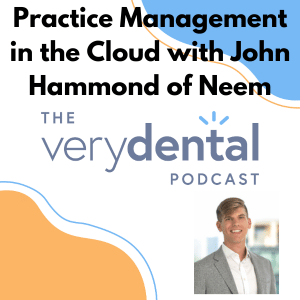
Imagine being a patient who shows up for their appointment only to be turned away because the office's server was down. Now imagine if you're a software guy and this happens to you! That's the story with John Hammond, co-founder of Neem, a cloud based practice management software!
Alan and John have a wide ranging discussion about the advantages of cloud based practice management!
- It's not the technology as much as the switching
- The Neem elevator pitch
- The pros and cons of cloud computing in dentistry
- Why has medicine jumped into cloud so easily?
- The key to Neem...painless migration
- Two options for imaging with Neem
- Making Neem intuitive
- Dental software is less sexy than a lot of other technology
- Intelligent forms that patient input built in
- Real time insurance eligibility
- Will cloud be in the majority in 10-15 years? (software has a shelf life)
- DSOs and the cloud
Some links from the show:
Join the Very Dental Facebook group using the password "Timmerman," Hornbrook" or "McWethy," "Papa Randy" or "Lipscomb!"
The Very Dental Podcast network is and will remain free to download. If you'd like to support the shows you love at Very Dental then show a little love to the people that support us!
--
Crazy Dental has everything you need from cotton rolls to equipment and everything in between and the best prices you'll find anywhere! If you head over to verydentalpodcast.com/crazy and use coupon code "VERYDENTAL10" you'll get another 10% off your order! Go save yourself some money and support the show all at the same time!
--
The Wonderist Agency is basically a one stop shop for marketing your practice and your brand. From logo redesign to a full service marketing plan, the folks at Wonderist have you covered! Go check them out at verydentalpodcast.com/wonderist!
--
Enova Illumination makes the very best in loupes and headlights, including their new ergonomic angled prism loupes! They also distribute loupe mounted cameras and even the amazing line of Zumax microscopes! If you want to help out the podcast while upping your magnification and headlight game, you need to head over to verydentalpodcast.com/enova to see their whole line of products!
--
CAD-Ray offers the best service on a wide variety of digital scanners, printers, mills and even their very own browser based design software, Clinux! CAD-Ray has been a huge supporter of the Very Dental Podcast Network and I can tell you that you'll get no better service on everything digital dentistry than the folks from CAD-Ray. Go check them out at verydentalpodcast.com/CADRay!
[00:00:01] This is a production of the Very Dental Podcast Network. This is the Very Dental Podcast.
[00:00:17] Welcome to the Very Dental Podcast, where you'll find entertaining and relevant conversations with visionaries, clinicians, and your friends in the dental space. Now, here's your host, Dr. Alan Mead.
[00:00:29] Very Dental people, welcome to another episode of the Very Dental Podcast. I'm your host, Dr. Alan Mead, and joining me today as co-host, a new friend of mine by the name of John Hammond.
[00:00:40] John, how are you doing?
[00:00:42] I'm doing great, Dr. Mead. Thanks for having me on.
[00:00:45] So, John and I have been talking a bunch about cloud software and the misnomer of cloud computing and how dentistry is sort of seems like it's dragging its feet a little bit to come into the cloud.
[00:01:03] And so, and John has a particularly good take on this. But John, let me start with this. Where do you come from and how in the world did you get into dentistry?
[00:01:14] Yeah, that's usually where people start. It's funny because, you know, I don't come from dental. So, you know, I'm not a dentist and I don't even have any family members who are dentists, which is usually what people guess.
[00:01:25] Yeah.
[00:01:25] My background's always been more so in the technology and software and honestly, traditional healthcare space. So I started off my career as a healthcare consultant and I did massive migrations for hospital systems and insurance companies and Fortune 500 companies.
[00:01:41] And I did that for several years and then I became a software product manager, which is basically just the person that's in charge of like building something like, you know, Facebook or usually something much smaller than Facebook.
[00:01:53] Sure, sure, sure. Building a software product.
[00:01:54] Yeah.
[00:01:56] And, and yeah, you know, I got the idea for my company, Neem, when I, you know, I went in to get my teeth cleaned and I got sent home because their server was down.
[00:02:06] That's right. You told me that before. That's freaking great.
[00:02:08] Yeah. And I remember being like, your server was down. Like you guys have a server? Like what?
[00:02:13] But on top of that, on top of that, they sent you probably because they couldn't take x-rays because their server was down.
[00:02:22] I mean, they could scrape your teeth and polish your teeth, I suppose. But, but I mean, like, I sort of get it. Like when the computers are down, you do feel like your, your hands are tied behind your back a little bit.
[00:02:33] And that's interesting. That's interesting. Yeah. I mean, they could have just paper charted me, I guess, but I, you know, depends what practice you're dealing with and when it comes to how they handle that situation. But, you know, long story short, I got sent home.
[00:02:45] I think, I'll bet you it was sunny out and kind of nice. Maybe Doc was thinking about golf. I'm just going to put it out there. But in any case, I like, I like the fact that the inspiration came from a server being down. That's classic.
[00:02:56] Yes. Yes. And that's what piqued my interest. Because I was like, server, what do you mean server? Like, you guys still have a server? And yeah, the more I looked into the space, the more I realized that like, you know, 70% of dental practices today are still running on a server, still using server based software. And I think that's, you know, in large part, because, you know, the process of switching has been really scary.
[00:03:19] Yeah. It's not that they don't want to use a newer, better tool. It's like, they're just afraid of the headache that comes with switching to that tool. Yeah. You know, if that makes sense. And, you know, from my background, you know, managing all those giant migrations and stuff like that, I kind of just developed this belief that if you could, if you could build a great product and build a great process of switching, you'd have a lot of success.
[00:03:44] That's really interesting. You said one of your original jobs was, was the migration part, which is very interesting to me, because the migration part is one of the huge, like, first off, in a dental practice, the less change you bring to your team, the less you have to change stuff. Like that's, that's a pain point, the change thing. Even if your team is like, this software sucks, we can do so much better.
[00:04:08] The idea of having to go from one software to another software is scary. And, and there's a lot of practices that are just super happy to just go day to day and, and do dentistry and do it the way that they've done it. And, and, you know, so on some level, a lot of times they're, they're not probably going to make that change until, okay, when do it, when did I buy my last x-ray sensor? When the sensor before it broke and was unusable.
[00:04:34] I mean, like that's, let's be like, like, so on some level you're, you're, you're in a position where there's not a lot of practices that have a software that are just itching to change necessarily, except for the fact that there's a lot of upside to cloud. Probably I'm thinking about, we'll get to that. We'll get to that. So, so I, before we even start, I always thought this was good for someone who's an entrepreneur and has been in kind of software spaces.
[00:04:59] I want to know you, you step on the elevator on the ground floor with a dentist and you're going, I don't know, you got about, it's a slow elevator. You probably got 10 floors. You're going up. What's your elevator pitch for Neem software for a dentist? If you've got a, just a couple minutes to explain the, the reason that they should be super psyched about it.
[00:05:20] Yeah, no problem. Neem is a cloud-based all-in-one practice management system that makes running dental practices easier and more affordable by eliminating the server and consolidating usually three to five different software tools into a single product to run your practice.
[00:05:47] That's, that's, that's a, that's pretty compelling. I, when you and I talked back, John and I first talked when I was driving to the Chicago midwinter in February and I, I was railing to him about, I don't even know how many swipes my credit card is getting for different software things that I've kind of added over the years. And guess what? That was like two plus months ago. I still don't know how many, I have no idea. I didn't look, I didn't.
[00:06:12] No one wants to look up that stuff.
[00:06:13] I know, I know, I know. Cause it, it, it can fly under the radar if you're poorly managed like I am. But so the reality is like, I have, I have Dentrix. I've had Dentrix since 1998, multiple servers in on that deal.
[00:06:26] Um, and no matter how recently it feels like you've upgraded yourself, your server, it was probably longer ago than you think.
[00:06:35] Like, I, I think we did the, uh, I don't even want to, I don't even really want to know. Um, and I've just, one of the reasons I continue to use Dentrix is because it's, it hasn't, I don't even love the software. I think the software is clunky. There's a lot of it that we don't use. I think a lot of it is not very intuitive. Um, and, but I think the, like I said, the reason I haven't changed is cause I haven't, I haven't had, I haven't had to change. And it's, you know, the, the idea of changing has been a bigger thing in my brain than, than not changing.
[00:07:05] So, uh, with that in mind, knowing that's the case, do you think dental practice management software is really ready for cloud computing? Is it what, what are the, what about dental practice software practice management software is great for cloud and not great for cloud? Like what are the, what are the pros and cons? And, and tell me, tell me your take on that.
[00:07:28] Yeah. I mean, it's, you know, it's a multi-part question. Um, the first question, like, you know, is, is, is dental ready for cloud or is cloud ready for dental? Like, of course I'm going to say yes. Right. Like I have a vested interest in saying yes, obviously. Um, you know, but if I were to, if I were to play devil's advocate and try to say no, um, you know, the things I probably look at are like internet access, reliability, um, you know, like compliance, security concerns, you know,
[00:07:57] more like macro infrastructure level stuff. Yep. And by and large, like that stuff is ready for cloud and dental cloud solutions. Like, you know, it hasn't always been that way. Right. Like 10 years ago, there wasn't any 5g. Yeah. Right. Like, uh, 10 years ago, you know, you know, internet access was a much bigger consideration.
[00:08:17] Yeah. Like internet access and speed. It's roughly like tripled, I guess, in terms of like, just, you know, breadth and depth across the country in the past 10 years. And, um, yeah, nowadays, like the internet goes down, you whip out your cell phone, fire up your hotspot. You're good to go. 10 years, 10 years ago, you couldn't do that. And, you know, the main cloud players that came out about 10 years ago. And I think that's part of the reason why maybe cloud hasn't proliferated within dental quite as much as it has across other industries.
[00:08:45] It's just because maybe the infrastructure wasn't there to meet the unique needs of dental because to your point, like dental does have unique needs and that it is a, it's the type of tool that you're using like all the time.
[00:08:57] Yeah.
[00:08:57] You're using it day in and day out for every patient appointment.
[00:09:00] Sure.
[00:09:00] It's not like something that is just sitting on in the background or whatever for hours at a time. So you need it to be reliable and easy to use and yeah, good basically.
[00:09:10] And you, it sounds like you were in, you were in kind of medical spaces and I'm just wondering like medicine seems to have taken onto the, this is, I'm guessing, I don't know this for sure, but I think, I think medicine is sort of taken onto this a little bit quicker.
[00:09:24] Is that accurate or not necessarily?
[00:09:25] Yes. Yes. Yeah. So if you look at dental, roughly 70% on-prem today, it's, it's almost like the inverse of that in the traditional medical and healthcare space where it's roughly, you know, 50, 60, 70% cloud-based.
[00:09:36] Mm-hmm.
[00:10:06] And that's why I think you've seen a faster rate of adoption, maybe in traditional healthcare relative to the dental.
[00:10:12] It's really interesting. My, so when I go to my, my family practice doc, I'm a little jealous on, on one level, it's kind of terrible because literally the, the physician that I'm having my, or the physician's assistant that I'm having my appointment with is kind of asking me questions.
[00:10:28] We're talking about stuff and they're literally like taking the notes right there on a laptop, which is a little distracting, but the reality is, is like what I know is that they, they can do this on, they can do this from a laptop from anywhere.
[00:10:40] I'm certain, I'm certain that they're cloud-based. So the rate, they could be on an iPad if they want or whatever. But the, but the reality is like on some level that, that convenience.
[00:10:53] And I think you can do that with other softwares too, but the reality is like, I mean, when you're, when you're cloud-based, whatever, whatever device you're using is getting all the same information of every other device.
[00:11:03] It isn't, you don't have to be, you know, hardwired ethernet into the system necessarily. In fact, I think that's, that's one of the limitations, I think on some level for dental software.
[00:11:12] I think sometimes imaging becomes an issue with that, that we could talk about that, but I guess, so that's one of the cons.
[00:11:19] What are some cons of a server-based system that, that cloud-based software fixes? One of them is obviously you can, whatever device you want to use, basically it's in a browser. Is that right?
[00:11:30] Yeah. I mean, there's like, I'd say you can kind of bifurcate it into like two buckets. One being like day-to-day stuff that you'll notice and other, the other being like maybe one time or in the background stuff that it's still good, but you won't necessarily notice.
[00:11:44] So like, you know, the stuff that you're going to notice day-to-day is one, like, yeah, you can sign on from any device from any location. Right.
[00:11:52] So like all of, you know, you can sign on from home, no more remote login software needed or anything like that. And, and two, everything's combined. Right.
[00:12:00] So like if you have two practices or more and you know, you have patients that go across both locations, you know, their charts are going to be a single chart.
[00:12:09] It's going to be a single record, you know, across like the whole ecosystem of your business, if you will.
[00:12:15] And then, you know, stuff that's, you know, in the background, it's honestly like, it's less expensive.
[00:12:19] You don't have to buy a new server every 10 years or whatever. It costs you 10, 20 grand.
[00:12:24] Don't have to do backups. Don't have to worry about, you know, updates that break things.
[00:12:30] I guess that makes sense. And yeah, like less kind of like hardware.
[00:12:36] Well, actually, when you think about that, when you think about that, that probably means less time on the phone with, with tech support too.
[00:12:42] Cause I'll say that Dentrix, Dentrix, when we up, when a, when a serious update comes through, it's almost always an afternoon where I've got a team member in on the day that we're not there just running through to make sure everything, everything's updated and all the different computers and stuff like that.
[00:12:56] And it's honestly, most cloud software that I'm familiar with, basically the updates come every time you open a new browser window.
[00:13:06] I mean, like it's one of those things where it's, it's, they're just kind of sent along.
[00:13:09] So you don't have to think very much about that. Is that accurate with, with, with Neem?
[00:13:13] Yeah. It's all seamless. So, you know, we really, we release updates overnight, you know, you log in and you're good to go.
[00:13:21] Um, and even if like, you know, we release updates when you're, you know, we don't do this during working hours or us working hours, but you know, it wouldn't affect anything until you like logged out, log back in.
[00:13:31] But there's no like process of updating that you need to complete like you would, like you do with Dentrix and other server-based software.
[00:13:37] Yeah. And then honestly, it's just more secure, right? Like I think that's a real factor now, especially considering the whole change healthcare fiasco and craziness or whatever that's happened recently is it's a whole lot harder to hack, uh, Amazon than it is to hack, you know, like a on-prem server at a dental office.
[00:13:56] I guess if that makes sense. So there's that consideration too.
[00:13:59] Yeah. And your server is like, your server is kind of one of these things where it doesn't happen very often, but occasionally you're like, ah, this is really like the cloud.
[00:14:07] It's a classic story of someone who, who's been doing the backups exactly as their IT person has explained, you know, over the years. And so they're, they're bringing a backup offsite and all this stuff.
[00:14:17] And then they go look and they never had it. They haven't had a backup for, for, I say this, I say this as someone that that's actually happened to, we didn't lose any data, but I mean, for a long time, we'd been doing it exactly as described.
[00:14:30] And we, we were getting no backup whatsoever. Like we didn't, we only knew after we tried to verify the backup was pretty, pretty scary. And I feel like those kinds of, uh, the pit of your stomach, oh my God, kind of moments would be when your server is not, when your server's in, you know, somewhere else and all your data is somewhere else.
[00:14:48] And you can get that, that, that would probably be worth some stomach lining to say the least. I don't know. I like the idea of being able to use them.
[00:14:57] Uh, I like being able to use whatever, whatever, uh, screen you got in front of you. You know, I like that. That's kind of great.
[00:15:04] Yep. What other kinds of things?
[00:15:06] There's just less things that can go wrong.
[00:15:07] Yeah. I mean, what's funny about, okay. So I want to ask about, there's so many things to ask about. So, okay. You can use different devices. What kind of services are included in Neme that, that, that are the, because that's the classic thing that drives me crazy.
[00:15:21] Because when texting came along, okay. So there was, I was a dentist before texting a patient was like a normal thing. Like I remember when the worst job in the world was whoever had to call tomorrow's patients to verify that they were coming in or was like the worst job in the world. Texting makes that better. It's patients will still not show up. It doesn't matter. But the story is the texting is very convenient and we can really communicate with patients really well.
[00:15:45] And there are about a million different companies that offer this service and almost all of them are an add-on to whatever server based software you have. I literally, I probably have two or three different ways I can text patients at this point because I haven't been careful about what I'm doing.
[00:16:01] So I'm wondering like what kinds of add-on services that a person, an old guy like me would be thinking of are just kind of part of the deal with Neme that people might be thinking of. I'm assuming texting and patient communication is built into it.
[00:16:17] Exactly. So, you know, we obviously can't do everything possible under the sun. Like we can't boil the ocean or anything like that. But what we try to do are call it like the most common types of add-ons that most practices are using. So, you know, when we look at a given dental practice, they're usually using, you know, like a Dentrix or an Open Dental or an Eagle Soft for practice management.
[00:16:38] Then they're using something else maybe for appointment reminders and text messaging, maybe something else for forms, like online forms, digital forms. Maybe they're using something else for like the phone or even like reports, reporting, even imaging, you know, they could be using, you know, like even Dentrix to Dexus, you know, like a separate imaging solution, everything like that.
[00:17:02] And then there's the nitty gritty like claims and attachments and things like real-time eligibility.
[00:17:09] Yes, all that. There's literally that each one of those things could be a $199 a month swipe right there that you're talking about is what I'm saying. That's the reality.
[00:17:18] And so Neme does like everything that I just mentioned, Neme does basically like those are the most common types of add-ons that we see.
[00:17:25] And, you know, Neme does imaging, appointment reminders, text messaging, claims, attachments, digital forms.
[00:17:34] That sounds really good.
[00:17:34] Real-time eligibility, reporting, custom reports, dashboards, you know, analytics and KPIs and all that stuff.
[00:17:41] So you've kind of covered the basis of what dentists have been yelling and screaming about a little bit.
[00:17:47] So, like, I guess my thing is, like, what does it look like when you – what does it look like when – let's say a dental office decides, okay, we're doing Neme.
[00:17:58] Can you walk me through – and let's say there's someone like me who's had Dentrix since 1998.
[00:18:02] There's probably a lot of crap data in there.
[00:18:04] There's probably a lot of – but, I mean, there's a lot of images.
[00:18:06] There's a lot of – what does that look like?
[00:18:08] How hard or easy is it and how long does it take to transfer and all that stuff?
[00:18:14] Yeah, that's a good question.
[00:18:17] So, like, for Neme, we want to be known as the best at this, right?
[00:18:20] So, like, that's why I said, like, you know, the genesis of our story was me thinking, like, hey, if you can make a great migration, you can have a lot of success.
[00:18:28] So we try to make the migration and the process of switching as painless as possible.
[00:18:35] So, like, that takes the form of a few different examples.
[00:18:38] Like, one, we'll migrate you over the weekend, right?
[00:18:41] So, like, we can migrate you very quickly, like overnight, basically, and we do it over the weekend.
[00:18:46] We have our guys work weekends.
[00:18:47] So you don't have to work or you don't have to shut down your practice during the week.
[00:18:51] You don't have to miss any patient appointments.
[00:18:54] And we'll do so with very little kind of legwork or effort needed from your end.
[00:19:01] So typically the way it works is we'll get, like, remote access to your server, you know, like through ThemeViewer or LogMeIn or some, like, you know, remote desktop tool.
[00:19:12] We'll log in.
[00:19:13] We'll take a copy of your database.
[00:19:16] We'll migrate the data over as sort of like a preliminary trial.
[00:19:20] And we'll let you look at it, right?
[00:19:22] Like, take a look.
[00:19:24] Do, like, call it an audit to make sure that all the, you know, reports are lining up in terms of the numbers and the patients and the charts and everything looks correct.
[00:19:32] And then when you're ready, we'll essentially do team trainings and we'll do the real migration over a weekend.
[00:19:37] So the only effort needed from your end is, like, you know, allow us to log into that server for the first time, take that copy.
[00:19:45] Then we'll send you, like, a form to fill out with some basic information like your, you know, tax information, stuff like that.
[00:19:51] And then we'll basically do the migration and set up the product for you ourselves.
[00:19:58] And the only thing needed from your end after that is, you know, like, attend a few training sessions and, you know, shut down on Friday and get started with NIM on Monday, basically.
[00:20:07] That's really cool.
[00:20:09] Training done, I'm assuming, over, kind of remotely so you don't have to send 10 people in the office to show everyone how to do it?
[00:20:18] Yeah, we can do it.
[00:20:19] We can do it live or remote.
[00:20:21] There's, you know, an added cost for live just because we had to cover, like, travel expenses and stuff like that.
[00:20:25] Interesting.
[00:20:26] So what do most practices prefer?
[00:20:28] Do they start with the remote?
[00:20:30] How many people do it live?
[00:20:32] Most practices do virtual because, you know, virtual can almost be better in some ways because, you know, like, it's almost easier to, like, do this over Zoom, right?
[00:20:46] Like, where you can maybe have the other person, like, share their screen and, like, you know, you walk them through something rather than, like, crowning behind a desktop.
[00:20:53] Yeah.
[00:20:53] Yeah, no, that's actually an interesting point.
[00:20:56] You could potentially have the whole team looking at one big monitor and show them.
[00:21:00] That's actually interesting.
[00:21:01] I hadn't thought about that.
[00:21:02] I'm literally picturing it in my office.
[00:21:04] We have a giant TV in our lunchroom that's connected to one of the computers.
[00:21:10] It's how we do our morning meeting, and we could totally train like that.
[00:21:13] That's kind of a good idea, actually.
[00:21:16] So, okay.
[00:21:16] So you've got the migration part kind of figured out.
[00:21:20] You've got the training part kind of figured out.
[00:21:22] I know one question that dentists that are worried about cloud is how do you guys handle imaging?
[00:21:29] And by imaging, I'm talking about the typical radiographs, maybe panoramic or something like that.
[00:21:33] I'm not going to go too crazy with all that.
[00:21:35] Maybe intraoral photos, that sort of thing.
[00:21:37] How does that work?
[00:21:38] Do you guys need a separate bridge software, or does it go directly into Neem?
[00:21:41] And where are those images, and how quickly do they get uploaded to the cloud?
[00:21:46] Sure.
[00:21:47] So there's two options.
[00:21:48] One is we bridge to your existing software.
[00:21:51] So if you're using a Sodexis or Apteryx or Dexis or anything like that, we'll just build a bridge.
[00:21:57] Click a button.
[00:21:58] It fires up that program just like it normally would with any other bridge.
[00:22:01] And then the second is we have native cloud-based imaging.
[00:22:05] So we have a native cloud partner called Soda.
[00:22:11] Oh, sure.
[00:22:12] Yeah.
[00:22:12] Yeah, if you've heard of them.
[00:22:14] So they've been around for about 20 years.
[00:22:16] They're compatible with just about every device under the sun.
[00:22:19] You know, like probably one of the first questions most owners ask me is like, am I going to have to get new devices or whatever?
[00:22:25] Like, can I keep my current devices?
[00:22:27] Yeah.
[00:22:27] Short answer is yes.
[00:22:28] And that way, you know, you can basically pull all your images into the cloud, just like your PMS data.
[00:22:33] Yeah.
[00:22:34] And fully ditch the server.
[00:22:35] Otherwise, you know, if you keep Dexis or whatever, like you're currently using, you still have to keep the server.
[00:22:41] Yeah, you're going to need a server of some sort.
[00:22:43] Okay, just for fun.
[00:22:44] Just, okay.
[00:22:46] In my brain, I'm like, why would I want to keep a server?
[00:22:48] But let's just pretend you're like, okay, I really like this.
[00:22:51] Can I see images?
[00:22:53] Will, if I use it, you know, at my house on my iPad, sitting on the dock, looking at it, will I still be able to see my images even though they're on the server at the office?
[00:23:03] Will the cloud part kind of pull it from my server in the office?
[00:23:09] No.
[00:23:10] If you're at home, if you're not in the office, then you're not going to be able to access.
[00:23:14] So you won't have images.
[00:23:15] So if you want the full deal, you'd need to go, which would make most sense anyhow.
[00:23:19] Who wants to keep a server anyhow?
[00:23:20] I just was curious.
[00:23:21] I didn't know how it worked.
[00:23:24] So go ahead.
[00:23:25] I'm sorry.
[00:23:26] And intro photos, I'm assuming same kind of thing, that sort of thing.
[00:23:30] Yes.
[00:23:30] Yeah.
[00:23:30] Pretty much everything except for CBCT can be handled on the cloud.
[00:23:35] 3D imaging, the file sizes are just too massive, honestly, to be stored on the cloud.
[00:23:40] But most practices already have like a specific software they're using for, you know, CBCT.
[00:23:44] Yeah.
[00:23:45] From what I understand, most CBCT doesn't really work within a practice management software anyhow for that very reason.
[00:23:50] There are these monster files on one computer that's hooked up to that.
[00:23:54] That's pretty typical.
[00:23:55] And honestly, maybe the same kind of thing for an inter-oral scanner as well.
[00:23:58] Sort of just that sort of thing.
[00:24:01] Yeah.
[00:24:01] So as far as, would you say Neem?
[00:24:05] I mean, how user-friendly is Neem?
[00:24:07] Coming from a guy who's been using Dentrix, like I said, I think Dentrix is clunky.
[00:24:11] I think I know how to use it the way I know how to use it.
[00:24:13] But frankly, there's so much that we don't use.
[00:24:16] Where does, you know, how's the user interface?
[00:24:18] What do people think of it, you know, compared to their old software, that sort of thing?
[00:24:23] Yeah.
[00:24:23] I mean, I think if you were to ask me, like, hey, what makes Neem different from any other cloud software that's trying to be all-in-one or whatever today, I'd say that, like, ease of use is one of our hallmark differentiators.
[00:24:34] Because, again, if you want to create a great tool and process of switching, something that's easy to switch to, it can't just be, like, the migration.
[00:24:43] It can't just be the tech and the data that you migrate.
[00:24:45] You have to be able to migrate the people very well to, right?
[00:24:48] And so we poured a ton of time and effort into making our tool just super easy to use because, yeah, that's a hesitation we hear from a lot of folks is they might have, like, an older staff member or just, like, less tech-savvy staff members.
[00:25:02] They're afraid they're not going to be able to learn something new.
[00:25:04] Like, the thought of them learning something new might be unimaginable.
[00:25:07] But across the board, like, this is what we've been, I guess, most surprised by or we've heard people are most surprised by when it comes to Neem is how easy it is to pick up and learn.
[00:25:20] Because, yeah, we've put a ton of time and energy into making it so because, again, we have to be able to make that process of switching as easy as possible.
[00:25:29] Yeah, and, you know, you'd think that software companies can look at the, you know, the 800-pound gorilla in the market like Dentrix or EagleSoft or whatever and kind of look at the clunkiness of it and say, okay, so we've got a low bar to beat here.
[00:25:49] But, you know, on the other hand, there's, like I said, people don't really want to change so much.
[00:25:52] So user interfaces needs to be really, really intuitive.
[00:25:59] Like, if anyone's ever used that, I mean, that's a big deal.
[00:26:03] I mean, it sounds like you guys are kind of, I don't know, I kind of like the idea of a young upstart coming from a medical, like, background saying, okay, dental software sucks.
[00:26:12] We need to do better.
[00:26:13] You didn't say that.
[00:26:14] I said that.
[00:26:15] But, I mean, we all know it's kind of true.
[00:26:17] And, I mean, it's an interesting concept to try and change the way people look at their dental software because I think most people just tolerate their dental software instead of being all psyched about it.
[00:26:29] You know, I think a lot of times they're psyched about the cool new intraoral scanner they have or their, you know, or their CEREC or whatever.
[00:26:35] But, you know, so the software is kind of the least sexy part of the interaction.
[00:26:40] But it would be kind of nice to like your software too.
[00:26:43] I mean, that sort of doesn't seem like so much to ask.
[00:26:47] A hundred percent.
[00:26:48] I think, you know, that's a great way of putting it is, you know, it would be nice if you could be psyched about your dental software too, right?
[00:26:54] It's more so just like a necessary evil.
[00:26:58] That's very true.
[00:26:59] It's very true.
[00:26:59] I think a lot of dentists look at it that way.
[00:27:02] Yeah.
[00:27:03] And I think that's – oh, sorry.
[00:27:04] Go ahead.
[00:27:04] I was just going to ask again because you said, okay, you said you have online forms, which is so funny because that was 10, 15 years ago unheard of that you'd have patients fill forms out online, you know, whether it's on their, you know,
[00:27:17] their computer at home or tablet or – now it's somewhat commonplace.
[00:27:21] But, like, that's – how easy is it for a patient to get to that and how easy is it to fill out?
[00:27:27] And how customizable is the information you're asking for?
[00:27:31] In other words, is the form easy for – you know, if I want to have a specific kind of question set on my forms, is that pretty easy to put together?
[00:27:39] Yes.
[00:27:40] So this is a feature that a lot of people really love is our forms capabilities because we can essentially digitize your current forms.
[00:27:49] So if you guys have PDFs or forms that you're really married to, been using for a long time, whatever, we can essentially transform those PDF or paper forms into a digital form that patients can fill out on their phone, on their tablet, laptop, whatever.
[00:28:08] And, yeah, the process for the patient is designed to be much easier and more pleasant as well.
[00:28:15] So, you know, first of all, it's automated.
[00:28:17] So, you know, when you create a new patient, book their appointment, the new patient forms automatically go out.
[00:28:22] You know, if it's medical history or something like that, that needs to be renewed at certain intervals.
[00:28:26] You know, it goes out automatically at certain intervals when you book an appointment for them.
[00:28:30] And what the patient sees is, you know, they get an email with a link or a text with a link and they just click that little link and it essentially opens the forms for them.
[00:28:39] The forms themselves are basically intelligent enough to the point where it has sort of like if this, then that logic built into it.
[00:28:49] So it'll shorten the amount of time the patients actually need to spend filling out the forms because it'll only ask them for stuff based on what the patients indicated previously on the form, I guess, if that makes sense.
[00:28:59] No, it does make sense.
[00:29:00] Yeah.
[00:29:00] So, yeah, like it won't ask for insurance information if the patient says, for example, like I don't have insurance.
[00:29:05] Okay.
[00:29:05] Okay.
[00:29:06] And then it's all one experience.
[00:29:08] So, like they just fill out one form and that one online form can generate essentially like hard copies of the six different forms that you might have across like HIPAA and privacy policy and patient information and medical history and blah, blah, blah.
[00:29:25] And the last thing is when the patient fills out those forms and submits them, the information in them automatically gets pulled into the patient's chart.
[00:29:35] So the staff doesn't have to actually, you know, open up the forms and type them into the chart, type in the medical history or anything like that.
[00:29:42] And that can save hours a day.
[00:29:43] Yeah, it does.
[00:29:44] Frankly, for a lot of practice.
[00:29:45] And it's just honestly, the people that are having to interact with patients like on the phone or on the – like this is a huge time saving all the way around.
[00:29:54] And you said also with that in mind you've got built into it the – oh, checking insurance eligibility and that sort of thing also built into it?
[00:30:05] Yep, real-time eligibility essentially.
[00:30:08] Just click a button, basically make sure that the patient's coverage is still active, they still have enough benefits, everything like that.
[00:30:15] Yeah, the real-time eligibility I think is a mixed can of worms across the space right now.
[00:30:23] You have like a varying degrees of success depending on the payer that you're trying to verify.
[00:30:28] Well, that's on them less than you.
[00:30:31] Yeah, and that's the problem is it's hard to have a consistent experience across, you know, the 200-plus different insurance companies or whatever.
[00:30:39] Yeah.
[00:30:40] But we basically just tell people that like our tool can essentially do real-time eligibility for about 85% of insurance companies out there.
[00:30:50] That's pretty good.
[00:30:50] That's pretty good.
[00:30:51] And of course, everyone knows whoever they're working with, different insurance companies, some are better than others with that information already.
[00:30:57] So it's a matter of – it's probably the – you guys just kind of can plug into their resource.
[00:31:03] It's pretty cool.
[00:31:04] So tell me this.
[00:31:05] When someone is looking at a price comparison of what they're doing now, which is really funny because I always felt like, well, I bought Dentrix.
[00:31:15] But I actually – I have the – I mean, I have a monthly swipe from Dentrix that's shocking on top of all the extra stuff that I have.
[00:31:23] Like I just thought that – no, I didn't buy Dentrix on a subscription when I bought it.
[00:31:28] I bought it in 1998.
[00:31:30] You buy – they sent you DVD-ROMs is what they sent.
[00:31:33] You know, you loaded the thing up.
[00:31:34] Well, shoot.
[00:31:34] I think I'm on a subscription now because I see a pretty big swipe every month.
[00:31:40] I don't remember that part of it when I first bought it.
[00:31:42] But so then the question is, I'm assuming that you're describing all these amazing things you get with Neiman.
[00:31:47] You're also saying there's potentially a price savings with the monthly.
[00:31:52] And I'm assuming it's a subscription like a lot of these are.
[00:31:55] So you're paying for it monthly.
[00:31:57] Is that correct?
[00:32:00] Yeah, you pay for it monthly.
[00:32:01] That's correct.
[00:32:02] And yeah, on average, there's a cost savings for most of our customers.
[00:32:06] Sure.
[00:32:06] And do you – is it all – is everything comes in one or is it different tiers depending on what services you want to add to it?
[00:32:14] It's different tiers.
[00:32:15] But we do try to keep it simple, right?
[00:32:17] Like we do price per location, not per provider.
[00:32:21] And, you know, we just have like three different tiers of a set of functionality.
[00:32:25] It's not like $20 for this feature here and $20 for that feature there and whatnot.
[00:32:30] Like I think a few other of the server-based guys kind of charge.
[00:32:35] It's more simple and I guess standardized, I guess.
[00:32:39] That's good.
[00:32:40] That's good.
[00:32:40] So there's obviously people listening and saying, okay, I'm kind of interested in this.
[00:32:45] What's the best way to get a look at Neiman and just kind of poke around at it?
[00:32:49] Are there any – does the website show what they can look for?
[00:32:52] Where should they go?
[00:32:54] Yeah.
[00:32:55] So our website right now is sort of intentionally nondescript.
[00:32:59] So we've been trying to fly under the radar for a few years.
[00:33:01] But they can go to getneem, G-E-T.
[00:33:04] Okay.
[00:33:05] N as in Nick.
[00:33:05] E as in Eric.
[00:33:06] E as in Eric.
[00:33:07] M as in Mary.
[00:33:09] Getneem.com to check out more.
[00:33:12] And they could also just shoot off an email to info at getneem.com.
[00:33:16] Okay.
[00:33:17] Okay.
[00:33:17] And actually I can see that the website has a contact form.
[00:33:20] And I'm assuming that one of the reasons that you don't have a bunch of YouTube videos or anything like that is because you want people to call to find out more.
[00:33:28] Is there a way that they can – once they get in touch with you, you can maybe do a session with them and show them what the software looks like?
[00:33:33] Is that right?
[00:33:33] Yeah.
[00:33:34] Yeah, absolutely.
[00:33:35] The first thing we – the way we usually like to do this is we'll – you reach out, split the contact form.
[00:33:41] We'll usually set up what's called like an intro call or something like that where I just learn about your practice, what you're looking for, what's important to you, where there might be opportunities to help or create a better experience or value add relative to what you've got today.
[00:33:56] That usually takes 20 minutes or so, and then we'll do a demo after that so I can tailor the demo or we can tailor the demo to what you told me on the first call.
[00:34:05] But yeah, anyone that wants to learn more, it's very easy.
[00:34:08] Just reach out and we're happy to show you the tool and answer any questions that you have.
[00:34:12] That's exciting.
[00:34:13] Like, so after all this, after we've talked a little bit, do you feel like – do you feel like from where you're coming from, is cloud going to be – let's say 10, 15 years from now, will cloud be the overwhelming majority of dental software?
[00:34:31] Do you think there's going to be diehards that are hanging onto their server with their fingernails?
[00:34:36] No, that's a good question because I think – it's hard to put a timeframe on it, but I think, yeah, like over the next 10 years, it'll become the majority of most dental practices because frankly, like the whole on-prem model, it's just not as scalable as people seem to think it is.
[00:34:55] I mean, look at Softend.
[00:34:56] Like they just shut down, right?
[00:34:58] Yeah.
[00:34:58] I mean, think about your iPhone, right?
[00:35:00] Like there's a reason why you have to get a new iPhone every few years.
[00:35:03] It's because they keep updating the software.
[00:35:05] But the hardware can't keep up.
[00:35:07] The hardware can't contain it, right?
[00:35:08] Yeah.
[00:35:09] Like that's why you have to have something on the cloud.
[00:35:11] Yeah.
[00:35:11] And, you know, software, it has a shelf life.
[00:35:15] Yeah.
[00:35:15] Like frankly put, right?
[00:35:16] Like, you know, these systems, Open Dental, Dentrix, EagleSoft, eventually they will die.
[00:35:20] Yeah.
[00:35:21] And honestly, if I'm not mistaken, Dentrix is built on like a DOS base that was brand new circa about 1991 or something like that.
[00:35:31] Like I think it's still at its core is kind of one of those sorts.
[00:35:34] That's what I've been told multiple times.
[00:35:36] It's one of the reasons why Dentrix is such a pain sometimes.
[00:35:39] Yeah.
[00:35:40] I mean, literally like some of the reasons, like one of the main reasons softwares will die is because the people that built the software literally die.
[00:35:50] And like, you know, if they're built on, you know, MS-DOS, you know, languages, the people that have those skill sets to, you know, to engineer with those languages, you know, they become fewer and further in between.
[00:36:04] So you can't support maintaining a product like that indefinitely, right?
[00:36:09] So eventually you have to move to a new tool that, you know, can be, you know, easier to maintain over the long term, like one that's in the cloud.
[00:36:18] And I think, yeah, you know, you're going to see that in Dental over the next 10 years.
[00:36:22] Before we started talking on the podcast, we were sort of laughing that I think sometimes the switching to a cloud thing, one of the hangups is I'm an old guy.
[00:36:31] Like I said, I bought my software back in 1998 and there's dentists older than me.
[00:36:36] And somehow there's a little fear of the cloud itself.
[00:36:39] Like, oh, but what's so funny is I think that as younger dentists come forward, they've been, they're native to cloud-based everything.
[00:36:47] I mean, when you think about the social media that we use on a daily basis, it's all cloud.
[00:36:51] I mean, they're not storing all that crap on your phone.
[00:36:53] I mean, that's like, so everything's cloud.
[00:36:55] It's just a matter of, it's like, we're sort of the hangers on at this point.
[00:36:58] So I wonder if it, it just becomes more mainstream because that's what people know after a while.
[00:37:05] Like, yeah, yeah, I want to get it in a browser.
[00:37:07] I don't want to have an application on my computer and I don't want to, you know, if I want to use a Mac in my office, I want to use a Mac and I'll just download the Chrome browser and use whatever software I want.
[00:37:17] You know, like I, I, I use, I use a Mac for everything except my office.
[00:37:22] My office is full of Windows-based computers.
[00:37:25] I got no beef against Windows computers, but the reality is, is that I probably wouldn't have made that choice if I didn't, if, if I wasn't kind of stuck that way with the software.
[00:37:33] That's another beautiful thing.
[00:37:34] Like you pick your hardware.
[00:37:35] I mean, if you want to run your, if you want to run your office on an iPad, you probably could.
[00:37:39] I mean, it's on some level if you've got a Chrome browser on it.
[00:37:42] So it's just interesting to me that, that these options become, it's, it's, it's honestly kind of amazing to me that we're still using servers at all.
[00:37:51] And I know that we are, but it just, when you think about how much more flexible this can be in, and I think it's just cause we're just cause that's the way we've always done it.
[00:38:01] I think it's honestly really interesting if you just think about like what has kind of stymied the proliferation of cloud adoption within dental, right?
[00:38:10] Like there's a few different factors, like one being like the infrastructure, like we talked about earlier.
[00:38:17] And then two, and like, like, I think some of the other issues there's like, the biggest one, honestly, is that no one's built something compelling enough to deal with the headache of switching.
[00:38:26] Yeah.
[00:38:26] Right.
[00:38:26] Like to warrant the, warrant the headache of switching.
[00:38:29] And that, and that has two sides of the equation, right?
[00:38:31] One is you got to build something that's compelling.
[00:38:33] Yeah.
[00:38:34] And two is you got to lessen the headache of switching.
[00:38:37] Yeah.
[00:38:37] Right.
[00:38:37] And I think a lot of early cloud providers built a software product, but they didn't build a process of switching that was good enough.
[00:38:47] Yeah.
[00:38:47] So that makes sense.
[00:38:48] And people got burned.
[00:38:49] Yeah.
[00:38:49] And that had trickled down effects for years to come.
[00:38:51] Everyone's heard a story of even not cloud-based, but everyone's heard a story of a nightmare of switching people losing data or something dumb like that.
[00:38:58] You know?
[00:38:59] Yep.
[00:39:00] Yep.
[00:39:00] And I think, you know, that will only continue to improve over time too, right?
[00:39:03] That's just like a function of technological progression.
[00:39:07] Like switching will become easier and it has become easier over time.
[00:39:10] And I think the other factor that people fail to consider is like just the industry dynamics of dental itself, right?
[00:39:17] Like industries that tend to be earlier adopters, faster movers or whatever, they tend to be a lot more consolidated, right?
[00:39:25] Like, and that's just a math thing, right?
[00:39:26] Yeah.
[00:39:27] Like a fewer number of businesses is required to adopt the cloud for the overall industry to adopt the cloud, right?
[00:39:33] Oh, here's a classic.
[00:39:34] Here's a classic.
[00:39:35] The hospital system in your town uses this EMR.
[00:39:39] Guess what?
[00:39:40] You can either not use that EMR and not be connected or you can switch to that EMR.
[00:39:44] That's exactly what you're talking about.
[00:39:46] And I agree.
[00:39:46] I agree.
[00:39:47] And, of course, you've got all these dental offices with each one of us making our own choices, which is great.
[00:39:52] But I think that's why it's been harder for us to kind of, you know, it's harder to get any kind of a consolidated, you know, group of people using any particular software.
[00:40:00] I got friends who are using software, like server-based software from the mid-90s I've never even heard of.
[00:40:07] And they're still using it because that's what they've known.
[00:40:09] It's kind of crazy a little bit.
[00:40:12] Yep.
[00:40:13] Yep.
[00:40:13] There's a lot of players out there.
[00:40:15] I mean, there's a lot of dental practices, right?
[00:40:17] I mean, there's literally 10 times as many dental practices as there are Starbucks in the United States.
[00:40:22] Wow.
[00:40:22] Let that sink in.
[00:40:23] Wow.
[00:40:23] It's crazy.
[00:40:24] Yeah.
[00:40:24] And, you know, like 70% of them are privately owned.
[00:40:27] Yep.
[00:40:27] Right?
[00:40:27] So it's just like a lot of different actors.
[00:40:30] It's hard for them all to move in one direction very quickly.
[00:40:33] But, you know, the industry is consolidating more and more.
[00:40:36] That's what everyone seems to want to talk about.
[00:40:37] And, you know, with that, you're going to see more multi-location practices.
[00:40:41] And, you know, there's no better reason to switch to the cloud than having a second practice or multiple locations, right?
[00:40:47] Yeah, yeah.
[00:40:47] Because then you get all your data in one place and it's just a lot easier.
[00:40:50] Have you seen DSOs or groups kind of take a particular hard look because it's cloud-based and there's less servers they have to deal with?
[00:41:01] Yeah, 100%.
[00:41:01] I mean, like 50% of DSOs have some sort of homegrown custom-built program because they didn't even have the option of a cloud-based platform like 10 years ago.
[00:41:14] But, yeah, I think most DSOs are, you know, they typically are the first ones or really just any multi-location practice are the first ones to look at cloud.
[00:41:23] Because honestly, I think like cloud alone isn't enough for, you know, a single location private practice owner, right?
[00:41:29] Like the benefits of cloud are great, but like honestly, it's like it's not that big of a deal.
[00:41:34] You have to build great software too, right?
[00:41:36] You have to build software that's going to actually move the needle, make doing your job easier, give you back time in your day, put more butts in chairs, you know, some or all of the above, right?
[00:41:46] Like you can't just build something on the cloud and say, hey, look, it's on the cloud.
[00:41:49] Like this is better.
[00:41:50] Totally.
[00:41:50] You know, plan up for us.
[00:41:52] That's real.
[00:41:53] That's totally real.
[00:41:54] That's interesting.
[00:41:55] Actually, that's probably a good note to wrap up on.
[00:41:57] That's really cool.
[00:41:58] So I want you guys to go check out Neem.
[00:42:00] Here's what my hope is.
[00:42:02] My hope is that poor John has some people calling and texting and emailing.
[00:42:06] He doesn't even know what to do with.
[00:42:08] And we'll start to start getting him in the – I know that it's – trying to break into dentistry is tough because dentists are a hard nut to crack.
[00:42:16] I know that.
[00:42:17] I know that because I'm one of them.
[00:42:19] And I don't – you know, none of us like change anyhow.
[00:42:21] And I think we're skeptical of technology because some of us have been burned in some ways or another.
[00:42:25] So I appreciate what you're doing.
[00:42:27] And it looks really cool to me.
[00:42:28] I'm kind of excited to see what happens with you guys.
[00:42:31] So I thank you for your time.
[00:42:32] And I'll make sure that in the show notes people have links to get in touch with you and ask questions.
[00:42:38] And I appreciate your time.
[00:42:41] Thank you so much, Dr. Mead.
[00:42:42] The last word I will say is, yeah, like dental is a hard space to break into.
[00:42:48] But even if you're just a little bit curious, it's worth at least reaching out to learn more about because we actually have seen a good amount of interest.
[00:42:58] And we're booked fully out with onboardings for the next several months.
[00:43:02] So if you want to even consider something like this, better to look into it sooner than later.
[00:43:08] I guess if that makes sense.
[00:43:09] That's a good problem to have.
[00:43:10] That's a good problem to have.
[00:43:12] All right.
[00:43:12] Well, thank you a ton for being on.
[00:43:13] I appreciate it.
[00:43:15] Thanks, Dr. Mead.
[00:43:16] Yeah, it was a great time.
[00:43:17] Thank you.