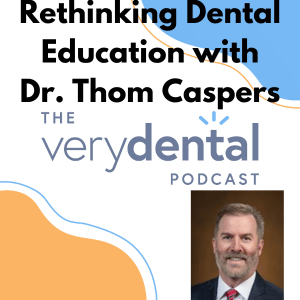
13:574">Alan interviews Dr. Thom Caspers, a former Seattle-area dentist who now teaches at Midwestern University College of Dental Medicine in Arizona. They discuss the early days of Dentaltown, the transition from private practice to academia, and the unique aspects of Midwestern's dental program, including its focus on the private practice model and comprehensive patient care. They also delve into the challenges and opportunities facing dental students today, including the impact of social media, rising tuition costs, and the evolving landscape of dental technology.
15:18">Key Takeaways:
- 17:223">Dentaltown's Influence: Dentaltown played a crucial role in shaping Thom and Alan's careers and connecting them with other dentists.
- 18:282">Midwestern's Unique Model: Midwestern's dental program stands out for its private practice model, where students work in suites with experienced faculty, providing comprehensive care to patients. This approach fosters continuity of care, mentorship, and real-world experience.
- 19:260">Competency-Based Education: Midwestern emphasizes competency-based education. This contrasts with traditional dental schools that often rely on a set number of procedures.
- 20:242">Financial Realities: Dental students today face significant financial burdens due to rising tuition costs. While Midwestern offers some opportunities for loan forgiveness, many students are drawn to DSOs for their financial incentives.
- 21:229">Social Media's Impact: Social media presents both challenges and opportunities for dental students. While it can provide valuable information and connections, it can also contribute to anxiety and unrealistic expectations.
- 22:199">Technology in Dental Education: Midwestern embraces technology, offering students access to CAD/CAM systems for same-day dentistry, but significantly less emphasis on traditional lab work.
- The Changing Student: Thom observes that today's dental students are different from previous generations, with higher levels of anxiety and a preference for technology-driven learning.
Some links from the show:
Join the Very Dental Facebook group using the password "Timmerman," Hornbrook" or "McWethy," "Papa Randy" or "Lipscomb!"
The Very Dental Podcast network is and will remain free to download. If you'd like to support the shows you love at Very Dental then show a little love to the people that support us!
--
Crazy Dental has everything you need from cotton rolls to equipment and everything in between and the best prices you'll find anywhere! If you head over to verydentalpodcast.com/crazy and use coupon code "VERYDENTAL10" you'll get another 10% off your order! Go save yourself some money and support the show all at the same time!
--
The Wonderist Agency is basically a one stop shop for marketing your practice and your brand. From logo redesign to a full service marketing plan, the folks at Wonderist have you covered! Go check them out at verydentalpodcast.com/wonderist!
--
Enova Illumination makes the very best in loupes and headlights, including their new ergonomic angled prism loupes! They also distribute loupe mounted cameras and even the amazing line of Zumax microscopes! If you want to help out the podcast while upping your magnification and headlight game, you need to head over to verydentalpodcast.com/enova to see their whole line of products!
--
CAD-Ray offers the best service on a wide variety of digital scanners, printers, mills and even their very own browser based design software, Clinux! CAD-Ray has been a huge supporter of the Very Dental Podcast Network and I can tell you that you'll get no better service on everything digital dentistry than the folks from CAD-Ray. Go check them out at verydentalpodcast.com/CADRay!
[00:00:00] Let's be honest, running a dental practice takes grit and determination. Between keeping your schedule on track, supporting your team, and delivering top-notch care, it can feel like there's never enough time in the day. And when things aren't organized, that's when the real stress starts to build. I've talked to so many practice owners who say the same thing. There's got to be a better way to stay organized. And the truth is, there is. They've developed the Color Method, a smart, color-coded system for organizing our instruments and materials. We're talking procedure tubs, trays, burr blocks, and affordable cassettes,
[00:00:29] that make it easy to stay on top of everything. So your team works more efficiently and your day runs smoother. I've had the Zerk team on the podcast a number of times to talk more about this. And the fact is, you can no longer afford to ignore lean clinical performance. Just picture it. No more of your assistant getting up to retrieve something mid-procedure. No more frustration with misplaced materials. No more expired materials costing you thousands. Imagine easier onboarding with new hires. And best of all, being self-sufficient for weekend emergency calls. With Zerk's Color Method, you're not just saving time. You're creating an environment where you're going to be a better place.
[00:00:59] Where your team can thrive and your patients and your bottom line feel the difference. If you're ready to trade clutter and disorganization for control, visit colormethod.com. Trust me, you'll wonder why you didn't do it sooner. That's colormethod.com. Your path to a more efficient, stress-free practice. Check it out today. Your future self will thank you.
[00:01:19] This is a production of the Very Dental Podcast Network. This is the Very Dental Podcast. Welcome to the Very Dental Podcast, where you'll find entertaining and relevant conversations
[00:01:40] with visionaries, clinicians, and your friends in the dental space. Now, here's your host, Dr. Alan Mead.
[00:01:48] Very Dental people, welcome to another episode of the Very Dental Podcast. I'm your host, Dr. Alan Mead.
[00:01:53] Joining me is co-host, a guy who was on one of the very first Dental Hacks episodes. I don't know if he remembers that or not. He was on one of the original Brain Trusts.
[00:02:03] A guy by the name of Dr. Tom Caspers. Tom, how are you doing?
[00:02:06] Good. Thanks for having me. Yeah, I do remember that. That was very early on.
[00:02:10] It was early. What's funny, too, probably Tom remembers this as well. You guys were all on a group chat from a bunch of us that sort of were.
[00:02:19] I don't know that we were not on Dental Town, but we were not into Dental Town as much as we were.
[00:02:25] And that group chat is where I workshopped the idea of doing a podcast at all, because I had been listening to lots of podcasts,
[00:02:30] and there weren't a lot of dental podcasts at the time. So you guys were all, if I remember correctly,
[00:02:35] I rolled out the theme music to you guys first, just to see if it sounded okay and all that.
[00:02:39] It was just like 11 years ago or something like that.
[00:02:42] Yeah, yeah.
[00:02:43] Yeah, I was still in Washington.
[00:02:45] That's right.
[00:02:46] That's right.
[00:02:46] So one of the things I want to talk to Tom about is the early Dental Town days.
[00:02:50] And he practiced in Washington around Seattle. It wasn't in Seattle.
[00:02:55] Yeah, I was just south in the suburbs.
[00:02:56] Okay. Okay. So he was a Seattle guy, and then he moved to Arizona. And I want to hear about that.
[00:03:01] And now he teaches at a dental school, which is actually one of the reasons he reached out to me.
[00:03:05] Matt Standridge and I had been talking so much about what younger dentists are coming into and what their expectations are and all that stuff.
[00:03:12] So we have lots to talk about. But I guess I met Tom. I got on Dental Town in 2002.
[00:03:18] And I think you were probably already there, I'm guessing. Would that be right?
[00:03:22] Yeah, I think I was 2001, something like that. Excuse me.
[00:03:27] So Dental Town was kind of social media before there was social media, really.
[00:03:30] It was a bulletin board system. So it was a little bit, the technology wasn't the same, but it was, I think it fed the same parts of your psyche to go on and be with other dentists.
[00:03:41] What was Dental Town to you?
[00:03:43] Yeah, it was huge because prior to that, practicing through, for me, the late 80s and through the 90s, it was every man was an island.
[00:03:51] You went to your study club meetings once a month, and you would talk to people, but nobody wanted to put their guard down and talk about problems they were having.
[00:04:00] So there wasn't really a place to vent or to commiserate or find out what was working.
[00:04:06] The problem is you don't really start to see how successful you are until your senior recalls for five, six, seven years.
[00:04:14] So that was just a huge thing. I'm always going to be grateful to Howard Fran for that.
[00:04:21] That was a huge thing.
[00:04:23] Honestly, Dentaltown affected basically everything I did in dentistry at that point.
[00:04:30] Like it was early on, it was the composite versus amalgam.
[00:04:33] And I remember the neuromuscular versus CR and epic threads about dental topics.
[00:04:40] What's funny though, is that I don't know that it was always necessarily civil, but it was, at the time it was the Wild West.
[00:04:46] And you could say what you were thinking. It was pretty great.
[00:04:48] But it was also like, those were the people that I knew.
[00:04:50] Those were, I spent an inordinate amount of time on Dentaltown.
[00:04:54] When I started, I didn't, I literally had just gotten out of treatment and everything.
[00:04:57] So I was newly recovering and Dentaltown was the addiction I fell into.
[00:05:01] And there were a lot of people that weren't necessarily like me that were still on there all the time.
[00:05:05] So we had this community of people that we just knew over there.
[00:05:09] That's right. Hey, that reminds me, I wanted to congratulate you.
[00:05:12] You said 20 years now?
[00:05:14] In about 11 days or so.
[00:05:16] Okay.
[00:05:17] Everything goes the way I expect it will.
[00:05:18] Well, 23 years.
[00:05:21] So yeah.
[00:05:22] Oh, wow.
[00:05:22] Wow.
[00:05:22] That's incredible.
[00:05:23] I came in 2002.
[00:05:25] But, and it is funny because it was another recovering person that pointed me to Dentaltown too.
[00:05:31] I don't know.
[00:05:32] I remember seeing something that they had posted somewhere and I emailed them and they say,
[00:05:39] Hey, you should try this thing on.
[00:05:40] Oh man.
[00:05:41] That's all it took.
[00:05:42] I was off to the races.
[00:05:43] Yeah.
[00:05:43] It affected the way I practiced dentistry for the next solid shoot.
[00:05:46] There's still things and people that I do that I learned on Dentaltown.
[00:05:51] Oh yeah.
[00:05:52] A ton of people that were on the podcast, guests of the podcast.
[00:05:56] I've had Jason Smithson on countless times on the podcast.
[00:05:59] He was just getting up and running as the clinician and teacher that he is now.
[00:06:03] There was just a lot of people got their start there.
[00:06:06] So it was just a, it was really influential to me.
[00:06:08] And I know, and I've stayed in touch with a lot of those people.
[00:06:11] It's pretty amazing.
[00:06:12] Some people I've met since that were there.
[00:06:14] And because they had a handle that I didn't know their name.
[00:06:17] I just knew them as their, like Kevin Fryer, who's on the podcast all the time was big dumb
[00:06:21] molar.
[00:06:22] He was, he was there.
[00:06:23] I knew of him, but I didn't know that.
[00:06:25] I didn't ever attach a person to it.
[00:06:26] I just knew him as big dumb molar.
[00:06:28] I should probably call him that.
[00:06:29] Just see how he reacts.
[00:06:32] But yeah, Tom was one of the, Tom was one of the guys too.
[00:06:35] Like you could go on there and you wouldn't necessarily have to show your clinical work,
[00:06:38] but you did.
[00:06:39] You were willing to put yourself out there.
[00:06:40] That was always impressive to me.
[00:06:42] Yeah.
[00:06:43] That I talked to my students about that all the time.
[00:06:46] Just taking photos of your work, having people look at it.
[00:06:49] It's terrifying.
[00:06:50] And you have to, you have to put yourself out there.
[00:06:52] And especially at that time, people weren't bashful about telling you if you did something
[00:06:56] that sucked.
[00:06:57] Yeah.
[00:06:57] Yeah.
[00:06:57] So that was really formative and it really helped my dentistry over the years.
[00:07:01] No question.
[00:07:02] Yeah.
[00:07:03] You, I remember too, you, the washing tradition of, God, were you a Tucker guy?
[00:07:08] Did you ever work on with Tucker study clubs?
[00:07:10] The gold stuff?
[00:07:12] So we, that was basically our curriculum in dental school was that whole gold.
[00:07:17] Yeah.
[00:07:18] So yeah, that's a, that was a big part of my dental DNA.
[00:07:21] Yeah.
[00:07:22] The millennials and younger, there's younger in dentistry.
[00:07:26] Now you can tell me about that, but there, they won't probably understand about the Tucker
[00:07:30] gold stuff, but that was, that was next level.
[00:07:32] And that, that's where a lot of the, a lot of the rubber dam porn stuff started for me.
[00:07:38] Like the stuff, Instagram and Facebook, where these people are really serious about all
[00:07:41] that stuff.
[00:07:42] That was Tucker thing.
[00:07:43] He was like that before it was a thing.
[00:07:45] Yeah.
[00:07:45] Yeah.
[00:07:45] That was beaten into us.
[00:07:47] Literally beaten into us.
[00:07:49] You ended up in Washington.
[00:07:50] You grew up in Washington, didn't you?
[00:07:52] Yeah.
[00:07:52] Yeah, I did.
[00:07:53] Yeah.
[00:07:53] I grew up outside the Seattle area, just a little tiny logging town, less than a thousand people.
[00:07:59] My graduating class was 32.
[00:08:01] Okay.
[00:08:01] Wow.
[00:08:01] So yeah, really ultimate small town.
[00:08:05] Okay.
[00:08:05] And how did dentistry become a thing for you?
[00:08:08] Was it, what do you have it in your family or did you just stumble upon it or what?
[00:08:12] No, my, my dad was a teacher and my mom stayed at home.
[00:08:15] So very Ward and June Cleaver.
[00:08:18] There you go.
[00:08:19] I think like a lot of us, I got braces when I was in high school.
[00:08:22] I'm done.
[00:08:22] Hey, this is a cool thing.
[00:08:24] So I talked to my orthodontist and he said, Hey, yeah, it's a great profession, but you
[00:08:28] have to go through dental school.
[00:08:29] And so go check out dentistry and make sure that's something you want to do first.
[00:08:32] So I did the typical thing, did some shadowing and whatnot and went to dental school and enjoyed
[00:08:38] the general dentistry part of it.
[00:08:40] Here I am.
[00:08:41] There you go.
[00:08:42] When you got out of dental school, how did you, you were a practice owner in, in, in
[00:08:46] Washington for quite some time.
[00:08:47] How did that come about?
[00:08:48] Were you an associate first and bought in?
[00:08:50] What'd you do?
[00:08:52] Yeah.
[00:08:52] My, my first year, I thought I was going to get into a group practice with a couple of
[00:08:57] older dentists.
[00:08:59] They were looking at building a new building.
[00:09:00] And as you can imagine, trying to get a bunch of dentists to agree on things ultimately
[00:09:06] imploded.
[00:09:07] So I found out I found myself with no place to go.
[00:09:09] So, so I did some day or two here and there associate kind of things until I found the
[00:09:16] practice that I wound up going into.
[00:09:17] It was a guy who taught part-time at UW and he had a great practice.
[00:09:23] I worked as his associate for three years, which was good because it allowed me to learn some
[00:09:28] of the business side of it, which was good.
[00:09:30] We were very ill prepared at that time to, yeah.
[00:09:33] Yeah.
[00:09:34] And then we were partners for three years.
[00:09:37] And then unfortunately he was in a really bad skiing accident.
[00:09:40] Oh, geez.
[00:09:41] Excuse me.
[00:09:41] He had to be airlifted to Harborview, had to have a spinal fusion in his neck and that was
[00:09:46] it.
[00:09:47] He was able to regain most of his function, but he could never practice again.
[00:09:52] Oh, wow.
[00:09:53] Okay.
[00:09:53] Yeah.
[00:09:53] So I took over and it was weird the way things work out was I was interested in moving to
[00:10:00] Arizona at that time.
[00:10:01] My wife and I had actually put money on a house.
[00:10:03] Oh, wow.
[00:10:05] And so we came back and it was the following weekend when he got in the accident and I had
[00:10:10] to buy him out.
[00:10:11] So that was a major life shift at that point.
[00:10:15] Yeah.
[00:10:16] But it worked out fine.
[00:10:18] About when was that?
[00:10:20] What time period was that?
[00:10:22] Let's see.
[00:10:22] Let me do the math.
[00:10:23] That would have been like 93 or four.
[00:10:27] Okay.
[00:10:28] Okay.
[00:10:28] Yeah.
[00:10:28] So you were, I mean, you were in Washington past that for another, God, 15, 15, 20 years,
[00:10:33] something like that.
[00:10:34] Yeah.
[00:10:35] Yeah.
[00:10:36] I practiced there 28 years.
[00:10:38] Okay.
[00:10:38] So it was 2016 when we moved.
[00:10:40] Okay.
[00:10:41] Okay.
[00:10:41] Man, it was okay.
[00:10:42] So it was not even 10 years ago that you moved.
[00:10:44] Okay.
[00:10:44] So you were, I didn't know that you were originally planning on Arizona and then you, that's
[00:10:47] interesting.
[00:10:48] I didn't know that.
[00:10:50] My wife grew up here.
[00:10:51] There's always been a pull for her to get back.
[00:10:54] She thought that she was going to move to Washington and work for a year and then move
[00:10:58] back.
[00:10:58] And that turned into 25 years and three kids and yeah, you know, that whole thing.
[00:11:03] So I remember in 2000, I took, I took Kois, Kois one in Frank and Tammy.
[00:11:09] Yeah.
[00:11:10] And all people that the podcasters probably know were taking it at the same time.
[00:11:14] I was sitting way far.
[00:11:15] I was like third row back.
[00:11:17] They were all sitting in the back as you can imagine.
[00:11:20] So during breaks and stuff, I could go hang out with them.
[00:11:22] And I think, I honestly think we, you took us out to dinner at one point or something like
[00:11:25] that when we were, again, that was the haydip.
[00:11:28] The dental town stuff.
[00:11:29] And so I always just thought of you as a Seattle guy.
[00:11:32] And so when I, when you decided to move, I was like, I didn't, I thought Tom was just
[00:11:35] Mr.
[00:11:36] Seattle.
[00:11:36] So it was just, these are things that dental town will do just enough to be dangerous about
[00:11:42] people or you don't even know their name.
[00:11:44] You just know that their handle or whatever.
[00:11:45] But so you, what, how did you end up in Arizona after being there?
[00:11:51] What was the impetus?
[00:11:51] You knew you always wanted to go back there and you just, the time was right.
[00:11:55] Yeah.
[00:11:55] My wife, as I said, my wife, she comes from a big family.
[00:11:58] Her family was all there with the exception of one brother who was in Washington.
[00:12:03] And I was tired of the rain, started just political environment, the business environment,
[00:12:08] everything was just going in the wrong direction.
[00:12:12] And so we'd been looking at it, as I said, for a number of years.
[00:12:15] Our oldest son at that time was going to be starting his junior year at ASU.
[00:12:19] Okay.
[00:12:20] Our younger son was going to be starting as a freshman and our daughter was going to be
[00:12:24] a freshman in high school.
[00:12:25] So it was a good, it was a good break point.
[00:12:27] Yeah.
[00:12:28] And it was a good time to sell practice.
[00:12:30] Real estate was strong.
[00:12:31] So it was a good time to sell a home.
[00:12:33] So it just all lined up.
[00:12:34] It worked out.
[00:12:36] 20, you must've felt pretty smug through all the.
[00:12:39] Through all the chaos that's happened in Seattle in the last 10 years and COVID and all that stuff.
[00:12:45] Yeah.
[00:12:46] Seattle has, at least it makes the headlines.
[00:12:48] I don't know anything from personal experience, but it sounds like Seattle.
[00:12:51] You got out at the right time.
[00:12:53] It sounds like to me.
[00:12:54] Yeah, I think so.
[00:12:55] And it's been fantastic living here.
[00:12:57] Really nice.
[00:12:58] Yeah.
[00:12:58] And where do you live?
[00:12:59] And I know you're in Phoenix area, but whereabouts?
[00:13:01] Just because we spent some time there too.
[00:13:03] So we're in Scottsdale and so we're probably maybe 10 minutes north of where you had the
[00:13:10] Voices of Dentistry.
[00:13:11] Okay.
[00:13:12] Okay.
[00:13:12] So Gainty Ranch, McCormick Ranch area, if that means anything.
[00:13:16] Yeah.
[00:13:16] It's a nice place.
[00:13:17] Honestly.
[00:13:17] Yeah.
[00:13:18] Every time I've been to Spear several times down there, we had Voices of Dentistry there,
[00:13:21] what, four times or something.
[00:13:23] And every time I'm there, I'm like, ooh, I think I could live here.
[00:13:26] I think.
[00:13:26] Yeah.
[00:13:26] Like I was at Spear in August once and I was like, oh, you're going to see it at its worst.
[00:13:31] I'm like, nope, I'm here for it.
[00:13:33] Everything's air conditioned.
[00:13:34] So it's fine.
[00:13:35] It was, I like it there.
[00:13:37] I like it there a lot.
[00:13:38] It's inverse living compared to being in the Northwest.
[00:13:42] So here you've got four months that are really hot and you spend a lot of time indoors.
[00:13:48] And the winter's in the Northwest.
[00:13:50] It's dark, rainy, cloudy, just miserable, cold.
[00:13:53] Nobody wants to go outside.
[00:13:54] Yeah.
[00:13:55] But here I get up early.
[00:13:57] I'm an early morning person.
[00:13:58] I get up, roll out, go for a swim.
[00:14:01] It's two degrees at six in the morning.
[00:14:04] It's just fantastic.
[00:14:06] Yeah.
[00:14:06] And then it's hot during the day, but once the sun goes down, you can be outside.
[00:14:11] And so you've got 365 days of outdoor living here really if you want.
[00:14:16] No, that's appealing to me.
[00:14:18] And I've since picked up mountain biking and I know that's a great place to have a mountain
[00:14:21] bike.
[00:14:22] I know that.
[00:14:22] Yeah, absolutely.
[00:14:23] Yeah.
[00:14:23] We just went on a nice hike up in the Sonoran Preserve yesterday.
[00:14:26] It's 72 degrees.
[00:14:28] Yep.
[00:14:28] Every time I go to here, I'd find this.
[00:14:31] I can't remember the place, but it was like, it was literally like a couple blocks from
[00:14:36] like just regular neighborhoods.
[00:14:37] And you go up there and it was this insane hiking.
[00:14:41] There's just tons of it.
[00:14:42] Yeah.
[00:14:42] Mm-hmm.
[00:14:43] And it was basically built around a big mountain.
[00:14:45] I wonder if it's the same place we're talking about.
[00:14:46] The place is awesome.
[00:14:47] It's amazing.
[00:14:48] Yeah.
[00:14:49] It had short loops.
[00:14:51] It had long loops.
[00:14:51] It had everything.
[00:14:52] It was so cool.
[00:14:53] I, and it was, everyone thought I was nuts that I wasn't like wanting to go to all the
[00:14:57] restaurants.
[00:14:58] I'm like, nope, I want to go out in the desert and see what it looks like out there.
[00:15:01] Michigan is a beautiful place, but it's flat.
[00:15:03] It's very flat.
[00:15:05] And it's very dark for a good portion of the year.
[00:15:07] Speaking of that right now, actually.
[00:15:09] Yeah.
[00:15:10] Yeah.
[00:15:10] Very similar.
[00:15:11] Move to Arizona.
[00:15:12] Come teach at Midwestern.
[00:15:13] I'll tell you what, man.
[00:15:15] That has some appeal.
[00:15:17] Yeah.
[00:15:17] We'll talk more about this, but really it's been fantastic.
[00:15:21] It's, it's a great second career.
[00:15:23] Yeah.
[00:15:23] So you, when you sold your practice, you're leaving Seattle.
[00:15:27] You just, you'd been an owner for that long.
[00:15:29] You sold your practice.
[00:15:30] Did you know you were going to go to teach by at that point?
[00:15:32] Or were you like, let's see what happens?
[00:15:33] What was the mindset there?
[00:15:35] I knew that there were two dental schools in Arizona, but I had no thoughts about it.
[00:15:39] I had actually, I was sending out resumes to Striker and like medical supply companies.
[00:15:45] And my dream job was to get a job with Striker working in ORs doing robotic surgery.
[00:15:52] Oh, wow.
[00:15:52] Because it was that whole CAD cam transfer.
[00:15:56] What I found is it's not like the old days of going into HR and handing off a resume and
[00:16:02] talking to somebody.
[00:16:03] It's everything's online.
[00:16:05] You put in the information, you hit send, and you hope that you have enough
[00:16:08] keywords there that, you know.
[00:16:10] Somebody sees it.
[00:16:11] Somebody actually sees it.
[00:16:13] So that wasn't very fruitful.
[00:16:16] And I reconnected with a friend from Washington who I'd gone to dental school with, and he was
[00:16:21] teaching at Midwestern and I'll go out there and check it out.
[00:16:25] So I did that for a day a week for the second year I was here.
[00:16:28] And then really liked the people and the whole program.
[00:16:31] And they had a clinical opening the following year.
[00:16:35] So I applied and they had an advanced general dentistry program at that time.
[00:16:41] And so they brought me in to direct that and did that for two years.
[00:16:46] And then unfortunately the program got killed by CODA, who is the dental accreditation thing,
[00:16:51] because I wasn't, because we didn't have a prosthodontist that was running it.
[00:16:55] But yeah, that's kind of how I wound up there.
[00:16:57] It was just complete dumb luck.
[00:17:00] That's wild.
[00:17:00] Okay.
[00:17:01] I have a question.
[00:17:02] Why do they call it Midwestern University if it's in Arizona?
[00:17:05] That's based out of Chicago.
[00:17:07] So Chicago is the Midwestern connection.
[00:17:09] I've always wondered that because they have multiple campuses.
[00:17:11] Okay.
[00:17:12] Okay.
[00:17:12] Yeah.
[00:17:12] So they have their primary one in Downers Grove, the suburbs of Chicago.
[00:17:17] And then this one started, I want to say early 2000s, maybe late 90s.
[00:17:22] And the dental school started, I think, 2006 and graduated its first class in 2010 or 11.
[00:17:30] Something like that.
[00:17:30] Yeah.
[00:17:31] It's new.
[00:17:32] It is new.
[00:17:32] And you come from the University of Washington, which is honestly right up there with dental
[00:17:37] schools that have tradition.
[00:17:38] If you want to be a prosthodontist, Washington's the place to go.
[00:17:41] And honestly, it's known for the Tucker and all that stuff.
[00:17:44] There's lots of Washington tradition.
[00:17:45] It's been there forever.
[00:17:46] It's like Michigan.
[00:17:47] Michigan's been there forever.
[00:17:48] You're at a brand new dental school.
[00:17:50] It's got no reputation or anything, or it didn't have.
[00:17:52] So how do they handle that?
[00:17:53] How do they get the word out?
[00:17:54] It's a different, you don't think of universities as starting.
[00:17:58] I always think of universities have always having been there.
[00:18:01] Like it's this fixture.
[00:18:02] I'm like, but all of a sudden you've got a campus and a dental school that started
[00:18:05] in recent memory.
[00:18:06] That's wild.
[00:18:08] Yeah.
[00:18:08] It was almost like a grassroots kind of thing.
[00:18:11] And the first dean, or maybe it was the second dean that was there, had this idea of this
[00:18:17] dental school that's all based on the private practice model.
[00:18:21] Instead of having departments, we don't have any departments.
[00:18:24] We have a kind of a short administrative chain.
[00:18:28] But it was, like I said, started with the idea of private practice models and experienced
[00:18:35] general practitioners coming in and teaching.
[00:18:37] And so we have 20 suites each, pardon me, 10 suites.
[00:18:44] Each suite has 20 chairs and there's a leader for each suite and then two additional faculty
[00:18:50] and then 14 student pairs for each suite.
[00:18:53] So 28 students in each.
[00:18:56] It's a huge building.
[00:18:57] There's a third floor with specialists.
[00:19:00] Okay.
[00:19:00] And it's essentially, so I have a suite that I run and it's like having a practice with
[00:19:05] two senior dentists, the faculty, and then 28 junior dentists, the students.
[00:19:11] And the students work in pairs as a D3 and a D4.
[00:19:14] Okay.
[00:19:14] So there's always this lineage.
[00:19:16] So once the D4s graduate, the D3s rise, then the D2s come in and get partnered up.
[00:19:22] So they have this mentorship and partnership that works out really well.
[00:19:26] That's wild.
[00:19:27] And then, and then we do almost everything on the floor procedure wise.
[00:19:32] And then if it's outside the skillset of the students, then they'll do it with a specialist.
[00:19:37] That's wild.
[00:19:38] So how are, my, the first place my mind goes, okay, if you're doing everything in within a,
[00:19:45] there's a consistency there that I didn't have at the University of Minnesota.
[00:19:49] It was all departments and everyone, every department had a reputation for this, that God
[00:19:54] help you if you needed a perio consult anywhere.
[00:19:57] Cause like they were always understaffed and they were always running ragged.
[00:20:01] And so you were an operative needed a perio consult.
[00:20:03] You're going to wait for an hour or something.
[00:20:04] So you're never going to get anything done.
[00:20:06] And it sounds like you guys handle all of it in under one roof there a little bit.
[00:20:11] It sounds like.
[00:20:11] So patients are holistically treated by that suite.
[00:20:14] Is that right?
[00:20:15] Yeah.
[00:20:15] Think of the suite as your office.
[00:20:17] Okay.
[00:20:17] The patient, new patient comes in, you provide all the services that, that you would provide
[00:20:22] as a general dentist for them.
[00:20:24] And then if it's outside your skillset, then you refer it out.
[00:20:27] Instead of it going to an outside provider, it goes to one of the specialty providers.
[00:20:33] And we don't have, we don't have grad programs.
[00:20:35] Okay.
[00:20:35] Yeah.
[00:20:36] The students get to do, they don't have specialty students cherry picking cases.
[00:20:41] Cause that was always the thing you come up.
[00:20:43] This really cool case in dental school.
[00:20:44] And they're like, all right, man, this looks awesome.
[00:20:47] Yep.
[00:20:47] There it goes.
[00:20:47] Some resident.
[00:20:48] Yep.
[00:20:49] Exactly.
[00:20:49] Some resident gets to do it.
[00:20:50] So yeah, it's really a good system that way.
[00:20:53] It sounds like, okay.
[00:20:54] So it sounds like you're, they're probably better prepared for what it's like to work
[00:20:58] in the real world than I ever was in dental school.
[00:21:01] And mind you, I was, it was a long time ago and it was what it was.
[00:21:05] But so I do know that other schools are using a similar model.
[00:21:09] Like I I've talked with, we have the student that does the very dental student Mo described
[00:21:15] a somewhat similar system at Oklahoma.
[00:21:18] So I think probably dental schools are getting wise to this and it's probably, probably students
[00:21:22] like it more.
[00:21:23] They probably get more out of it.
[00:21:24] And also, God, I can only imagine that if you have the same faculty you're dealing with
[00:21:29] all the time, you probably have a little bit more confidence to ask them questions, to
[00:21:34] be a little vulnerable to, but because God, you never knew who you're going to work with.
[00:21:38] And I remember that.
[00:21:39] Whatever you do, don't schedule an operative on Thursday mornings.
[00:21:42] One of those things.
[00:21:42] Cause there was a chance you're going to get with one of the people that, you know, or you
[00:21:46] try and schedule every process at one, knowing that you got along really well with one instructor
[00:21:51] and you would go to great lengths to get that instructor and all that stuff.
[00:21:55] It was, there was a lot of manipulation of the system.
[00:21:57] I remember that.
[00:21:58] It sounds like they don't really have to do the, you guys are the faculty.
[00:22:01] Is that kind of how it works?
[00:22:03] So I'm always in this suite and then the faculty will rotate maybe twice or once yearly.
[00:22:11] So one of the things about being in a younger school is it's, there's a lot of flux and
[00:22:17] it's nice because there's not this huge layer of administration to go through that they can
[00:22:22] make changes pretty rapidly.
[00:22:24] Yeah.
[00:22:24] So there's been different iterations of the rotations, but they're on a year long where
[00:22:30] they'll come into the suite for a year now.
[00:22:32] And that seems to be really good.
[00:22:33] It gives us the students continuity and stability and they like to have the same faces.
[00:22:41] So what I do is I do all of the screenings for all the new patients coming in and I do
[00:22:47] all the comp exams and then we'll treatment plan collectively as faculty if it's a little
[00:22:53] bit more complex, but simple stuff we won't.
[00:22:57] And then I make up the schedules each day.
[00:22:59] We try and have continuity of care with the students for anything that's ongoing.
[00:23:03] Let's say they're doing a partial or a denture and there's going to be five or six visits.
[00:23:07] It's they'll work with the same faculty each time.
[00:23:09] They have continuity because, you know, we try and calibrate, but we've all had different
[00:23:13] practice experiences and whatnot, our own little biases.
[00:23:18] So yeah, it works out really well.
[00:23:19] So we had a...
[00:23:20] Do you just work with the same patients all the time or are the patients divided up amongst
[00:23:24] the students with, because different procedures are needed?
[00:23:27] But what we always ran into is you'd have one student in my class that had already done
[00:23:30] 30 crowns by the time they were in their junior year.
[00:23:33] And then some of us had not done any or something like that.
[00:23:35] How do you handle that?
[00:23:37] So the students have their own patient pool.
[00:23:39] Okay.
[00:23:40] And for them to graduate, we don't have a number of procedures that they have to do.
[00:23:46] Interesting.
[00:23:47] They have to...
[00:23:47] So we're on a competency-based system.
[00:23:51] So essentially, in order to become considered competent in something, they have to be able
[00:23:55] to do it start to finish with minimal or no direction or advice.
[00:24:01] Sure.
[00:24:02] They still have the checkpoints along the way to make sure, did you get the carriers out,
[00:24:06] is your prep drawing, and those kinds of things.
[00:24:08] But they're responsible for doing that.
[00:24:10] So there's not a number.
[00:24:13] And there'll be...
[00:24:14] You remember that.
[00:24:15] There were numbers for you.
[00:24:17] I know it.
[00:24:17] And there are numbers...
[00:24:18] Oh, absolutely.
[00:24:19] Yeah.
[00:24:19] Every department had their own little flip book thing.
[00:24:21] And you were just like, oh God, I just remember.
[00:24:23] Oh yeah.
[00:24:24] I was a super senior.
[00:24:25] I didn't even finish on time because I had a few of those books that were not quite full
[00:24:30] by the time I got out.
[00:24:30] I love the idea of a competency.
[00:24:33] And honestly, working with the same faculty would give a student more confidence because
[00:24:38] they could...
[00:24:38] I don't know, man.
[00:24:39] I just feel like that would be huge.
[00:24:41] That sounds like a way better way to do it than what I...
[00:24:43] And from my standpoint, it's great because I get to work with these students for two years
[00:24:49] before they graduate and really get a chance to know them.
[00:24:51] Hopefully, you know, influence them positively so that when they get out, they have a good
[00:24:56] chance for success.
[00:24:58] So it's...
[00:24:59] I would say probably two-thirds of the faculty has a similar background to me.
[00:25:04] Really experienced practitioners.
[00:25:06] A lot of real world experience.
[00:25:08] Really good people.
[00:25:09] They care about the students.
[00:25:10] They want to see them succeed.
[00:25:12] These students pay just a huge amount of money.
[00:25:16] It's...
[00:25:17] And that was something that had some internal struggles.
[00:25:20] Yeah.
[00:25:21] Initially, thinking about starting here, it's like, wow, these guys are putting all this
[00:25:24] money.
[00:25:25] Are they going to be able to get it back?
[00:25:27] Yeah.
[00:25:28] I'm curious about your thoughts on that.
[00:25:29] But did the students...
[00:25:30] What I remember, and I've talked to many people since then, I would just show up at the financial
[00:25:38] aid office every quarter or so and sign on the dotted line.
[00:25:41] And I'm sure that they tried to explain to me what was going on, but I had an operative
[00:25:45] practical that was happening in five minutes.
[00:25:47] So I had to get the hell out of there.
[00:25:49] Like, I never...
[00:25:50] There was no understanding of what I was taking out loan-wise.
[00:25:55] It was just...
[00:25:55] Look, I'm here.
[00:25:56] I'm halfway through this thing.
[00:25:57] I can't stop.
[00:25:58] So I got it.
[00:25:59] Whatever I got to do, I'm going to sign on the dotted line and I'll talk to you later.
[00:26:02] I remember that vividly.
[00:26:03] I remember vividly not being able to worry about it.
[00:26:06] And then you graduate.
[00:26:08] And then you get to visit the bursar's office to explain, to sign on the dotted line to get
[00:26:12] you out of there.
[00:26:13] And you're like, oh, wow.
[00:26:14] I had no idea.
[00:26:15] I didn't even know what loans I'd taken.
[00:26:16] I'd taken a bunch of University of Minnesota loans that I didn't...
[00:26:20] Separate from the Stafford Federal.
[00:26:22] I'd taken a bunch of...
[00:26:22] And mind you, I got out with $85,000 in debt.
[00:26:26] I've said this about a thousand times on the podcast.
[00:26:28] And I thought that was a lot.
[00:26:29] I'm like, oh my God, what am I going to do with that?
[00:26:31] And that's nothing.
[00:26:33] That wasn't even freshman year.
[00:26:34] Now, it's just like...
[00:26:35] 85,000 seemed like a lot at the time.
[00:26:37] But it was...
[00:26:38] I remember vividly my payment per month once I refinanced it some ridiculously low amount.
[00:26:44] I think it was like 1.7% or something like that.
[00:26:47] And my account was pissed because I was paying it off faster than I needed to.
[00:26:51] That's the cheapest money you're ever going to get in your whole life.
[00:26:54] Stop it.
[00:26:54] So my payment was $446.71.
[00:26:58] That was it.
[00:26:58] And I'm thinking to myself, a kid graduating now, you got to figure, do they know what
[00:27:05] they're going to be paying on a monthly basis when they get out, do you think?
[00:27:09] Oh, yeah.
[00:27:10] Yeah, for sure.
[00:27:11] And there's different repayment strategies.
[00:27:14] They can pay, I think it's a percent of their income or...
[00:27:20] There's different ways that they can go about it.
[00:27:22] But the students that are really on top of it, going into it, they'll do a national health
[00:27:29] services scholarship or a military scholarship, public health, those kinds of things.
[00:27:34] Or they'll go to work for a nonprofit.
[00:27:37] So we've had some students that have practiced for 8 to 10 years.
[00:27:42] They come back.
[00:27:43] They work at Midwestern.
[00:27:44] After 10 years, their loans are forgiven because we're considered a nonprofit.
[00:27:47] I got it.
[00:27:48] I got it.
[00:27:48] Okay.
[00:27:48] And then there's a lot of really nice cars in the parking lot.
[00:27:53] Wow.
[00:27:53] And yeah, it's crazy.
[00:27:55] So when you go and you see the Porsches and the Land Rover SUVs, it's not the faculty that's
[00:28:01] driving those.
[00:28:01] It's a lot of the students.
[00:28:02] So they've got parents that are able to pay for it.
[00:28:05] Yeah, I can't imagine.
[00:28:06] So the typical number that I hear from the students is it's about a half million right
[00:28:11] now for four years with their living expenses.
[00:28:14] Yeah.
[00:28:15] But I would think...
[00:28:16] What is Midwestern in technically?
[00:28:18] Uh, Glendale.
[00:28:20] Okay.
[00:28:20] Glendale.
[00:28:20] And would you say Glendale?
[00:28:22] How does Glendale rate as far as cost of living in the Phoenix area?
[00:28:26] Is it high, low, mid?
[00:28:28] Uh, I would say it's probably mid.
[00:28:30] Okay.
[00:28:31] Okay.
[00:28:31] Yeah.
[00:28:31] Because I just, you lived in Ann Arbor or I was in Minneapolis.
[00:28:34] Cost of living.
[00:28:35] I was able to get by pretty cheaply, but I had friends that didn't bother.
[00:28:40] They were...
[00:28:40] I lived in the Si Omega house for three years and that was a public health problem, the
[00:28:46] Si Omega house.
[00:28:47] But it was, when I was the treasurer for two years, it was 150 bucks a month to live in downtown
[00:28:52] Minneapolis.
[00:28:53] It was a pretty good deal.
[00:28:53] Like you, I lived pretty cheaply at the time and I knew friends, I had friends that were
[00:28:58] paying six, 700 bucks a month for an apartment.
[00:29:00] And of course now I'm sure in Glendale, I'm sure that it's twice as much as that or more.
[00:29:04] I just am like, man, cost of living.
[00:29:06] I don't know how anyone would ever choose to go to University of Michigan for the sheer
[00:29:10] fact that it's so expensive to live in Ann Arbor.
[00:29:12] It's expensive to park in Ann Arbor for crying out loud.
[00:29:14] So I don't...
[00:29:15] Again, all of this stuff was lost on me because I seemed to weasel around it, but it just,
[00:29:21] everything is expensive about going to school now.
[00:29:24] Even more so than it ever was.
[00:29:25] I think it's just wild to me.
[00:29:26] You're talking about Glendale.
[00:29:27] So one of the big advantages that the school has is we are a 15 minute drive from Sun
[00:29:34] City, which is this massive retirement community.
[00:29:37] So we have, you know, 200 operatories or excuse me, 200, yeah, 200 chairs.
[00:29:43] Okay.
[00:29:43] Just for the D3s.
[00:29:44] That's not including specialty.
[00:29:46] And so it's this huge operation and we keep it full because there are so many retired people
[00:29:53] there.
[00:29:53] So it's almost like doing a geriatric dentistry residency.
[00:29:56] What's crazy about that is it's...
[00:29:58] You couldn't have planned it any better.
[00:29:59] I wonder if they did plan it that way because man, that's...
[00:30:02] Yeah, I don't know.
[00:30:03] Those are the people who need all the dentistry and they probably have funds to get it, to
[00:30:07] do it in a lot of cases if it's a fancy retirement place like that.
[00:30:11] Yeah.
[00:30:11] So we have, when you were talking about numbers earlier, it's really not an issue.
[00:30:17] The only issue about lack of procedures is just whether or not the students are motivated.
[00:30:23] Some of them are, some of them aren't as much.
[00:30:26] They just want to do the minimum and get their competencies.
[00:30:29] But by and large, most of the students take advantage of it.
[00:30:32] Yeah.
[00:30:33] And we've had, I think the record for crowns, I think it was 160.
[00:30:40] That's amazing.
[00:30:41] That's amazing.
[00:30:42] Something like that.
[00:30:42] Yeah.
[00:30:43] And then I think the high water mark for implant placements in the low 40s, 43 or 44.
[00:30:50] So some of these students, it's like doing your dental school and a residency all in one.
[00:30:55] And so they come out really prepared.
[00:30:57] It's great because DSOs and employers love them because they're not your average student at that point.
[00:31:03] Yeah.
[00:31:04] If you pay that much for the education, that makes me feel a little bit better about what the value they're getting out of it.
[00:31:09] That kind of training is unbelievable.
[00:31:11] So you mentioned implants.
[00:31:13] So their implant placement is happening there, it sounds like.
[00:31:16] Oh, yeah.
[00:31:17] Okay.
[00:31:17] How do students learn treatment planning at Midwestern?
[00:31:20] In other words, it sounds like the patients that come in, you guys treatment plan them as the faculty.
[00:31:24] But if the students need to learn that stuff too, how do they, at what point do the students get to start working on treatment plans?
[00:31:30] They do all the treatment planning initially.
[00:31:32] Okay.
[00:31:32] The typical situation is once the patient's been accepted, we'll do the comp exam.
[00:31:37] They'll do it in completion.
[00:31:38] Then I'll sit down and go through it with them and tooth by tooth, do the oral cancer screening, soft tissue exam, all that to confirm what their findings are.
[00:31:49] And then at that point, it's up to them to figure out the treatment plan.
[00:31:53] And I'll talk a little bit about, okay, this tooth is going to need this or this as we're going through this.
[00:31:57] But I want them to start thinking through it.
[00:32:00] And so then they'll present the treatment plan to us and then we'll go through and modify it as needed.
[00:32:07] Yeah.
[00:32:07] So I think back to a time like that.
[00:32:09] I didn't have the benefit of a system like that.
[00:32:12] But even at the University of Minnesota, there were always financial constraints on the way that we treatment plan because the patients would get, some of these patients had been coming to the dental school for a thousand years and they'd done a lot of dentistry.
[00:32:25] But I think about even in my office where I'm pretty blue collar, we still do a fair amount of single tooth to quadrants.
[00:32:32] We're not doing a lot of full mouths.
[00:32:33] But when I'm in a practice like that for as long as I've been, I'm jaded.
[00:32:38] I might not see a patient as holistically as probably the patient deserves and maybe as I should.
[00:32:44] But you're in a position where you're getting this dental student and they're literally looking at patients in this way for the first time holistically and you can steer them.
[00:32:55] And so at what point do you have them treatment plan with no thought for financial concerns?
[00:33:03] Do you have that?
[00:33:03] How do you introduce the treatment planning and how you should look at patients to students like this?
[00:33:08] Yeah, definitely.
[00:33:09] We don't want them to look at the financial concerns about it.
[00:33:12] At this stage, they should be treating everything to ideal.
[00:33:16] Exactly.
[00:33:17] Exactly.
[00:33:17] Yeah.
[00:33:18] We're not, we'll screen patients out.
[00:33:22] So let's say somebody's got a few missing teeth, a lot of wear.
[00:33:26] They'd be a great case for somebody who's really experienced.
[00:33:28] We may not accept that patient for the students because they're not going to be doing full mouth reconstructions as a D3 and D4.
[00:33:36] But this may be somebody that's got a lot of caries control and disease control and we can get them stabilized.
[00:33:43] Yeah.
[00:33:43] Maybe get them in a flux partial or a partial or something.
[00:33:47] And then they can go out to the real world and find a provider.
[00:33:51] Oftentimes they come to the school because it's, they're looking for care that's less money.
[00:33:56] Sure.
[00:33:56] So they're not going to do that.
[00:33:57] But at least it gives the students experience to treat these more comprehensive cases.
[00:34:02] Yeah.
[00:34:02] Even though they're just setting them up.
[00:34:04] And that's the way my practice was.
[00:34:07] I didn't have people coming in saying, hey, Dr. Kaspers, I got 50 grand here.
[00:34:11] I'd love you to give me two arches of ground and bridge, right?
[00:34:15] Next time that happens to me will be the first time.
[00:34:18] Yeah.
[00:34:18] So you get these patients and you take care of them and you build trust and learn how to communicate.
[00:34:24] And as you become more confident in the care that you can provide, you can start offering it.
[00:34:29] That's how it was for me.
[00:34:30] I remember in school that they would hand patients off.
[00:34:33] We had what was called a patient care group and it was just a, we met every week or something like that.
[00:34:39] And there was like, you'd get patients from a senior that was in your patient care group.
[00:34:45] You weren't working with that senior.
[00:34:47] You didn't know the patient and the patient was done.
[00:34:58] That's right.
[00:34:59] That's a good, better experience for the patient.
[00:35:01] Although I got to remember at Minnesota, the patients were, they loved the students.
[00:35:05] Like so many of them are there because they've got time and they enjoyed being around the students.
[00:35:10] And so half the time you got your patients were the ones that were patting you on the back.
[00:35:14] And after you've just been dressed down by an instructor or something like that, the patients were like in your corner.
[00:35:19] It was pretty great.
[00:35:20] But like, I love the idea that you have a consistency for the patients too.
[00:35:24] That's a big, that's a big deal that we definitely didn't have in dental school.
[00:35:28] Yeah, they've done a really good job of setting up the school.
[00:35:32] And it's, I think it was Howard Fran used to say, you can always find the pioneer because they're the one with the arrows in the back.
[00:35:39] And so the school, I think there was a lot of people that weren't necessarily believing that we could do what we were doing.
[00:35:48] But in the last six or maybe the last five years or so, there's been multiple schools that have come through and the dean has given them a hard drive or essentially this is what we do and how we do it.
[00:36:02] And if you want to, if you want to reproduce that.
[00:36:05] So I think Detroit Mercy may have, there was, I'm trying to think of a number of schools.
[00:36:10] It's probably Mercy has, it was really interesting.
[00:36:11] I, of course, it's where my dad graduated from 1968.
[00:36:14] And I looked at Mercy when I was looking at dental schools.
[00:36:18] I was there for a short time and I whispered in my dad's ear for, it was in the roughest part of Detroit.
[00:36:23] Oh yeah.
[00:36:24] And it was still really rough.
[00:36:26] And I said, I can't go here.
[00:36:29] I think he was a little disappointed, but it was like the same dental, the same building that he had graduated from in 1968.
[00:36:35] And I was, this was like 1992 we were looking through, but Detroit has moved twice.
[00:36:40] Like they've moved into two different buildings since then.
[00:36:43] They're in like an old hospital now.
[00:36:45] I actually gave a talk there a while ago and it's such, it's a hospital and it's self-contained.
[00:36:51] It's so cool.
[00:36:51] So I suspect they are doing that in Detroit because they definitely have a kind of a forward thinking way of looking at stuff.
[00:36:57] So what do you think about, oh, go ahead.
[00:36:59] I'm sorry.
[00:36:59] Oh no, that's.
[00:37:01] What do you think about the students that you work with?
[00:37:05] How, do they have an understanding of what they're getting into once they're done with school?
[00:37:10] Do you feel like they have, or what are the things that they understand well and maybe things that they don't understand that well?
[00:37:16] That's a really good question.
[00:37:17] I think they have a kind of a general understanding of what they're going to get into.
[00:37:20] Most of them have picked their path.
[00:37:22] When we were in school, everybody was going into private practice or you were going to go to a residency.
[00:37:28] Hardly anybody did any kind of.
[00:37:30] DSOs, maybe somebody to do a GPR or public health, that kind of thing.
[00:37:36] So a lot of them now know they're going to be on a DSO track.
[00:37:41] I have a few students that are interested in going directly into private practice, but I think the majority are probably doing the DSO.
[00:37:51] Do you think most of them are planning on being around Phoenix area?
[00:37:57] No.
[00:37:58] Right now, the promised land for DSO seems to be Oklahoma.
[00:38:01] Oh, wow.
[00:38:02] Okay.
[00:38:03] Yeah.
[00:38:03] There's been a number of students that are going there.
[00:38:06] Really good opportunities.
[00:38:07] I know a bit about Oklahoma.
[00:38:09] Having worked with Muhammad from the, he's at Oklahoma.
[00:38:12] They have their AAG program is basically world renowned and they've got a lot of, yeah, there's a lot going on in Oklahoma.
[00:38:18] That's interesting.
[00:38:20] Do you feel like, do you feel like the students, what don't they understand?
[00:38:25] What are the things that they might not?
[00:38:26] And I'm curious too, along with that question, you and I didn't have any kind of social media.
[00:38:31] We didn't have, social media wasn't a thing when we were in dental school.
[00:38:34] So we didn't have, we didn't have a lot to compare ourselves to in a lot of ways.
[00:38:37] Do you feel like social media plays into their understanding of real life and what's not real and all that stuff?
[00:38:44] Yeah.
[00:38:45] It's hugely impactful for them.
[00:38:47] Social media is just a double-edged sword.
[00:38:50] Yep.
[00:38:50] So what people post is not always realistic.
[00:38:54] So I think our students are pretty good in keeping in touch with either their previous partner or classmates or something that have gone to, let's say, Oklahoma or California or whatever for different practice opportunities.
[00:39:08] So I think they're pretty well informed in that sense.
[00:39:12] Okay.
[00:39:12] I just was always, I feel, and again, I have strong feelings.
[00:39:15] Social media is a problem for me at times and just because it's a lot of comparing my insides with everyone else's outsides kind of thing.
[00:39:22] And I'm sure I, I always, these kids have grown up with social media.
[00:39:26] They don't know anything but that.
[00:39:28] So there's a part of me that goes, God, what if you dropped them off in the wilderness?
[00:39:31] How would they handle things?
[00:39:32] It's because they're digital natives.
[00:39:34] They all are.
[00:39:34] And maybe that's the old fogey in me talking, but I always wonder, I'm like, man, it's the other thing I'm sure.
[00:39:39] And I didn't really ask you about this, but I'm sure that the technology, dental technology, you guys probably are flooded with it.
[00:39:44] Do you guys do CAD CAM same day chair side stuff for Crownsburg?
[00:39:47] Do you have CAD, like CEREC or CAD CAM there or not really?
[00:39:50] What kind of lab work do they do?
[00:39:52] So we just switched from E4D to CEREC in the last year, which was a huge change.
[00:39:58] Yeah.
[00:39:58] So yeah, that's always been one of the kind of the selling points for the school has been really on top of technology.
[00:40:05] Have the opportunity to do same day.
[00:40:07] Some of them are capable, some not.
[00:40:09] Yeah.
[00:40:09] But it's there.
[00:40:11] They don't do much lab work.
[00:40:13] It's more of a kind of an eight to five experience for them.
[00:40:16] So yeah, very different than what we experienced.
[00:40:19] So their lab work consists of maybe pouring up a model, making an Essex for somebody or making custom trays.
[00:40:25] That's the extent of it.
[00:40:27] We don't do any, almost any cast metal unless I can, unless a patient requests something like that.
[00:40:34] Yeah.
[00:40:34] But it's almost all Emacs, zirconia.
[00:40:37] Okay.
[00:40:37] A little bit of PFM for doing surveyed crowns, those kinds of things.
[00:40:41] Okay.
[00:40:41] Right.
[00:40:42] Yeah.
[00:40:42] So they, it's a shame in a sense because they don't get that experience of having to eat what you kill, so to speak, of do your prep, pour it up, do your lab work, and then make the restoration.
[00:40:54] So that really builds a lot of kind of critical thinking and looking at your preps a little closer.
[00:41:01] It's interesting to me too, because so much of what on social media and podcasts and stuff are, it is lab work.
[00:41:08] People are doing a lot of lab work, but it's digital stuff.
[00:41:10] It's all printing and scanning and all that stuff.
[00:41:12] And I do think that I'm curious.
[00:41:15] Okay.
[00:41:15] So I podcasted with a bunch of guys from Midwestern at the last Voice of Dentistry.
[00:41:20] They showed up, they got, they took a half day off from school, came up and they sat down and podcasted with us.
[00:41:25] And they were really, all of them were really just, they were gung ho to get going.
[00:41:29] And they were, they wanted to be practice owners.
[00:41:32] They were, so I, but I also wonder, I'm like, okay, they're self-selecting.
[00:41:36] If they would bother to show up at a podcasting meeting, clearly they're self-selecting.
[00:41:40] And most people probably are not like that.
[00:41:42] So I'm just like, it is interesting.
[00:41:44] You get to see students all the time and it's just, are they the same as they ever were?
[00:41:48] Or are they different than, you know what I'm saying?
[00:41:50] Obviously they deal with what the school, the level that the school is at, but is it, are kids still kids?
[00:41:58] Yeah.
[00:42:00] It's hard as being the old guy yelling at the kids to get off my lawn.
[00:42:05] Based on my dental school experience and, you know, what I did.
[00:42:10] And I'll see them.
[00:42:12] It seems like this generation, not just dental school, but everywhere.
[00:42:16] There's just a, there's a huge amount of anxiety, a lot of pressures.
[00:42:20] Maybe it's, maybe social media is contributing to that to some degree.
[00:42:24] Yeah.
[00:42:25] I see that a lot.
[00:42:27] And they feel like they're really tapped out.
[00:42:30] Yeah.
[00:42:31] I believe it.
[00:42:32] Yep.
[00:42:33] And they are, that's, this is their experience.
[00:42:35] This is what they know.
[00:42:36] So for them, it's real.
[00:42:38] And I'm, what I realized is it's not fair for me to say, if you were doing what I'd done 20 years ago, you'd be really stressed.
[00:42:46] Yeah.
[00:42:46] That's, you know, their experience is their experience.
[00:42:48] So it is.
[00:42:49] Yep.
[00:42:50] And the idea that it is, I have a tendency to want to think about it as this is what I went through, but that was in the early to mid nineties when it was in stuff was really different.
[00:43:01] And the way that they teach things is different.
[00:43:03] And honestly, more, more importantly, probably is a world environment.
[00:43:08] The fact that they were born with a smartphone in their hand and they've never known anything where they, their entire life wasn't online and everything like that.
[00:43:15] That is, I do think the, I think that online and social media probably, probably affects just the way life is so much more.
[00:43:23] And so it's hard for old guys to put their brain around that.
[00:43:27] Tom, there was a time when I couldn't check my email at any point or I couldn't look at texts or Facebook while I'm at the coffee shop.
[00:43:34] There was a time.
[00:43:35] I remember I had a laptop my freshman year of dental school.
[00:43:38] I had, it was a PowerBook 145.
[00:43:41] I've put, it had a track ball and the screen was grayscale and it was about a thousand pounds.
[00:43:46] And I was the only person that I knew that had a laptop.
[00:43:49] It was revolutionary.
[00:43:50] If you can imagine, I started dental school when laptops were brand spanking new and no one had one.
[00:43:55] And now you're like, everyone's got all the technology and it's all of school is done via a Chromebook or a laptop or whatever.
[00:44:03] It's just like so different.
[00:44:04] It is hard to put your brain around it.
[00:44:06] And honestly, I also, I sometimes wonder about the generations if they can even, if they can even understand each other on some level.
[00:44:11] It's just because my dad practiced dentistry until not that long ago and he graduated in 1968.
[00:44:16] And I always thought he and I could barely understood each other.
[00:44:19] And I'm like, oh my God, I can only imagine.
[00:44:20] So it's wild.
[00:44:21] It's wild.
[00:44:22] And you're seeing a lot of that.
[00:44:24] Yeah, there's definitely a generation gap there.
[00:44:26] Dental school experience was papyrus and stone tablets.
[00:44:29] So way before laptops.
[00:44:32] Also abuse.
[00:44:33] I'm sure it was the classic.
[00:44:35] Look to your left.
[00:44:36] Look to your right.
[00:44:37] One of you.
[00:44:37] Yeah.
[00:44:38] Be here at the end.
[00:44:38] One of those deals.
[00:44:39] Yeah.
[00:44:40] Yeah.
[00:44:40] It was not the student advocate experience like we have.
[00:44:44] In fact, our students are really, they're very well taken care of.
[00:44:48] Yeah.
[00:44:49] Yeah.
[00:44:49] That's for the best.
[00:44:50] Lots of.
[00:44:51] Oh yeah, for sure.
[00:44:52] No question.
[00:44:53] Yeah.
[00:44:53] What we experienced didn't make the dentistry better.
[00:44:56] No.
[00:44:56] That was for sure.
[00:44:57] Honestly, as much as it's not fair to blame, I suspect that I might not have had the same
[00:45:02] experience with addiction if the University of Minnesota experience had been more like
[00:45:06] what the Midwestern experience is.
[00:45:08] Because it was, I, not only was I not ready for it, I wasn't used to that kind of pressure
[00:45:14] and abuse and I didn't handle it very well.
[00:45:15] That's not, I developed coping mechanisms that didn't serve me well.
[00:45:19] And I know that still happens, but the reality is like having a system where you're advocating
[00:45:23] for the students, I think that's, it's all for the better.
[00:45:25] I, you'll never get me to say, oh, what they really need is a little good discipline.
[00:45:29] I'm like, eh, it's not great for me either.
[00:45:31] So I think it's probably a good thing.
[00:45:32] Maybe worth paying more for it too, for that matter.
[00:45:34] Yeah.
[00:45:35] I think the whole COVID experience really changed the students as well.
[00:45:39] So they, you mentioned talking about technology.
[00:45:44] They don't like in-person lectures.
[00:45:47] Their ideal is a recorded lecture that they can play at one and a half or two times speed.
[00:45:54] And then a printout of a PDF of a PowerPoint so that they can get the salient points.
[00:46:00] Yeah.
[00:46:00] And so it's going to be interesting to see, I think licensing boards are keeping in-person
[00:46:06] CE alive, but it's really shifting.
[00:46:10] Yeah, it is.
[00:46:11] Yeah.
[00:46:12] Hands-on is, I think, a really important way to do CE.
[00:46:17] What's interesting is there's places now that are doing hands-on online.
[00:46:21] So in other words, they send you the kit.
[00:46:23] They send you the kit.
[00:46:24] Dennis Hartlebe, he's been on the show.
[00:46:26] He's a great guy.
[00:46:26] He was over at Cosminant forever and he still teaches at Cosminant, but he literally
[00:46:29] sends you the whole kit and you do the CE in your office with your instrumentation.
[00:46:34] But like, he's teaching it live, but you're in your office with all the materials, all
[00:46:39] the kit.
[00:46:39] It's brilliant because it's true hybrid, but like, he's basically recognizing that, yes,
[00:46:47] there's a lot of people that don't like the in-person.
[00:46:49] They don't like the travel.
[00:46:50] They don't like the, and everything's changing.
[00:46:52] It's interesting.
[00:46:53] I don't know.
[00:46:54] You've seen a lot.
[00:46:55] I can only imagine.
[00:46:56] I was just going to say that the travel has really become burdensome.
[00:47:00] Yeah.
[00:47:00] That's, and if you're a younger practitioner, you got kids and decide how much time away
[00:47:05] do my family do I want to spend?
[00:47:07] Yeah.
[00:47:07] There's a lot that goes into that.
[00:47:08] Yeah.
[00:47:09] I used to travel a lot more now.
[00:47:10] Even when my kids were littler, but I just, I barely go anywhere anymore now.
[00:47:14] And maybe that'll change once they're out of high school and stuff, but it's, it is
[00:47:17] interesting.
[00:47:18] I think that's all COVID changed a lot of stuff too.
[00:47:20] So we're, it's an evolution.
[00:47:22] I think it's great that, that you like actually being in a school can talk.
[00:47:26] I've talked to a lot of dental students.
[00:47:28] I haven't talked to very many people that teach at the school, but this was very interesting.
[00:47:31] I really appreciate you being on Tom.
[00:47:33] This was fantastic.
[00:47:33] Oh, absolutely.
[00:47:34] And yeah, it's in touch.
[00:47:36] And honestly, I'll make sure that people have links about the school and everything like
[00:47:40] that so they can see, cause that is, it's interesting.
[00:47:42] I suspect that's the model where we're heading to.
[00:47:44] So thank you a ton for being on.
[00:47:45] Yeah, you bet.
[00:47:46] Yeah.
[00:47:46] If people have questions, that Midwestern email address I've got you is the best place they
[00:47:51] can.
[00:47:51] Perfect.
[00:47:51] Like I said, we're in our faculty pool, unfortunately is my age or a little bit older.
[00:47:57] So we're always looking for people.
[00:48:00] I've, in fact, I was trying to twist Melissa Zeller's arm.
[00:48:06] She has an Arizona connection too.
[00:48:08] So there's that.
[00:48:09] I know.
[00:48:09] Yeah.
[00:48:10] We had, yeah, we talked about that.
[00:48:11] Yeah.
[00:48:12] All right.
[00:48:12] Hey, Tom, thanks a ton for being on.
[00:48:14] This was great.
[00:48:15] Thanks, Ellen.
[00:48:15] Thanks, Ellen.
[00:48:15] Nice.
[00:48:16] Nice.
[00:48:16] Yeah.
[00:48:16] Nice.