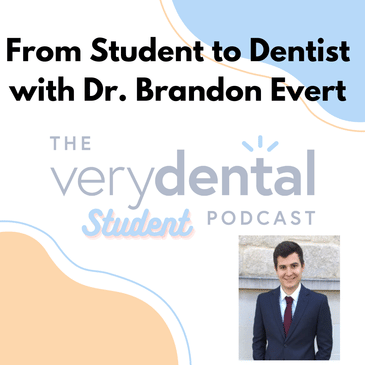
This throwback episode features how we introduced the Very Dental Student Podcast! Mohamed talks with Al for a couple minutes and then brings in Dr. Brandon Evert to talk to him about the transition from student to dentist!
Original show notes:
Welcome to the inaugural episode of the Very Dental Student Podcast! Alan introduces your host, Mohamed Abo-Basha, who is a D2 at University of Oklahoma! Al's tips for dental students:
- If you can swing it, many dental companies will sell stuff to dental students at a pretty great discount (think loupes, headlamps, etc.)
- Take advantage of your dental student email address!
Then, Mohamed brings the one and only Dr. Brandon Evert on for an amazing interview!
- Brandon's take on dental school
- Learn what kind of student you are (morning person, night person) and learn how to organize a routine
- Comparing and contrasting dental school styles (case studies vs. route memorization)
- When did you first get patient contact?
- Brandon was heavy on reps in the sim lab (note from Al: that makes Brandon smart!)
- Get used to indirect vision in preclinic!
- Brandon's first year out and his 4 year military commitment
- Military = seeing LOTS of dentistry
- Rotations at Paris Island (CAD/CAM, endo with a scope, surgery)
- Is the military experience worth it?
- Brand explains the financial aspects of a military scholarship ("it's not just a way to get free dental school.") and the non-financial aspects
- HPSP vs. HSCP
- Brandon's long term plan for private practice
Some links from the show:
Join the Very Dental Facebook group using the password "Timmerman," Hornbrook" or "McWethy," "Papa Randy" or "Lipscomb!"
The Very Dental Podcast network is and will remain free to download. If you'd like to support the shows you love at Very Dental then show a little love to the people that support us!
--
Crazy Dental has everything you need from cotton rolls to equipment and everything in between and the best prices you'll find anywhere! If you head over to verydentalpodcast.com/crazy and use coupon code "VERYDENTAL10" you'll get another 10% off your order! Go save yourself some money and support the show all at the same time!
--
The Wonderist Agency is basically a one stop shop for marketing your practice and your brand. From logo redesign to a full service marketing plan, the folks at Wonderist have you covered! Go check them out at verydentalpodcast.com/wonderist!
--
Enova Illumination makes the very best in loupes and headlights, including their new ergonomic angled prism loupes! They also distribute loupe mounted cameras and even the amazing line of Zumax microscopes! If you want to help out the podcast while upping your magnification and headlight game, you need to head over to verydentalpodcast.com/enova to see their whole line of products!
--
CAD-Ray offers the best service on a wide variety of digital scanners, printers, mills and even their very own browser based design software, Clinux! CAD-Ray has been a huge supporter of the Very Dental Podcast Network and I can tell you that you'll get no better service on everything digital dentistry than the folks from CAD-Ray. Go check them out at verydentalpodcast.com/CADRay!
[00:00:01] This is a production of the Very Dental Podcast Network.
[00:00:10] It's time for a Very Dental Podcast just for students and new dentists.
[00:00:14] Welcome to the Very Dental Student Podcast.
[00:00:17] And now here's your host, Mohamed Aboubasha.
[00:00:21] Very Dental people, I have something kind of cool to show you.
[00:00:26] As you noticed or you may have noticed in the title of this episode,
[00:00:29] you have something a little different going on.
[00:00:32] So I've been podcasting for almost 10 years.
[00:00:37] And we've basically aimed, we've tried to aim podcasts at all kinds of different audiences.
[00:00:43] But I mean the reality is the Very Dental Podcast is kind of a general audience
[00:00:48] because we cover a lot of stuff. We cover a lot of clinical stuff,
[00:00:51] particularly very clinical with the guys with Kevin and Zach.
[00:00:55] But I cover clinical topics, I cover personal topics, I cover all kinds of stuff.
[00:01:00] And so we have a relatively wide-ranging audience.
[00:01:04] And over the years, I've been in contact with a lot of dental students as well.
[00:01:07] But what's funny is it's always been kind of hard for me to do dental student content specific
[00:01:16] because it's been 30 some years or 20 some years anyhow since I was a dental student.
[00:01:21] And obviously dental school is much different now than it was back then.
[00:01:24] But we still get lots of students. Honestly, I think of it, I'm like, man, I would like to believe that when I was a dental student,
[00:01:31] I would have listened to dental podcasts because like I just felt like I had my hands full
[00:01:36] and it was a hard thing to do to listen. But I mean, podcasts didn't exist.
[00:01:40] So maybe I would have, maybe I would have soaked it all up. But in any case, we, there's a lot of dental students that listen to the podcast and lots of other podcasts too.
[00:01:48] And so I've been in contact with lots of them over the years.
[00:01:51] And one of them that actually I met at VOD 2021. Is that right, Mo?
[00:01:57] It was 22.
[00:01:58] 22.
[00:01:59] 22.
[00:01:59] 2021.
[00:02:00] We didn't have VOD.
[00:02:01] Trick question.
[00:02:02] Trick question.
[00:02:03] Trick question.
[00:02:03] I met Mohamed Abu Basha and Mohamed.
[00:02:07] So we've sort of been in touch over the last couple of years.
[00:02:11] And then I had him on the show probably three months ago, something like that, kind of talking about being a dental student.
[00:02:17] And he pitched me a month, month and a half ago about what if, what if we had a show or a segment or every once in a while, a very dental podcast show that focused on dental students.
[00:02:32] I'm like, man, that sounds great.
[00:02:34] The only thing that would make that better is if I didn't have to do it.
[00:02:39] And here we have Mohamed who said, you know, maybe I guess because Mohamed is he's going into a second year at Oklahoma.
[00:02:46] Is that right, Mohamed?
[00:02:47] Yep, that's correct.
[00:02:48] Okay.
[00:02:49] So we're recording on squad cast right now and I can see that he's wearing scrubs right now and it's in the evening.
[00:02:56] So he was at school.
[00:02:57] I was not at work today.
[00:02:59] I actually am coming off of 11 days of vacation.
[00:03:02] I have to go in to work for the first time in 11 days tomorrow, which is something.
[00:03:09] But so Mohamed had had pitched this idea.
[00:03:12] I thought it was a great idea.
[00:03:13] So what does Mohamed do?
[00:03:15] He goes out and for the very first episode of the very dental student podcast, you like that?
[00:03:22] See what we did there?
[00:03:23] Very dental student.
[00:03:23] It's a, I mean, it's a little on the nose, but really and truly, I think it describes very well.
[00:03:28] Um, he got, uh, Brandon Everett who runs the extracting wisdom podcast.
[00:03:33] He's he's the guy who, and if you, if you haven't heard Brandon, I, I know I've played the episode that we did.
[00:03:39] We recorded an episode at VOD 2022 where Irene and I took over his booth thinking he wasn't there.
[00:03:47] And we were going to like, we're going to like record something on his, and it was a, it was an excellent episode.
[00:03:51] It was really fun, but a good time.
[00:03:53] And, but I know, uh, Mohamed was there too, and he recorded with, with him as well.
[00:03:57] So, uh, turnabout's fair play.
[00:04:00] Mohamed got Brandon on for the first episode, which is you're going to hear in a few minutes here.
[00:04:05] So Mohamed, how'd I do?
[00:04:07] Did I describe what happened?
[00:04:09] Okay.
[00:04:10] Yeah.
[00:04:10] I would say that was pretty accurate recollection of events.
[00:04:13] Yeah, for sure.
[00:04:14] And it was really, it was really great to have Brandon on for the first show.
[00:04:18] Um, yeah, like you mentioned, he had me on his show at that VOD conference.
[00:04:23] So it was really, really pleasure to have him on for sure.
[00:04:26] Yeah.
[00:04:26] He's, he's really good.
[00:04:27] He's a good interview.
[00:04:28] He threw out a ton of points, a ton of, of suggestions, honestly, because he's closer to it than I am.
[00:04:37] Those are great suggestions.
[00:04:38] And actually he seems to have weathered dental school with less mental injury than I did, which is good.
[00:04:44] I mean, it's a good thing.
[00:04:44] He's, he's got in mind what he wants to do.
[00:04:46] He's been really, I have to tell you.
[00:04:49] Okay.
[00:04:49] So I've had, I, I had a round table of, of dental students, um, from Arizona.
[00:04:56] I was a while ago.
[00:04:57] I mean, it was after voice of dentistry here in January and, and all of them are so driven.
[00:05:02] I have to say, I think what it is, is the kind of people that listen to dental podcasts
[00:05:07] and dental school are probably the kind of people that are particularly driven.
[00:05:12] Um, cause every one of them wants to be like a practice owner, like before they graduate from dental school and have like giant practice and day like, like Brandon wants to do all kinds of surgery.
[00:05:24] And he really just wants to place implants and maybe take some wisdom teeth out and all this, which is really cool.
[00:05:29] It's not necessarily typical, but I, I sometimes wonder, do you feel like, do you know what I'm talking about?
[00:05:34] Do I sound crazy saying that to you, Muhammad, or do you, do you notice the same thing?
[00:05:38] No, I know exactly what you're talking about.
[00:05:39] I would definitely say the demographic of dental students who are really into podcasts or just are doing stuff related to dentistry outside of dental school.
[00:05:49] I would say it's definitely a minority, but it might make it seem to people like you who just interact with us at like conferences or like through the podcast that like, all the dental students.
[00:06:01] All the adults who they interact with are like, are like, they're basically ready to explode into being Mark Costas or something like that.
[00:06:07] Yeah.
[00:06:08] They're wildly like they have these huge, big, audacious plans, which is cool.
[00:06:12] Don't get me wrong.
[00:06:12] But I think that is right.
[00:06:13] I think that probably the people that really are doing stuff even outside of dental school with it, like you and Brandon and all that stuff are probably there.
[00:06:21] I would suggest maybe it's a minority, but it's, but it's also, it's interesting to see that you guys all have kind of big plans.
[00:06:28] I didn't have big plans.
[00:06:29] I just wanted to get out.
[00:06:30] I just wanted, I just wanted them to not kick me out.
[00:06:33] That was pretty much my plan.
[00:06:34] And I, my dad was a dentist, so I was going to go work with him.
[00:06:37] It was pretty easy.
[00:06:37] But so you, I've talked with you before about this.
[00:06:42] We can kind of go back on it, but you, I mean, you, you have some pretty big plans in school so far.
[00:06:48] Would you say you're starting your second year?
[00:06:50] So any dentists listening to this are like, oh, I can hear dental school was, was probably for most of us.
[00:06:57] It was, it was the most brutal for me.
[00:06:59] It was, you know, we just had tons of academics and academics were my strong suit.
[00:07:04] I was better with the academics.
[00:07:05] And it's not because I studied well.
[00:07:06] I was, you know, it is, I was gifted with a, I had, I had a killer memory.
[00:07:11] I was real lucky that way.
[00:07:12] Um, so I would like, I could go over the material a couple of times and kind of know what, which was, which was bordering on supernatural.
[00:07:20] But I mean, like the clinical stuff, the hand skill stuff was, I, I was real slow to pick up.
[00:07:24] Uh, so second year was tough cause there were just, just test after test.
[00:07:30] So many academic classes, so many, you know, um, didactic classes along with all kinds of preclinical stuff sort of piled up on you.
[00:07:38] And then they threw in a couple of weird, uh, clinical interactions that, that you, oh my God, the best is that we had something in Minnesota.
[00:07:47] They probably still have is called special pros.
[00:07:49] They would pair you up with another dental student bordering and randomly, uh, somewhat alphabetically.
[00:07:55] And they threw a denture patient at you, but they, we didn't, we didn't know that much about dentures in like the first dental patient that you're actually treating as a denture list.
[00:08:07] That's crazy.
[00:08:08] Right?
[00:08:09] Like that seems ridiculous.
[00:08:10] That's ridiculous.
[00:08:11] Looking back, I'm like, why would it, and I think in some ways like, well, okay, you don't have to spin the handpiece.
[00:08:15] So as a second year, you can actually treat them.
[00:08:17] You're just taking impressions and pushing wax around, which is fine.
[00:08:20] But dentures suck.
[00:08:21] Dentures are hard to understand as a second year, much less of 27, 27 year graduate.
[00:08:27] Dentures are not necessarily easy.
[00:08:29] And they are particularly when you're trying to learn about specifically teeth.
[00:08:33] And then dentures are like a full mouth rehab attached to nothing.
[00:08:37] It was crazy.
[00:08:38] Anyhow, that's what, that was my first clinical experience.
[00:08:40] Now you are going into second year and you have some ideas about what you guys tell me, tell me a little bit about what you're expecting for your second year.
[00:08:47] Yeah.
[00:08:48] So we do, we will still have a lot of obviously didactic classes and preclinical stuff.
[00:08:53] Um, but then we'll also, we are being assigned our patients, um, to start doing like workups and, uh, profis and stuff on and come January.
[00:09:04] So our spring semester will actually be able to do operative.
[00:09:08] Um, which will be pretty cool.
[00:09:10] So hopefully, uh, I know already, I think my sister, she got diagnosed with some carries.
[00:09:15] Yeah.
[00:09:16] So I'll hopefully be working her up, doing her cleaning and then January getting started on operative.
[00:09:21] So that should be, should be pretty fun.
[00:09:24] Um, but yeah, in terms of clinical stuff too, um, we up until now, we've only done like profis and, and then like operative on the type of donts and stuff.
[00:09:35] So we're just definitely going to learn all the other stuff like during second year.
[00:09:40] Cause for us come third year, we're allowed to do anything.
[00:09:44] Like we're allowed to do, uh, crowns, bridges, uh, full dentures, all of that stuff from third year.
[00:09:51] No extractions.
[00:09:53] So they're going to teach us everything this year, which seems daunting.
[00:09:58] Yeah.
[00:09:59] It's a lot.
[00:09:59] Second year is a lot.
[00:10:00] I remember that.
[00:10:01] And the other thing is, is like the way, the way that stuff works is, you know, how they, they, there's a certain amount of time that they cover and then they test.
[00:10:09] It seemed like you'd have weeks where you'd have like four tests a day because you had so many classes.
[00:10:15] I remember it was like second semester, second year.
[00:10:19] Um, it was brutal.
[00:10:20] I mean, mind you, I might be different there and they may do things differently.
[00:10:23] I just remember it.
[00:10:24] You just felt like literally you couldn't, even if you were on top of the stuff, you couldn't really stay that much on top of it because it's just the hits kept coming.
[00:10:32] Plus you were trying to get your preclinical stuff done.
[00:10:34] And I was so slow at preclinical stuff.
[00:10:36] And it was just a, it was something else.
[00:10:38] Now, I would tell them to give a pretty good attitude about it.
[00:10:40] Shoot.
[00:10:40] You're trying to podcast for crown.
[00:10:41] You know, that's more than I would have been able to do.
[00:10:45] Um, I, so the other thing that, that you're, but I don't want to take too much of your, your, uh, I don't want to take too much time here.
[00:10:51] Cause this is a really good interview you have with Brennan.
[00:10:53] So I, I don't, I just wanted to introduce you to, to the folks that are listening and let them know that yes, Brent or, uh, Muhammad is going to be our guy.
[00:11:02] He's going to be our dental student, our dental student guy.
[00:11:04] This is the very dental student podcast.
[00:11:06] And we're hoping that we can draw.
[00:11:07] I mean, I think a lot of our content is really good for dental students also, but I think, uh, Muhammad's got, got dental student stuff in his brain.
[00:11:15] Cause it's sitting right in front of him.
[00:11:17] He's living it.
[00:11:17] So I, I'm really excited about that part, but Brennan gives a couple of really good pointers.
[00:11:22] I mean like a ton of really good pointers in his podcast, but also in this particular episode, two things that he said that, um, were really good.
[00:11:30] We're I'm going to kind of build on them a little bit.
[00:11:32] First off, um, when you're a student companies will sell you stuff for relatively cheap.
[00:11:38] And I know that like students don't have a bunch of money sitting around, but there are a few things that, that, uh, will really help you in your career that they are willing to sell at a stupid discount.
[00:11:50] And I'm talking about loops and lights for the most part.
[00:11:52] I don't think you need to be buying hand pieces or I remember we used to go, we'd go to like a student mixer things or whatever.
[00:11:59] And they would always have drawings.
[00:12:01] It was like, there's always a deck was always like sponsoring them.
[00:12:06] So you'd have someone winning a random air, water syringe to the, I mean, which meant nothing.
[00:12:13] We didn't tell you, I have a dental chair.
[00:12:15] I didn't have a dental operator.
[00:12:16] I mean, like, I think about that now.
[00:12:17] I'm like, yeah, that's like 400 bucks, dude.
[00:12:19] That's pretty good deal.
[00:12:19] But I mean, at the time, so you'd walk away with some really bizarre prizes from the a deck rep and stuff like that.
[00:12:25] But, but the reality is, is like, if you're a student, you have this weird buying power.
[00:12:30] They're willing to sell you stuff at a discount.
[00:12:32] And I will say at most dental meetings, if you have a dental student badge, they will ignore you because they know you don't have any money.
[00:12:38] But you podcaster types, the people like you and, and, and like the guys, the life and dentistry crew and all those people that are basically owning practices as dental students and stuff like that.
[00:12:48] You do have sort of a unique buying position because they do sell stuff for cheap.
[00:12:53] So you, you bought some loops, not that long ago.
[00:12:55] Tell me about those.
[00:12:56] Yeah.
[00:12:57] So I did, we had our loops fair, um, December of D one.
[00:13:01] So it's been like seven, eight months, something like that.
[00:13:04] Yeah.
[00:13:04] Um, but I did, I went with the, uh, Luminant ergo prism loops, um, which is, I got like 4.3 X, but they say it's more like 3.5 because of the hardcore dude.
[00:13:17] You won't regret that.
[00:13:18] If you can get used to it, you won't regret that because the problem is usually you start out low and it's easy to do.
[00:13:23] It's easier to get used to them at a lower magnification.
[00:13:25] And then, then you're like, yeah, I kind of want to go higher.
[00:13:27] And then you got to buy a whole other pair of loops and it's, you know, the expense is still there.
[00:13:31] And actually, even if you start out low as a student, just remember, like, they'll give you that deal till you graduate.
[00:13:36] So know that you might like, okay, I'm liking these.
[00:13:39] And maybe you can squeeze out that extra couple thousand bucks or whatever it is to, to get the, get the loops at the end.
[00:13:44] But anyway, you won't regret that.
[00:13:46] Well, you will not regret that.
[00:13:47] I think you'll be glad you did that.
[00:13:48] Yeah.
[00:13:49] I think I'm pretty happy with the, with the magnification I have.
[00:13:52] I have some classmates that went for like 6.0 and stuff.
[00:13:56] And I mean, even they're not have, they didn't have too much trouble adjusting.
[00:14:01] Maybe if it's the first thing you ever use period is faster.
[00:14:05] It's like those Eastern European guys.
[00:14:06] They've never used loops.
[00:14:07] All they know is a microscope.
[00:14:08] I'm like, wow.
[00:14:09] That's one way to do it.
[00:14:10] I guess that's right.
[00:14:11] Um, so the other thing is, is that, uh, Brendan talks about this a little bit in your episode, that if, as long as you have a student email, um, you can kind of log into PubMed and basically look at all the, all the research and all the literature and stuff.
[00:14:26] And I'm going to tell you as a, as a, like a private practice owner, that's harder to come by than, you know, it's harder to get those reprints.
[00:14:32] And you'd think there's people that say, oh no, you can just contact your dental school library.
[00:14:36] And I'm like, yeah, but I went to Minnesota and I live in Michigan.
[00:14:39] It's kind of a whole weird thing for you have access as a student to basically all of the dental literature out there.
[00:14:45] Now I know you've got more to do than you, than dealing with literature, but just remember that, man, oh man, you might want to, you know, talk to some people that are on these podcasts or whatever, and have them point you the direction.
[00:14:56] Honestly, just so you can get the reprints because you don't have to pay for them.
[00:14:59] It's unbelievable.
[00:15:00] As a student, that's like, there's not a lot of advantages.
[00:15:03] You're kind of, you're kind of a low man on the totem pole, but you do have a bunch of, you have some stuff that the rest of us don't have.
[00:15:10] So remember that it's, it's not the worst thing being a student.
[00:15:12] Yeah.
[00:15:12] I don't know that I would have listened to any of that advice if you had, if you'd go back in time and give it to me.
[00:15:17] But I mean, I suspect as we've talked about the people listening to this podcast are probably already likely pretty driven.
[00:15:23] So I'm glad you're here and you know, you're welcome to listen to all the content that Muhammad's going to create for you.
[00:15:31] But you know what?
[00:15:31] Stick around.
[00:15:32] We got some other stuff too.
[00:15:33] We got, we got the very dental podcast.
[00:15:35] We got very clinical and we've got, we got the Alameda experience.
[00:15:38] We got all this stuff.
[00:15:38] So we're not exactly sure what days and how often Muhammad's going to create.
[00:15:43] Cause here's the thing.
[00:15:44] He's a dental student.
[00:15:45] He's got stuff to do.
[00:15:46] This is really back burner for him, but he's already got two interviews recorded and we haven't put anything out yet.
[00:15:50] But, and the interviews are good.
[00:15:52] Like he's, he's got it figured out.
[00:15:54] He's listened to podcasts.
[00:15:55] He knows how it works.
[00:15:55] So I'm pretty excited about that.
[00:15:57] How are you feeling about it?
[00:15:58] Appreciate the flattery.
[00:16:00] Yeah.
[00:16:01] I felt like they were pretty good and I'm just excited to, to keep putting stuff out there that I would want to hear.
[00:16:08] You know, I'm going to be learning as I go along.
[00:16:11] You got to put stuff out there that you'd want to listen to.
[00:16:13] That was the whole goal when I started.
[00:16:14] That's exactly right.
[00:16:16] Exactly.
[00:16:16] Yep.
[00:16:17] And I can't, I do have to say also that like this podcast, the very dental podcast in general has been really beneficial to me already as a student.
[00:16:28] So, um, any students listening, definitely fall, fall along and listen to the other segments as well.
[00:16:35] Yeah.
[00:16:35] I've already gained a lot from them.
[00:16:38] Excellent.
[00:16:38] Excellent.
[00:16:39] All right, guys, without further ado, uh, this is the first episode of the very dental student podcast with Muhammad Abu Basha.
[00:16:48] All right.
[00:16:49] Hello everybody.
[00:16:50] And welcome to another episode on the very dental podcast network.
[00:16:55] Now you might be wondering, this is not any of your usual hosts.
[00:16:59] Um, not Alan Mead, not Kevin Fryer and not Zach Miners.
[00:17:03] This is Muhammad Abu Basha and we're introducing a new segment to the network today.
[00:17:10] And the new segment will be called very dental student kind of a play on words.
[00:17:15] So I'm, my name is Muhammad Abu Basha.
[00:17:18] I'm a second year dental student at the university of Oklahoma college of dentistry.
[00:17:23] And I was on the show, I think less than a month ago or a couple of months ago.
[00:17:27] So you might recognize me from there, but we thought it would be neat for me to kind of have this segment and just talk about stuff, anything that would interest a dental student.
[00:17:39] So I'm going to talk a lot of preclinic clinical stuff.
[00:17:43] I'm going to also talk about practice ownership or different career paths that I might take after dental school.
[00:17:50] And a big part of this show will be also interviewing people that I feel might have a voice that dental students want to hear.
[00:17:58] And on that note, our first guest on this show is Dr. Brandon Everett, DMD.
[00:18:06] And Dr. Everett is actually one of the people who encouraged me to start the show when we met last year at Voices of Dentistry.
[00:18:13] And I don't know if any of y'all listen to his show, but I was a guest on that show and I did promise to get him onto my show once I started a podcast.
[00:18:24] So although this isn't my own complete podcast, I still want to honor that promise.
[00:18:29] So without further ado, I will introduce Dr. Brandon Everett.
[00:18:34] And Dr. Brandon Everett, I want you to go ahead and just tell us a little bit about yourself and where you're at currently, where you went to school, stuff like that.
[00:18:41] Yeah, man. It's an honor. Thanks so much for having me on your first episode of your segment. That's pretty sweet.
[00:18:48] I remember talking to you. Was it the 2022 Voices of Dentistry that I had you on?
[00:18:53] Okay.
[00:18:53] It was, yeah.
[00:18:54] So we got to meet you. I still remember you were wearing your Bloody Tooth Guy sweatshirt and we had a great time podcasting.
[00:19:01] So thanks for having me on. I appreciate it.
[00:19:04] For those of you who don't know me, I'm a typical dental nerd.
[00:19:08] I started listening to dental podcast in college before I even got into dental school.
[00:19:14] And that's kind of how I started this whole journey into podcasting.
[00:19:18] I did a little internship with Dr. Justin Moody, who a lot of you, I'm sure, have heard that name before.
[00:19:25] And being able to see how he works and see kind of how he does his podcast.
[00:19:30] I'm like, hey, why can't I do this podcast for, you know, pre-dental students and dental students?
[00:19:35] And now that I'm, you know, a new dentist, I'm kind of tailoring my podcast to that.
[00:19:40] So it's called Extracting Wisdom.
[00:19:43] I've had a blast.
[00:19:43] I've got to meet a lot of different people.
[00:19:46] But one unique thing that I have going on right now is that I did not go the traditional, you know,
[00:19:52] associateship route or private practice right away after dental school.
[00:19:55] I decided to take a four-year Navy military scholarship.
[00:20:01] And I'm sure we'll get into that a little bit later in the show.
[00:20:04] But I'm currently serving at Parris Island in South Carolina with Marine recruits.
[00:20:11] So that's kind of where I'm at right now.
[00:20:12] I'm about, let's see, 13 or 14 months out of school.
[00:20:17] So I'm still fresh, still new.
[00:20:19] You know, I can still feel the pains of dental school.
[00:20:22] So I know what it's like.
[00:20:23] But there is a light at the end of the tunnel.
[00:20:25] Yep, absolutely.
[00:20:27] And Brandon, one of the reasons I really wanted to have you on the show is because we're kind of in our same part of different journeys in that I'm a year into dental school and you're just a year out.
[00:20:40] So I thought it would be really cool.
[00:20:42] One of the first things I wanted to do with you is kind of now that you've been out, I wanted you to go back to that trauma.
[00:20:49] And I wanted to kind of reflect on the first couple of years of dental school and how that went for you, me being right at the beginning of my second year.
[00:20:58] So that's all super relevant to me right now.
[00:21:00] And I want to know also while you're going through that, anything you wished you had focused more on knowing what you know now or anything you seem you feel like maybe was stressing you out a lot back in dental school, especially the first couple of years.
[00:21:14] But now it doesn't seem as big of a deal.
[00:21:17] Sure.
[00:21:17] All right.
[00:21:18] Where do you want to start?
[00:21:18] That's a lot to unpack there.
[00:21:20] So where do you want me to start?
[00:21:22] We'll start with where you like first year of dental school, just a general reflection of like the transition in.
[00:21:29] Yeah.
[00:21:30] Okay.
[00:21:30] So I feel like transitioning from like you're talking about like undergrad into dental school.
[00:21:36] Okay.
[00:21:38] I knew it was going to be a lot of work and I spent pretty much my senior year of undergrad really developing a really good study schedule.
[00:21:46] And like getting to know how I like to operate.
[00:21:50] Right.
[00:21:50] So and I've talked about this on my show a lot too.
[00:21:54] The big thing for any dental student or somebody who's about to go to dental school, figure out what kind of person you are.
[00:22:01] And what I mean by that is number one, how do you like to study?
[00:22:05] And number two, are you a morning person or a night person?
[00:22:09] Okay.
[00:22:09] I think those are two really big questions.
[00:22:11] Once you identify if you're a morning person or a night person, you can kind of start developing a routine.
[00:22:16] Okay.
[00:22:16] I'm huge on the morning routine.
[00:22:18] Okay.
[00:22:18] I'm a morning person.
[00:22:19] So I, and especially I'm in the military, so I wake up super early.
[00:22:24] But having that time to have for yourself to really jumpstart your day.
[00:22:29] And if you're a night person, that's great.
[00:22:32] You have that time to kind of end your day and be really productive before you, you know, end your day and start the next one.
[00:22:38] Having that routine of working out or taking care of yourself, going for a walk, you know, something in there that is not studying related.
[00:22:47] Okay.
[00:22:47] Get your body moving, you know, watch, watch a couple episodes of your favorite show, whatever.
[00:22:52] But then making sure that you have time to study as well and being able to develop those healthy habits.
[00:22:58] Because what I see a lot of dental students do, and it's typical of college students too, like we, we like to wait until like a week before the exam to start studying.
[00:23:07] I approach dental school a lot differently.
[00:23:10] Whereas like, you know, and as opposed to like microbiology stuff, like this is not stuff that I'm going to use on a daily basis.
[00:23:16] But when I'm at dental school, this is stuff I'm going to use for the rest of my career.
[00:23:21] And I should know, you know, although I might not remember every little mechanism or, you know, every little, you know, health condition.
[00:23:28] I need to be able to know where to find that information because it pertains to my career.
[00:23:32] Okay.
[00:23:33] So I really tried to study a little bit every day.
[00:23:37] And over time, that's really, really good because you're not saving all of that setting for like a week before the exam.
[00:23:42] And that's really when you're talking about the first year dental school, second year dental school, it's very lecture and exam driven.
[00:23:49] Okay.
[00:23:49] You're not, I mean, yeah, you're getting into sim clinic and stuff, but it's not like you're seeing a whole lot of patients or anything quite yet.
[00:23:54] It's all about exams.
[00:23:55] So that's really what you need to excel at is being able to study a lot of information and being able to organize all of that information.
[00:24:04] So knowing what time of day to study and what time your brain is working and most productive is huge.
[00:24:10] Okay.
[00:24:11] Um, and then the second thing is knowing how you're, you retain information and how you study.
[00:24:20] I always recommend that you try to study the material in several different methods.
[00:24:25] So whether that's like flashcards or drawing like flow charts, especially if you're doing like pharmacology or you're doing, you know, um, some sort of medical condition where we, you know, in dental school, we had this like small group learning type deal.
[00:24:38] I don't know if you do the same thing.
[00:24:40] Um, no, we don't have anything that's like, uh, I don't, I don't know actually what you mean by small group learning.
[00:24:47] Okay.
[00:24:47] So this is a big thing that we did in Chicago.
[00:24:50] Um, and some other dental schools do.
[00:24:53] So we were given like a case, like a patient, like, Hey, they have this condition.
[00:24:56] Okay.
[00:24:58] And we weren't allowed to move on to like the next part of the case until we explored this whole condition.
[00:25:05] So we had to discover, like we had to research what causes this condition.
[00:25:09] Is it genetic?
[00:25:10] Um, what drugs would the patient typically be on?
[00:25:13] What's the mechanism of action of all of those drugs that the patient's on?
[00:25:16] So we had to like dive into all these little areas.
[00:25:19] Um, so I just think it's important that with all of that information that you're able to digest all of that in several different ways.
[00:25:27] So being able to break that stuff down into flashcards is great.
[00:25:30] Um, I recommend Anki to a lot of people, A-N-K-I, there's a great phone app.
[00:25:34] You can also use it on your laptop and if you, you can get them to talk to each other.
[00:25:40] So you can start on your laptop and carry over to your phone.
[00:25:42] You know, if you're on the bus or traveling or whatever, it's fantastic.
[00:25:47] Um, and flashcards are great just for like memorize it.
[00:25:51] Either, you know it or, or you don't type of questions.
[00:25:53] But then when it comes to those more complex type of like small group learning, like cases where you have all this stuff revolving around one single condition or one single patient, like drawing pictures or drawing flow charts or like, you know, breaking out like notability on your iPad and just sketching out a whole bunch of stuff is really helpful.
[00:26:11] So either like drawing and then flashcards or just try to study the material that you're, you're given in like at least two different ways.
[00:26:19] Kind of helps your brain work differently and kind of, you might learn different types of material better using different methods.
[00:26:26] And then that second method kind of just reinforces it.
[00:26:29] So knowing all that to answer your question, I know it's a long answer, but knowing those two things about yourself going into dental school, like it makes it way easier and a lot less stressful.
[00:26:41] Yeah, that's, I really like how you, I do want to ask a follow-up question though.
[00:26:46] So it does sound kind of like, was your school integrated by chance or have like some sort of integrated curriculum?
[00:26:53] Cause it, it sounds like, uh, I don't know for our classes, we don't really do those like group case studies or anything.
[00:27:00] It is more like honestly wrote memorization, unfortunately.
[00:27:04] So I was kind of just wondering.
[00:27:06] Yeah.
[00:27:06] So like that's, that's kind of what that small group learning type deal is.
[00:27:09] Yes, we had like our normal lectures that we would go to, but then a couple times a week, um, we would break into these small groups and it was only like six or six students.
[00:27:19] And then like a faculty member that would sit in on it.
[00:27:22] And, um, it would integrate all those things together.
[00:27:26] So it wasn't just one topic.
[00:27:27] We were talking about a little bit of dental stuff with some of the medical, you know, like I said, like the drugs or medical conditions or whatever.
[00:27:35] And we kind of, yes, integrate all of that together.
[00:27:37] I think it's a great way to approach dental school too.
[00:27:40] And even if your school for, if you're a dental student listening to this does not do that, that's a great exercise for you to run through.
[00:27:47] You know, if you learn something in your, in your lecture and, you know, a patient has, you know, X condition, um, how would you approach that patient as a dentist?
[00:27:57] And then, you know, what type of drugs might they be taking?
[00:27:59] Let's explore that a little bit.
[00:28:01] Knowing all of that and then really tying it together into one kind of patient scenario is really huge.
[00:28:07] And that's actually how the, the dental boards are kind of written in that kind of format.
[00:28:12] So, yeah, yeah.
[00:28:14] I wonder if, so we do have a lot of those courses kind of coming up.
[00:28:18] Like I still haven't done farm or a lot of like, uh, different clinical classes.
[00:28:23] So I wonder if that will be something we eventually do.
[00:28:25] I'm sure.
[00:28:26] Like that sounds, yeah, that sounds really awesome.
[00:28:28] Well, okay.
[00:28:29] So I did want to touch on something for, as far as you remember the first two years, did you guys get to have any patient contact at all at your school?
[00:28:38] Very little, um, very little actual patient contact.
[00:28:42] Um, obviously we were in the sim clinic a lot.
[00:28:46] Um, but we might've like shadowed like a D3 or a D4, you know, for an appointment or two, something like that.
[00:28:54] But we did not get a lot of, yeah, like, you know, chair side experience quite yet.
[00:29:00] That's interesting because I guess that's one thing.
[00:29:03] So at Oklahoma, we, uh, um, I'm, I'm in the summer of my DS2 year and come August, I'm going to be doing, uh, workups and, and profis, um, on my own patients.
[00:29:17] And then come January, we're going to go ahead and start operative as well on our own patients.
[00:29:22] So I guess maybe they, instead of giving us kind of like the integrated like case studies and stuff, they just kind of maybe throw us in there and maybe that's how they get us to kind of build those, those reps and working through cases and stuff.
[00:29:38] Cause our, our workup process is like very comprehensive and we have to work through it with several faculty and all the medical history and stuff.
[00:29:46] So I wonder if that's, that's one of the ways they kind of integrate it for us all the knowledge.
[00:29:51] Sure. Sure. Yeah. And we had that, we had that same kind of treatment planning process too.
[00:29:56] Like, you know, the phase one, two, three, and four and all that good stuff.
[00:29:59] Um, but, uh, yeah, that's cool.
[00:30:02] I mean, the earlier you can get in and do something on patients, if it's profis or like even just shadowing, like the better.
[00:30:08] So yeah, that's sweet.
[00:30:09] Man, that's great. So your angst must have been like through the roof cause you were already podcasting like before dental school.
[00:30:15] So all the way, like two full years of just like not still seeing patients, you must've been like really ready to get in once you did get in.
[00:30:25] Absolutely. Yeah, for sure. Um, but a lot of that time too, I don't know if your school is this way and it might've changed since COVID, but like I was able to go into school on weekends, um, during like my D1, D2 years.
[00:30:37] So I pretty much every Saturday morning, I was living in the SIM clinic practicing over and over again and just kind of developing my own scenarios eventually.
[00:30:47] Um, and that's one thing I think that really kind of transferred ball to patient care is just practicing on your mannequin as much as possible.
[00:30:55] Yes, I was dying to work on patients, but I was kind of practicing in a way, which I think really does help once you actually get to patient care.
[00:31:01] Yeah, absolutely. Yeah. We just started. So our operative two course and, uh, an operative one, everything was bench top and then operative two, everything's in the simulator rubber dam.
[00:31:12] And it's definitely been a very steep transition in terms of hand skills and indirect vision.
[00:31:20] And this is yes, a hundred percent. And this is a crucial time for you to make sure that you learn to do things the right way. Okay. Cause a lot, I've seen it where people will never really
[00:31:31] quite develop indirect vision skills and they're leaning over to their side and breaking their back the entire time. And then when boards come around, they're still doing that kind of thing.
[00:31:40] So as, as hard as indirect vision is like really take your time. I mean, you might feel like you suck at it at first and everybody does, but the more time you actually slow down and work on that skill, like by the time you get patients, you're going to be zipping through teeth and it's going to be second nature to you to, to do work indirect vision, you know, through indirect vision.
[00:32:00] So, um, it's a very important time in the sim clinic. So really take advantage of it.
[00:32:05] Yeah, absolutely. Yeah. I, I, uh, purchased those ergonomic, like those angle prisons.
[00:32:10] Yeah, those are cool.
[00:32:11] So I really can't cheat on the maxilla because I, I literally would have to be in a very awkward position to see anything. I'd almost have to be underneath the patient to see anything.
[00:32:21] Correct.
[00:32:22] Yeah. So that is one thing, but I, I have noticed on the, on the mandible, it is a little bit more awkward. I have to have this, the patient kind of sitting up a little bit more with those angle prison loops, but I think, I think it was a good decision.
[00:32:35] And for sure.
[00:32:35] Yeah. Okay. Well, enough about dental school. Um, so how has your first year out been? Um, I know you said you're in Paris Island. Tell me a little bit about that and how the Navy has been going.
[00:32:48] Yeah. And, uh, some key, I would love to hear some key experiences like, uh, that you've had in clinic.
[00:32:54] For sure. Um, happy to talk about it. So this past summer I went to, um, officer development school. So I did have to have a little bit of military training. Um, so any military dentist has gone through some sort of, it's not quite bootcamp. Okay. It's nothing compared to what, like, I see my Marine recruits going through every day, but, uh, you know, they kick you around a little bit and you're up, you're up early and running around.
[00:33:17] And you learn how to become a military officer, which is pretty sweet. Um, but then you kind of transition into your first duty station for me, it was Paris Island. And for everybody, it's different, but what's cool about the Navy is the Navy takes care of both Navy and Marines.
[00:33:39] Um, and so my job at Paris Island is take care of all the recruits. Okay. We have hundreds and hundreds and hundreds of recruits coming through each and every day. Um, especially now during the summer, everybody coming out of school. It's crazy. Okay. But I can't stress enough how amazing it is of how all of the ridiculous stuff you see on a daily basis.
[00:34:02] Um, so let's just kind of, I'll kind of break it down for you. So my credentialing year. Okay. So I did get a GPR decided to turn it down specifically because that GPR does not count toward my four year payback. So I'd end up having to serve five years in the military. Now, if you're somebody who likes the military and wants to make it a career, that's fantastic. But for me, I want to go private practice. Um, I have a very clear vision of what I want to do. So the faster I can get to private practice, the better.
[00:34:32] However, Paris Island is probably the best place I could have ended up because we do rotations through CAD cam. We go through, um, endo with a microscope, which is pretty cool. Um, oral surgery. So we get some experience taken out impacted third molars. Um, and then obviously just regular general dentistry. Um, so.
[00:34:51] Yeah, I think I heard you say that they kind of still run their credentialing tour almost like a, an AGD or a GPR.
[00:34:58] Yes, that is absolutely correct. Yeah. So it's pretty similar to that. So we might not have read as much literature as like an AGD resident would. Um, but the clinical experience from what I've heard from other people is we get just as much, if not more than a lot of the AGD residents, which is sweet.
[00:35:16] Very cool. Um, and that's exactly what I want to do. Like, I don't want to just be a bread and butter general dentist. Like, and we've talked about this before. Like I'm very surgery heavy, love surgery. Um, you know, I don't mind doing an endo here and there, you know, and I want to be able to keep as much in my future practice without referring, referring as possible.
[00:35:37] Um, so you want me to just kind of talk about each like kind of rotation?
[00:35:43] That would be cool. That would be. Okay. Yeah. And then I'll kind of get into some crazy stuff. So I guess the first rotation I'll talk about is CAD cam. We do have Sarek in the building, which is pretty cool. So for recruit does need a crown after endo or something. We're able to prep and scan and mill and cement same day, which is pretty cool. Um, and going, and I mean, most dental schools now, this is not a new thing. Most
[00:36:06] dental schools have some sort of CAD cam rotation. So it is pretty cool to have a little bit more freedom now though. Like we get to designer on restorations and kind of work pretty independently, which is pretty cool. Um, so that's pretty much CAD cam. Endo is pretty fun. I mean, we have endo on a daily basis. How it works though at our clinic is that typically we have like, we have endodontists and we also have just general dentists as a rotator kind of standing by. Cause what happens is everybody goes, uh, who's assigned to general dentistry that
[00:36:36] day. We'll start prepping teeth for, you know, carries and whatever. And a lot of times we're going to pulp teeth, you know, the, the cavities can sometimes be so big. So we'll go ahead and do the pulpotomy on the general dentistry side and we'll temp everything. And then we'll send it over to endo for that to be done. So it's cool that we'll, we get experience, um, with microscopes too. Microscopes are sweet, especially I feel like you, um, having experience with those ergo prisms,
[00:37:03] kind of being used to looking, you know, straight ahead, but also looking straight down. Um, you'll have an advantage. Like it's, it'll be a little bit easier transition working with the microscope, but it is super cool. It's a cool experience. Like you're looking at a tooth, you know, 10, 15 times magnification. It's, it's kind of, it's, it's a cool experience.
[00:37:21] Yeah. All those, uh, Instagram, uh, videos and pictures I see through the microscope just seem like, man, it would be really nice to be able to see a tooth this up close.
[00:37:29] Exactly. And how cool is it to be able to like, you'd be able to show a patient like, Hey, this is your cavity, you know? And that's why I like, you know, cameras are such a big thing too. Like I'm able to snap a couple of photos and be like, this is what your tooth looks like. You know, this is why, this is why we need to do what we're saying we're doing, you know?
[00:37:46] Um, and Dr. Mead, I think talks about that quite a bit also, cause he's, he's the microscope, he's a microscope connoisseur as well. So he talks about the diagnostic power of it. I think it is definitely something I'd be interested in in the future.
[00:37:59] For sure. So I think, I, I think I saw you post a case, um, of that, of like a pulpotomy with like a quadrant of fills today. I think.
[00:38:07] Yeah, I did do that case today. Um, I try to every, every like once a week, cause it's too hard to like document every single case just at the pace we go.
[00:38:16] So it's amazing how much progress you can make in like a year after dental school. Okay. Like you're going to drill on your first class to restoration. You're gonna be so nervous, trying not to hit the adjacent tooth. And, and that's how it is. That's how everybody starts.
[00:38:31] When I'm in general dentistry now though, at, uh, you know, working on Marine recruits, it's not just one tooth. I mean, we're doing quadrant dentistry. So today that case I posted, um, I had a, uh, pulpotomy and a buildup at the same time. The whole buckle wall got blown out of this tooth.
[00:38:50] So excavated did the pulpotomy. I had to kind of do a buildup because endo needed to be able to get a rubber dam clamp on that tooth. And with the whole buckle wall blown out, you can't get a rubber dam clamp on. So you got to build it up. And then, you know, there was a couple, like, I had like a class five in that quadrant. I had a DO, I had like a facial and an MO and that stuff. Like the more you encounter it. And that's, what's awesome about the military is you have these patients with all of this quadrant type dentistry. So you get really quick.
[00:39:18] Like I would say at this point, nothing really restorative in terms of like carries or like deep margin elevation or anything restorative really doesn't really phase me that much in just a year because it's just the pace of how everything works. It's, it's pretty cool.
[00:39:33] Yeah. Um, but, uh, yeah. And then we also get some surgery experience. So I had a great time working with our, uh, oral surgeons and in the military, we have exodontists. So they're not quite oral surgeons, but they're like, their specialty is taking teeth out.
[00:39:49] Um, so, you know, we got to flap and section teeth and, you know, trough bone and, you know, it, it was a very cool experience. So it's really neat to have all that, that variety.
[00:40:01] Yeah. Um, and that's, that's what I would say about the military. It's variety. It's a little bit of everything.
[00:40:05] Yeah. I know that whenever you were in, uh, dental school, you had managed to be able to like place an implant as a student. And I remember hearing an episode and you were like super excited about that.
[00:40:17] I know, um, you can correct me if I'm wrong, but I think in the, you've mentioned in the military, you're not really placing implants. Um, so I know that probably stings a little bit. That's probably one of your biggest, like, uh, your downsides, if you had to have a list of downsides. So tell me how you feel about that. I don't, are you still taking CE, um, to try and, you know, keep that, that passion alive?
[00:40:40] Yeah. Um, it's actually really funny. Cause I just, uh, I recorded my own podcast just last night with Dr. Moody for my hundredth episode. So, and thank you. Thank you. Um, but we were just talking about that very, very subject. Um, yes, that is, I would say that's one of the downsides. There's very little downsides to kind of my scholarship. Like I'm getting my school paid for, you know, I get a whole bunch of clinical experience. The only thing is just not quite getting that implant experience that I had.
[00:41:08] And like, I really fought really hard in dental school to get to that point, to place multiple implants, to 3d print guides. And, you know, I'm very grateful for that. Um, but we just don't do a whole lot of that in the military. Number one, because especially in my situation, working on recruits, like they're not, they're only there for like 13 weeks. So there's no, there's no time to graft, to place an implant, to get them, get them back, put a crown on. So there's just not enough time. Second of all, like they're too young. They're only 18. They're still growing. You know, a lot of them are.
[00:41:37] Um, so yes, it is. It is a bummer, but yes, you're a hundred percent correct. I've been doing a lot of CE, you know, behind the scenes, um, reading, reading a lot of books. Um, one thing too, for you dental students, you have something that's very special and that is a, um, student email. So, and this is my student email through my school still active. So I will go through PubMed and every now and then I'll just find like 15 articles. There's something that interests me, something that's kind of recent.
[00:42:05] And I'll just save it on my computer and I'll read it at a later date, some sort of study, you know, that's more cutting edge about implants or grafting or whatever. So that's, that's one way that's like free CE right there. Okay. So reading books, listening to podcasts, which is another big thing. Um, and then starting to take some courses. So, um, I've taken a couple of courses, um, on like third molars, a couple, you know, dental implant ones. It's hard for me to travel being in the military. I have very limited days off.
[00:42:31] So trying to do either courses that are near me, um, that are in person or online courses, you know, so I'm trying to, trying to just soak it all in behind the scenes and get as much experience so that when I do finish the military, like I'm ready to hit the ground running.
[00:42:45] Yeah. I think that's awesome. I think, um, yeah, like you said, I think that's a, that's not a big enough hit to make the overall military experience, like not worth it for sure.
[00:42:57] Oh no, there's so much, um, experience and so much benefit from the military experience. Plus I know you mentioned you like wanted to serve your country. Um, but yeah, I think that's awesome that you're still finding that work around to still get in that implant knowledge and stuff. Um, so I do want to talk about specifically your military scholarship because a lot of, it's obviously a hot topic with dental students, you know, with, with dental school tuition and fees being so high.
[00:43:27] Um, you know, all time high, um, you know, all time high, not going to get any better any, any time soon. So like, did you, was the financial aspect of the military scholarship, like a very big driver for you or was it more of a, of a thing that you just would have done it regardless?
[00:43:46] Sure. Um, I would be lying if I said that the, you know, the financial aspect had no bearing on my decision cause it absolutely does. Um, but then you start talking to people about the scholarship and you learn more about it and you realize it's not just a way to get free dental school. Okay. Um, that's one of the amazing things. So one, okay, let's talk about it. Like you get your tuition paid for, you get a monthly stipend while you're in dental school. And I'll never forget when I talked to my recruiter for the very first time, he said,
[00:44:15] you will find no better scholarship out there than the military scholarship. And he was absolutely a hundred percent correct when it comes to dental school. But then number two, like it's a way to serve in the military and be around that. Um, without, you know, being on the front lines basically. Yeah. Like Dennis can get deployed certain situations, but we're never like out there in the battlefield.
[00:44:39] And being able to have that experience, I think is really, really cool. You get the possible experience to travel the world and go all over and, you know, do dentistry and serve the people that are actually going out there and doing the fighting for us, which is, you know, it's a really cool experience. And the closer you are to it, like every day, um, you know, it gives you a whole new appreciation for what our, our service members go through on a daily basis.
[00:45:04] And like what they, the sacrifices that they make, um, to be able to protect us and, and, you know, our democracy basically. So that's another thing. And then obviously the, the other big chunk of it is like the experience. Like you see so many, so many patients in the military, you get so much experience with everything that we just talked about.
[00:45:26] So those are the big three things, the financial reasons that being able to serve without, you know, being too much in harm's way. And then, you know, obviously the, the dental aspect of it as well. So those, those are the big three. Um, it's not just the financial thing, although obviously that's a big one. Um, but there's so much more that comes with it.
[00:45:43] Yeah. If, uh, so what exactly the scholarship, how much tuition did it kind of save you from having to pay approximately like your classmates and stuff?
[00:45:53] Um, so it's awesome about the, so there's two different versions of the scholarship. I got the, there's, so there's the HPSP, which is what I got. And then there's the HSCP, which is a little bit different. Um, the HPSP pays for 100% of your school tuition. So you're not paying a dime for dental school. Okay. And all the books that are required for dental school, um, are paid as well. You get reimbursed for that. You might have to pay for it on the front end, but then you get reimbursed for all of it.
[00:46:21] Um, so that's, I mean, it's an awesome, awesome scholarship. Um, so at the end of the day, I've done a couple of calculations just to see how much the scholarship is worth, you know, and it's really cool. So out, let's say, you know, dental school ranges from, let's say 300 to $500,000. Okay. You know, for four years. So let's just put it right around the $400,000 mark. And that's for just tuition only. Right.
[00:46:49] Then they pay you about $30,000 a year, maybe 40 now, um, for just like your monthly stipend. So you get that. Okay. So that's like another $120,000. Add that on. So we're now at about, we're a little over a half a million.
[00:47:05] Then they give you a $20,000 signing bonus. So if you take the, the scholarship, you will get $20,000, um, as a signing bonus, which is pretty sweet. And then you also have to factor in a lot of people don't realize like you're being paid in the military while you're working for them.
[00:47:23] So, you know, let's, you're being paid a little over a hundred grand for four years. Plus the more years of service you have at upticks. So at the end of the day, this is a million dollar plus scholarship, you know, with all of your school and then your salary, your benefits, all of that. Like people don't realize that like that's how much money that this in one way or another that this scholarship gets you. So it is cool.
[00:47:47] Yeah, it is very cool. Yeah. So I know I've had that conversation with a lot of my classmates. Um, there are a few of my classmates that went into that, the HPSP scholarship. And when, when, when we sit down and crunch the numbers, um, I guess we feel because we're in Oklahoma, our tuition is pretty low if you're in state. So we're definitely on the lower end. Um, like for me, I'm only taking out loans for tuition and fees. Um, and I should come out less than $2,000.
[00:48:18] And like, um, like significantly less than 200, like maybe 160 or 150. So for us, we felt like, um, or at least I, I talked to them about it. I felt like in, at that point, it wouldn't be so much of a financial decision as much as it would be like an experienced decision while you're in the military, like all the great experiences you'll get.
[00:48:41] And then also, you know, obviously nobody should be doing the military if they don't have an, an itch to, to, you know, serve their country in one way or another.
[00:48:50] Sure. Yeah. Uh, and that's one way too. Um, other benefits that people don't think about though, too, just to, you know, throw another, you know, I don't know, wrench into things, I guess, um, is healthcare. Um, we get free healthcare, anything for me and my wife, like it's pretty much covered. You know, when you get out of school and you, how old are you right now?
[00:49:11] Okay. 23. So when you turn 26, you'll get kicked off your parents, uh, you know, health insurance eventually. So, um, having that, that awesome plan that we don't really have to pay for is pretty sweet. So that's also another thing. Um, and I, I don't have a monthly, well, I have a little bit of undergrad debt that I'm paying off, but like, I don't have a huge monthly payment, um, for student loans. So it's, it's interesting because my, unfortunately Seth couldn't make it tonight, but my cohost on my podcast, so he's in private practice and we kind of talk about these things too.
[00:49:40] And he, when we compare kind of private practice versus military dentist, it's very, very close at the end of the day. Like if we just compare raw salaries, he's making way more than me. Right. But he also has a whole bunch of student loans. He's paying like he has healthcare to pay for, you know, he has business expenses.
[00:49:59] And housing too, right?
[00:50:01] Oh yeah. Yeah. And he has, I mean, um, in the military, you do get a housing allowance and if you play it just right, like you can pick a place that's just at, or even under your,
[00:50:10] housing allowance. So you'll be able to, you know, pack it a little bit of cash. So, um, yeah, like at the end of the day, it's very, very similar. Um, what's the biggest difference is kind of the freedom that you have. Like, you know, you get told, and some people like this too, like some people get told like, Hey, this is where you're going next year in the military. Um, and that's kind of tough. Sometimes if you want to take CE or do implants or stuff like that. Um,
[00:50:35] as a private practice dentist, like you have a lot more freedom in that aspect. Like you can travel when you want to travel, you can do the procedures that you feel comfortable doing. You have more freedom to just travel, you know, travel somewhere to take CE. Um, so there's definitely pros and cons, but I think, you know, both options are great. And I'm, and I'm very happy with the military route that I ended up choosing.
[00:50:54] Yeah. Um, yeah. I don't think, I don't think there can be a wrong decision, honestly.
[00:50:58] No, not at all.
[00:50:59] The decision you make. Yeah, for sure.
[00:51:01] For sure.
[00:51:02] Mm-hmm.
[00:51:03] Yeah. It's just, I, I wanted to ask you about that. Cause I talk about, there's specifically one of my friends that I talk about that all the time with, um, like we're, we like guesstimate.
[00:51:13] Like 10 years down the line, if it, you know, how it'll work out and all that. So I know that you, um, had told me and had mentioned before that you're very interested in practice ownership.
[00:51:25] So is the plan currently like finish military and then the very next day go into private practice ownership? Is that pretty much your plan?
[00:51:35] So my plan is, um, yes, that, that is basically my plan. So right now I plan on doing my obligation to the military is four years. Um, and I've seen myself just being done after four years. Um, simply cause like you said, I want to pursue that practice ownership.
[00:51:53] So hopefully I'm in a location within my last two years that I can either go visit where I want to practice, start scouting out practice locations. Um, and my goal, I want to do scratch startup. I want to build my building from the ground up. I want to organize the way I want to want it organized. Um, and I don't mind talking about this too. Like I have a vision. I want, I want my normal dental office and then I want two big surgical ops in my office.
[00:52:19] So, so, so that I can both do surgery and treat, treat patients, um, you know, in a normal general setting, but also have the capacity to do, um, you know, implants and then eventually grow into like, you know, sedations and all on X and you know, all the crazy stuff that's down the line.
[00:52:36] But that's kind of how I envision my office being right now. Um, so the plan is to hopefully scout out places while I'm, you know, towards the end of the military. So at least I have something going. So as soon as I kind of get out of the military, yes, I'm kind of already headed in that direction.
[00:52:51] I may have to be an associate somewhere for a little bit depending on, you know, just like finances and stuff at that time. But yeah, as soon as I can get into my own office and start a build out or start something like that, that's where I'm going to be.
[00:53:06] Yeah. That's very cool. Yeah. The concept of a startup, uh, to me is, is very kind of, uh, enticing just having everything set up the way that you want. I don't know if you listen to, um, the, uh, I sure you, I'm sure you have the shared practices podcast.
[00:53:22] Oh yeah. Yeah. So I was a big, I was on that podcast and very hooked on it for a while. Um, and I feel like the only way for me that a startup would make sense is if I was starting like, uh, with a big, big building and like plenty of room to grow. Um, because in Oklahoma, at least it's very easy to get into a kind of like a solo sized office.
[00:53:51] And it's not a very competitive market, which I'm very grateful for. So I, I wouldn't feel the need to like start up a solo office. If that makes sense, if I was planning to always be a solo. So I don't know. So it's one of those things that I, I come back and forth on. Cause I'm not sure that I want to have to deal with associates and do all that, but I'm also, I don't know, just having the vision from the beginning and building everything the way you want. It seems very enticing. Like, just like you mentioned it, you could,
[00:54:20] have your surgical ops exactly how you want them with exactly face and everything. So, yeah, I think that's very cool. I think, I think that also definitely takes a little bit of a, somebody who's very disciplined and able to wear plenty of hats, which I think, uh, that's definitely fits, fits the description for you for sure.
[00:54:40] Yeah. Well, thanks man. Um, but yeah, you're right. You're right. And I'm like, even now I have like, it's, it's kind of disgusting actually, but I have like, I have documents on my computer. It's like, okay, these are, this is the list of all the instruments that I like and that I want to order for my office. Like, this is the cone beam I want. This is like the software I want to get. So like, and I know it's going to change in a couple of years. Cause everything's going to be new and updated by the time I'm ready to get that stuff.
[00:55:06] But having that plan already in place, kind of how even Dr. Mark Costas talks about, you know, he's really big on his like practice manual and how he wants things to operate. And I don't have a 600 page manual quite yet, but I'm starting to kind of develop like just little, you know, things where I'm like, Hey, this is how I want my trace to be set up. Like this is, I want it set up the same way every time. This is what I want it to look like. And these are the instruments if I'm doing, you know, XY procedure, whatever.
[00:55:35] Without even having a practice yet, you know, so having to think about these things ahead of time is going to really help in the long run. Even if like, even if you see yourself being an associate, knowing how you like to operate, even in dental school, like I was saying at the very beginning of this podcast, knowing how you like to operate and knowing your preferences pays dividends in the future. So, um, yeah, it's really important to figure that out.
[00:55:57] Yeah. Yeah. I'm really excited to kind of see how that journey goes for you. Yeah. But I guess so we will both.
[00:56:04] Uh, you'll be finishing your commitment about the time I get out.
[00:56:07] Yeah, that's right.
[00:56:08] To kind of also be starting a new chapter kind of around the same time. We'll have to, we'll have to do another episode three years.
[00:56:18] Yeah. Even before then have me on, we can talk about a million different things. So, yeah, absolutely. Well, I'm going to start, go ahead and wrap up, but I will hopefully after this, we can talk about getting you back on in the not so, not three years from now.
[00:56:32] A little bit. But it was a pleasure having you on and as my inaugural guest, and I really appreciate you coming on.
[00:56:40] Hey, thanks, Muhammad. It was a pleasure being the first guest of the Very Dental Student Podcast. So, uh, or Very Dental, what is it? Very Dental Student Segments, right?
[00:56:48] Yes. The Very Dental Student Segment of the Very Dental Podcast.
[00:56:52] Okay. Love it. Hey, but thanks again. It was an honor to be on. I appreciate it.
[00:56:55] Absolutely. Thank you so much.
[00:57:00] The Very Dental Podcast Network is and always will remain free to download. If you'd like to support the shows you love at Very Dental, then show a little love to the people that support us.
[00:57:09] Crazy Dental has everything you need from cotton rolls to equipment and everything in between and the best prices you'll find anywhere.
[00:57:16] If you head over to verydentalpodcast.com slash crazy and use coupon code verydental10, you'll get another 10% off your order.
[00:57:23] Go save yourself some money and support the show all at the same time.
[00:57:27] The Wondrous Agency is basically a one-stop shop for marketing your practice and your brand.
[00:57:31] From logo redesign to a full-service marketing plan, the folks at Wondrous have you covered.
[00:57:36] Go check them out at verydentalpodcast.com slash Wondrous.
[00:57:39] Cadray offers the best service on a wide variety of digital scanners, printers, mills, and even their very own browser-based design software clinics.
[00:57:48] Cadray has been a huge supporter of the Very Dental Podcast Network,
[00:57:50] and I can tell you that you'll get no better service on everything digital dentistry than the folks from Cadray.
[00:57:56] Go check them out at verydentalpodcast.com slash Cadray.
[00:57:59] Innova Illumination makes the very best loops and headlights, including their new ergonomic angled prism loops.
[00:58:05] They also distribute loop-mounted cameras and even the amazing line of Zoomax microscopes.
[00:58:09] If you want to help out the podcast while upping your magnification and headlight game,
[00:58:14] you need to head over to verydentalpodcast.com slash Innova to see their whole line of products.
[00:58:18] Woo!