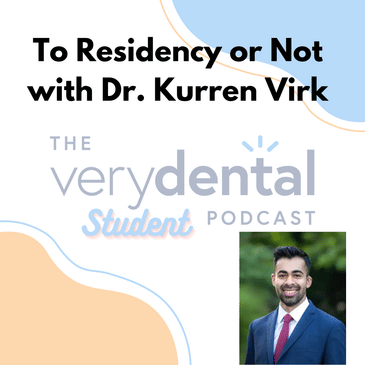
In this throwback episode of the Very Dental Student Podcast, host Mohamed Abo-Basha is joined by recent graduate (at the time) Dr. Kurren Virk! Dr. Virk shares his experiences from dental school at Midwestern University, his advanced residency at the University of Oklahoma, and his extensive continuing education pursuits. The conversation covers Dr. Virk's motivations for choosing dentistry, the unique clinical opportunities at Midwestern, and the advanced cases he handled during his AGD residency. The episode also touches on Dr. Virk's approach to selecting a residency program and his ongoing job search post-residency. This episode provides valuable insights for dental students and new dentists aiming to enhance their clinical skills and career trajectories.
Some links from the show:
Join the Very Dental Facebook group using the password "Timmerman," Hornbrook" or "McWethy," "Papa Randy" or "Lipscomb!"
The Very Dental Podcast network is and will remain free to download. If you'd like to support the shows you love at Very Dental then show a little love to the people that support us!
--
Crazy Dental has everything you need from cotton rolls to equipment and everything in between and the best prices you'll find anywhere! If you head over to verydentalpodcast.com/crazy and use coupon code "VERYDENTAL10" you'll get another 10% off your order! Go save yourself some money and support the show all at the same time!
--
The Wonderist Agency is basically a one stop shop for marketing your practice and your brand. From logo redesign to a full service marketing plan, the folks at Wonderist have you covered! Go check them out at verydentalpodcast.com/wonderist!
--
Enova Illumination makes the very best in loupes and headlights, including their new ergonomic angled prism loupes! They also distribute loupe mounted cameras and even the amazing line of Zumax microscopes! If you want to help out the podcast while upping your magnification and headlight game, you need to head over to verydentalpodcast.com/enova to see their whole line of products!
--
CAD-Ray offers the best service on a wide variety of digital scanners, printers, mills and even their very own browser based design software, Clinux! CAD-Ray has been a huge supporter of the Very Dental Podcast Network and I can tell you that you'll get no better service on everything digital dentistry than the folks from CAD-Ray. Go check them out at verydentalpodcast.com/CADRay!
[00:00:01] This is a production of the Very Dental Podcast Network.
[00:00:09] It's time for a Very Dental Podcast just for students and new dentists.
[00:00:14] Welcome to the Very Dental Student Podcast. And now here's your host, Mohamed Aboubasha.
[00:00:20] All right, everybody, and welcome to another episode of the Very Dental Student Podcast.
[00:00:26] Today we have a guest. His name is Dr. Kurren Virk. Dr. Kurren Virk is from California.
[00:00:33] He attended dental school at Midwestern University in Arizona.
[00:00:38] And he also just completed his advanced education in general dentistry residency
[00:00:43] at the University of Oklahoma College of Dentistry.
[00:00:46] Dr. Virk, how are you doing today?
[00:00:49] Dr. Kurren Virk, I'm doing great, Mo. Thanks for having me.
[00:00:51] This is my first time on the podcast, but I'm pretty excited.
[00:00:54] Yeah, I'm excited to have you on. I mean, so Dr. Virk has had a lot of experiences
[00:01:00] that I feel like a lot of dental students or even some practicing dentists would like to hear about.
[00:01:05] So, Dr. Virk, could you go ahead and just walk me through, you know,
[00:01:09] some of your background and why you got into dentistry in the first place?
[00:01:14] Yeah, so background on me, you know, I'm from the California Bay Area.
[00:01:19] And then growing up, I didn't really, I don't really have any family members actually
[00:01:22] who are in any type of healthcare field.
[00:01:25] So, you know, going into dentistry was kind of a new thing for me.
[00:01:29] And, you know, growing up, I kind of, I think like a lot of us, like, you know,
[00:01:32] I like sciences and was kind of thinking about going into healthcare.
[00:01:36] And then when I was in undergrad, I went to UC Santa Barbara, like right on the beach.
[00:01:44] That was nice.
[00:01:44] But I was kind of thinking maybe dentistry, maybe medicine,
[00:01:47] and I kind of shadowed both and like talked to people and both.
[00:01:51] So, to me, dentistry just seemed a lot more like interesting and the problems and solutions
[00:01:58] that people came in was more tangible.
[00:02:00] Like, you know, you kind of see something, you work their hands, you get to be kind of creative
[00:02:03] and got to solve those issues.
[00:02:06] And it also like, I also like the fact that it seemed like doctors had a lot of autonomy
[00:02:12] in the way that they did things.
[00:02:14] Like, you know, what's cool about the field is, you know, you can take your career in so many different ways
[00:02:18] and you have so much control about how you want to practice and the way you run your practice and just everything.
[00:02:26] So, that's kind of what appealed to me about it.
[00:02:29] Yeah, very cool.
[00:02:30] Yeah.
[00:02:30] I also didn't really have anybody in dentistry.
[00:02:33] Yeah, my mom was a, she was a physician in Egypt, but she didn't practice.
[00:02:37] So, yeah, I was also just like kind of just happened upon it.
[00:02:40] But it does seem like dentistry, you know, like for the majority of people do have some sort of family member in it.
[00:02:46] So, yeah, it's cool to meet somebody and that kind of just stumbled upon it same way as I did.
[00:02:51] Yeah, for sure.
[00:02:52] Yeah.
[00:02:52] So, talk to me about your dental school specifically, like where you went to school and how you like that experience.
[00:03:01] Yeah, so I ended up going to dental school at Midwestern in Arizona.
[00:03:08] And so, I mean, you know, relatively speaking, it's a newer school.
[00:03:11] I think the first graduating class was something like 2011, 2012, something like that.
[00:03:17] Interesting.
[00:03:18] So, you know, it's newer, you know, it's one of two kind of newer private dental schools in Arizona.
[00:03:24] And I think now it's starting to get really well known for giving students a lot of clinical experience.
[00:03:30] And, you know, people are starting to take note of that.
[00:03:32] You know, even when I've been talking to jobs, people are kind of hearing about the reputation of the school.
[00:03:38] And, you know, a lot of other dental schools are also hearing of the reputation and, you know, are sending in their leadership to see how our school was run
[00:03:46] and how the clinic functions that is allowing students to get a lot of experience.
[00:03:52] Yeah, yeah, for sure.
[00:03:53] I mean, even just in my class, so many people talk about like, oh, I have a buddy at Midwestern
[00:04:00] or I heard about somebody who went to Midwestern and they got to do this.
[00:04:04] And so, it definitely has a reputation for itself for sure.
[00:04:07] Yeah, I was really, you know, when I interviewed there, it was probably like my, I don't know, like fourth or fifth interview or something.
[00:04:17] And what stood out to me about it is that they, you could tell that they really had a handle about what was going on in the real world.
[00:04:26] It wasn't just like, I feel like a lot of people talk about how like, you know, academic and dental schools are very separated from what's happening in real life private practice.
[00:04:34] And I felt like Midwestern was the opposite of that, you know, most of the faculty had been successful private practice, Dennis, and they wanted to make sure that the school was set up to help the students succeed in private practice.
[00:04:47] Yeah.
[00:04:48] And I think it's interesting to think about, cause I wonder if there's, there's two factors that I feel like would maybe contribute to that for the, for the Arizona location at least is that, well, first of all, it's a new school.
[00:04:59] So, there's not all that history of kind of backwardness that exists at so many, so many schools.
[00:05:04] But then also it's, it's like right next to the hub of like all of dentistry, which is Phoenix.
[00:05:11] Like, I feel like just everything happens in Phoenix that's related to dentistry.
[00:05:16] So, or Scottsdale or whatever.
[00:05:18] Yeah.
[00:05:18] Yeah.
[00:05:18] That was definitely cool.
[00:05:19] Like, you know, during dental school, it was very convenient for me to go to different CE courses.
[00:05:24] And yeah, you're right.
[00:05:25] There was just tons of stuff going on in that area.
[00:05:28] Yeah.
[00:05:29] Yeah.
[00:05:29] I went to two conferences in Phoenix as a pre dental and that's actually where we met at one of them before you made it over to Oklahoma.
[00:05:37] Yeah.
[00:05:37] But it was very inconvenient for me to go to those conferences.
[00:05:41] Yeah.
[00:05:42] And I feel like if I, yeah, if I was in Arizona, I would definitely be going like every month to some conference for sure.
[00:05:49] Yeah.
[00:05:49] But well, maybe not every month, but like way more frequently.
[00:05:52] Yeah.
[00:05:53] It was nice.
[00:05:53] And then the other thing, kind of shout out to like the local AGD chapter, Academy of General Dentistry chapter in Arizona.
[00:06:01] They were also very active.
[00:06:03] And during COVID, you know, because like I guess kind of half my dental school experience was during COVID, they didn't really have that.
[00:06:10] But before and after, they had tons of hands-on, you know, like weekend long CE courses that were essentially like free or like, you know, 50 bucks for students.
[00:06:21] And they were all really, really good.
[00:06:23] Yeah.
[00:06:23] That's really cool.
[00:06:24] So, talk to me about that.
[00:06:25] What years was like, so when did you graduate?
[00:06:29] First of all, was it 2022?
[00:06:31] Yeah.
[00:06:31] 2022, a year ago.
[00:06:33] Okay.
[00:06:33] So, COVID was like, it was there like during your third year, right?
[00:06:40] Yeah.
[00:06:40] Like pretty heavily.
[00:06:41] Yeah.
[00:06:42] So, that's true.
[00:06:42] That's another real interesting, you know, when we're talking about Midwestern being very different than most schools that I think that was during COVID was even more so because, you know, most schools and even most practices and stuff had real strict policies of hopefully I'm not getting anyone in trouble by saying all this, but.
[00:07:04] Yeah, I'm sure you won't.
[00:07:06] But like, you know, most schools were like mandating like all the PPE, like N95s and face shields and, you know, patient students to get COVID testing and, you know, a limitation on procedures and all this stuff.
[00:07:20] Which, I mean, there's nothing wrong with that.
[00:07:22] It's all reasonable.
[00:07:23] Especially, you know, back then we were all very scared.
[00:07:25] You know, it was, we didn't know what was going on.
[00:07:28] But Midwestern, you know, we were shut down for a month, month and a half.
[00:07:31] So, we were shut down before we started a clinic.
[00:07:35] And then when we started back up, we basically started a clinic.
[00:07:39] And it was funny because if anything, we actually had less PPE than we had before COVID.
[00:07:47] Interesting.
[00:07:47] Meaning that normally, we'd have like the nice level three masks and then, you know, no one could get anything.
[00:07:53] So, then we just had like these cheap probably level one masks and, you know, no face shields, no nothing really.
[00:08:00] It was just normal masks, loops and doing all the procedures, not testing.
[00:08:04] I mean, you know, taking temperatures and stuff.
[00:08:06] We're not doing like actual COVID tests.
[00:08:08] Yeah.
[00:08:09] Well, I've talked to a few people who were either in their third or fourth year when COVID hit.
[00:08:15] And I'm sure they would have much rather had that experience than the experience that they had.
[00:08:19] Yeah.
[00:08:19] So, we were pretty much doing everything normally.
[00:08:21] The only limitation we had initially for like was the first couple of months of my D3 year.
[00:08:26] We were basically only doing like half shifts.
[00:08:28] So, like we, instead of being in clinic all day, you'd only be in clinic either morning or afternoon.
[00:08:34] Okay.
[00:08:34] You're still doing as much stuff as you could.
[00:08:36] If anything, you would be doing more stuff because, you know, we were trying to be more efficient with our more limited time.
[00:08:40] But yeah, after those couple of months, we were back to normal and we were, you know, doing everything.
[00:08:48] Okay.
[00:08:48] So, talk to me about that because a half day for, so, any other dental student hearing a half day would think, okay, so, you're doing like one appointment.
[00:08:57] So, is that what it was?
[00:08:58] Was it just one appointment or were you actually able to, because I know, I've heard stuff about Midwestern being like set up more like a private practice.
[00:09:07] Right.
[00:09:07] And allowing the students to do things differently.
[00:09:12] Was there like chair hopping happening?
[00:09:14] Did you always have an assistant?
[00:09:16] What was going on there?
[00:09:17] So, how Midwestern is set up is you work in like D3 and D4 pairs.
[00:09:23] So, when I was a D3, I had a D4 partner and then when I was a D4, I had a D3 partner.
[00:09:27] So, you and your partner do everything together.
[00:09:29] You guys are each other's assistants and you kind of just, you know, figure out who wants to do what procedure and you do it and you assist each other.
[00:09:36] And, you know, if a little bit of chair hopping has to occur due to, hey, you needed to schedule something or, you know, just if you ran late on something and needed to get someone else in, it does happen.
[00:09:47] But in general, we don't really chair hop.
[00:09:50] We, for the majority of stuff, you're kind of seeing everything, everyone in one chair and, but yeah, sometimes it would be more than one appointment.
[00:09:56] It just kind of depends on what you're doing.
[00:09:59] That's interesting.
[00:10:00] That's, that's pretty cool.
[00:10:01] Yeah.
[00:10:01] We have something like that.
[00:10:02] We have vertical teams, which is like, so second year, third year and fourth year are all paired together.
[00:10:10] And we, but we only, we don't really assist each other that much unless like one of the patients doesn't show up.
[00:10:17] Like in second year, you'll have another second year that's your clinic partner and you guys will assist each other on everything.
[00:10:23] But then once you get to third year, you just have your patient and basically like an isovac.
[00:10:30] Yeah.
[00:10:32] Yeah.
[00:10:32] That's interesting for sure.
[00:10:34] Yeah.
[00:10:34] I still haven't really gotten into the clinic at all.
[00:10:39] So I can't speak too much about how it works, but I will be in August getting into it a little bit.
[00:10:44] So, so then tell me, did you guys get to see patients at all before third year or was it really third year that you guys started?
[00:10:51] No, not really.
[00:10:52] The only patient thing we did before third year was just like, there's a couple of hygiene rotations where like two or three times you go and just do cleaning some people.
[00:11:03] Like kind of with the hygienist helping you there.
[00:11:07] But even that got affected by COVID a little bit.
[00:11:10] Not that, well, just cause just cause of the time off.
[00:11:13] Like I think I did it twice and then my third one didn't happen just cause we were shut down.
[00:11:18] So, so before you actually like start clinic full time, there's very little clinic, you know, like patient experience.
[00:11:27] Which I think is, which I think is normal for across all or if not most dental schools.
[00:11:33] Yeah.
[00:11:33] Yeah.
[00:11:33] I've heard it both ways.
[00:11:35] I think some schools will have you start doing fillings and stuff like as a second year, which I think is smart.
[00:11:39] I mean, you know, a lot of it, it's not about the procedure.
[00:11:43] It's just about being comfortable talking to someone and working in a real mouth and getting over that initial like awkwardness and fear.
[00:11:50] So, it's definitely helpful to start early.
[00:11:53] Yeah.
[00:11:53] Yeah.
[00:11:54] I'm excited for sure to get started.
[00:11:56] Yeah.
[00:11:56] But, um, so then tell me also, I know for, for like most schools, cause you guys talk, you talk about like it being set up more to like prepare you better for private practice.
[00:12:08] So, I can, in most schools, there's this experience where there's like so much red tape in the clinics and there's so much waiting around.
[00:12:17] Yeah.
[00:12:17] And doing absolutely nothing while you just wait for the faculty to be available.
[00:12:22] Yeah.
[00:12:22] So, is that something you experienced at Midwestern?
[00:12:24] No.
[00:12:25] So, that's the main difference.
[00:12:26] So, I think the main difference, the key differences of Midwestern are, I think, not, so I'll kind of list them.
[00:12:35] It's like, I think no treatment is really off limits.
[00:12:38] Um, you know, pretty much any patient that walks in, the only real rules of cases that you can't really do is like, we can't, we didn't do cases where you're opening the bite.
[00:12:50] Obviously, with dentures and stuff that's different but like, with like fixed cases, we couldn't do cases where you're opening the bite.
[00:12:56] They used to do them and it ended up just kind of getting into, you know, getting messy.
[00:13:02] And aside from that, that's really the only thing.
[00:13:05] And then, you know, other than that, it's kind of, you know, you see your patients in your own chair as much as you can.
[00:13:11] And then, um, for specialty procedures or if it's more, even if it's like an extraction or an endo, if it's more difficult and your clinical faculty who are in your suite.
[00:13:21] So, we have like 10 suites, each suite is made up of about 11 or 12 student pairs.
[00:13:28] So, if the faculty in your suite aren't comfortable with a certain procedure or like think that it should be better be done with a specialist, then, you know, you'd go downstairs where all of our specialty specialists are and you basically, you would do the procedure with them or they would do the procedure in your system or kind of a mix of both.
[00:13:47] So, it was just kind of like, you know, do whatever the patient needed and try to get it done as efficiently as you could.
[00:13:52] Was there any situation where they would like turn away a student from the student program or not a student, a patient from the student program?
[00:14:02] Yeah, yeah.
[00:14:02] So, like, you know, we did the, you know, like a couple times a year, your suite would be on screening.
[00:14:08] So, you'd see all the screening patients coming in.
[00:14:10] And we would, if it was a patient who had like TMJ issues, we would turn that down.
[00:14:17] If it was a patient who, yeah, like needed their, you know, VDO increase and was interested in that, we would turn that down.
[00:14:28] Sometimes, if they had a real high kind of biomechanical cross risk, meaning they already have crowns on every single tooth and we don't know what's going on with them.
[00:14:38] Well, sometimes we would turn that down.
[00:14:39] Unless it's something obvious like, oh, we know that this person needs a denture, like sure, you can do that.
[00:14:43] But if it seemed like it was way too crazy where basically it would potentially need to be like a full mouth rehab type of situation, they used to take those patients but now they don't.
[00:14:56] That's crazy to me that they even used to take those patients.
[00:14:59] Like the clinic at Midwestern, what they used to do is a lot more crazy than what they do now.
[00:15:05] I mean, it's not good, but they used to be even a lot more.
[00:15:08] So, they were even more before.
[00:15:10] That's crazy.
[00:15:11] And maybe it's like they were really trying to push the limits and now they've finally settled down on like, okay, what really is the limits for a dental student to be doing?
[00:15:20] Which I think is amazing.
[00:15:20] I think it's amazing that they went ahead and actually tried to push those limits and find out exactly what you can handle as a dental student.
[00:15:28] Because I'm sure, I mean, we've had this conversation before, but like you had told me that like you were very comfortable going into private practice straight out of school.
[00:15:37] But instead, you did the AGD more to learn even more complicated procedures versus like versus for an actual like confidence factor.
[00:15:48] Yeah.
[00:15:49] And for me, it wasn't even so much the procedures because like I had done most procedure.
[00:15:55] And for me, like I don't think learning how to do a procedure is the difficult part.
[00:16:00] Like I think, you know, one, I had a good foundation from the school.
[00:16:04] I had done a little bit of everything.
[00:16:05] But, you know, for most procedures, you can kind of, I mean, maybe that sounds bad, but you know, you can YouTube it, you can read about it, you can do whatever research you need to do ahead of time to figure out what you need to do for it.
[00:16:21] And, you know, I think most dental schools should have given you the foundation to set yourself up to be able to do that.
[00:16:27] For me, the decision to do an AGD and what I think is a hard part of dentistry and that takes more time to build up to is the treatment planning and the diagnosis and figuring out what procedures need to be done.
[00:16:41] And just figuring out what's going to be the best thing for the patient.
[00:16:44] I mean, that takes a lot more knowledge and experience than just, I'll just let you do an implant.
[00:16:50] Yep. I would have to agree with you for sure.
[00:16:52] I mean, I, everybody talks about CE being, even if you never do the procedure in your life, it just opens your eyes to being able to diagnose better.
[00:17:02] And really just like, I mean, that there's, there's entire courses just centered around treatment planning and they're like very extensive courses.
[00:17:13] So, I think that's definitely something that is definitely not intuitive.
[00:17:17] And why would it be, especially as a dental student that, you know?
[00:17:21] Yeah. And a lot of it, you know, in terms of like what knowledge you need kind of in your career and early on, a lot of it also depends on kind of the demographic that you're in.
[00:17:32] Like, you know, for example, there's a, like a dentist in San Francisco.
[00:17:40] You probably follow him on Instagram, SF Dental, Dr. Dr. Ballywas.
[00:17:44] Yep.
[00:17:45] So, I've shadowed with him a couple of times.
[00:17:48] And, you know, so they're in San Francisco, they're in the city, they have like a, you know, a high-end office, you know, it's not cheap.
[00:17:55] So, the, a lot of the patients that they get, you know, they're not, you know, they're not coming in with all their teeth broken.
[00:18:03] And like a lot of patients, you'll see, like we see in the AGD in Oklahoma who just need extensive stuff.
[00:18:09] So, yeah, I bet you guys saw some crazy stuff walking into the AGD.
[00:18:12] Yeah, yeah, yeah.
[00:18:13] For sure.
[00:18:14] All the time.
[00:18:14] But, you know, when you have those patients, you know, they're not looking for, so dentistry is funny that way.
[00:18:21] It's like the, the.
[00:18:23] Yeah.
[00:18:24] The bigger problems have very obvious solutions, right?
[00:18:28] Because like if someone's mouth is completely just bombed, you kind of know what they need.
[00:18:33] Where someone who has much more subtle, smaller problems, that might be a lot more difficult of a solution because you don't really know what is going to be needed to, to, to give them like long-term success.
[00:18:45] It's just minor things.
[00:18:47] Yeah.
[00:18:47] And so, when you're, I would say some people, sorry, I would say some people would even like, with those patients that have.
[00:18:55] They just, they just like don't even know at all what to do.
[00:19:00] Or they, they would even say like, they would even say like, oh, you don't need anything.
[00:19:04] Yeah.
[00:19:05] Whereas like sometimes there are issues that they're just incapable of diagnosing due to
[00:19:09] the lack of training.
[00:19:11] Yeah.
[00:19:11] And a perfect example of this actually happened to me today.
[00:19:14] A friend called me and said, oh, I went to this dentist.
[00:19:19] I told him I have like, you know, some TMJ pain and he recommended that I get a phrenectomy.
[00:19:24] And I was like, wait, a phrenectomy for TMJ pain?
[00:19:27] Like that, it didn't add up.
[00:19:28] I'm like, I don't, I don't know what that means.
[00:19:31] And then I kind of looked more into it and I, I asked a dentist that I know, like, he's
[00:19:35] like, I'm like, what does this, what does this mean?
[00:19:38] And then he told me that sometimes for people with TMJ pain, you know, they'll do like a
[00:19:45] lingual phrenectomy if they have like, basically if they have like a tongue tie issue and how
[00:19:51] that affects, you know, where they're able to put their tongue, you know, in their mouth
[00:19:56] while they're swallowing and sleeping and how that can affect, you know, their breathing
[00:20:00] and joint issues and stuff.
[00:20:02] So, like you can go so deep on all these things.
[00:20:06] You know, you can learn, you know, first you learn how to do a crown, then maybe you'll
[00:20:09] learn how to do a couple of them, then you'll learn occlusion.
[00:20:11] Then even if you learn like a full mouth, you think, okay, wait, I've reached the top
[00:20:15] now, I know how to do everything, I can do a complex face.
[00:20:18] That's true but do you know what caused that person to have the wear in the first place?
[00:20:24] Do you know what caused them to have acid in the first place?
[00:20:27] Do you know how they're sleeping?
[00:20:29] Do you know how their joints are functioning?
[00:20:31] It's like you can dial back the layers so deep on all this stuff in dentistry that kind
[00:20:39] of when you get to the top, you realize that, you know, there's only a slight few percentage
[00:20:44] of people who are taking that total, total like integrated approach into the way they're
[00:20:52] doing things.
[00:20:53] So, and hopefully you're going to be one of those people.
[00:20:58] All right.
[00:20:59] So, I do want to unpack a little bit more about specifically school at Midwestern.
[00:21:05] So, I know everybody hears about these crazy things like placing a bunch of implants or
[00:21:11] even doing like cosmetic cases.
[00:21:12] But if you can like shed some light on like exactly what kind of numbers if you remember
[00:21:18] even a ballpark like for everything like were you guys doing a lot of the bread and butter
[00:21:25] stuff as well?
[00:21:26] And just tell me about that.
[00:21:28] Yeah.
[00:21:29] So, I think in when I interviewed, you know, they put up a chart like a bar graph saying
[00:21:36] this is the amount of crowns the average Midwestern student does and then here's like other schools
[00:21:40] and other schools like 4, 5, 6, 10 and then they showed Midwestern was like 70.
[00:21:45] Oh my gosh.
[00:21:46] So, it's a lot and that's also factoring in mind that you know what you're working as a
[00:21:52] part in a pair.
[00:21:54] So, as like a partnership you would have done like 140 you know or you know but half
[00:21:59] the time you're assisting.
[00:22:01] So, I think what it comes down to is just there's not that red tape like one of my co-residents
[00:22:06] said that you know to do like any crown or anything it's like you have to first schedule
[00:22:10] them with the period department to make sure the period of the tooth is like healthy then
[00:22:16] you should you know schedule them with the endo department to like do endo testing and
[00:22:19] make sure that's good to go.
[00:22:20] So, it's just like all these appointments and which is I think is good for learning.
[00:22:26] It makes you learn.
[00:22:28] I think Midwestern is kind of almost more around like a residency where you kind of try to be
[00:22:33] efficient and you kind of learn as you go.
[00:22:36] So, you know, let's like walk through a patient coming in the clinic.
[00:22:42] They'll come in for a comp exam.
[00:22:45] We always took a full set of photos.
[00:22:47] I think not a lot of schools do that but we took a full set of photos on everyone.
[00:22:51] Like intraoral and extraoral photos?
[00:22:55] We didn't we had an intro camera.
[00:22:56] We didn't really use it very much like DSLR photos like yeah, yeah.
[00:23:00] Intro oral and extra oral but using a DSLR setup.
[00:23:03] That's awesome.
[00:23:04] Yeah, I've never heard of that being done in dental school at all.
[00:23:07] So, it's a good experience because I mean it teaches you how to take photos which are
[00:23:10] very important and then it also gives you the ability to look back at them you know when
[00:23:14] you're coming up with your treatment plans and stuff.
[00:23:16] So, comp exam average time it would take would be two hours just because you know most people
[00:23:22] you would see they had a decent amount of issues.
[00:23:26] And I think one thing is like you know we just didn't have red tape and we're like oh,
[00:23:31] you have to take every single measurement of like maximum opening and all this other stuff.
[00:23:37] I've seen the forms at Oklahoma.
[00:23:39] So, there's a lot of stuff to record and kind of check off.
[00:23:42] Whereas for us they kind of gave us a little bit of leeway into like making that judgment
[00:23:48] call of what you think is important to record versus not important to record.
[00:23:51] So, if you wanted to you could.
[00:23:52] If you don't want to you could skip it.
[00:23:54] But either way it would take an hour and a half two hours comp exam then you know send
[00:23:58] the patient home, work on a treatment plan, bring them back for a treatment plan and
[00:24:04] a cleaning or SRP whatever they needed.
[00:24:06] So, the first cleaning or SRP us as students we would do it for them.
[00:24:12] After that each suite had a high or had two or two?
[00:24:18] One hygienist.
[00:24:19] Each suite had a hygienist and then after that they would do other cleanings for us.
[00:24:23] So, then the hygienists whenever people would come in for the hygienists were you guys going
[00:24:28] in and doing like a periodic exam on the hygiene patients?
[00:24:31] Yeah, yeah.
[00:24:32] So, we would do it for our own patients that were being seen by hygienists.
[00:24:35] That's just so cool.
[00:24:37] I can't explain like how cool that all sounds to me.
[00:24:41] It just like everything that everybody takes issues with in dental school seems to have been solved in that model.
[00:24:49] Yeah.
[00:24:50] So, okay.
[00:24:50] So, you know, you do your comp exam, you write down your findings, you write down what
[00:24:54] you think might be needed treatment wise and you're going to call your faculty and then
[00:24:59] they're going to sort of review it with you and say I agree with this or whatever, change
[00:25:03] this.
[00:25:04] And then, okay, you make your treatment plan.
[00:25:07] Let's say they need three crowns next to each other.
[00:25:09] I'm just making this up.
[00:25:11] You know, you could schedule them like depending, it just depends on you know what you're comfortable
[00:25:16] with and what you want to do.
[00:25:17] So, when I was a fourth year, my D3 partner, he was faster than I was, you know, definitely
[00:25:24] at doing dentistry.
[00:25:25] So, we had a patient I remember he needed three or four survey crowns for a partial.
[00:25:33] Okay.
[00:25:33] And so, we had scheduled to do like one of them and something else I don't remember and
[00:25:39] maybe like another patient counselor or something so, we had a little more time.
[00:25:43] Don't tell me he did all of them.
[00:25:44] Yeah, he did all of them.
[00:25:45] Yeah, he prepped one and like okay, we have plenty of time like you know, call the instructor,
[00:25:49] take a look and like okay, we'll just go to the next one and go to the next one.
[00:25:53] That's amazing.
[00:25:54] Yeah, that's like to put that in perspective, he's doing what some people do in all four
[00:26:01] years of dental school.
[00:26:03] Yeah.
[00:26:03] In one appointment as far as crowns go.
[00:26:06] Yeah.
[00:26:06] Yeah.
[00:26:07] So, and then the other thing I liked is that we, I don't know how it works with you guys,
[00:26:12] but it was never like you have to, you do something and you're waiting in a line to go
[00:26:15] get it checked.
[00:26:17] It was on our axiom and I feel like every school should do this, it's so much better.
[00:26:22] And then on our axiom, we had little buttons like a pager button.
[00:26:27] So, depending on what we needed, you know, we could press a button and call like the assistant
[00:26:30] over to get us some supplies or we could call the faculty over.
[00:26:35] There are a few different things, but so you can call the faculty over.
[00:26:37] So, you press the button and then the faculty gets it on their little iPad in their office.
[00:26:41] So, they know, okay, this person needs me.
[00:26:43] So, you don't have to stop working.
[00:26:46] Yeah.
[00:26:46] Yeah.
[00:26:47] That's such a crazy concept because like, honestly, most of the time wasting is not because
[00:26:51] you're like, because you couldn't be doing something else.
[00:26:55] It's because you're worried to start doing something else.
[00:26:58] Yeah.
[00:26:58] Because then you'll feel like the faculty will get busy with another thing.
[00:27:01] Yeah.
[00:27:02] So, like if you could just page them and like form some sort of line on their iPad or whatever
[00:27:07] of who's next.
[00:27:09] Right.
[00:27:09] That would solve that issue completely.
[00:27:11] Yeah.
[00:27:11] For sure.
[00:27:12] It seems like such a simple thing.
[00:27:13] Yeah.
[00:27:14] Yeah.
[00:27:15] So, I think, you know, it was efficient that way and I know one of my co-residents who
[00:27:20] went to OU, he said, you know, even just like for you guys, like if you forgot to get
[00:27:25] one supply thing or something, like it's a big deal and you have to go and wait in my
[00:27:29] own dispensary and you have to book everything.
[00:27:32] So, like for us, like say my schedule the next like tomorrow had a root canal and then
[00:27:37] a crown.
[00:27:38] We're not doing any of the setting up for any of that stuff.
[00:27:40] Or no, we're setting it up like in an operatory, but as far as like getting all the supplies
[00:27:43] ahead of time, our assistants in our suite, you know, get everything set up.
[00:27:48] So, we didn't have like our own hand pieces and our own beers.
[00:27:51] It's all just commonly shared and then this is brought to us.
[00:27:54] So, like each suite has some dental assistants who are actually working as dental assistants,
[00:28:01] like they're experienced dental assistants.
[00:28:03] It's not part of like some sort of dental assisting school.
[00:28:06] Yeah.
[00:28:06] So, they're experienced dental assistants.
[00:28:08] They're not really working as dental assistants because they're not working with the chair
[00:28:10] side.
[00:28:11] They can if you really needed them to for something and you know, they can help you with
[00:28:15] x-ray and stuff.
[00:28:16] If your third year partner or fourth year partner was just gone or something.
[00:28:19] Yeah.
[00:28:20] So, they could but it didn't happen very often.
[00:28:22] Okay.
[00:28:25] But yeah, so, you know, if you needed help with an x-ray or something.
[00:28:28] So, they're kind of like, you know, front desk slash floaters for setting up stuff, getting
[00:28:33] stuff.
[00:28:34] Very cool.
[00:28:35] Yeah.
[00:28:37] Okay.
[00:28:38] So, tell me about like some of the craziest cases you did while you were in like dental
[00:28:44] school.
[00:28:48] Yeah.
[00:28:48] Yeah.
[00:28:49] I mean, I guess another case was like, I mean, it wasn't crazy but I think the timeline
[00:28:55] of it.
[00:28:56] So, I had a patient.
[00:28:58] So, one thing is, you know, we got we all got four free Bicon implants we can place.
[00:29:03] So, Bicon is a brand of implants, a little bit different.
[00:29:05] You have to rather than the traditional kind of screw and threads and being like screwed
[00:29:11] in all the way.
[00:29:12] It's kind of tapped in with a mallet but I mean, it's still an implant.
[00:29:16] It's not super different.
[00:29:18] So, we had a patient who needed two of them.
[00:29:23] So, yeah.
[00:29:24] So, we got four for free and so, we're going to do two free ones on this one patient and
[00:29:29] we were planning to do it like it was kind of like probably the second week of my D4 year.
[00:29:35] So, second week of my third year partner's D3 year and we were planning to do one each.
[00:29:40] So, I was going to do the first one and then he was going to do the second one and it was
[00:29:43] going to be his first implant.
[00:29:45] But what I didn't think about is when you're doing implants kind of side by side like that,
[00:29:48] you know, you don't do one start to finish and then do the other one.
[00:29:51] That's not efficient.
[00:29:53] You do the same steps on both of them going through it, right?
[00:29:56] Yeah, like the osteotomies at the same time.
[00:29:59] Exactly, exactly.
[00:29:59] Yeah.
[00:30:00] So, I was like, oh, well, I messed up this planning.
[00:30:03] So, he ended up just doing both of them.
[00:30:06] Wow.
[00:30:07] That was like early on in third year, huh?
[00:30:10] Yeah.
[00:30:10] It was like his second medical clinic.
[00:30:12] Oh, my God.
[00:30:14] That's ridiculous.
[00:30:16] That's awesome though.
[00:30:17] Like I feel like that's, I mean, I'm always, I've always told everybody that I've ever talked
[00:30:22] to that I'm very much a hands-on learner.
[00:30:25] So, I feel like that would be so ideal for me because like nothing like feels more like a waste
[00:30:33] of time for me than sitting there listening to somebody explain something without me getting
[00:30:39] to try it.
[00:30:40] Like obviously, you need to learn like everything didactically and actually understand what you're
[00:30:45] doing.
[00:30:46] But then at some point, you just have to do it in order to actually learn anything.
[00:30:51] Yeah.
[00:30:51] And I think it's a balance.
[00:30:53] Like I think, you know, in AGD, when you guys are on breaks and the downstones are on
[00:30:58] breaks, we get emergencies of, you know, a temp fall off or something like that.
[00:31:04] And, you know, I can tell that, you know, you guys in your clinic are doing amazing work.
[00:31:07] Like every prep looks beautiful.
[00:31:09] Every temp looks beautiful.
[00:31:12] But it's kind of like what does it need to be like that in the real world?
[00:31:18] Does everything need to be absolutely perfect?
[00:31:20] Not necessarily.
[00:31:21] So, you kind of have to find that and it's kind of like what I was saying, like, you know,
[00:31:25] preparing yourself for real life.
[00:31:27] It's good to learn.
[00:31:28] There's nothing wrong with learning stuff super, super perfect and ideal.
[00:31:31] But at the same time, it's like you have to think about that trade off between that
[00:31:36] and being efficient.
[00:31:39] Yeah, definitely.
[00:31:42] As far as other crazy cases.
[00:31:45] You told me you were doing like veneer cases and you were placing like implants.
[00:31:52] That wasn't just like the only implant case you did.
[00:31:54] Like you placed several, correct?
[00:31:56] As a middle student.
[00:31:57] Yeah, yeah, yeah.
[00:31:58] I would say, I don't know what the average is, but like, I think I had a classmate who
[00:32:01] did like, it was some crazy number.
[00:32:03] I think he did like, he did like 10 in like one month or something.
[00:32:07] Oh my gosh.
[00:32:09] And yeah, I mean, there's definitely a lot of people who will do like, you know, up to
[00:32:12] 20 implants.
[00:32:13] You know, it just depends on what your patient needs.
[00:32:15] Like if your patient needs that and you know, they accept treatment, then you're going
[00:32:21] to do it.
[00:32:21] There's nothing stopping you at that point.
[00:32:23] That's really cool.
[00:32:24] Yeah.
[00:32:26] Yeah.
[00:32:26] Well, okay.
[00:32:28] So, I had all of this experience in dental school.
[00:32:32] Yeah.
[00:32:32] Well, sorry.
[00:32:32] One's like, I was going to say the other thing I forgot to mention earlier is that there's
[00:32:35] no, there's no specialty departments or residents.
[00:32:38] So, all dentistry is happening with the dental student involved.
[00:32:43] So, those specialists that are downstairs in those downstairs clinics that you mentioned,
[00:32:49] those are, they're just there to teach undergrad students like dental school students.
[00:32:54] Exactly.
[00:32:54] Yeah.
[00:32:54] So, they're just seeing our patients.
[00:32:57] So, like if I have a heart endo, then I take my patient to them and that's all they're
[00:33:01] doing is seeing our patients and helping us with our patients.
[00:33:03] That's very cool.
[00:33:04] Yeah.
[00:33:05] Okay.
[00:33:05] I think, I think we've given people a good enough idea about how awesome the clinical experience
[00:33:10] is at Midwestern.
[00:33:11] But so, you did get all of this experience and then you still chose to do an AGD.
[00:33:16] And we did kind of talk about that just a little bit.
[00:33:18] Yeah.
[00:33:19] But like, how many of your classmates did that?
[00:33:22] Or did you think that most of your classmates definitely just went straight into practice?
[00:33:27] Yeah.
[00:33:27] Very few, very few people from Midwestern do, you know, an AGD or GPR.
[00:33:33] So, yeah.
[00:33:33] So, I'll talk about that.
[00:33:34] It's a good question.
[00:33:36] So, I felt like, you know, so, okay.
[00:33:38] So, we talked about what's good about Midwestern.
[00:33:41] I think if you break it down between clinical years, you know, third and fourth year versus
[00:33:46] preclinical years, I have, I can't really complain about anything the last two years.
[00:33:51] I think the way the schools run, clinical years are awesome.
[00:33:54] I think that's very efficient.
[00:33:56] You can do a lot.
[00:33:57] You learn a lot.
[00:33:58] It's really good.
[00:33:59] I think to me what the weakness of Midwestern was is the first two years, like I feel like
[00:34:08] they, like I said, they have the model of, you know, wanting to prepare you for private
[00:34:14] practice.
[00:34:15] So, you know, they're not teaching you how other schools might do to like, how to cast
[00:34:18] a gold crown and like how to make your own denture and all this other stuff, which I
[00:34:23] like.
[00:34:23] I like that idea.
[00:34:24] It doesn't make sense to teach stuff that's not going to be relevant for real life.
[00:34:28] Yeah.
[00:34:29] But in my opinion, and you know, I talked about this with other faculty and other students
[00:34:33] and I think a lot of people agree is that they kind of took that philosophy a little
[00:34:38] bit too far in that there are definitely some fundamental things that I feel like weren't taught
[00:34:43] very well.
[00:34:44] You know, for example.
[00:34:45] For example.
[00:34:46] Yeah.
[00:34:47] Like, so, you know, you guys probably have like a fixed course and like a removable course
[00:34:51] and you know, you're having, you're going through this courses for months and months
[00:34:53] and you're learning all these things.
[00:34:55] Yeah.
[00:34:55] Whereas like for us, we didn't have any classes.
[00:34:58] So, all of our dental lectures were kind of all under the umbrella of just like this
[00:35:02] dental class and it was all random.
[00:35:04] So, it's like you might have an endo lecture today and then your next endo lecture is like
[00:35:08] three months from now or something.
[00:35:10] Interesting.
[00:35:11] So, I felt like the curriculum was a little bit scattered and a little bit almost surface
[00:35:16] level in some aspects.
[00:35:19] Like for example, I think for, you know, maybe for let's see like removable like dentures or
[00:35:26] partials, I feel like we probably didn't have more than a total of max like 10 lectures
[00:35:33] on that stuff.
[00:35:35] Whereas I think, you know, a school like Oklahoma are going to have a ton of it and you're
[00:35:38] going to have a ton of lab work and different things.
[00:35:39] Yeah.
[00:35:40] A lot for sure.
[00:35:41] So, I feel like and I think that also kind of plays into how the clinic gets run because
[00:35:47] if you guys are learning like every single detail and like absolute perfection of everything,
[00:35:53] it's going to make your clinic experience a little bit like this stuff is going to take
[00:35:57] longer because there gets to be more particular about how everything happens.
[00:36:01] Yeah.
[00:36:02] Whereas if you kind of glossed over that stuff a little bit, I mean, it sounds bad but I'm
[00:36:06] just saying what I experienced.
[00:36:08] Whereas if you kind of glossed over a little bit that stuff more, you're going to just kind
[00:36:13] of do it a little quicker.
[00:36:14] More likely to just be looking for clinically acceptable, good outcomes rather than exactly.
[00:36:23] Exactly.
[00:36:24] You know, because when we start off in the clinics, we start off like departmental faculty
[00:36:30] will supervise each procedure.
[00:36:32] So, like if you're doing a crown, you have a fixed faculty that only teaches fixed and
[00:36:37] nothing else doing your crown prep with you.
[00:36:41] Right.
[00:36:41] And they know exactly what you've had in your lectures.
[00:36:44] Yeah.
[00:36:44] So, like they definitely do take it to the point of scrutiny on every little detail.
[00:36:50] So, I can see the benefit in that.
[00:36:51] And maybe that is the culture of academia with like the older schools versus the newer schools
[00:36:56] for sure.
[00:36:57] Yeah.
[00:36:57] Yeah.
[00:36:58] So, I think there has to be a balance.
[00:37:00] Like I think there's pros and cons to both systems.
[00:37:03] I think Midwestern clinically was like, again, like I said, really good.
[00:37:11] I wouldn't change anything.
[00:37:11] I just think, you know, they could have been a little bit slightly more emphatic with different
[00:37:16] things the first couple of years.
[00:37:18] It must have been a little bit more kind of pushing you to learn more.
[00:37:21] Okay.
[00:37:21] So, that kind of was one of the big factors that pushed you into a residency?
[00:37:26] So, yes.
[00:37:27] Not really?
[00:37:27] I mean, I'd say yes and no.
[00:37:29] A little bit of that.
[00:37:30] Okay.
[00:37:31] But I think most of the stuff that I maybe felt like I hadn't learned, I was able to
[00:37:35] go and learn on my own.
[00:37:36] Like just picking up different books and reading them or whatever.
[00:37:40] I think the bigger thing was just like I said, just wanting to learn, get better with more
[00:37:48] advanced cases like things like implants, things like overdentures, like bigger occlusion
[00:37:56] or rehab cases, cosmetic cases.
[00:37:58] Yeah.
[00:37:58] And just doing them in a way that doing them to a higher, like I think to like a higher
[00:38:03] standard.
[00:38:04] That's what it comes down to.
[00:38:05] Anyone can just go do crowns or just place an implant.
[00:38:07] But I think doing that stuff to a really, really good standard is why I wanted that
[00:38:13] more training.
[00:38:14] Because, you know, otherwise, you know, obviously, you can learn on your own, but you know, it'll
[00:38:19] take more time.
[00:38:20] It'll take a lot of CE and things like that.
[00:38:22] You're not going to just have patients who need all this stuff just thrown at you immediately.
[00:38:26] Yeah.
[00:38:26] And the other thing is since you're used to being a dental student, it's not like you have
[00:38:31] this huge income that you're used to.
[00:38:33] So, getting all of that training out of the way early on and just continuing to live as
[00:38:39] a dental student.
[00:38:40] Yeah.
[00:38:40] Now you don't have to drop $20,000, $30,000 for some of those big courses that are available.
[00:38:46] Yeah.
[00:38:47] Yeah.
[00:38:47] And the thing is, you know, a lot of people would take courses, but then you still kind
[00:38:50] of have that fear of implementing it because it's a big change.
[00:38:53] It's like if you've never done any implants ever and you know, you're not in a practice
[00:38:57] that has done any implants ever.
[00:38:59] Okay.
[00:38:59] Well, now like do you have a CBCT?
[00:39:01] Do you have all the implant components?
[00:39:03] Does your team know how to schedule for it?
[00:39:05] Your assistants know how to set up for it?
[00:39:08] There's so many things that go into it where doing it in a residency that's already used to
[00:39:15] it and does it all the time.
[00:39:16] It's just like, I don't have to think about all the other stuff that goes along with it.
[00:39:19] I can just focus on clinically learning it the best I can and just executing it over
[00:39:23] and over with people helping me.
[00:39:25] Yeah.
[00:39:26] So, it's different.
[00:39:27] Tell me a little bit more about the residency at OU specifically.
[00:39:31] Exactly.
[00:39:31] I mean, I know you told me that you felt like OU was one of the few AGD slash GPRs that
[00:39:38] would have actually offered you anything with the experience that you've already had.
[00:39:44] Yeah.
[00:39:44] So, tell me about that.
[00:39:46] Yeah.
[00:39:46] So, you know, I feel like I'm always very extra and very systematic in the way I make
[00:39:52] decisions.
[00:39:53] So, you know, you always hear, you know, like not all residencies are going to be good.
[00:40:00] A lot of them are just kind of a waste of time or like a fifth year of dental school.
[00:40:04] Fifth year of dental school.
[00:40:05] Heard that a lot.
[00:40:05] Yeah.
[00:40:07] So, I was like, okay, well, you know, I went to, well, one, I went to Midwestern so I already
[00:40:12] have a pretty good experience and two, I just personally, I'm always pushing myself to learn
[00:40:17] as much as I can.
[00:40:19] You know, I did probably like 400 CE hours during dental school which is another topic we can get
[00:40:24] into in a little bit.
[00:40:25] Yeah, we can definitely talk about that.
[00:40:28] So, I'm like, you know, I don't want to just go somewhere like average or you know, so,
[00:40:34] what I did is and it took a lot of time and COVID was very helpful for this because how
[00:40:40] our clinical years in Midwestern are scheduled or are structured.
[00:40:44] It's like Monday mornings you have class, lecture and then the rest of the week is clinic.
[00:40:49] But because of COVID, Monday mornings we had class from home on Zoom.
[00:40:55] So, that was very helpful for me because then during that block of time I could talk
[00:41:01] to programs.
[00:41:02] So, I kind of like just, you know, did the usual stuff.
[00:41:06] You know, I searched Facebook, searched SDN and that's kind of the bulk of what's out there.
[00:41:10] There's also a list from Dr. Jordan Brown.
[00:41:15] I know he's kind of big on Instagram these days.
[00:41:16] He had a list.
[00:41:17] Yeah, I know.
[00:41:18] He put it together.
[00:41:19] And then Ignite DBS, I think that's the name of the website.
[00:41:22] They have a list.
[00:41:24] Okay.
[00:41:24] So, those lists were okay and then I kind of, I used that.
[00:41:29] I used whatever information I could find.
[00:41:30] I kind of just like looked at websites and figured out which ones seemed decent.
[00:41:35] And so, I kind of made an Excel sheet and I just, you know, I just went through it and
[00:41:40] just called programs and I just said, you know, can I talk to...
[00:41:43] Or first I emailed them and then I said, you know, can I set up a time to talk to the
[00:41:47] director or can I talk to a current resident?
[00:41:50] And I just had like a list of, I don't know, a few questions that I made to try to figure
[00:41:56] out, you know, what programs seem to be really good.
[00:41:59] And kind of narrowed it down to like 10 or so that I applied to.
[00:42:03] And the things that stood out to me about Oklahoma is that the, all the current residents were
[00:42:10] very happy.
[00:42:11] They felt like all their needs were being listened to.
[00:42:16] They had really good faculty.
[00:42:19] They had, you know, plenty of patience for kind of all kinds of cases and, you know, good
[00:42:26] implementation of like different types of technology.
[00:42:29] So, it wasn't just like this is the one way to do something.
[00:42:32] We were in close contact with all the local reps and whatever you wanted to try or experiment
[00:42:38] with or whatever, like everything was on the table.
[00:42:41] So, it really kind of, you could push yourself as much as you wanted to and you kind of have
[00:42:48] the support to do it.
[00:42:49] Yeah, that's very cool.
[00:42:50] Yeah, I know.
[00:42:51] And the location of the dental school is pretty nice that we're right by kind of an area where
[00:42:57] a lot of the people there need pretty extensive dental work.
[00:43:01] So, I'm sure that helps with not having a lack of patience or cases that you guys get to work
[00:43:06] through for sure.
[00:43:07] Yeah.
[00:43:08] Yeah.
[00:43:09] So, then yeah, tell me like what do you feel like you learned specifically?
[00:43:14] I know you said it wasn't so much about procedures.
[00:43:18] It was more about like implementing better diagnostic protocols and being able to learn how to
[00:43:25] diagnose and treatment plan properly.
[00:43:27] But you definitely did do some things that you didn't do as a dental student.
[00:43:30] So, talk to me about some of the things that you did and how that worked in terms of like
[00:43:36] how quickly you got into those kind of more complex cases.
[00:43:39] Yeah.
[00:43:41] So, I would say like coming from Western, there's like not a ton like on the table that's
[00:43:47] like, oh, I couldn't do this in dental school that I can do now.
[00:43:51] That's obviously different for most people, but for us, it wasn't like that.
[00:43:54] So, I would say stuff that I did that I didn't personally get to do in dental school, you
[00:44:00] know, was did some sinus lifts.
[00:44:04] You know, we did both using like osteotones like the mallet where you can top the floor
[00:44:08] up as well as like Versa reverse cutting osteodensification drills.
[00:44:14] Okay.
[00:44:15] So, did sinus lifts, did also lateral wall sinus lifts.
[00:44:22] And then our program director is a periodontist.
[00:44:24] So, you know, she's really good with any kind of period surgery a patient may need such as
[00:44:29] aesthetic crown lengthening, you know, gingival grafts, things like that.
[00:44:36] So, we got to do some of those.
[00:44:38] What else?
[00:44:40] We had endodontists come every other week.
[00:44:43] And so, you know, I mean, you could schedule endo if you wanted to just do it on by yourself
[00:44:46] or with the kind of GP faculty you could or you could do it with an endodontist.
[00:44:51] So, you know, I got more experience with endo.
[00:44:54] Did like, you know, some of us did a couple of retreats as well.
[00:44:59] Very cool.
[00:45:00] Yeah.
[00:45:00] You could do any like full arch implant cases or any like hybrids or anything like that?
[00:45:05] Yeah.
[00:45:06] So, we did a decent amount of hybrids.
[00:45:07] I personally didn't do any hybrid surgeries, but a lot of micro resins did and a lot of people
[00:45:12] do multiple even.
[00:45:13] Okay.
[00:45:15] So, yeah.
[00:45:15] So, it's the same thing.
[00:45:16] It's like, you know, you can work, you can do them freehand, you can do them with a stackable
[00:45:21] guide, you can do a different type of methods for the conversion and the pickup.
[00:45:26] We actually kind of tried a new one this year that was really good.
[00:45:30] So, there's a lot of flexibility in how you do things like I mentioned earlier.
[00:45:34] And then, what else was cool?
[00:45:38] Did like some full mouth or full arch crown cases.
[00:45:42] Did a kind of like a full arch composite injection case.
[00:45:49] Some new cases.
[00:45:51] Yeah.
[00:45:51] So, kind of, I mean, basically anything you can think of.
[00:45:53] If we did it.
[00:45:54] And did you, you guys were also opening vertical dimensions and stuff and doing like full mouth
[00:45:58] rehabs and stuff as well?
[00:45:59] Mm-hmm.
[00:46:00] Yeah.
[00:46:00] Yeah.
[00:46:01] I mean, sounds like pretty much anything you could ask for in terms of a general practice
[00:46:05] residency.
[00:46:06] Yeah, for sure.
[00:46:06] Yeah.
[00:46:07] The only, you know, the only like thing is, you know, when you get into those, those treatment
[00:46:11] plans are expensive.
[00:46:12] I mean, the, I'd say our fees are maybe about 30% cheaper than like a standard private practice.
[00:46:19] Okay.
[00:46:19] But when you're talking about a treatment plan that's going to be $40,000 in private practice,
[00:46:23] it's still expensive.
[00:46:24] That's it.
[00:46:25] That discount doesn't cut it for most people still.
[00:46:27] Exactly.
[00:46:28] Exactly.
[00:46:28] So, you know, that's kind of, you know, in those cases, you know, you might need to settle
[00:46:32] for something less.
[00:46:33] But, you know, a lot of times, a lot of, a lot of these patients did go for a treatment
[00:46:38] just because like when they're being referred to the AGD, like they know it's not a surprise
[00:46:44] for them, but they need a lot of work.
[00:46:45] They're coming to you and they're coming to the program because they know like, I really
[00:46:49] want to get this done, but I'm just looking for something that's a little bit more affordable
[00:46:52] for me.
[00:46:53] So, you know, a lot of people and, and, and, and what's cool is like the AGD program
[00:46:56] is very well known in the state of Oklahoma.
[00:46:59] So, like a lot of private practice done is, you know, if they know like, oh, this patient
[00:47:02] needs us, but they just can't afford it.
[00:47:04] They'll, they'll send their patients to us too.
[00:47:06] Yeah, for sure.
[00:47:07] I mean, I worked as an assistant for, and I remember several cases that he sent over to
[00:47:13] AGD because either for the case was too complex for him or because the patient just couldn't
[00:47:21] afford it.
[00:47:21] So yeah.
[00:47:22] That's really cool.
[00:47:23] Yeah.
[00:47:24] Okay.
[00:47:24] So I didn't know about this that you just mentioned that you took 600 hours of CE in
[00:47:29] dental school.
[00:47:31] I think like, I think like, I think like 400 during dental school and then 400 during dental
[00:47:36] school.
[00:47:36] Now I'm probably up to 600 after the past year as well.
[00:47:39] Okay.
[00:47:40] So you had time for CE during that, during your residency as well.
[00:47:44] Yeah, definitely.
[00:47:45] Um, that was very cool.
[00:47:46] I had less time I'd say cause I was always busy with, um, you know, just we had so many hard
[00:47:54] cases that, you know, it's hard to deal with.
[00:47:55] It's like, you know, like a lot of times I'd stay late and just be like, okay, what should
[00:47:58] I do with this?
[00:47:59] And try to plan things out.
[00:48:01] But yeah, you have plenty of time.
[00:48:03] It's crazy to me, like the dedication you have to learning.
[00:48:07] Cause even with all that exhausting, I'm sure.
[00:48:10] And very extensive treatment that you're providing, you still went out and chased after
[00:48:15] CE anytime, any chance you got.
[00:48:17] That's pretty, that's pretty inspiring for sure.
[00:48:20] So talk to me about what you did during dental school in terms of CE.
[00:48:23] What just give me like the highlights, like the, maybe some big names in terms of courses
[00:48:27] that you might've taken.
[00:48:29] Yeah.
[00:48:29] So probably the biggest name and the most thing that I did was, um, so during third year,
[00:48:36] uh, remember I was saying that, you know, when we first started clinic, we were only
[00:48:39] working half the time, like either morning or afternoon.
[00:48:42] So what we were doing the other half of the time is we were actually watching spear
[00:48:45] videos as a group.
[00:48:46] So we all got spear accounts and we, we'd watch a video and then discuss it over zoom.
[00:48:52] Um, but we had that account, you know, so, so the school did this for you.
[00:48:57] Yeah.
[00:48:58] That's amazing.
[00:48:59] Yeah.
[00:48:59] Yeah.
[00:49:00] So we have the spear accounts, you know, spear.
[00:49:02] I mean, probably it's probably like, you know, the a hundred, 150 hours of good stuff
[00:49:07] on there.
[00:49:07] And they're always adding to it as well.
[00:49:09] So I watched a lot of spear stuff.
[00:49:12] Um, I did implant ninja.
[00:49:16] I'm sure you know of him.
[00:49:17] Yep.
[00:49:19] Um, I did a, uh, an endo course.
[00:49:22] I was probably like 20 hours, um, online.
[00:49:27] I did a lot.
[00:49:30] So those are probably the big ones.
[00:49:32] Um, and I, I joined ripe global.
[00:49:34] That website is really, really awesome.
[00:49:37] Um, they, it's kind of like spear and that it's like a video library, but I, I like that
[00:49:42] more than spear.
[00:49:43] I think it's a better value.
[00:49:44] It's, I think as a dental student, you can get it for like 500 bucks for a year.
[00:49:48] Wow.
[00:49:49] Very nice.
[00:49:49] Yeah.
[00:49:49] And they have topics on like literally everything.
[00:49:53] How, how soon would you suggest that a dental student, uh, sign up for something
[00:49:58] like that?
[00:49:58] Third year, fourth year.
[00:50:02] Um, it's hard to say.
[00:50:04] Cause I think, I think like, for example, at Midwestern.
[00:50:07] You know, the limiting factors on the school, the limiting factor a lot of times is a student.
[00:50:11] So if I'm, and it's the same thing in residency, right?
[00:50:14] Like no one is, is gonna, I mean, it can happen, but a lot of times no one's gonna kind
[00:50:19] of spoon feed you the case or the, the method of how you should do something.
[00:50:25] So if you're aware of different things and you say, oh, this is a cool idea.
[00:50:30] I want to do this.
[00:50:32] And now I can come, come bring it in and actually do it.
[00:50:35] That's kind of more on you versus someone giving that to you.
[00:50:38] So I think, I think for me, you know, it made sense to do that even in, even during dental school.
[00:50:43] But if you're at a school where they kind of don't let you do anything, then maybe it makes
[00:50:46] less sense.
[00:50:48] But, but I, but I don't, I don't, but I don't think that's a bad thing if you have the time
[00:50:51] for it to start, you know, second year of dental school.
[00:50:54] Cause yeah, I guess it's only, it's only 500 bucks.
[00:50:57] Right.
[00:50:58] So yeah.
[00:50:59] So that's, that's always the, if, if, you know, when people ask me like, oh, you've
[00:51:02] been so much CE, what do you recommend?
[00:51:04] And, and you know, I'm cheap.
[00:51:04] Like I haven't spent tons and tons of money on CE.
[00:51:07] I try to find what's a good deal and you know, what I can get discounts on and things
[00:51:11] like that.
[00:51:12] Um, so when people ask me, that's always my number one recommendation is that website.
[00:51:16] Cause I think it's very comprehensive and it's affordable too.
[00:51:19] Okay.
[00:51:20] So it was ripe global, like R I P E global.
[00:51:23] Yep.
[00:51:24] Correct.
[00:51:24] Okay.
[00:51:25] Just if anybody wants to go ahead and check that out.
[00:51:27] Yeah.
[00:51:27] That sounds like a good idea.
[00:51:29] Yeah.
[00:51:29] I might actually check that out myself and maybe talk about it on a future episode.
[00:51:33] What I see.
[00:51:34] All right.
[00:51:35] Yep.
[00:51:35] So, um, that sounds pretty cool.
[00:51:38] Uh, the one last thing that I wanted to talk about, um, is that you are currently going
[00:51:44] through a job search.
[00:51:45] Yeah.
[00:51:46] Um, and you, you did tell me that you elected to still go in as an associate, even with the
[00:51:52] amazing clinical experience you, you have, you didn't quite want to go into ownership,
[00:51:57] um, just yet.
[00:51:59] So talk to me about that decision process.
[00:52:01] Um, why obviously.
[00:52:04] Yeah.
[00:52:05] And, um, yeah, just tell, tell me about how the job search has been going so far.
[00:52:09] Yeah.
[00:52:09] Um, I think again, you know, it depends on personality.
[00:52:12] I I'm not like a super, you know, maverick person when it comes to things.
[00:52:16] I like to kind of take things slow and kind of make sure I'm ready for them.
[00:52:21] So, I, and it's kind of, it's kind of the exact same thing, thing of how I looked for residencies,
[00:52:28] you know, being methodical, making sure if I, I'm trying to find a good practice and I'm trying to want to, I want to work with a doctor who I'll get along with and I can collaborate with.
[00:52:38] Cause I think dentistry.
[00:52:39] So, another thing that I did during residency is on my Saturdays, I was kind of, I was moonlighting on a local, on a local, local, um, uh, DSO.
[00:52:47] And so, over there, and so, over there, I was the, uh, just a solo doctor.
[00:52:51] I was there by myself on Saturdays.
[00:52:53] And, um, I was really fine doing that.
[00:52:55] Like I didn't have any issues with it, but I, I didn't feel like it was helping me to, to grow as much as I, as I would have working with someone else.
[00:53:03] And also, it just wasn't as fun.
[00:53:04] I felt like, you know, in residency and school, it's so much more fun when you have, you know, your colleagues that you can collaborate with and talk about cases with and, and you grow that way.
[00:53:14] So, so that was one thing I, you know, I wanted to kind of have that collaborative environment.
[00:53:21] And, and two, you know, even though you same thing, even we've done a lot of stuff, there's still a long way to go when it comes to, to just learning things.
[00:53:30] And if you really want to be a good comprehensive, um, doctor, who's really, really skilled in how they do things, I think there's still a lot to learn.
[00:53:40] Um, I don't know if you've ever listened to, um, uh, have you seen the millennial dentist podcast, Dr. Sullivan?
[00:53:48] No, I haven't, but I might have to check it out.
[00:53:50] Yeah.
[00:53:50] Yeah. So he works with, um, Dr. uh, uh, Agarwal from 3d dentists as well.
[00:53:55] Yeah. Yeah.
[00:53:55] Heard of that. Yeah.
[00:53:56] I know him a lot. Yeah.
[00:53:58] Yeah. So he, he, and that's actually the same thing I was talking about that practice in San Francisco.
[00:54:02] They both kind of said the same thing. It's like, you know, when they have an associate, they're not really having the associate do a lot of people say, oh, we're gonna have the associate do all the new patient exams and all the everything and see all the new patients and the, and the POEs and stuff.
[00:54:16] That's fine. But they have the opposite viewpoint of it. And I agree more with that is that they have so much years of experience. Patients know them and they've had so much training with the dent CE and stuff is that when they're looking at the same patient, that a new grad is looking at the same patient, they're going to see a lot more things.
[00:54:34] Yeah. Definitely.
[00:54:35] To diagnose and treat and plan. And they're going to be in general, better at gaining case acceptance on that stuff. So, so they're gonna, they're gonna treat and plan it and then they're gonna kind of hand it off to the associate to execute it. So I think that's a good model. The patient wins, you know, they're getting the treatment that they need. The practice wins, you know, you're producing more and the associate wins because well, they're producing more too, but they're also learning from, from what was kind of set up for them.
[00:55:01] Yeah. So like they can, you would, as the associate in that model, you would be able to open up the case and be like, okay, let me walk myself through why they diagnosed this treatment.
[00:55:12] Exactly. Yeah.
[00:55:12] Yeah.
[00:55:14] So, so that's just kind of an example of, you know, if I think that's the fastest way to, to work with someone who's really good like that and see the way they do things, the way they talk to people. It's such a fast way to just get really, really good.
[00:55:31] So you're looking for something like that basically, ideally. Yeah. Well, I wish you all the best in that job search. I think we are getting up against it on time, but I'd love to do a follow-up with you here in a few months or maybe like six months or so just to see how the new job is going at that point in time. And maybe, maybe I can also complain to you about how clinic is going.
[00:55:58] Yeah, for sure. Anytime.
[00:55:59] All right. Well, this is us signing off. It's your host, Muhammad Abu Ghasha with Dr. Virk.
[00:56:09] The Very Dental Podcast Network is and always will remain free to download. If you'd like to support the shows you love at Very Dental, then show a little love to the people that support us.
[00:56:19] Crazy Dental has everything you need from cotton rolls to equipment and everything in between and the best prices you'll find anywhere.
[00:56:26] If you head over to verydentalpodcast.com slash crazy and use coupon code verydental10, you'll get another 10% off your order.
[00:56:33] Go save yourself some money and support the show all at the same time.
[00:56:36] The Wondrous Agency is basically a one-stop shop for marketing your practice and your brand.
[00:56:41] From logo redesign to a full-service marketing plan, the folks at Wondrous have you covered.
[00:56:46] Go check them out at verydentalpodcast.com slash Wondrous.
[00:56:49] Cadray offers the best service on a wide variety of digital scanners, printers, mills, and even their very own browser-based design software clinics.
[00:56:57] Cadray has been a huge supporter of the Very Dental Podcast Network, and I can tell you that you'll get no better service on everything digital dentistry than the folks from Cadray.
[00:57:05] Go check them out at verydentalpodcast.com slash Cadray.
[00:57:09] Inova Illumination makes the very best loops and headlights, including their new ergonomic angled prism loops.
[00:57:15] They also distribute loop-mounted cameras and even the amazing line of Zumax microscopes.
[00:57:19] If you want to help out the podcast while upping your magnification and headlight game,
[00:57:24] you need to head over to verydentalpodcast.com slash Inova to see their whole line of products.