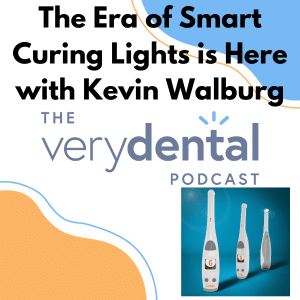
In this special Michigan-centric episode of the Very Dental Podcast, Alan is joined by Kevin Walberg from Garrison Dental Solutions. They discuss the launch of Garrison Dental's groundbreaking new product—a curing light named 'Loop'.
Kevin reveals the technology and development behind this curing light, which includes features like self-calibration and real-time adjustment based on distance from the tooth. The Loop ensures consistent power output and improves curing accuracy, addressing common issues dentists face with traditional curing lights. The episode also touches on the evolution of dental products and the practical challenges in everyday dental practices.
The Loop is available starting today! Garrison is offering Very Dental listeners a discount to go take a look at the Loop. If you use the code "SO1124MEAD" for 10% off of any "non light curing" product and $100 credit off a future purchase if they buy a curing light!
Some links from the show:Episode index:
00:34 Meet Kevin Walburg from Garrison Dental Solutions 02:23 History and Evolution of Sectional Matrices 03:24 Challenges with Curing Lights in Dentistry 05:36 Importance of Curing Light Maintenance 12:17 Innovative Features of the new Loop from Garrison Dental Solutions 19:38 Curing Light Precision 20:49 Price Range of Curing Lights 22:23 Self-Analyzing Curing Lights 23:09 Smart Curing Light Features 24:05 Calibration and Power Adjustment 30:35 Upcoming Events and Demonstrations 34:45 Conclusion and Final ThoughtsJoin the Very Dental Facebook group using the password "Timmerman," Hornbrook" or "McWethy," "Papa Randy" or "Lipscomb!"
The Very Dental Podcast network is and will remain free to download. If you'd like to support the shows you love at Very Dental then show a little love to the people that support us!
--
Crazy Dental has everything you need from cotton rolls to equipment and everything in between and the best prices you'll find anywhere! If you head over to verydentalpodcast.com/crazy and use coupon code "VERYDENTAL10" you'll get another 10% off your order! Go save yourself some money and support the show all at the same time!
--
The Wonderist Agency is basically a one stop shop for marketing your practice and your brand. From logo redesign to a full service marketing plan, the folks at Wonderist have you covered! Go check them out at verydentalpodcast.com/wonderist!
--
Enova Illumination makes the very best in loupes and headlights, including their new ergonomic angled prism loupes! They also distribute loupe mounted cameras and even the amazing line of Zumax microscopes! If you want to help out the podcast while upping your magnification and headlight game, you need to head over to verydentalpodcast.com/enova to see their whole line of products!
--
CAD-Ray offers the best service on a wide variety of digital scanners, printers, mills and even their very own browser based design software, Clinux! CAD-Ray has been a huge supporter of the Very Dental Podcast Network and I can tell you that you'll get no better service on everything digital dentistry than the folks from CAD-Ray. Go check them out at verydentalpodcast.com/CADRay!
[00:00:01] This is a production of the Very Dental Podcast Network. This is the Very Dental Podcast.
[00:00:17] Welcome to the Very Dental Podcast, where you'll find entertaining and relevant conversations with visionaries, clinicians, and your friends in the dental space. Now, here's your host, Dr. Alan Mead.
[00:00:29] Very Dental people, welcome to another episode of the Very Dental Podcast. This is a special episode. Co-hosting with me today is a guy by the name of Kevin Walburg. He's from Garrison Dental Solutions. Kevin, how are you doing?
[00:00:40] Doing great this morning. Hey, thanks for having me on.
[00:00:43] So Kevin is coming to you live from the basement of Garrison Dental Solutions in Spring Lake, Michigan. We're both in Michigan at the same time. I'm in the basement of my house in Midland, Michigan. So this is a very Michigan-centric podcast right now.
[00:01:00] And apparently everybody in Michigan does things in the basement.
[00:01:02] Well, there's something, and they've talked about Michigan basements. That again is for another podcast, to be sure. If you want to look at a Michigan basement, it's the very end of the Silence of the Lambs, I believe, is the Michigan basement.
[00:01:15] In any case. So Kevin, I got in touch with Kevin earlier this week because I saw a teaser. It was a very sexy teaser, actually, because it was like a product that they're going to be releasing.
[00:01:28] Well, when this podcast comes out, they're releasing today, I think. And it's in shadow. And it's just coming soon. And Kevin, I'm not going to lie to you, it looked like a curing light to me. That's what it looked like to me.
[00:01:38] I mean, as a dentist. It wasn't too terribly well hidden. It was in shadow, so I couldn't get the details, but it definitely looked like a curing light.
[00:01:45] So I reached out, and I'm like, dude, we should do a podcast about this. And of course, at the time, I didn't even know all the details.
[00:01:51] I still don't know all the details. But interestingly, Kevin, literally yesterday, Thursday, I received this in the mail.
[00:02:00] Oh, yeah.
[00:02:30] They are what put sectional matrices on the map in the United States. And all that we were talking about, the evolution of particularly like the rings that separate teeth.
[00:02:40] I mean, we sort of laugh about how far they've come. I OK. This is this will tell you what I do.
[00:02:45] You remember the company from New Zealand that had the tri clip? Do you remember the tri clip?
[00:02:51] Yeah. Simon, Dr. Simon McDonald.
[00:02:53] Yes. OK. Simon had had the thing. It was a disposable ring and it was also like a gel wedge.
[00:03:02] And so you'd buy them.
[00:03:03] Incredibly complicated.
[00:03:04] It was complicated. And also you threw away a lot of stuff like you threw away a lot of stuff.
[00:03:08] That was that that sort of stuff. And I think they worked fine.
[00:03:11] I mean, they're clearly clearly were part of the evolution.
[00:03:14] So the evolution of like those things would make for a very great podcast as well.
[00:03:19] But I am here to to talk about the teaser.
[00:03:24] So tell me a little bit about how in the world did Garrison, who is kind of a hardware company, like a composite hardware company?
[00:03:30] How do they come into how do they come into the equipment part of this thing?
[00:03:34] Yeah. Well, you know, the the new curing light, the name of the product is loop and.
[00:03:42] The this product was entirely designed and patented in house.
[00:03:48] This is not something that we went out and talked to a curing light manufacturer about and or picked up somebody else's technology.
[00:03:55] What would happen was about 10, 10 years ago, we hired a new director of engineering and that director of engineering came from X-Rite.
[00:04:04] Which, of course, a fairly well-known dental company and also just in in optics and in color matching and paint matching for automobiles and paint stores and all this kind of stuff.
[00:04:17] So he had been high up in the engineering.
[00:04:22] The organization over at X-Rite.
[00:04:24] And when he came on board here, we are director of marketing at the time was an ex-colting person.
[00:04:31] Of course, they have small equipment and he had managed some of their small equipment, including their curing lights.
[00:04:38] And so these two guys got to talking about kind of the state of the curing light technology at that time.
[00:04:48] And, you know, what what were some of the issues with curing lights?
[00:04:55] And that's when this whole thing kind of was born.
[00:04:58] And this literally is seven years of hardcore development to get to the launch, which is happening today.
[00:05:09] OK, so tremendous, you know, because building it from scratch, really.
[00:05:14] Yeah. Right. Yeah.
[00:05:15] And, you know, first to world technology, which, you know, you tell me when you want me to talk a little bit about that, because it's it's we're going to get there.
[00:05:25] One of the things you and I you and I emailed back and forth about it.
[00:05:28] And I find this a little fascinating.
[00:05:31] OK, so as a dentist, I'm sure you guys spend a lot of time like contemplating and analyzing how dentists actually think.
[00:05:39] And actually, it's worth mentioning the garrison is literally a company that started in the basement of a dental office to dentists kind of.
[00:05:45] So so which I know myself and other dentists kind of love the idea that, OK, so dentists sort of started this.
[00:05:52] Clearly, it was to address problems that dentists actually have.
[00:05:56] But one of the problems dentists have is that there's a lot of stuff we don't want to deal with.
[00:06:00] Like there's a lot of there's a lot of. OK, well, gosh, you look at what everything you got to do in a given day.
[00:06:07] You've got a bajillion different procedures. You've got to run a business.
[00:06:11] You've got H.R. concerns. Oh, my God.
[00:06:14] There's a lot of this. You guys got a hard job.
[00:06:15] The fun but the fun stuff, it's the stuff that the non sexy stuff is the stuff we don't want to deal with.
[00:06:20] Like, let me ask you this. Any dentist out there, do you know how your sterilization works in your office?
[00:06:25] The answer is no. No, you don't. You have someone else set that up correctly and do it.
[00:06:30] So another thing like this is I hesitate to use the term hygiene.
[00:06:35] But but curing light hygiene is knowing that you're curing light is putting out the you bought a curing light.
[00:06:42] And in the beginning, it says it will put out this much power.
[00:06:45] And it's you know, there's some great number and you're super excited about it.
[00:06:47] The problem is over time, the lens gets nasty. The lens gets scratched.
[00:06:52] The battery, you've charged a million times. The battery gets worse.
[00:06:56] And so we're really supposed to be checking that really regularly about how much because because what happens is is you buy a light and it's great until it's not.
[00:07:07] And unless you catch it, you literally could be in a lot of us.
[00:07:11] You I have to admit, I run through curing lights.
[00:07:15] Not fast, but faster than I would expect.
[00:07:17] In other words, when I think I just got a couple of new curing lights, I look back and it was not I didn't just get them.
[00:07:23] I've had I've had them for a while, you know, and it's one of these things where and so and there's been a lot of solutions that have come out to try.
[00:07:30] I mean, a lot of them, some of them have a built in radiometer and all this stuff.
[00:07:32] So you can measure the output, which is fine.
[00:07:35] But then some some solutions have come out.
[00:07:37] And I've even talked about them on the on the show where it's a it's like an app based thing where you can compare, you know, what what's happening is is the light putting out less all this all this sort of stuff.
[00:07:47] But but like some of those have subscriptions involved with them.
[00:07:50] And frankly, you got to do it, too.
[00:07:52] You got to do it.
[00:07:52] And you got it.
[00:07:53] So you have to delegate it to a staff member or whatever to make sure your lights are doing.
[00:07:56] So part of it is that we just don't do it.
[00:08:00] A lot of times it's much easier.
[00:08:01] And the other solution you'll hear a lot of people say, and I'm sure you've heard this before.
[00:08:05] Well, I'm just going to get the one on eBay.
[00:08:06] They cost like 300 bucks and and they're fine.
[00:08:09] And when they break, I'll just throw it out and I'll get it.
[00:08:11] The problem is that the problem is that they don't break soon enough because like they don't they're they don't put the power out that you think.
[00:08:19] So you think you're curing your composite and it doesn't cure as well as you think.
[00:08:23] I'm sure that's kind of what you're going through.
[00:08:25] But the other thing is, is that when composite doesn't cure well enough, one of the big problems, it's hard to tell.
[00:08:31] Like it'll still be hard to touch, but but it doesn't cure completely.
[00:08:35] So tell me, I'm assuming that these are some of the things you guys wanted to address.
[00:08:39] Did I am I coming close at all?
[00:08:41] Yeah.
[00:08:41] Yeah.
[00:08:41] That's certainly a big part of it.
[00:08:44] And then, you know, the other matching part of that is distance from the tooth surface.
[00:08:51] Oh, my God.
[00:08:51] Yes.
[00:08:52] Oh, my God.
[00:08:52] So look, if your assistant is curing and God love the assistants.
[00:08:55] Don't get me wrong.
[00:08:57] But they don't they don't have the same.
[00:09:00] They're kind of off to the side.
[00:09:01] And a lot of times they can't see the tooth as well as you can.
[00:09:03] So if if you're not curing, the assistant is probably doing their best.
[00:09:06] But if you look, you'll notice, you know, quite often they're a little further away maybe than they should be or off to the side or something.
[00:09:12] Or not at a right angle.
[00:09:14] Yeah.
[00:09:14] Yeah.
[00:09:14] All of those all of those things come into play.
[00:09:18] And, you know, white curing shouldn't be an afterthought.
[00:09:23] It should be an exceptionally deliberate activity that you engage with.
[00:09:29] Yeah.
[00:09:29] Because if it's if you're just kind of waving it in the general direction of the person's face, you know, it's it's it.
[00:09:36] You might you might get it to solidify, but you won't know.
[00:09:40] You won't know that there's a problem.
[00:09:42] And when that composite fails, you know, three, four years down the road and inevitably it fails down by the gingival margin.
[00:09:49] Sure.
[00:09:49] Deep, deepest part of the box.
[00:09:51] How do you know what the cause of that was?
[00:09:55] It's the patient's fault.
[00:09:57] That's all.
[00:09:57] That's my answer is always you're not flossing enough too much pop.
[00:10:02] That's yeah, that's always the case.
[00:10:03] Yes.
[00:10:03] But but if you can if you can at least be very deliberate in your actions, be very deliberate with the equipment that you're using and make sure that it is within specs and producing the appropriate amount of energy, then at least you can check that box.
[00:10:23] Right.
[00:10:23] You know, in your heart and mind that that you've done your due diligence there.
[00:10:28] And if there's a failure down the road, then you need to look at, OK, you know, did I not get all the carries out or or was my bonding procedure?
[00:10:37] Maybe not tip top on that one.
[00:10:39] There's there's certainly other causes for it.
[00:10:42] For sure.
[00:10:43] For sure.
[00:10:44] And like there's enough things like a lot of dentistry.
[00:10:48] It's amazing that it ever works at all.
[00:10:49] There's enough things that can go wrong with composite that this you'd be wise to make sure that light curing isn't one of the problems.
[00:10:57] I mean, like in I don't know, I've been what's funny is a lot of people, like I said, don't want to spend.
[00:11:03] They're like they want to spend as little on a curing light.
[00:11:05] They want to have about 20 curing lights in the office and they want to spend like 200 bucks a piece on them.
[00:11:09] And I have been I've been a bit of a curing light snob over the years where I'll spend the money because I figure that that's that's making that's for the long term.
[00:11:17] But even at that, if you're not checking your output on the regular, even if you're getting the light where it needs to go, even if you're getting it really close, you're not checking the output.
[00:11:27] Then so what's interesting is some of the technology built in that sort of does a lot of that for you.
[00:11:33] Yeah.
[00:11:33] And I think one of the key aspects there, and this was really interesting reading some of the survey work that we did, you know, about, you know, how often are you checking your curing lights?
[00:11:42] And, you know, we get a response like, oh, you're supposed to check your curing light.
[00:11:45] Oh, wow.
[00:11:45] Yeah.
[00:11:46] If I were answering that, I would lie and say I do it three times a day.
[00:11:49] Of course.
[00:11:50] Yeah, exactly.
[00:11:51] You can tell those people, too.
[00:11:52] They're like, well, what what answer should I?
[00:11:54] Yeah, exactly.
[00:11:56] But, you know, a lot of a lot of the answers was, well, my my rep comes in and checks it.
[00:12:01] Right.
[00:12:02] Walks in with a radiometer.
[00:12:04] Yeah.
[00:12:04] And what do you do if it's out of spec?
[00:12:08] Yeah.
[00:12:09] The reps going cha-ching.
[00:12:11] I get to sell you a new curing light.
[00:12:12] Yeah.
[00:12:12] Right.
[00:12:13] Yeah.
[00:12:13] So it's not just checking that it's in spec, but it's doing something about it.
[00:12:17] And I think that's the really critical thing about this product is that in the hand, in the device itself, in your curing light, there is a radiometer inside of it.
[00:12:28] And so when it when you put it back in the base and it checks itself, then it adjusts itself to bring it back into spec.
[00:12:38] OK, so if the battery is getting a little weak, LEDs age.
[00:12:42] Right.
[00:12:42] Yeah.
[00:12:43] They have a curve to them.
[00:12:45] And then, you know, they have a curve to them where actually initially the power output goes up for a little while and then it starts to taper, taper off slowly over time.
[00:12:53] So all the things that you mentioned earlier, battery, lens conditions, huge impact.
[00:12:58] Mm hmm.
[00:12:59] And then LED age are going to degrade that output.
[00:13:04] And even if you're checking your light and you go, OK, well, I've got it set at a thousand milliwatts.
[00:13:10] Well, my radiometer is telling me I'm at 900 milliwatts.
[00:13:14] What do you do?
[00:13:15] Right.
[00:13:15] Well, you zap it again.
[00:13:16] Right.
[00:13:17] Now you've got to remember every time you cure, you need to, you know, a single a single cycle isn't going to cut it anymore.
[00:13:24] You're not producing the energy you need to not delivering the energy you need to.
[00:13:27] So now you start curing it again and curing it again.
[00:13:31] And there are studies out there that show that's a problem.
[00:13:36] You can't just keep zapping that composite.
[00:13:40] You can over cure it and make it brittle.
[00:13:44] Oh, my God.
[00:13:45] OK, so that's a rule I've always said out loud.
[00:13:48] You can't over cure composite.
[00:13:49] You're saying you can over cure composite.
[00:13:52] Yeah.
[00:13:52] Look it up.
[00:13:54] There are studies, you know, and some of these are, you know, by some of these really well-known experts in curing light.
[00:14:03] It's not a garrison study.
[00:14:04] These are published.
[00:14:06] They've been out there for a while that over cure is an issue.
[00:14:11] You can certainly you can blow air on there to help control heat.
[00:14:17] That's what everybody thinks.
[00:14:18] Number one.
[00:14:19] Well, I just blow air on it.
[00:14:20] So I don't overheat the tube.
[00:14:21] Well, that's not the only issue.
[00:14:23] It's the composite itself.
[00:14:24] Mm-hmm.
[00:14:25] That there is a set amount of energy that the composite manufacturer wants you to deliver.
[00:14:33] Mm-hmm.
[00:14:33] Not more, not less.
[00:14:36] Interesting.
[00:14:37] I'm wrong.
[00:14:37] I'm wrecked now because that was that's that's always been my thing.
[00:14:40] Well, you know, we just want to make sure that we're getting OK.
[00:14:43] That's very interesting.
[00:14:44] Yeah, that is that is a myth that you can't over cure composite.
[00:14:48] So absolutely.
[00:14:49] So the reality is you want to make sure that you actually read the manufacturer's recommendations, which no one does.
[00:14:56] And then I'm raising my hand.
[00:14:58] That is also me.
[00:14:59] You just light cure it.
[00:15:00] That's what you do.
[00:15:02] So figure that out.
[00:15:03] And then and then you're saying that that you you want to make sure that your light is putting out the right amount, you know, to whatever the manufacturer is saying for the right amount of time in the right amount of thickness in the in the layer.
[00:15:16] And then but the other thing.
[00:15:17] OK, so let me ask you a couple questions about it.
[00:15:19] So can you change the output amount if you if you have let's say they made a composite that wanted 700 instead of a thousand, which I have no idea if that's true.
[00:15:27] But can you can you change?
[00:15:29] Is there a range that you can change for the output?
[00:15:32] Oh, yeah.
[00:15:32] Yeah.
[00:15:32] The there's three power output levels and then multiple times associated with each one of those.
[00:15:40] OK, so you can you know, the kind of the standard, the industry standard is a thousand milliwatts for 20 seconds.
[00:15:47] Well, at that thousand milliwatt output, you can you can dial in five seconds, 10, 15, whatever you need.
[00:15:53] OK, you can ramp it up to 2000.
[00:15:56] OK, don't go all the way up to 3000.
[00:15:58] OK.
[00:16:27] OK.
[00:16:29] It was like a lightsaber.
[00:16:30] And yeah, exactly.
[00:16:31] Yeah, exactly.
[00:16:32] And it was in your cure in one second.
[00:16:35] And you're like, OK, that seems like and and there was a lot of talk about that.
[00:16:39] So so the reality is, is this is this allows you to kind of follow the manufacturer.
[00:16:43] But then more than that, you need to talk about what if what if what if I'm having a really long day and I'm really tired and I have the light and I might I might have it a little further away just accidentally than I needed to.
[00:16:56] Or even my excellent rubber dam placement is such that I can't quite get it exactly right on top of the.
[00:17:03] So what this is the craziest technology I can possibly imagine.
[00:17:07] Tell me about that.
[00:17:08] Well, that's that's the name loop.
[00:17:10] Right.
[00:17:10] What does loop refer to loop refers to that?
[00:17:14] This device is a closed loop system.
[00:17:17] Every single other curing light on the market is open loop.
[00:17:21] It outputs.
[00:17:22] Right.
[00:17:23] That's that's the open side is it outputs.
[00:17:26] It doesn't receive any input inside the lens of this device.
[00:17:32] There is a little tiny fiber optic capillary that measures the reflection off of the tooth surface and adjust the power output in real time.
[00:17:44] So if you are.
[00:17:46] So there's a couple of things that that does.
[00:17:48] Number one is distance.
[00:17:50] Right.
[00:17:50] It measure.
[00:17:52] It can tell how far away it is from the tooth.
[00:17:54] And if you've got it set to a thousand milliwatts.
[00:17:59] And you're, let's say, six millimeters away from the tooth surface.
[00:18:04] The device ramps up power output.
[00:18:07] So it's still delivering a thousand milliwatts at the tooth surface.
[00:18:12] That's amazing.
[00:18:12] That's amazing.
[00:18:13] OK.
[00:18:14] And that's there isn't anything even close to that.
[00:18:16] Not only.
[00:18:17] So it does that.
[00:18:17] It does that because it's literally measuring reflecting like what's reflecting off the surface of the tooth.
[00:18:22] Yeah.
[00:18:22] It's in.
[00:18:24] And what that also does is, let's say, you know, and I've watched assistants do this.
[00:18:29] Bless their heart, you know, where they're.
[00:18:31] Let's say it's a buckle, a buckle, you know, filling.
[00:18:37] Sure.
[00:18:37] Just glass more on the buckle.
[00:18:40] And, you know, the area is illuminated, but they've got, you know, 75% of the surface of the lens is aimed at the gums.
[00:18:47] Yep.
[00:18:48] Yep.
[00:18:48] Yep.
[00:18:49] Yep.
[00:18:49] Yep.
[00:18:49] So that's not, you know, you're not going to cure those gums very well.
[00:18:53] Right.
[00:18:53] So that fiber optic capillary allows the device to say, hey, I'm not even pointed in the right direction.
[00:19:01] Oh, my God.
[00:19:02] And the light will start to flash, flicker.
[00:19:07] And let's say it flickers for two seconds, right?
[00:19:09] Because you're not.
[00:19:09] And then you adjust it.
[00:19:10] You get it aimed at the right spot and it kicks back on.
[00:19:13] It adds the two seconds.
[00:19:15] Oh, my gosh.
[00:19:15] So it even fixes the timer.
[00:19:18] Yeah.
[00:19:18] So it's like, okay, doc, you're hungover.
[00:19:23] Let's.
[00:19:24] No, no, no.
[00:19:24] We can't say that.
[00:19:26] No, I get it.
[00:19:27] I just can see.
[00:19:28] You had a short.
[00:19:29] You didn't sleep well last night.
[00:19:30] You're up with the baby.
[00:19:31] How about that?
[00:19:31] You're up with the baby.
[00:19:32] You were not hungover.
[00:19:33] We do not condone that.
[00:19:35] You are not hungover.
[00:19:36] You are up with the baby and you're a little sleepy.
[00:19:38] And maybe your hands are not as steady on with the.
[00:19:42] This will tell you when you're off center.
[00:19:44] This will tell you.
[00:19:45] And literally, it'll flicker at you.
[00:19:47] So you can tell you'll get on center.
[00:19:49] It'll add those seconds that you lost.
[00:19:52] That is nuts.
[00:19:53] It's it definitely knows how well it's curing better than you do because it's right there
[00:19:58] looking at it.
[00:19:58] That's wild.
[00:19:59] You know, and now there's there's pros and cons to that, frankly.
[00:20:02] Okay.
[00:20:03] And, you know, I want to be upfront with that.
[00:20:05] That takes a little bit to get used to.
[00:20:08] You know, I've talked to folks that have gotten.
[00:20:13] They've gotten frustrated and then they think about it for a while.
[00:20:17] And they go, oh, my God.
[00:20:20] I'm curing the same way I've cured, you know, thousands of composites before.
[00:20:26] Sure.
[00:20:26] And this is telling me that when I was doing that, I wasn't even pointed in the right
[00:20:30] direction.
[00:20:31] That's a little scary.
[00:20:32] Yeah.
[00:20:32] Yeah.
[00:20:32] So it is it is the people who get it.
[00:20:37] They go.
[00:20:37] This is the most incredible training tool to teach you.
[00:20:42] Oh, wow.
[00:20:43] Deliberateness of what you need to do when you're curing.
[00:20:46] God, it's not as wild.
[00:20:48] Yeah.
[00:20:48] It's pretty cool.
[00:20:49] And, you know, the interesting thing is, you know, you know, curing lights have a huge
[00:20:53] price range.
[00:20:54] Right.
[00:20:54] Yep.
[00:20:55] I've got a $300 cheapie down here in the studio, you know, and for my studio work, it's
[00:21:02] fine.
[00:21:02] Right.
[00:21:02] Because my plastic typodont patient doesn't complain.
[00:21:06] No sensitivity.
[00:21:07] No sensitivity.
[00:21:07] You'll never do a root canal on that tooth.
[00:21:09] Yeah.
[00:21:10] No, don't have to worry about that.
[00:21:12] And, you know, and they range all the way up.
[00:21:14] Some of those really high end like laser lights, you know, like 35.
[00:21:17] Oh, yeah.
[00:21:18] Oh, yeah.
[00:21:18] Yeah.
[00:21:19] Yeah.
[00:21:19] You know, and you could cure composite on the moon, but.
[00:21:22] You could also cook bacon probably with some of those lasers.
[00:21:25] Honestly, I feel like that's an option as well.
[00:21:28] Yeah.
[00:21:28] Yeah.
[00:21:29] And, you know, and this one, this is, yeah, it's a premium light.
[00:21:34] You know, it's not a $300 light, but it's also not a $3,500.
[00:21:37] You know, we price this right in there with the market leaders.
[00:21:42] Okay.
[00:21:42] Okay.
[00:21:43] Yeah.
[00:21:44] Very competitive pricing.
[00:21:46] Um, and, and it just, uh, it's a, it's a completely different animal.
[00:21:50] I think a good analogy is, um, we all had a flip phone at one point in time.
[00:21:56] Okay.
[00:21:56] Well, you're $300 cheapie off of eBay.
[00:21:59] That's like an old rotary phone.
[00:22:01] Okay.
[00:22:01] Yeah.
[00:22:02] Then we stepped up to a flip phone and that's kind of what's on the market right now.
[00:22:06] Now we've gone full blown smartphone.
[00:22:09] Yeah.
[00:22:10] With our curing light.
[00:22:11] It's like a smart curing light, but okay.
[00:22:12] So I, I don't want to miss this feature because this is, this is the feature that dentists
[00:22:16] don't think about or care about because, uh, you know, we see the curing light when it's
[00:22:21] sitting on the tray when we're about to use it.
[00:22:23] But the reality is, is like, okay, so I have, I have a wireless led.
[00:22:27] I mean, I've got, we've got several, but they're the ones that we use actually have
[00:22:31] the, uh, it's a 3M it's, it's a nice light and it's the metal one too.
[00:22:35] So not only can you use as a curing light, if your patient gets out of line, it's like a
[00:22:39] club.
[00:22:40] It's really, it's super heavy.
[00:22:45] Is your, is your office in a rough neighborhood?
[00:22:47] Well, you know, I, I am in Saginaw.
[00:22:49] You never know really.
[00:22:50] So here's the thing about the, uh, it's a great light.
[00:22:54] Don't get me wrong.
[00:22:55] And we have the charge, we have our composite rolling composite cart.
[00:22:58] We plug it in and, in it, and then we set it in the charger.
[00:23:01] So it charges.
[00:23:02] And typically we have a really good charge on the thing, but all it's doing is charging.
[00:23:06] It's not, it's not, it's not, uh, analyzing itself.
[00:23:09] Now what you're telling me is the loop does a little self analysis when, when it's on
[00:23:13] the charger.
[00:23:14] Tell us a little bit about that.
[00:23:15] Yeah.
[00:23:15] So when every single time that you set the device back into the base, it runs a quick self-check
[00:23:22] that is basically to make sure there's not a bunch of crud on the lens.
[00:23:27] And if, if it detects that, uh, you know, things are compromised, it flashes, uh, it's
[00:23:34] kind of funny.
[00:23:35] It's this big splotch pops.
[00:23:37] And that's the other thing.
[00:23:38] This thing's got an led.
[00:23:39] Yeah, that's right.
[00:23:40] Display screen on it.
[00:23:40] Yeah.
[00:23:41] It's, it's, it's like it talks to you.
[00:23:42] It tells you what's going on.
[00:23:44] And it's something that you can, it's something you can, you, that's where you, you adjust
[00:23:48] the power and the, but, but also then it can tell you if, if something's, something's
[00:23:52] not right.
[00:23:53] Okay.
[00:23:53] Yeah.
[00:23:53] It tells you if something's not right.
[00:23:54] It puts a big splotch on there, says, check your lens.
[00:23:57] So you, you know, you take it out of the device, clean the lens, pop it back in there.
[00:24:01] And it goes, yeah, bingo, we're good.
[00:24:03] And if it doesn't tell you that it's good, then it's going to recommend that you do a
[00:24:07] full calibration, a little, uh, in the, in the charging base itself, you extend, uh,
[00:24:15] part of it, put it back, put the, put the wand back in the charging base and it'll run
[00:24:19] a full calibration.
[00:24:21] And that's where it will actually make adjustments to the light itself and, uh, uh, ramp up power
[00:24:30] as necessary.
[00:24:31] So, you know, every curing light's got a spec.
[00:24:33] So if it's supposed to put out a thousand, you know, if you've got it set at a thousand,
[00:24:37] the specs usually plus or minus like 10%, right?
[00:24:40] So it might go up to 1100 down to 900.
[00:24:43] And if it's out of spec, the device goes, okay, I need to add 3% to my output to get
[00:24:51] it back into spec again.
[00:24:54] So again, that's, that's, uh, uh, that I think is a critical, critical thing that, you
[00:25:00] know, there are several devices that have radiometers in them, but that's it.
[00:25:07] It just tells you, it just tells you that the output is, is, uh, adequate or, or whatever,
[00:25:11] whatever it's telling you the output is.
[00:25:13] What's interesting about this is that, and I said something a little bit earlier about
[00:25:16] it, but it's the, one of the problems with, with a light over time, as I said, you're setting
[00:25:22] it on that curing thing.
[00:25:24] Probably we're, I don't know, we're probably, we're probably charging it too much.
[00:25:29] I mean, what I understand about those batteries is like the, it's best, there's different
[00:25:33] ways to cycle through them.
[00:25:34] We're setting them on that charger and, you know, if you've had a light for some years,
[00:25:39] that battery has been through a lot.
[00:25:41] And so the reality, yeah.
[00:25:43] So it might not be putting out the power that you think it is.
[00:25:46] Cause so what you're saying is literally like, okay, I've had a loop for two years.
[00:25:50] The battery, the battery has been used a bunch.
[00:25:53] So what it's going to do is it's just going to increase the output or it's going to increase
[00:25:57] the power.
[00:25:57] So the output is, is measured.
[00:25:59] That's nuts.
[00:26:00] That's crazy.
[00:26:01] So what you're saying is you've got a light that'll probably last, will, will give you
[00:26:05] consistent output over a longer period of time because it's measuring.
[00:26:09] Yeah.
[00:26:10] Yeah.
[00:26:10] Cause it can adjust itself.
[00:26:12] And that's, you know, we haven't had one, uh, to the point that we could cycle it for
[00:26:20] four years.
[00:26:21] Yeah.
[00:26:22] Yeah.
[00:26:22] And, and know exactly how far that'll go.
[00:26:25] Right.
[00:26:26] I can't say that, uh, you know, the thing's going to last forever.
[00:26:30] Um, but the, uh, the fact of it is that, yeah.
[00:26:34] Whereas a prior light, you know, an open loop expensive flashlight, we'll call it an expensive
[00:26:42] flashlight.
[00:26:42] When it, when it gets out of spec, then you've got to make that decision.
[00:26:47] Am I going to replace it?
[00:26:48] Um, because there's nothing else that you can do.
[00:26:52] Yeah.
[00:26:53] Yeah.
[00:26:54] And, and that's, what's interesting is I think these are all things that dentists want to
[00:26:59] spend their money on, on sexier technology than light.
[00:27:03] I mean, as much as I like, I like a good curing light as much as the next guy, but the reality
[00:27:07] is that cold beam scanner is looking for you.
[00:27:09] Yeah, exactly.
[00:27:10] There's a new scanner out from.
[00:27:12] Yeah, exactly.
[00:27:12] But, but here's the thing.
[00:27:15] Arguably, this is something you use even more.
[00:27:18] I mean, like this is something you use all the time.
[00:27:20] Of your, of your procedures involve some kind of use of a curing light.
[00:27:25] Exactly.
[00:27:25] Think about that.
[00:27:26] Exactly.
[00:27:27] It's wild.
[00:27:28] It's, it's wild when you think about it.
[00:27:30] So on some level.
[00:27:31] You're using your curing light more than you're using your x-ray.
[00:27:34] Yeah.
[00:27:34] Yeah.
[00:27:35] And so having, having consistent, like, like the, it isn't even so much that it's, there's
[00:27:40] a lot of really cool features to it, but, but probably the most important feature is that
[00:27:44] it's consistently putting out what you think it's putting out.
[00:27:46] Yeah.
[00:27:46] And exactly.
[00:27:48] And honestly, it's telling you where to cure, making sure that you're curing correctly on
[00:27:52] the tooth.
[00:27:52] There's a lot of, so, I mean, like this, you're saying that the age of smart curing lights has,
[00:27:57] has arrived.
[00:27:58] It has arrived.
[00:27:58] Survived.
[00:27:59] Yeah.
[00:27:59] That's wild.
[00:28:00] You know, we were, of course, throughout the entire development process, I mean, it's
[00:28:06] like anything, you know, the first proof of concept equipment, you know, was the size
[00:28:13] of a desk, all this stuff and, you know, making it all the initial proof of concept.
[00:28:20] And, and then, you know, you start making it smaller and smaller and smaller until it fits
[00:28:23] in a curing light and, you know, in those initial phases, you know, we, we went to these testing
[00:28:34] organizations and said, okay, this is what we're working on.
[00:28:36] What do you think about this?
[00:28:38] And, you know, are we missing anything?
[00:28:40] Are we, are we barking up the wrong tree?
[00:28:43] And, uh, the undeniable overwhelming response was, oh my God, you can do that.
[00:28:54] Yeah.
[00:28:55] Yeah.
[00:28:56] And, and, and it's, it, it's here it's now.
[00:28:59] And now there's an uphill battle because there's a whole, uh, you know, slew of people out there
[00:29:06] who, you know, they just want to point a flashlight at the tooth and cure it.
[00:29:10] Sure.
[00:29:10] And, and if, if it, if they think they're under curing zap it again, I just hit it again.
[00:29:16] And we've heard that countless times.
[00:29:19] Um, so again, the, the technology now is, is there and, you know, our challenge is to,
[00:29:26] uh, now present that to the marketplace and, uh, build our case for why, why it's important.
[00:29:32] I, I I'm fascinated by the whole thing.
[00:29:35] I really am.
[00:29:35] It's in, and I mean, the fact that it's the size of a curing light, it's not, it's not
[00:29:38] any, like that's a lot, that's a lot to put into a curing light.
[00:29:42] It seems like to me.
[00:29:43] Yeah.
[00:29:43] And, and, you know, and it does open the door for, um, some really interesting options going
[00:29:50] forward, you know, as we continue to develop the, uh, the line, you know, as, as we work
[00:29:58] to perfect round one, you know, concepts are floating around for round two.
[00:30:03] It's like, you know, we cycle back to the sexual matrix system by the time we launch
[00:30:08] a new sexual matrix system with new features and benefits.
[00:30:14] There's five more ideas that have been queued up for the next one.
[00:30:20] Yeah.
[00:30:20] But at some point in time, you got to cut it off and go, okay, this is as much as we,
[00:30:24] you know, we need to launch by X, Y, Z date, this is as much as we can do in that time.
[00:30:29] Okay.
[00:30:29] So I got a question for you.
[00:30:30] So, okay.
[00:30:31] People are like, okay, this is interesting to me.
[00:30:33] I I'm, I'm interested in this.
[00:30:36] So the next big show, which, and, and I, I'll be curious to, cause I mean, you go to,
[00:30:42] you go to shows, you're, you're, uh, uh, an education guy, but do you, are you a sales
[00:30:46] guy at shows ever or not really?
[00:30:48] Yeah, absolutely.
[00:30:49] Um, yeah, I've been all over the world.
[00:30:52] Yeah.
[00:30:53] So the next big show in the United States is greater New York.
[00:30:56] I mean, it's, it's, it's after Thanksgiving.
[00:30:58] Is this going to, are you going to have these at the greater New York for people to touch?
[00:31:01] Okay.
[00:31:02] I wish I couldn't send you a picture of this yet, but we have built the most insane
[00:31:09] comparative testing equipment that you've ever seen.
[00:31:13] These are custom machines that you put two curing lights in there.
[00:31:17] You put a loop in there, you put a competitor in there and they're on little tables that
[00:31:22] move up and down and there's radiometers on there and you hit the test button and it starts
[00:31:30] doing stuff and you can see in real time on the screen, the amount of energy being delivered
[00:31:35] by the different devices.
[00:31:37] Yeah.
[00:31:38] Yeah.
[00:31:38] That's really cool.
[00:31:39] What a story does that tell?
[00:31:41] Yeah, it does.
[00:31:41] Yeah, it does.
[00:31:42] That's well, that's an interesting, that's, that'd be an interesting thing to see.
[00:31:45] So if people are interested in, and you happen to be going to the greater New York, then
[00:31:49] you need to go to, and Garrison is, I mean, you're at shows.
[00:31:53] I know shows are different now than they used to be.
[00:31:55] They are very different.
[00:31:57] Yeah.
[00:31:57] And, and I mean, they're just, there's just less people going to shows, but there's a
[00:32:01] few shows that are reliable.
[00:32:03] I'm sure.
[00:32:03] Midwinter, Chicago Midwinter, you're probably going to, okay.
[00:32:05] Cause that's, that's just across the lake, man.
[00:32:07] I mean, that's just like, yeah.
[00:32:08] Yeah.
[00:32:09] It's pretty close to you guys.
[00:32:10] It's a two and a half hour drive for us.
[00:32:11] Yeah.
[00:32:11] That's not too bad.
[00:32:11] But so, I mean, people will be able to see this and hopefully you'll be, it's, it's
[00:32:15] released today.
[00:32:17] This, this episode is going to go out on, on Monday.
[00:32:20] Um, on a, so it's on a Monday, but it, it'll be released and available.
[00:32:24] And you guys are, you buy Garrison from Garrison.
[00:32:27] You, it's a direct, I mean, you buy direct, so you'll go to the website and I suspect
[00:32:31] it will be on the front page.
[00:32:33] Cause it's kind of, cause it's kind of the, kind of the big thing.
[00:32:37] Um, that's really cool.
[00:32:39] That's exciting.
[00:32:40] Um, now the other, other thing I've got going on next week, if they want to take a look at
[00:32:44] it, uh, Wednesday night after the, uh, election Tuesday, uh, Wednesday night, I've got, we're
[00:32:50] all going to need a break from that.
[00:32:51] So listen closely people.
[00:32:52] Yeah.
[00:32:53] Yeah.
[00:32:53] Let's not go there.
[00:32:57] But anyways, on, on Wednesday night at eight o'clock Eastern time, um, I'm doing a, basically
[00:33:02] like an unboxing webinar.
[00:33:04] Oh, cool.
[00:33:04] Okay.
[00:33:04] And, um, where, you know, I'll be showing, uh, you know, uh, slides of the technology, but
[00:33:10] then we'll actually mess around with it on a type of not, and you get a chance to, to look
[00:33:15] at it and see kind of how this, uh, how this thing functions.
[00:33:19] So, you know, you can pick that.
[00:33:20] I want to see it.
[00:33:21] Tell me that I'm curing in the wrong spot.
[00:33:23] I want to know how that works.
[00:33:24] Cause that's wild.
[00:33:26] Yeah.
[00:33:27] And it, well, it's just, it's that reflectance, right?
[00:33:29] Okay.
[00:33:29] So the, the little fiber optic capillary is dead center in the lens.
[00:33:35] And so if that fiber optic capillary is not pointed at a reflective surface, then it goes,
[00:33:42] okay, it starts flashing and then adding the time.
[00:33:45] Now, after about three seconds, it'll time out and say, Hey, you're, you're, you need to
[00:33:49] start over.
[00:33:50] So maybe in the second, the second version of this, it'll, Hey, dummy, it'll just, it'll
[00:33:54] just yell at you.
[00:33:55] So you're paying attention.
[00:33:56] The little robotic hand that we're going to have come out and slap the, you know,
[00:34:01] wake up.
[00:34:01] Come on.
[00:34:02] Yeah, exactly.
[00:34:03] I feel like, I feel like, I mean, it is funny cause I, as a dentist, no dentists want to
[00:34:08] take that.
[00:34:08] We take ourselves really seriously, but this is, this is the kind of, uh, corrective measure
[00:34:13] that we need.
[00:34:14] We're doing, you know, it isn't that we were trying to do it wrong, but the reality is
[00:34:17] we do this so often.
[00:34:20] I mean, when you think about how often you're using a curing light, you do it like you do it.
[00:34:24] And if you're saying that, like, literally this will teach you if you're doing well enough
[00:34:30] or not, that's amazing.
[00:34:31] That's amazing.
[00:34:32] I think it's going to be interesting to maybe get it in the hands of, uh, some of the assisting
[00:34:38] schools.
[00:34:39] Yeah.
[00:34:39] Yeah.
[00:34:39] Yeah.
[00:34:39] Great idea.
[00:34:40] Again, it's a training tool at that point.
[00:34:43] That's really cool.
[00:34:44] All right.
[00:34:45] Well, Kevin, this was really interesting.
[00:34:46] And by, by the time you hear this, you'll be able to see it on the website.
[00:34:49] It's likely that you, your office has already received a very nice brochure that goes over
[00:34:54] a lot of these features.
[00:34:55] Cause that's what I was, I was reading.
[00:34:57] And, uh, and this is going to change, this is going to kind of change everything.
[00:35:00] I, it's, I, uh, I can only imagine the technology because when, when a new technology comes in
[00:35:06] to the dental field or any field, but the dental field, there's two reactions.
[00:35:11] The first reaction is, oh my God, we have to get that feature.
[00:35:13] And we have to, so, so they're playing catch up.
[00:35:15] The other thing is like, oh, you don't need this.
[00:35:17] There's, there's the poo-pooing, you know, the sales guy saying, this is ridiculous.
[00:35:20] You don't need this stuff.
[00:35:21] So it'll be interesting to see what all happens.
[00:35:23] I'm kind of excited to, to, to see what happens with this stuff, but there's very exciting,
[00:35:27] very exciting stuff.
[00:35:28] Yeah.
[00:35:28] Well, I, uh, Dr. Mead, I just really appreciate, uh, the invitation to be on here and, um,
[00:35:34] you know, next time I'm over in Saginaw, I'm over there on a regular basis.
[00:35:37] We'll have to, uh, get together.
[00:35:39] Definitely.
[00:35:40] Yeah.
[00:35:41] Well, okay.
[00:35:41] I'm going to just put a bug in your ear too, because, um, I mean, I've used Garrison products
[00:35:46] in some format for a really long time.
[00:35:48] One of the things that I, I also am a big fan of LM instruments.
[00:35:53] And as you know, as you know, they were hard to get back in the day.
[00:35:58] Like you'd see, you know what it was, you'd see these guys from Eastern Europe and Italy
[00:36:01] in these fancy, these fancy Facebook groups and stuff.
[00:36:04] And you're like, man, those instruments are sexy as hell.
[00:36:07] And, and then you could order them, but you'd like have to order them from there.
[00:36:10] You couldn't get them anywhere.
[00:36:12] Like it was really a tough, like you'd either order them internationally, like direct from
[00:36:16] Finland or, uh, or you, at one point Patterson could get a few of them.
[00:36:22] It was one of those things where, and there was a real premium.
[00:36:23] And then all of a sudden I get to the Michigan meeting and I see a giant LM sign with, with
[00:36:28] Garrison.
[00:36:29] I'm like, oh, wow.
[00:36:30] Interesting.
[00:36:30] So Garrison has, has wisely chosen to distribute some really nice hand instruments as well with
[00:36:36] LM.
[00:36:37] I feel like there's a lot of podcasts here is what I'm saying.
[00:36:41] I feel like there's a lot we could talk about.
[00:36:42] Oh yeah.
[00:36:43] Yeah.
[00:36:44] There, there's a, certainly the tip of the iceberg and, you know, um, super happy anytime
[00:36:49] you want to get together and chat about some of this stuff.
[00:36:52] Yeah.
[00:36:53] Some of the stuff, you know, like the, the story behind why did Garrison get into a carrying
[00:36:57] light?
[00:36:57] Um, you know, there, there's always interesting stories behind the scenes of how did this stuff.
[00:37:02] Cause this is your first carrying light, right?
[00:37:05] Oh, absolutely.
[00:37:06] It's the first electronic device at all.
[00:37:07] Yeah.
[00:37:08] Yeah.
[00:37:08] Yeah.
[00:37:09] So yeah, you guys, you guys used to be, um, I mean, what's the, what are they?
[00:37:13] You used to be acoustic.
[00:37:14] Now you're electric.
[00:37:15] You're acoustic.
[00:37:17] I see.
[00:37:17] I see.
[00:37:17] Oh gosh.
[00:37:18] For how many years it was one style of ring and a couple sizes of matrix.
[00:37:22] And that was it.
[00:37:23] Yeah.
[00:37:23] Yeah.
[00:37:24] Yeah.
[00:37:24] Yeah.
[00:37:24] No, it's, it is the, uh,
[00:37:27] I like the evolution.
[00:37:28] It's very cool.
[00:37:29] I'm, I'm excited.
[00:37:29] I'm excited to, to take a peek at this thing and, and, uh, I'll, I'll keep everyone posted
[00:37:33] and we'll do this again.
[00:37:34] So thanks for being on Kevin.
[00:37:35] This was awesome.
[00:37:36] Yeah.
[00:37:36] Thanks Dr. Mead.