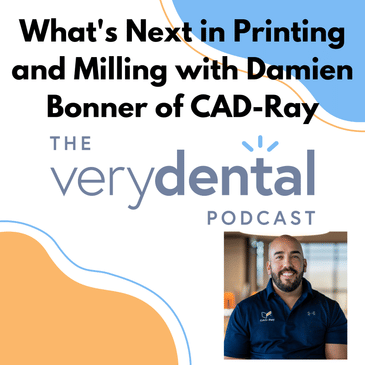
Alan was joined in the Chicago Midwinter podcast lounge by Damien Bonner of CAD-Ray.
CAD-Ray is a one stop shop for all things digital in dentistry and there is no one better to talk about it than Damien Bonner! Damien walks us through the state of the art in dental 3D printers. It turns out that which printer is right for you depends on what you're using it for, what materials you'll need to use, how much of an enthusiast you are and how much you'll be printing.
Then...we dig in to mills! If you can print it, you can mill it, too. CAD-Ray has those, too!
Some links from the show:
Join the Very Dental Facebook group using the password "Timmerman," Hornbrook" or "McWethy," "Papa Randy" or "Lipscomb!"
The Very Dental Podcast network is and will remain free to download. If you'd like to support the shows you love at Very Dental then show a little love to the people that support us!
--
Crazy Dental has everything you need from cotton rolls to equipment and everything in between and the best prices you'll find anywhere! If you head over to verydentalpodcast.com/crazy and use coupon code "VERYDENTAL10" you'll get another 10% off your order! Go save yourself some money and support the show all at the same time!
--
The Wonderist Agency is basically a one stop shop for marketing your practice and your brand. From logo redesign to a full service marketing plan, the folks at Wonderist have you covered! Go check them out at verydentalpodcast.com/wonderist!
--
Enova Illumination makes the very best in loupes and headlights, including their new ergonomic angled prism loupes! They also distribute loupe mounted cameras and even the amazing line of Zumax microscopes! If you want to help out the podcast while upping your magnification and headlight game, you need to head over to verydentalpodcast.com/enova to see their whole line of products!
--
CAD-Ray offers the best service on a wide variety of digital scanners, printers, mills and even their very own browser based design software, Clinux! CAD-Ray has been a huge supporter of the Very Dental Podcast Network and I can tell you that you'll get no better service on everything digital dentistry than the folks from CAD-Ray. Go check them out at verydentalpodcast.com/CADRay!
[00:00:00] This is a production of The Very Dental Podcast Network.
[00:00:05] This is The Very Dental Podcast.
[00:00:17] Welcome to The Very Dental Podcast, where you'll find entertaining and relevant conversations
[00:00:22] with visionaries, clinicians, and your friends in the dental space.
[00:00:27] Now here's your host, Dr. Alan Mead.
[00:00:30] Very Dental people, welcome back to another episode recorded live in the podcast lounge
[00:00:37] at the Chicago Midwinter 2024.
[00:00:39] Joining me, he's been on the show a bunch before.
[00:00:42] Damien Bonner of Cadray.
[00:00:43] Damien, how are you doing?
[00:00:44] Doing great.
[00:00:45] How are you?
[00:00:46] I'm good.
[00:00:47] So Cadray, you go to Cadray and there's like three people thick that you've got
[00:00:51] to wait because it's pretty busy.
[00:00:52] You guys are doing okay there, aren't you?
[00:00:54] It's not bad.
[00:00:55] It's an awesome opportunity to present to doctors and get to speak to our customers.
[00:00:58] It's an awesome opportunity.
[00:01:00] Yeah.
[00:01:01] Busy or the better, but we'll take it as it is.
[00:01:03] Yeah.
[00:01:04] I mean you guys have a bunch of people working there too.
[00:01:06] If you're at, it's too late.
[00:01:08] If you hear this, you've missed the Chicago Midwinter.
[00:01:11] But for another meeting anyhow.
[00:01:13] So Damien is going to tell me a little bit about printers mostly and maybe mills
[00:01:18] because they got a lot of new stuff going on over there.
[00:01:21] So I'm going to start with me because I'm dumb and ignorant and haven't really done any printing.
[00:01:27] And my situation is this.
[00:01:30] I told you about my, the guy that I use, local lab guy, literally bought the other side
[00:01:35] of the building from me and he's putting together a lab and I said, you know what?
[00:01:38] Let's get a printer together.
[00:01:39] We'll go in together and get a decent printer because right now I'm literally
[00:01:44] paying someone else to print my stuff.
[00:01:46] You know people can gouge you.
[00:01:47] It's ridiculously expensive.
[00:01:49] I print less models than I would because I'm going to get gouged price wise on the thing.
[00:01:54] So it's time for me to get a printer but I have no experience printing.
[00:01:59] My lab guy does, but I don't.
[00:02:01] So then the question is you got about a million options for me to choose from.
[00:02:06] It just, oh yeah, go to the booth.
[00:02:07] He's got like six of them sitting out there from, you know, and Wayne was sort of telling
[00:02:11] me a little bit.
[00:02:12] I'm like, man, he's got sprint rays.
[00:02:14] So give me everything.
[00:02:15] I want to know everything about printers.
[00:02:17] Yeah.
[00:02:18] So then we were primarily sprint ray and Accureta.
[00:02:21] As of today, we launched a Sega which has been really popular in the lab space, not so much
[00:02:26] in the clinical space.
[00:02:28] And Nexa 3D, which is an industrial printer now marketed towards the dental space.
[00:02:34] Both great options, all four options that we sell are incredible options.
[00:02:38] They all take you point A to point B.
[00:02:40] They all produce a great product in the end.
[00:02:43] How you get there is going to be a little bit different.
[00:02:46] What you pay and the materials that you use will be different as well.
[00:02:49] So they're all, they all do the same thing in the end of the day.
[00:02:52] They just do it a little differently.
[00:02:54] So I mean, primarily for starters, a lot of people like, I want to print models.
[00:02:58] They're all going to print models real well is what Wayne said.
[00:03:01] Absolutely.
[00:03:02] And I mean, tell me about model materials.
[00:03:07] Has that changed a lot or not really?
[00:03:09] Models are models and that's sort of the basic entrance point to printers.
[00:03:13] Yeah.
[00:03:14] So they're all different model, different cost of material obviously.
[00:03:17] And then with something like Sprint Ray, which is more of a closed system, it's selectively
[00:03:21] open and does have some third party options for resins.
[00:03:25] But primarily it's closed.
[00:03:27] Okay.
[00:03:28] And they have some great resins, but you're paying the price to the resin that they
[00:03:30] charge.
[00:03:31] And when you say closed, you're buying the resin from them.
[00:03:33] You're buying the resin from us, but it's their brand.
[00:03:37] You don't go to the hardware store.
[00:03:39] Yeah, exactly.
[00:03:40] So with the other printers, they're considered open and validated.
[00:03:43] Yeah, yeah.
[00:03:44] Over 200 validated materials for those.
[00:03:46] Okay, I get it.
[00:03:47] Now the difference with models is that model you print on Sprint Ray, roughly let's say
[00:03:51] $3 a model versus the NEXA 3D, which with their resin, which is a little less expensive.
[00:03:59] You're printing at about $1.50, $1.60, so about half the price per model based
[00:04:04] on the kilograms that you get of material, the price of the material.
[00:04:09] And then between all those printers, they're all calibrated differently for each material.
[00:04:14] So we can print really fast with the NEXA 3D on a model scan without doing any accessory
[00:04:22] upgrades or having to upgrade software.
[00:04:25] It's based on the material, based on the calibration of the system, is how fast it
[00:04:29] can put those things out.
[00:04:30] So we're printing models on the NEXA 3D which is our least expensive system in 16
[00:04:34] minutes.
[00:04:35] Oh, that's really cool.
[00:04:36] That's really cool.
[00:04:37] Okay.
[00:04:38] And then you've got Sprint Ray.
[00:04:39] In Sprint Ray, you said it's more Sprint Ray is the apple.
[00:04:42] They're the closed system.
[00:04:44] How well do these guys do for a dummy like me that is going to go from a scanner and
[00:04:50] would like to press as few buttons as possible to get a model?
[00:04:53] And that's what Sprint Ray does for you.
[00:04:56] So Sprint Ray is your turnkey solution that your staff can easily adapt to it.
[00:05:01] There's not a lot of things you can do wrong once you have the STL or the data
[00:05:05] to input it.
[00:05:07] You're pressing start, you're walking away, you come back, you press start into the
[00:05:10] wash unit.
[00:05:11] It automatically goes from wash one which is a dirty wash over to wash two and then
[00:05:16] a drying cycle and then from there you're curing the product.
[00:05:19] So very little human interaction when it comes to Sprint Ray.
[00:05:22] Other systems are sort of catching up to that.
[00:05:24] Everyone I've ever asked, I say, what's the best printer for a dummy who doesn't
[00:05:28] really, he's just not engaged, they always say Sprint Ray.
[00:05:31] Yeah, absolutely.
[00:05:32] And other printers are starting to catch up to the automation aspect but they're
[00:05:35] so far ahead of the game and have the best marketing in dental.
[00:05:38] Yeah, they do.
[00:05:39] It's synonymous with 3D printing.
[00:05:42] It's with good reason.
[00:05:43] Yeah, that's interesting.
[00:05:44] Okay, so but everyone can produce a model.
[00:05:47] There are some advantages to Sprint Ray because of the automation but it's all
[00:05:52] close you're going to use Sprint Ray materials maybe pay a little bit more.
[00:05:56] That said, you've got CAD-Ray for service on all this stuff.
[00:06:01] So the reality is that Damien is probably the guy you're going to talk to or
[00:06:04] one of the guys.
[00:06:06] If you, I'll link to the episode I did when I left him with my computer and went
[00:06:11] to Taco Bell and you fixed it while I was going to get it at my lunch.
[00:06:15] That is okay.
[00:06:17] I mean I think you can probably buy a Sprint Ray printer or any from a lot of
[00:06:20] other people but I'm going to tell you that you shouldn't because what CAD-Ray
[00:06:23] has that no one else has is Damien and the service guys that I mean listen,
[00:06:28] Damien's my guy but I mean there's a lot of people that know a lot of
[00:06:30] stuff there and the reality is if you're like me you're going to need
[00:06:34] help.
[00:06:35] So it's nice to talk to the people that are going to be helping and it's kind of
[00:06:40] a big deal.
[00:06:41] Yeah, Wayne's ahead of our 3D printing department.
[00:06:46] Wayne came from Sprint Ray.
[00:06:47] Oh jeez, he's sweet guy too.
[00:06:49] He's nice.
[00:06:50] He's okay.
[00:06:51] So Wayne and I worked together my first job in Dendall back in 2007.
[00:06:57] So 2007 I've known him quite a long time where we shared an office
[00:07:00] and now we share a lot of things.
[00:07:03] He's okay but you know, I get it.
[00:07:05] But he's our guru when it comes to printing.
[00:07:09] There's all of our training on boarding.
[00:07:11] It makes everybody feel very comfortable so no matter which system you get into
[00:07:14] you're getting your hand held throughout the process.
[00:07:16] He was showing me the, what's the new one that you said is mostly lab?
[00:07:21] The Ocega Ultra.
[00:07:22] Okay tell me about the Ocega Ultra.
[00:07:23] That's one for deep pockets and heavy duty.
[00:07:26] He said it was future-proofed and that's kind of a big deal in dentistry
[00:07:29] because like especially in printing because like sometimes you want to do
[00:07:35] more than models.
[00:07:36] Let's just say that.
[00:07:37] So tell me a little bit about that and then tell me about all the
[00:07:40] all the different stuff that we could be doing in these printers.
[00:07:42] Yeah, so the Ocega Ultra is a really nice product from an engineering
[00:07:46] perspective.
[00:07:47] A lot of different ways to prevent spillage, to prevent things that
[00:07:52] can go wrong, smudges on the equipment that you just spent thousands
[00:07:56] upon thousands of dollars for.
[00:07:57] So they have some nice features in the software and in the hardware
[00:08:01] itself.
[00:08:02] From a standpoint of ability it's a gigantic bill plate, a lot of room
[00:08:07] to build a lot of different things at one time.
[00:08:10] They come out with multiple resin trays, resin tanks for different materials.
[00:08:17] At the same time.
[00:08:19] Different resin tank for each material.
[00:08:22] Exactly.
[00:08:23] So if you were having let's say nightguards and surgical guides, those are two different materials.
[00:08:26] They would each have a resin tank.
[00:08:28] You just switch out the resin.
[00:08:29] But now they have a super high gloss resin tank.
[00:08:31] So those resins are clear.
[00:08:33] They have software that goes through and produces a better rendition
[00:08:38] with less refraction of light through the clear product to give you a highly polished
[00:08:44] nightguard, let's say, that's going to come right out of the printer
[00:08:48] and go into the curing unit after washing it and not have to polish anything off.
[00:08:52] No adjustments.
[00:08:53] Nice.
[00:08:54] No adjustments, no polishing.
[00:08:55] It's clear.
[00:08:56] Wow, that's very cool.
[00:08:58] Polar surface.
[00:08:59] That's very cool.
[00:09:00] Could you use clinics to make a nightguard and then send it over to that printer?
[00:09:05] So that's sort of the missing link with all these printers is that most people have one
[00:09:09] piece of the pie, which is the scanner.
[00:09:11] Now you have the data.
[00:09:12] Yeah.
[00:09:13] Now what do you do with that data?
[00:09:15] Do you send it to a service that Sprint Ray has to create an artificial intelligence,
[00:09:19] an AI created nightguard for $30?
[00:09:22] Yeah.
[00:09:23] Sure, you can do that.
[00:09:24] But if you do more than three of those a month, you're sort of wasting your money.
[00:09:27] You could just, yeah.
[00:09:28] So with clinics, we created it to fill that void for doctors who don't have
[00:09:32] access to software to create restorations or nightguards and don't want to spend
[00:09:37] $6,000, $7,000 on Exocad.
[00:09:39] So clinics is just for those that don't know, you know, because I've talked
[00:09:43] about it before, but it's a browser-based and kind of aimed, I got to figure it's aimed
[00:09:49] at dentists like me that are less engaged, that don't want to have to learn Exocad
[00:09:54] and do all this.
[00:09:55] Is that kind of the thought process?
[00:09:56] Yeah, we're trying to make it as easy as possible for everybody to go to point A
[00:09:59] to point B.
[00:10:00] Yeah.
[00:10:01] And to be able to hand it off to your team for them to design a quick nightguard
[00:10:05] and more a restoration and as few clicks as possible and get it over to your printer.
[00:10:09] So we've integrated with all the scanners we sell, we've integrated it with all the printers
[00:10:13] and milling units that we sell so that all the CAMM softwares are directly recognized by
[00:10:18] our end result and it easily loads into any of the softwares that you want to manufacture.
[00:10:23] And it's browser-based so you can do it on whatever computer.
[00:10:26] I'm assuming you like one browser over the other and you'd like to...
[00:10:29] Well, it has to go through Chrome.
[00:10:30] For them, okay.
[00:10:31] And it has to have a good graphics card that is doing 3D processing of data.
[00:10:35] Sure.
[00:10:36] But I would argue probably if you've got a scanner you've probably got.
[00:10:38] It's the same...
[00:10:39] So you could use it on my computer.
[00:10:40] Absolutely.
[00:10:41] I'm running the i700.
[00:10:42] Absolutely.
[00:10:43] Okay, okay.
[00:10:44] And obviously then it would really connect nicely.
[00:10:46] Probably go find it for me.
[00:10:47] Yeah, there is a Clinix integration right in the Med-It application where it will
[00:10:51] launch directly.
[00:10:52] When you do exporting from TRIOS it does launch directly into Clinix as well.
[00:10:56] So all these different scanners are integrated easily into the system.
[00:11:00] We can get you a restoration as few as five clicks if you wanted to.
[00:11:05] Okay.
[00:11:06] And then a night guard, it's a pretty simple process to make a night guard.
[00:11:10] From there you're manufacturing it to your printer or your milling unit and delivering
[00:11:14] the prosthesis to the patient with a night guard to the patient.
[00:11:17] That is $99 a month for Unlimited.
[00:11:19] Yeah.
[00:11:20] Or now we've moved to a new plan where you can pay per export.
[00:11:23] It's as little as $450 per export.
[00:11:25] So 10 exports is $45 and you can use the software as much as you want without
[00:11:30] exporting to test it out for yourself.
[00:11:32] Sure.
[00:11:33] No, that's cool.
[00:11:34] Actually I didn't realize that.
[00:11:35] I'm not sure what you're talking about for me.
[00:11:37] The idea that since I've got this lab guy here, Clinix, what are all the different things
[00:11:42] you can design in Clinix?
[00:11:43] So right now Clinix is still in its infancy.
[00:11:46] We have a nice user base and we're getting a lot of feedback from our customers on what
[00:11:50] they want to see.
[00:11:51] Right now it's crowns, inlays, onlays, and multi-unit single visit.
[00:11:58] That's the single crowns.
[00:12:00] Sure.
[00:12:01] And night cards.
[00:12:02] Okay.
[00:12:03] So as we grow...
[00:12:05] I'm sorry but that's friggin' huge appeal because that's what everyone's doing.
[00:12:08] Let's be honest.
[00:12:09] I mean, yeah, it'll be great when you can mill out your own...
[00:12:11] It's what 90% of what you're looking for is done.
[00:12:13] Yeah, no, I know.
[00:12:14] I get it.
[00:12:15] And I know that you're going to make more...
[00:12:16] You'll be able to do Zirconia full-arch implant.
[00:12:20] Great, that's good.
[00:12:21] But the reality is most of us schmos are doing exactly what you just said.
[00:12:24] Exactly.
[00:12:25] And so it fits the need of most of the dentists.
[00:12:27] Yeah, it does.
[00:12:28] Especially that have want to get a printer and don't want to spend that extra money.
[00:12:31] Yeah.
[00:12:32] The beauty of printing now with the final restorative or the definitive crown, so to say, is in my
[00:12:40] opinion not with the crown itself but with the inlay on-lay.
[00:12:43] It's something that when we all sold CEREC was...
[00:12:46] I know where you're going with it.
[00:12:48] A basis of saying, hey, how many inlays and on-lays aren't you doing per month?
[00:12:52] Because those are now three, four surface composites.
[00:12:54] Right, right.
[00:12:55] And we know that just a band-aid for new dentistry in seven years or whatever
[00:12:59] maybe until it fails.
[00:13:01] With printing, we can print out a whole quadrant of inlays on-lays that are designed in clinics
[00:13:05] in less than 10 minutes so faster than you could pack a matrix band on tooth of quadrant teeth.
[00:13:10] What do you print those in?
[00:13:12] Those are ceramic material.
[00:13:14] So it's anything that has 51% or more nanoceramic with the resin fill can be built as a
[00:13:20] definitive crown.
[00:13:21] Well, what kind of printer could you use to do that?
[00:13:23] That's Sprint Ray.
[00:13:25] Any of the printers we sell.
[00:13:26] Any printers you have, you could do that.
[00:13:27] Sprint Ray has their own material called ceramic crown.
[00:13:29] And then all the other printers, like I said, are open and validated.
[00:13:32] So they use rodent sculpture.
[00:13:33] Materials are changing crazy.
[00:13:35] Because I can remember when you were saying, oh, it's coming.
[00:13:37] It's coming.
[00:13:38] But that's awesome.
[00:13:39] It's an arms race for materials.
[00:13:41] Sure it is.
[00:13:42] That makes sense though.
[00:13:43] That's really kind of cool.
[00:13:44] So you've got people who are really doing that now.
[00:13:46] You've got people who are doing literally, you know,
[00:13:49] instead of this is what they do for composites basically.
[00:13:51] Yeah, I mean it's a better material than composite.
[00:13:54] Sure.
[00:13:55] There's no worrying about your carving anatomy in
[00:13:58] or do you have enough contact in between approximately.
[00:14:02] We're designing it that way.
[00:14:04] So when we design it that way, we can print it out.
[00:14:06] It prints out in 10 minutes.
[00:14:07] We seed it in.
[00:14:08] It's going to expand and contract like natural tooth structure.
[00:14:10] So less chance of micro leakage or possible recurrent decay.
[00:14:15] And they're not breaking off.
[00:14:17] It's a nice material.
[00:14:18] Again, it's resin filled ceramic.
[00:14:20] Or ceramic filled resin.
[00:14:22] Which way it goes.
[00:14:23] But it's a very flexible material.
[00:14:26] Yeah.
[00:14:27] Flexible.
[00:14:28] But if it's 51 plus percent ceramic, it's going to wear nicely too.
[00:14:33] It does.
[00:14:34] And it polishes like composite.
[00:14:35] Yeah.
[00:14:36] And then with the new Sprint Ray Nano Cure,
[00:14:39] they just put out a new curing unit as of today.
[00:14:42] So they had the ProCure 2, which is the fastest curing unit in the world.
[00:14:45] Now they have the Nano Cure, which is a smaller version of that
[00:14:48] but has three different wavelengths.
[00:14:50] 365, 385 and 405.
[00:14:52] What does that mean?
[00:14:53] That's the ability now to now put glaze, paint on glaze
[00:14:57] or paint on stain and cure it inside the curing unit for those restorations.
[00:15:01] So before we had to use either a triad box
[00:15:04] or your curing light used for the introoral use.
[00:15:08] I had one of those triad boxes 100 years ago.
[00:15:10] They get hot.
[00:15:11] I remember that.
[00:15:12] And also don't move them because they're old fragile.
[00:15:15] They can be.
[00:15:16] Interesting.
[00:15:17] So this is all very cool.
[00:15:18] So I mean, Cadre is interesting
[00:15:22] because you sell a lot of different...
[00:15:24] You're sort of a one-stop technology place.
[00:15:27] You've got scanners, scads of scanners.
[00:15:30] We can talk about that again.
[00:15:31] You got all these printers.
[00:15:32] You got the software.
[00:15:34] And I mean, I know you got mills.
[00:15:38] Let's just talk about mills.
[00:15:39] Let's just do it.
[00:15:40] You're here.
[00:15:41] Absolutely.
[00:15:42] So you got to go there.
[00:15:43] You got to go and talk to the people at Cadre
[00:15:44] when you're looking for a printer.
[00:15:46] Talk about mills and what do you think...
[00:15:49] Tell me about your mills.
[00:15:50] And then I got a couple questions about it.
[00:15:52] Yeah, I mean, I'll start with...
[00:15:54] Milling is a whole frontier that a lot of people
[00:15:56] who get into digital dentistry don't envision themselves
[00:15:58] doing in the future.
[00:15:59] Right.
[00:16:00] For sure you've heard that.
[00:16:01] Exactly.
[00:16:02] There's a fear factor involved.
[00:16:03] There's a cost factor involved for people.
[00:16:05] And that fear factor is can I do it?
[00:16:07] Can I produce an office?
[00:16:08] And that's sort of where printing comes in
[00:16:10] because if you can do it with a printer,
[00:16:12] you can do it with a mill
[00:16:13] because instead of...
[00:16:15] It's the same design.
[00:16:16] It's the same post-process.
[00:16:17] You're just sending it to a printer versus a mill,
[00:16:19] which is a reductive process versus an additive.
[00:16:22] So the fear factor when you have printing
[00:16:25] kind of goes out the window.
[00:16:26] Now it comes down to cost.
[00:16:28] Well, when you buy a fully integrated system,
[00:16:30] let's say like CERIC,
[00:16:32] it's $150,000, $160,000.
[00:16:34] But you're buying a scanner.
[00:16:36] Start to finish.
[00:16:37] You already have the scanner.
[00:16:38] You already have the software from clinics.
[00:16:40] Now you're just adding the new component.
[00:16:42] So there's options from 25,000 to $60,000
[00:16:46] and everything in between.
[00:16:48] So we sell three different milling units at this point.
[00:16:52] We've had the DOF
[00:16:54] for a degree of freedom, Cracked 5X,
[00:16:56] which is our best-selling product.
[00:16:58] It's a five-axis mill.
[00:17:00] All self-consane.
[00:17:01] So all it requires is a 110 outlet to run everything.
[00:17:04] There's no air required because it's all
[00:17:06] below the system, the air compressor, the vacuum.
[00:17:08] Everything is included in the system.
[00:17:10] It is wet and dry.
[00:17:11] So you can do both, CERCODIA,
[00:17:13] and you can do your glass ceramics.
[00:17:15] You can do your temporary materials if you wanted to,
[00:17:17] and you also do abutments in that system.
[00:17:20] So it's a five-axis mill, very versatile,
[00:17:23] and comes with a three-year warranty when you buy it from us.
[00:17:26] Also, we have the rolling system.
[00:17:32] So rolling is wet or dry.
[00:17:34] So you have your five-axis dry mill.
[00:17:36] You have your four-axis wet mill.
[00:17:38] So two separate units.
[00:17:40] Those require air at lower price point,
[00:17:43] but still in the $36,000, $40,000 range.
[00:17:46] Okay.
[00:17:47] And then we just signed on with VHF.
[00:17:49] So VHF is our newest partnership.
[00:17:51] A few years ago, we sold VHF through a third party.
[00:17:54] Okay.
[00:17:55] Didn't exactly have the best relationship with them.
[00:17:58] But through our newfound friendship here,
[00:18:01] we've now launched their products to the E4, the E5.
[00:18:04] Okay.
[00:18:05] And then they have the R5 also.
[00:18:08] So that's an exciting product because it's very small.
[00:18:11] Okay.
[00:18:12] It fits anywhere on a countertop,
[00:18:15] and is really cost-effective.
[00:18:17] So between $25,000 and $40,000 depending on what you're looking at.
[00:18:20] That's... See, that's...
[00:18:21] Okay, so one of the things I was going to ask you about the mill.
[00:18:24] Okay.
[00:18:25] I mean, it's not like milling in a dental office is particularly new.
[00:18:28] Anyone who's had a Sarek,
[00:18:30] and of course, Sarek has gone through a lot of stuff
[00:18:32] and people are milled, but the reality is like,
[00:18:34] I think there's a fear of dentists of like,
[00:18:36] oh yeah, but that system was already set up for me.
[00:18:38] I don't have to...
[00:18:39] I don't know that I know how to reinvent the wheel.
[00:18:41] You're saying you don't have to reinvent the wheel
[00:18:43] because if you can use...
[00:18:44] Let's be honest, if you can use clinics,
[00:18:46] which you guys have simplified honestly as it is,
[00:18:49] it is sent to a printer or a mill,
[00:18:51] and these mills can have different levels of ability or whatever.
[00:18:56] So do you see regular dentists having mills in their offices sooner?
[00:19:02] More often or is it still kind of a niche thing?
[00:19:05] And moving forward too, I guess in the next 10, 20 years.
[00:19:08] Yeah.
[00:19:09] I mean, I guess we have a good view of what the market is doing.
[00:19:14] Scanners and printers,
[00:19:16] and now when those people are coming back to us and saying,
[00:19:19] all right, talk to me about mills.
[00:19:20] That's exactly right.
[00:19:21] You can't just...
[00:19:22] It's like Pringles.
[00:19:23] You can't just have one.
[00:19:25] So we're seeing it more and more often,
[00:19:28] and a lot of that comes down to the service and support aspect
[00:19:31] of what we offer on the mill,
[00:19:32] because most people will just drop the mill off at your office
[00:19:35] and wish you luck.
[00:19:37] Okay, I won't lie to you.
[00:19:38] Okay, my lab guy, I shouldn't tell him.
[00:19:41] I won't tell who he bought it from,
[00:19:43] but they did do that.
[00:19:46] And he's like, so when are you coming in still?
[00:19:48] I don't know.
[00:19:49] I mean, if we have a service call, we can...
[00:19:51] We'll walk you through.
[00:19:52] It's that easy.
[00:19:53] We'll walk you.
[00:19:54] My eyes would be really big.
[00:19:55] Like, you've got to be freaking kidding me.
[00:19:57] He knows something about mills.
[00:19:58] I know nothing about mills,
[00:19:59] but he was still like, I don't know.
[00:20:01] I mean, so yeah.
[00:20:03] I mean, and he's a lab technician
[00:20:05] in those ways doing.
[00:20:06] A dentist, a lot of them would be like,
[00:20:08] I don't know where to start, you know?
[00:20:10] Yeah, the worst thing for us is to see something
[00:20:12] not be utilized when you produce from us.
[00:20:14] So we'd rather just...
[00:20:15] You know that dentists like to tell the stories
[00:20:17] of the whole, you know,
[00:20:19] the laser, the microscope,
[00:20:21] the hat rack or whatever you...
[00:20:23] Exactly.
[00:20:24] So we've expanded our team.
[00:20:27] So Frank DeLuca, who runs our milling department,
[00:20:30] we just hired two new people to work under him
[00:20:32] to help them do these installs around the country,
[00:20:34] because he gets pulled in many directions
[00:20:37] when we're installing in California,
[00:20:38] installing in New York in the same week.
[00:20:40] So we've worked it out where our install team comes out.
[00:20:44] They spent a half day installing the system,
[00:20:46] and then two days with the team
[00:20:48] to pump out restorations,
[00:20:49] to have patients come in
[00:20:51] and do live restorations on those patients
[00:20:53] and get the best training you could possibly do.
[00:20:55] It's amazing.
[00:20:56] I literally...
[00:20:57] I'm like, okay, we set up
[00:20:59] our favorite totally regular patients
[00:21:02] that were like, we're going to do this for you.
[00:21:04] You're going to be the guinea pigs.
[00:21:06] These are people that I could just literally...
[00:21:08] I know the patients in my office, I would do that with.
[00:21:10] And you literally sit there and just walk them through it.
[00:21:13] That's so good.
[00:21:14] Oh, my gosh, that's so good.
[00:21:15] No one does that.
[00:21:16] No one does that.
[00:21:17] I hope no other manufacturer is listening to this.
[00:21:19] They'll steal our ideas.
[00:21:20] Yeah, yeah.
[00:21:22] That's the...
[00:21:23] We're invested as much as the doctor has invested
[00:21:26] in the success of that practice.
[00:21:28] And so, we're not always going to be the cheapest,
[00:21:31] but we're by far going to be the best service.
[00:21:33] The services there.
[00:21:34] But also, hey, it works pretty good for you guys
[00:21:36] because if you've got a dentist that's cranking out the stuff
[00:21:38] they're using your software, they're buying the materials from you.
[00:21:41] It's good for everyone.
[00:21:42] It's good for everyone.
[00:21:43] Absolutely.
[00:21:44] I love that. That's really cool.
[00:21:46] You guys, like I said, have always done a great job for me.
[00:21:49] And I mean, you guys are kind of where I get my technology.
[00:21:51] I just feel like there's a lot...
[00:21:54] I mean, we could do multiple podcasts.
[00:21:56] I honestly want to do a podcast just on clinics
[00:21:58] because I'm...
[00:21:59] Now that I've got a lab sitting next to me,
[00:22:01] I want to see if I can figure out how to design some of this stuff.
[00:22:04] That means I have to actually be able to look at my own margins,
[00:22:06] not barf, but besides that,
[00:22:08] that whole other podcast right there.
[00:22:10] We do host a weekly webinar every Friday.
[00:22:14] You sign up at clinics.pro.
[00:22:16] Yeah.
[00:22:17] P-R-O.
[00:22:18] And watch an hour long webinar
[00:22:20] that we do live to review the software
[00:22:23] and ease of use of it
[00:22:24] and answer any questions you may have.
[00:22:26] You also have Scan Camp in Las Vegas
[00:22:27] that I keep promising I'm going to come out to.
[00:22:29] I haven't done it yet.
[00:22:30] Yeah, it's funny.
[00:22:31] We've been in that location now three years
[00:22:33] and there was nothing around us at all.
[00:22:35] Now they just popped up a hotel.
[00:22:36] The Durango Resort just opened up across the street.
[00:22:38] Is that where you guys have people stay?
[00:22:40] Yeah.
[00:22:41] Well, there's a little hotel in the parking lot
[00:22:43] that's so convenient
[00:22:45] that it's hard not to stay there.
[00:22:47] But the Durango is a five-minute walk
[00:22:49] across the street and that place is beautiful.
[00:22:51] My best friend from dental school
[00:22:52] and I've been talking about this,
[00:22:53] he's like, you set us up in Vegas
[00:22:54] and we're going to do it,
[00:22:55] so I got to do that.
[00:22:56] Because he has a meddit.
[00:22:57] I think he's still using an i-500.
[00:22:59] Nothing wrong with that.
[00:23:00] He would be an easy sell on any of these scanners
[00:23:03] and you'll have them all to play with there.
[00:23:05] Is that how it works?
[00:23:06] Yeah, so we'll have the scanners in our Vegas location.
[00:23:07] We have our milling units.
[00:23:08] We have the printers.
[00:23:09] So you get a full in-depth review of everything.
[00:23:13] It's the perfect place to dip your toe in.
[00:23:15] We send everybody home with a night guard.
[00:23:17] Yeah.
[00:23:18] We have the day design and clinics.
[00:23:20] They print out on our printers.
[00:23:22] It's like the perfect place to dip your toe in.
[00:23:24] You guys have thought this out.
[00:23:26] That's why you're having to hire some people.
[00:23:28] You've thought it out and it makes sense.
[00:23:30] It's a good problem to have.
[00:23:31] It is a good problem to have.
[00:23:32] That's great.
[00:23:33] Okay, Damien, thank you.
[00:23:34] What's the best way to get in touch with you guys?
[00:23:36] Cadray.com.
[00:23:37] I'll put the link in the show notes.
[00:23:39] Cad-ray.
[00:23:40] We'll get the hyphen.
[00:23:41] That's an important one.
[00:23:42] It's some bastard by that.
[00:23:44] With no dash,
[00:23:47] it probably goes to some Russian porn site
[00:23:50] or something like that.
[00:23:51] I'm sorry.
[00:23:53] I'm speculating here.
[00:23:54] I have no facts there, people.
[00:23:56] But the best way is always to call us
[00:23:58] A33 Cadray too.
[00:23:59] Okay.
[00:24:00] Pretty simple.
[00:24:01] That's your support line as well.
[00:24:03] I have to admit Damien answers on Facebook for me,
[00:24:05] but I'm not sure he can promise the same for you.
[00:24:07] I'm always on Facebook.
[00:24:08] He's Facebook Messenger, man.
[00:24:10] Damien, you've got to help me, man.
[00:24:12] It's pretty great.
[00:24:13] Having service where the person knows you are.
[00:24:15] You guys know your...
[00:24:17] I mean, half the people that wear your booth
[00:24:19] are people who've already bought stuff from you.
[00:24:21] That's kind of cool.
[00:24:22] It's not a bad problem to have.
[00:24:23] It's always good to see them
[00:24:24] and they're always looking to see what's next.
[00:24:26] Yeah, no, because you've got what's next.
[00:24:28] I love it.
[00:24:29] This is awesome, Damien.
[00:24:30] Good to see you.
[00:24:31] Thank you so much for the time again.
[00:24:32] You bet.
[00:24:33] See you next year.