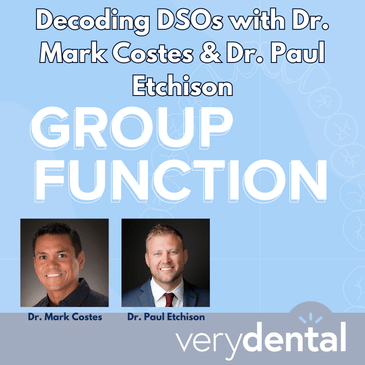
In this throwback episode of the Group Function Podcast, Alan Mead sits down with two titans of dental podcasting: Dr. Mark Costes and Dr. Paul Etchison! Together they decode the rapidly evolving world of Dental Service Organizations (DSOs). They break down complex industry jargon like EBITDA, recapitalization, and same-store growth, making it easily digestible for independent practice owners. The trio explores the transition from the initial wave of practice consolidation to the modern, highly discerning private equity landscape. Between dropping heavy business knowledge, they also take a nostalgic detour to reminisce about feral 1970s and 80s childhoods, riding bikes until sundown, and the ultimate debate: Star Wars versus He-Man.
Mark and Paul use quite a few terms that you might not be 100% familiar with. I had heard them kicked around, but before the conversation starts, I list a couple definitions that you might find helpful:
- DSO: Simply put, DSO stands for Dental Service Organization. A DSO is a company that helps administer the business aspects (management, marketing and business administration) of the dental practice.
- EBITA: EBITA stands for "Earnings Before Interest, Taxes and Amoritization." It is a measure of profitability that a potential investor can use to evaluate a potential company or practice. It's used help make "apples to apples" comparisons between potential investments. EBITA is calculated from financial data reported by a company. Many DSOs valuate dental practices as a multiple of their EBITA.
- same store growth (or same store sales): a measure of growth used by a DSO to know how well an individual practice within the DSO is doing. A DSO will want to know how well the individual practice is doing vs. the entire DSOs growth. The idea is to invest in a practice that has potential to grow in it's own location separate from its relationship to the whole DSO.
- Private equity (or PE): a type of investment where investors buy shares of privately-held businesses. Private equity is the money supply that has driven the DSO revolution in dentistry (and many other industries). Private equity money expects a return on their investment much like any investor would.
- Recapitalization (aka: recapitalization event): "the second bite at the apple" according to Mark and Paul. Recapitalization is the restructuring of a company's debt and equity mixture, and/or financing. This is usually done to stabilize a company's capital structure. In the context of a DSO, recapitalization might be the sale of a smaller DSO/group to a larger one and/or the buying out of dental owners.
Some links from the show:
- Dental Success Network (Mark's stuff)
- Dental Practice Heroes (Paul's stuff)
Join the Very Dental Facebook Group using one of these passwords: Timmerman, Paul, Bioclear, Hornbrook, Gary, McWethy, Papa Randy, Frank or Lipscomb!
The Very Dental Podcast network is and will remain free to download. If you'd like to support the shows you love at Very Dental then show a little love to the people that support us!
We're proud to be supported by the folks at Net32!
I'm a big fan of the Bioclear Method! I think you should give it a try and I've got a great offer to help you get on board! Use the exclusive Very Dental Podcast code VERYDENTAL8TON for 15% OFF your total Bioclear purchase, including Core Anterior and Posterior Four day courses, Black Triangle Certification, and all Bioclear products.
Crazy Dental has everything you need from cotton rolls to equipment and everything in between and the best prices you'll find anywhere! If you head over to verydentalpodcast.com/crazy and use coupon code "VERYSHIP" you'll get free shipping on your order! Go save yourself some money and support the show all at the same time!
The Wonderist Agency is basically a one stop shop for marketing your practice and your brand. From logo redesign to a full service marketing plan, the folks at Wonderist have you covered! Go check them out at verydentalpodcast.com/wonderist!
Enova Illumination makes the very best in loupes and headlights, including their new ergonomic angled prism loupes! They also distribute loupe mounted cameras and even the amazing line of Zumax microscopes! If you want to help out the podcast while upping your magnification and headlight game, you need to head over to verydentalpodcast.com/enova to see their whole line of products!
CAD-Ray offers the best service on a wide variety of digital scanners, printers, mills and even their very own browser based design software, Clinux! CAD-Ray has been a huge supporter of the Very Dental Podcast Network and I can tell you that you'll get no better service on everything digital dentistry than the folks from CAD-Ray. Go check them out at verydentalpodcast.com/CADRay!
[00:00:00] [SPEAKER_02] Did you know Net32 was actually started by a dentist? Someone who is just fed up with how broken and expensive the supply process had become. This isn't some generic medical site. It was built specifically for dental practices. Thousands of dentists use it every day to save time and money. You'll find all the big brands you already know and trust just at better prices. Instead of calling reps or chasing down quotes, you can compare products and pricing in seconds. It's completely transparent and you're in control of what you spend. Same products, same vendors, less hassle and lower prices.
[00:00:30] [SPEAKER_02] The next time you need supplies, check Net32. Built by a dentist for dentists like you. Check them out at Net32.com. This is a production of the Very Dental Podcast Network.
[00:00:52] [SPEAKER_02] First, you take a group of very dental people. Then you add some interesting topics and a few microphones. Finally, add some laughs and collegial good cheer and you get the group of very dental people. Welcome to another episode of the group function podcast. It's your host, Dr. Alan Mead. In mere moments, I'll be throwing to a conversation that I had with Dr. Mark Costas and Dr. Paul Etchison.
[00:01:20] [SPEAKER_02] It's really good conversation. I'm very proud of what we did and I think it's going to be super helpful and interesting to you guys. So, I had been talking about DSOs kind of on and off over the last couple months, couple weeks even.
[00:01:38] [SPEAKER_02] Only because as a concept, DSOs, dental service organizations, are a topic of conversation for a lot of us and have been for the better part of the last 10 years for sure, even five years, maybe more so. And I just haven't really been keeping my eye on the ball, paying much attention to them, but yet I hear quite a bit about them. So, I thought I would kind of dip back into just kind of taking the temperature, seeing what they're up to.
[00:02:04] [SPEAKER_02] So, this is sort of an update as to what's happening in the DSO world. It's not really a pro or con necessarily. And I'm not the business guy that Mark or Paul are. Both these guys, I really admire their understanding of the business of dentistry. And so, I thought it would be a really good thing to talk with them about it. And you're going to see it's a great conversation. However, they used some words that I wasn't 100% sure about or I had heard and didn't know exactly what it meant.
[00:02:34] [SPEAKER_02] In context, it made enough sense. But I thought for people who are maybe quote unquote beginners in this stuff, I could make it a little simpler by throwing out a couple terms and defining them for you before the conversation. So, I'm going to do that right now. First off, DSO. Simply put, a DSO stands for Dental Service Organization. A DSO is a company that helps administer the business aspects, whether that's management, marketing, business, administration,
[00:03:00] [SPEAKER_02] that sort of thing, of a dental practice. They talk about EBITDA. It's E-B-I-T-A. EBITDA stands for Earnings Before Interest, Taxes, and Amortization. It's a measure of profitability that a potential investor can use to evaluate a potential company or practice in this situation. It's used to help make apples-to-apples comparisons between potential investments. EBITDA is calculated from financial data reported by a company and many DSOs use EBITDA to evaluate dental practices.
[00:03:30] [SPEAKER_02] And they talk about dental practices being bought in multiples of their EBITDA. So, they talk a bit about same-store growth. On the Internet, it sounds like a lot of times they talk about that as same-store sales. It's a measure of growth of a company used by a DSO to know how well an individual practice within the DSO is doing. So, a DSO is typically multiple group of practices.
[00:03:56] [SPEAKER_02] A DSO wants to know that an individual practice is doing well or growing on its own because of what it's doing versus what the DSO has brought to help it grow. So, the idea is to invest in a practice that has potential to grow in its own location separate from its relationship to the whole DSO. So, they talk about private equity and everyone's heard about private equity. But basically, private equity is a type of investment where investors buy shares of privately held businesses, in this case, dental practices.
[00:04:22] [SPEAKER_02] Private equity is the money supply that has driven the DSO revolution in dentistry and in many other industries. Private equity money expects a return on their investment much like any other investment would. So, the money that's being put into DSOs is typically coming from private equity and that's what they're talking about. They also mention recapitalization or a recapitalization event. Mark describes this as the second bite at the apple.
[00:04:49] [SPEAKER_02] Recapitalization is the restructuring of a company's debt and equity mixture and or financing, usually done to stabilize a company's capital structure. In the context of a DSO, recapitalization oftentimes might be the sale of a smaller DSO or group to a larger one or buying out an existing dental owner. So, recapitalization typically, sometimes it's when owners are trying to leave, they'll recapitalize. So, I'm hoping that's a little helpful.
[00:05:14] [SPEAKER_02] They talk about a lot of different concepts here and those were some things that I had to kind of look up to be on top of. So, you guys sit back, take a listen to a really great conversation about DSOs and frankly where the business of dentistry is going in the next few years with two just absolute business geniuses, Dr. Mark Costes and Dr. Paul Etchison. Very dental people, welcome back to another episode of the Group Function Podcast.
[00:05:43] [SPEAKER_02] Group Function means that it's not just one person with me, there's multiple people with me. Today, I have, both people have been on the show multiple times before. Both people are epic podcasters. I mean, literally, although technology is none of our strong point, these guys all podcast like crazy. I think Dr. Mark Costas just rolled past 9 million downloads. Is that right, Mark?
[00:06:06] [SPEAKER_03] Whoa. True story. 1,750 episodes and 9 million downloads as of yesterday.
[00:06:13] [SPEAKER_02] That is terrific. Congratulations. That's fantastic. Yeah. So, one of the people joining us as I, Dr. Mark Costas, welcome.
[00:06:21] [SPEAKER_03] Hey, Alan. Hey, Paul. How are you guys doing? Oh, sorry. I let the cat out of the back. The other panel.
[00:06:25] [SPEAKER_02] That's right. The other person joining us, Dr. Paul Etcheson. How are you doing, Paul?
[00:06:30] [SPEAKER_04] Yeah, good, good. Excited to be here. Always good talking to you guys.
[00:06:34] [SPEAKER_02] Yeah, this is going to be great. We've been brewing this little episode up for a month or so. Paul is coming from outside Chicago area. Is that correct?
[00:06:45] [SPEAKER_04] Yeah.
[00:06:46] [SPEAKER_02] And Mark is-
[00:06:46] [SPEAKER_04] I mean, you wouldn't consider Chicago, but I'm 40 miles south. It doesn't feel very Chicago.
[00:06:52] [SPEAKER_02] You're closer to Chicago than the rest of us. Let's just say that. Yes.
[00:06:55] [SPEAKER_01] Yeah, that's true.
[00:06:56] [SPEAKER_02] And Mark is, are you in Prescott, Arizona, Mark? Is that right? Prescott like biscuit. Don't say Prescott. Prescott. Prescott. They'll know you're not a local if you say Prescott. That's the honest thing. Just get out of town. It's Prescott, Arizona. That's right. Okay. So before we start, we're mid-summer. I thought about this because I think both you guys are interesting and both you guys are storytellers. So I want you to throw back. Mark and I are 70s kids. I know that. I don't know how old Paul is.
[00:07:25] [SPEAKER_02] Paul, are you a 70s kid or are you more like an 80s kid? 80s. I'm 41. So he's 10 years behind us, Mark. I know Mark and I are born in the same year, if I'm not mistaken. So we're both old, pretty much. We grew up in the 70s. And I want each one of these guys to throw back and give me a great story of something great that happened when they were a kid in the summertime, a good summertime memory. So I'm looking at this. I want to hear from Paul.
[00:07:53] [SPEAKER_02] Paul, give me a good summertime memory.
[00:07:56] [SPEAKER_04] Shit, man. I always think about when being a kid in summertime, it was all about, we just rode our bikes everywhere. I mean, that's all we did. And it's just wild to think about like parenting nowadays. Like our parents had no idea where we were. It was like you left in the morning. You rode your bike to a friend's house. You rode to the store. You went and rode some trails. One played basketball. You know, nothing is like particular has come to mind. But I mean, that's what it was about like growing up was just being outside, playing baseball,
[00:08:24] [SPEAKER_04] basketball, hanging out with friends, riding bikes all over the place. And you just had to be home before the sun went down. Sometimes you had to be home for dinner. And sometimes you just said, hey, you know, I'll just check in before it gets dark. You can be gone all day and just figure it out as you go. But yeah, it's very different from how my kids are growing up nowadays. It's we know where they're at. And it's almost like we're scared to even let them ride their bike around the block sometimes. 100%. You know, so. But yeah, that's what it was just a lot about like riding bikes. You know, that's what it was.
[00:08:52] [SPEAKER_04] Just riding all over the place, being young and being independent.
[00:08:56] [SPEAKER_02] Mark, give me a 70s cool memory from summertime.
[00:09:01] [SPEAKER_03] Yeah, it's a lot like that. That's interesting, Paul, because even though you're an 80s kid, it sounds really similar to how I grew up. I grew up in Tucson, Arizona until high school. And then we moved to Southern California. So I grew up in the desert. And back then, if you go to Tucson now, it's like it's just like any other major city. There's a lot of concrete and condos and shopping centers and stuff. But back in the day, there was just a whole lot of desert, a whole lot of open desert. We did. We rode our bikes everywhere.
[00:09:30] [SPEAKER_03] It was literally like we would get up early, head out on our bikes and not come home until the sun was coming down. And there wasn't a whole lot of worry back in the day about safety or anything like that. We had BB guns and we'd shoot stuff. And then about fourth grade, I want to say, it transitioned from bikes, bicycles to dirt bikes and ATCs at the time, three wheelers.
[00:09:56] [SPEAKER_03] And we'd just ride around the desert all day, every day, shoot stuff with our BB guns. And it was like the idyllic, like perfect childhood if you're an outside kind of kid. And you're right, Paul, my kids are living a totally different existence. A lot of electronics, a lot of screens, a lot of inside time, even though there's tons to do here outside. It's a totally different experience for them. But childhood in Tucson, Arizona was just epic. Incredible.
[00:10:26] [SPEAKER_02] It's funny that you guys bring up the bikes because my story is also a bike story. But my story is also a story of gaslighting. So it was like fifth, sixth grade. I had a Schwinn Stingray banana bike seat. Mark knows what I'm talking about. Bright orange, three speed. And by that time, it was pretty old. It was kind of lame, pretty old. It wasn't very good. And, of course, everyone wanted a BMX bike.
[00:10:56] [SPEAKER_02] Well, fifth and sixth grade from a 70s kid, man. BMX was coming on pretty strong, if you remember correctly. Exactly. So my birthday is in August. And my parents had me believing that what they would do is they would just kind of buy some new parts for the Stingray to kind of turn it into a – it was definitely – it was going to be like a Frankenstein bike. And, of course, it was not cool. It was not good. It wasn't – everyone wanted a mongoose or a PK Ripper. Remember a PK Ripper? Or a Redline. Redline was the thing.
[00:11:25] [SPEAKER_02] And so my parents gaslighted me. We went in and we kind of picked out some parts. And they said this – and so on my birthday, they gave me a Redline. They got me – I had a Redline BMX bike, which was – it was a pretty sweet bike. Interestingly, I sold it. I sold – I still had it like four or five years ago. I sold it to a friend of mine from high school who's in Texas who revamps old bikes. And he said, oh, my gosh, this is a classic. We found it in my parents' basement or something like that. It was all beat up and stuff.
[00:11:52] [SPEAKER_02] But, yeah, so my parents gaslighted me when I was in sixth grade or like right before sixth grade. They got me a Redline. So, yeah. And, yes, indeed, I grew up on my bike. You went around the neighborhood. You played at someone else's house. It was Star Wars figures or playing like full size where you were the Star Wars character. That was a big mover. We did some sports, but I was a nerd. So it was a lot of Star Wars stuff. So, yeah, there you go. There you go.
[00:12:18] [SPEAKER_03] Star Wars is a big part. Star Wars was huge in the 70s.
[00:12:21] [SPEAKER_02] That was – Isn't that funny? And they think it's huge now. They think it's huge now. But, I mean, Star Wars – that's all we had. Star Trek on TV, I guess, if you wanted to. But, yeah, this is all we had. We had He-Man. Yeah. I'm sorry. Sorry, Paul. Yeah. That's a top quality program. I mean, if I had to pick between Star Wars as my childhood and He-Man as my childhood, I'm picking Star Wars. I'm going Star Wars every day. I'm just going to put it out there. Yeah. Okay.
[00:12:50] [SPEAKER_02] So I've brought these two minds together. So what I know about Mark and Paul is that they highlight things that I have weakness in because I'm just not much of a business owner. I like dentistry. I like being a dentist. I like being – but I have not focused on the business very well. I do fine. But as Mark has said, literally, I saw it in one of the ads, like, you can do kind – you can do dentistry, not manage your business, and still make a pretty good living.
[00:13:20] [SPEAKER_02] You can do that. But, I mean, the other thing is you can also work on the business and make an amazing living and do better. And so Mark has always been kind of a leader in that spot as far as I'm concerned. And then hearing Paul's story of how he's built his practice up, you two guys are kind of – as far as I'm concerned, you're the ones that people should be listening to if they're trying to build the business up. So along those lines, in the last couple months, I have focused a lot on just DSO.
[00:13:49] [SPEAKER_02] So what – I don't know that much about them, and I'm not looking hard at them for my own practice. But obviously, DSOs have become such a big part of the dental practice market. And I'm just like, okay. And I've done some episodes where I did some – an old episode where Rick Workman was talking about Heartland. It was probably seven or eight years ago. And then I did an episode more recently with someone who is kind of like a broker for DSOs. If you've got a really big practice, they can help you find the right DSO if that's what you're interested in.
[00:14:18] [SPEAKER_02] And so my – I brought you guys on to let's just talk about what DSOs are, what kind of practices might be looking at a DSO. What is it – what's changed in the last six, seven, eight years when people sort of started talking about DSOs? And I just – I know you guys have a lot to say about that. So I guess to throw it out there first, let's just do the dumb thing.
[00:14:42] [SPEAKER_02] Paul, explain what a DSO is to someone from Mars who doesn't know anything about anything. What is your understanding of what a DSO is?
[00:14:51] [SPEAKER_04] Yeah. My understanding of DSO is just that it's a dental service organization. It's a group of dentists banded together under some kind of central management functions, I guess. And I think what we've seen evolve over the years has been – there's been this kind of move towards centralization of functions such as phone answering and the revenue cycle and stuff like that.
[00:15:18] [SPEAKER_04] I think what's changing now is that groups are kind of backing off, realizing that some things should be in the practice level, is that not everything needs to be centralized. And what we saw originally, you know, a while ago was that everyone just said, hey, man, let's just batch together EBITDA. If we just band together, we do a roll-up, bring practices together, they can be completely unrelated. We can sell them to some group that wants to invest in dentistry. And they'll give us a really high multiple of EBITDA.
[00:15:47] [SPEAKER_04] And I think we're entering a second wave of this consolidation in dentistry where, you know, when we have a group of – you have a practice, you have a DSO get put together, and then they find a financial backer, which this is, you know, since a lot of times we talked to people where we hit record, sometimes government agencies' sovereignties are investing in back-rock investing in dentistry, as well as other private equity and stuff like that.
[00:16:16] [SPEAKER_04] And they're the ones that are supporting the growth. They're the ones that are financing it. And they're – at a certain point, they bring on a new person. And this is the recapitalization event. So a new person will come and they'll buy equity into the company, and there'll be the future financials for the – going forward. And the reason a group would want to do this is because, you know, they're getting like a 300% to 500% return on their money sometimes in five years.
[00:16:41] [SPEAKER_04] And the thing is, is what we saw was that all these groups got together, and it was working. But now we're – I think we're entering the second wave where they're saying, you know what, like, I think we need to look at the practices we're acquiring more because a lot of these groups are going to market now, and nobody wants to recapitalize with them. Nobody wants to purchase them at this high multiple. So they had these doctors come in. They say, hey, we're going to come into this – you come into this DSL.
[00:17:09] [SPEAKER_04] We're going to buy your practice for maybe a 4, 5, 6x of EBITDA. And then when we do a recapitalization event, man, you're going to cash out on the second bite of your practice. It's going to be like a 12 to 15x. But the problem is now they're not getting the 12 to 15x because they're missing certain elements. And I think the industry is realizing that this is a little bit different than it used to be. And I think a main driver of that is that a lot of these models didn't have – when the
[00:17:38] [SPEAKER_04] doctors sold, they didn't keep equity in the practice. So it was kind of more of an exit strategy. And there's no doctor retention. And I think the new model is going to be more about leaving practice level equity so that the doctors are retained. And it's all changing where this is a strategy for older docs. Now we're seeing guys like in their early 30s going with ESOs. But it's a partnership. It's for a long-term thing.
[00:18:06] [SPEAKER_04] And it's for having equity in the parent company and growing with that. And so you're getting to participate in these big level high EBITDA 12x to 15x sales of the equity that you have in the DSO. But you're also still incentivized to keep your practice performing and see that it's still growing. When these investors are coming in, they're looking at these groups. They want to look at something that has same-store growth. They want to see that the practices are growing on their own.
[00:18:35] [SPEAKER_04] When a practice joins a DSO, they're going to get supply savings. They're going to get better payer fee schedules. So there's going to be an increase in bottom line revenue or profit, I guess, immediately, sometimes 5%, 10% immediately. But if that practice doesn't continue to grow, it's kind of not that lucrative for investors to look at and say, hey, I want to pay a 15x of EBITDA because I know I'm going to cash out three to five years from now at the same level.
[00:19:03] [SPEAKER_04] So I think we're in the second phase now where it's different and there being a lot more discerning on what they're purchasing. And as people become more discerning and there's less brands to buy, the ones that are doing really well are going to do well. And we're going to see some of these other ones where it's sad for the doctors, but they might end up with their equity in the company that they thought was going to be worth a lot, not really worth much at all. I get it. So that's my take on it.
[00:19:33] [SPEAKER_04] Maybe that was a little over-explained for the question of what was a DSO, but that's what I see going on now. Okay.
[00:19:37] [SPEAKER_02] Mark, what would you add to that? What other things could you add? First off, that was great, Paul. By the way, it was fantastic. But Mark, I'm curious what your thoughts are on Mark's or on what Paul had to say.
[00:19:49] [SPEAKER_03] Yeah. Paul, you're so smart. There's so much in there and Paul's, I don't disagree with anything that he said. I will add a little color to it in that there are many, many more new private equity companies competing for these consolidation type events in different industries.
[00:20:14] [SPEAKER_03] So it's interesting because dentistry is considered by private equity in general as a hedge against riskier investments, right? So if you look at a private equity company and their holdings, they're buying things like upstart tech companies, which is extremely risky and has a very slim margin to be wildly successful. But if it is successful, you're looking at massive returns, right?
[00:20:44] [SPEAKER_03] So they speculate with some of these more risky industries like tech and manufacturing and certain things like that. And then they hedge this big pie of assets with dentistry and veterinarian and those types of safer, more stable industries. So dentistry will always have a place in private equity.
[00:21:09] [SPEAKER_03] But I think what's happening here, and to your point, Paul, so articulately put, what's happening is that the growth of these DSOs has in the not too distant past been all about arbitrage and buying more EBITDA. So you have a DSO that comes in and their foundational phase is $10 million in EBITDA. They buy a bunch of practices. They get to $10 million in EBITDA.
[00:21:35] [SPEAKER_03] Their focus now is to try to get to $50 million in EBITDA in a three to five year recap window. And if you can go from $10 million in EBITDA to $50 million in EBITDA, you're potentially going from a seven or eight times EBITDA to maybe a 15. That's historically what's happened. The larger you get, the more EBITDA you have, the better chance you get for elevated multiples.
[00:22:00] [SPEAKER_03] And they very heavily were relying on acquisition and arbitrage to buy more EBITDA. And I think a lot of private equity companies took their eyes off the ball and forgot about same-store growth. Same-store growth is extremely important. And what you're going to see, Paul, and you can add to this whenever, just interrupt me whenever.
[00:22:25] [SPEAKER_03] What you're going to see is if there's not a big focus on same-store growth, the founding doctor sells the practice, takes some chips off the table, has a few million dollars, takes his foot off the gas, turns things over to a group of associates, goes down to one or two days a week, and the practice flattens out or starts to decline. And that second bite of the apple, which is the recap event, becomes less important and
[00:22:54] [SPEAKER_03] motivating to a doc the more chips they take off the table or the higher multiple they got from the first bite. So I think what needs to happen is that DSOs and private equity needs to restructure and start refocusing again on same-store growth and withholding that second bite in a big way due to performance or with performance bonuses, et cetera. And I think that the ship can correct itself.
[00:23:22] [SPEAKER_03] But that's my speculation that there's going to be a higher focus or greater focus on same-store growth. And although acquisition and arbitrage is still going to be a big part of growing these DSOs, I think that they're going to refocus. I don't know. What do you think, Paul?
[00:23:42] [SPEAKER_02] That's it's it's it's let me before you answer, Paul. So let me just reframe. So basically, DSOs up to this point, maybe they looked at dentistry as a stable cash cow on some level for investment. So, Mark, you're basically saying there's there's some wild and crazy investment that these people need to put their money in. But they also want to have something on the other end that's more stable, which is like veterinary. Apparently, veterinary and dentistry are a big this is a this is where they want to invest their money.
[00:24:11] [SPEAKER_02] So that's in the in their stable because I think kind of what I said before, you know, you can run a practice pretty poorly and still make a good living. It's stable. I mean, like people need their teeth worked on and it's a it's a relatively high revenue model for what have you. So DSOs can see that and that's so it's a more stable thing to put their money in to outweigh the or to balance maybe more risky things.
[00:24:37] [SPEAKER_02] And what's happened is DSOs have been kind of in the last maybe 10 years or so the thought for how an older doc now is going to sell their practice, because right now with with younger dentists coming out of school, having a lot of debt, maybe not having that much clinical experience, they may be less likely to be ready to buy an old doc out when Mark and I or when I got out of dental school. Anyhow, a lot of people were still ready to just buy out old dentists.
[00:25:05] [SPEAKER_02] And that was that it was just like one dentist to one dentist, that sort of thing. And now debt levels are such and in risk risk tolerance is such that's not happening as much. And so people who are looking to get out have been in for a while have thought, OK, a DSO is an option because they've got all the money. But what you guys are kind of saying is like that's not as appealing for DSO anymore because they want to, you know, they don't want to practice. They don't want to be a dumping ground for practices. They want practices that are continuing to grow and continuing to crush it.
[00:25:34] [SPEAKER_02] Is that did I did I kind of put that all together? Mark, did I did I say it right? Paul, did I say it right?
[00:25:41] [SPEAKER_04] I think you're yeah, I think you're spot on. I think the the practices that they're looking for is changing a little bit. I mean, we look at the bigger ones like Heartland is is starting to kind of move to more of the de novo model. Aspen is a big one that we think about. Aspen's rebranded to the Aspen Group. So they've kind of their core competencies being that they, you know, they're really good at site selection. They're really good at doctor recruitment. But they've kind of said we've kind of tapped out on dental. And now Aspen is rebranded as Aspen Group.
[00:26:11] [SPEAKER_04] I believe they're calling it Tag or something like that. And they're buying veterinary practices and they're doing kind of a med spa thing. And they're having all these different arms of that because they're like, OK, we can really do site selection. Let's move into different industries. And then, yeah, you've got the groups that are sometimes called DPOs, dental partnership organizations. Some people call them invisible DSOs because they're kind of they're on the back end. They're not doing anything patient facing. They're just they're partnering with the doctors, leaving some practice level equity.
[00:26:41] [SPEAKER_04] And they're being very selective with what they're going to buy. And I think what we're going to see is that a lot of these I don't know if this is going to happen, but what I foresee happening is that a lot of these smaller, you know, two, three out practices, older dentists trying to sell to a younger associate. Some of these practices doing, you know, 400, 500 K a year in collections, maybe not not that appealing to a DSO and not that appealing to anyone else.
[00:27:06] [SPEAKER_02] And from the guy that I talked to who the large, large practice sales guy, he didn't want to talk to you until you're talking 1.8 million. That's a pretty big practice compared to that, that guy.
[00:27:16] [SPEAKER_03] There's other things with LPS. They're also looking for a younger doc. I mean, the late 40s is starting to get in the gray area of whether or not they're interested in you anymore. I know people our age, Alan and older are less attractive to these invisible DSOs and to these private equity companies. Now, now it's very specific. They want seven operatories. They want 1.5 million.
[00:27:42] [SPEAKER_03] They want 50% overhead, excluding, excluding doctor compensation. They want 45 minutes or less from major metropolitan airport. They want a growing economy within that, that microcosm. And they want a multiple practice, multiple providers in that practice. It's very specific.
[00:28:02] [SPEAKER_02] Honestly, they're looking for big, well-run practices already. In other words, they're not looking to come in and fix a practice that has a lot of room to run things better. They want well-run practices already.
[00:28:17] [SPEAKER_03] Yeah. And when I talk to these young docs, it's like, oh, I found a great, really profitable practice. It's really cute. It's three operatories. It's like, well, time out here. That's cool. And I'm not saying that's a bad idea necessarily, but you have to move your vision forward and say, okay, in 20 years when I'm ready to unload this or 15 years, who's going to be my potential buying pool? So you've really, really narrowed that buying pool down significantly if you're eliminating any interest from a DSO.
[00:28:45] [SPEAKER_03] So you can never get multiple providers in a three-op practice. You're looking at a single provider, maybe a hygienist, maybe. Um, and so you're going to eliminate yourself from a huge percentage of potential buyers.
[00:28:56] [SPEAKER_02] If you don't build correctly from, it's a different kind of practice for sure. Mark, when you and I graduated from dental school, actually I graduated earlier than you. I forget that. But like there was the whole thing was, there are so many different ways to practice dentistry and there's big practices and there's small practices. And it feels like right now, if you have a small practice, it's going to be harder to sell your practice. If you have a small practice moving forward, Paul is nodding his head. Tell me about that, Paul. What do you think?
[00:29:22] [SPEAKER_04] Yeah, I think, I don't know what's going to happen to the small guys. You know, I think it's, I can be at a chart sale. Um, I, I hate to like do the doom and gloom and be like, if you don't partner up with DSL, you're not going to be able to compete. Um, I, I don't necessarily think that's true. I think you can compete, but I think you have to compete on service. You have to, you have to do something different that people can't get from a DSL and group. And sometimes a group practice, what they can't do is doctor retention. Like they, you've got the turnover.
[00:29:51] [SPEAKER_04] Now the owner docs there, you know, that they're always going to be there, but you're going to have that turnover. And, um, sometimes I think it's hard to have a good culture, the bigger your practice gets. So that's where they're going to compete. Okay.
[00:30:03] [SPEAKER_02] Stop for a second, Paul, because you, you are kind of the guy who has figured out that kind of culture in a big practice. So I'm just curious if you were, if you were advising a DSL, if you were saying, okay, if you want, if you want better retention of team, if you want a better experience for that, a smaller practice might be able to give for a DSL client, let's say you've got it. What would you tell? What do they need to know that they got to focus on crazy dental already has some of
[00:30:29] [SPEAKER_02] the lowest prices on dental supplies anywhere, but you know, it's even crazier free shipping. Head over to crazy dental prices.com, load up your cart and use coupon code very ship. That's very ship for free shipping on every single order. Plus every time you use that code, crazy dental kicks back support to the very dental podcast network, save money, get free shipping and support the show. Use code very ship today.
[00:30:52] [SPEAKER_04] Well, I mean, from what I see in the DSL I'm partnered with, it's, they don't talk to anyone that's less than one and a half mil, you know? So, and a few reasons for that is I think that it's, they don't have the, I don't know, I don't want to say they don't have the manpower, but I think it's hard to go in and it's labor intensive to go in and redesign someone's practice. You want to find a practice that's running on its own, growing on its own.
[00:31:18] [SPEAKER_04] It's got a good leader at the helm and it's got somebody that's like you mentioned, Mark, younger, that's going to have some staying potential. Someone that's not trying to get out of the game because it's, you don't want these to go have your DSL go to market and they can't just, nobody's going to, they can't refinance their credit facility. And then they go to market. It's not like when you try to sell a house, you just take it off the market and then you put it back on. And three months later, it's like, you kind of have this like kiss of death almost.
[00:31:47] [SPEAKER_04] It's like you're, you're at a high school party playing spin the bottle and you got a big cold sore and it never goes away. Like everybody knows it, you know, it's like, it's like. Great analogy. So it's like, why are they going to know? So then they have to restructure their company and they're trying to figure out how to get this, like you mentioned the same store growth, but yeah, for small, small practices, I just don't know if it's a viable model anymore or it's, I mean, it's nice for someone to make a decent income. They graduated a long time ago. That's out of debt and it's just enjoying life.
[00:32:16] [SPEAKER_04] But I, I don't see how you can pay off a half a million dollar loan with a practice that's collecting half a million dollars a year. I just don't know how you can ever get ahead. So I think there's going to be a dropout of those smaller practices. You're going to see a lot of more group practices. And I think you're going to see a lot more DSO involvement, whether we like that or not and think that's good for the industry. But I think that we're seeing a new level of DSO that is good for the industry. That's more patient focused.
[00:32:43] [SPEAKER_04] And, and this is this kind of invisible idea that they're not going to, the doctor is going to retain the autonomy and still run the practice. And it's still going to be for the patient's good and stuff getting out of the way of, you know, these practices where they'll do a hundred percent buyout. The doctor has no ownership left at the practice level. And you've got these regional managers coming in saying, Hey, like your perio percentage sucks. We need to sell more perio. Come on. We need to push more sealants, push more fluoride and really just getting focused on, I don't
[00:33:13] [SPEAKER_04] give a crap about the patients. I just care about the profits. And I think we're going to see, we're seeing new models come out that it's going to be a hybrid of the old model and the new model where it's, it's going to be good for the patients. It's going to be good for the industry, but who the heck knows, man, we're in like the wild, wild west right now. You know, it's ever changing. And I don't think there's a long enough track record for investors to really look at this and say, this is good or not. All that we really know is that dentistry is pretty recession fruit. Proof. And, um, it's, you know, it's just, it's something that like you mentioned, uh, Mark,
[00:33:43] [SPEAKER_04] it's a hedge, you know, because there's always people always need to spend money on their
[00:33:46] [SPEAKER_02] teeth. Mark, I have, I just going to, this is a basic question for someone like me. That's kind of basic with this, but I thought about this and I might give an interesting answer. How would you describe the difference between multiple practice ownership and a DSO or are they automatically the same? In other words, can a person own multiple practices, but not necessarily consider themselves as a DSO if they're running them or is it, is it almost by default multiple practices becomes a DSO?
[00:34:13] [SPEAKER_02] I'm just very curious for someone who's kind of been in and out of multiple practice ownership. Tell me about that.
[00:34:18] [SPEAKER_03] Yeah. For, in my particular situation, I never did, um, consummate the, the DSO paperwork that I had drawn up for my practices. The most practices I ever had at one time was 10. Um, I've 16 total, uh, six to novos and 10 acquisitions, but I never did create a formal DSO. I think the difference between multiple practice ownership and a DSO all it's one of those things that all DSOs are multiple practices, but not all multiple practices are DSOs. Right.
[00:34:46] [SPEAKER_03] So, um, to, to, to Paul's point earlier, I think that the big thing is centralization in my experience. It was more practical to have a billing department for a cluster of practices instead of all 10. Um, it was more practical for me to have the front desk administrators answering the telephone at that practice to get to know that patient base instead of having one central call center.
[00:35:11] [SPEAKER_03] Um, we were a hybrid in the fact that because of DSN, we own our own GPO and we were able to negotiate the best prices. So that, that's something that DSOs are able to do. Um, and then we also did, I did have a C-suite. So I had a CFO, a COO, uh, uh, you know, I was the CEO. So that was similar, um, in a DSO structure as well. So there's certain things that I liked about a DSO structure and traditional DSO structure and certain things that weren't practical for me.
[00:35:39] [SPEAKER_03] So I just kept them, um, as small groups and each of them had their own LLCs. Um, but you know, from, you know, an enterprise level, when you're looking at 15, 20, 50 practices, I think that you have to have more of a structure. Um, and I do believe what Paul was saying, I do believe that it's possible to have a lot of the services rendered at the practice level. But I do think the bigger you get, the, the, the, the easier it is to manage with a centralized
[00:36:09] [SPEAKER_03] structure of a, of a formal kind of old school DSO.
[00:36:12] [SPEAKER_02] Okay. That's interesting. Cause I mean, I remember, okay. So it was, it was, uh, I think it was VOD two is the second one. It was the first time, first time that we were in Scottsdale and I, we had those standup tables and literally I heard, um, it was, uh, Brian Kaleo and the two guys from Bulletproof. It was those guys. And like, they happened to like, they were sort of, I'm not going to say they were arguing, but they were arguing. They may have had drinks in them.
[00:36:42] [SPEAKER_02] I don't know, but they, they were, they were sort of loudly speaking and they had a lot of different opinions. And, and, and this was sort of, and so I literally threw headphones on them and we did a podcast and I just let them talk into the mind, which was really cool, which saying that I probably need to find that episode and put it up again. Cause it was pretty cool. But I remember at the time it seemed like everyone just felt like that's it. I mean, the, the it's DSO time. You're just going to start your own DSO and build it up and you're going to sell it for, you know, sell it to a bigger company. And that's that. And I think for a long time, I think that people thought that that was just, that was
[00:37:12] [SPEAKER_02] just easy money. You just did that. I'm like, it doesn't sound like easy. It never sounded like easy money to me then. And, and to me, I'm just like, has that Paul has that? You know, say from, I don't know, that was probably six, seven years ago. Did that, I mean, has it always been easy money or is, or is that not accurate anymore? Like the idea of just building your own DSO. Has it ever been easy money?
[00:37:35] [SPEAKER_04] Well, I think it's the, it's the whole thing, the arbitrage, you know, it's, it's, it's, you're just taking things and putting them together unrelated and hoping you get a better multiple and to grow a DSO, like you mentioned from 10 million to 50 million just by, you know, M and a is going to be, if there's no quality EBITDA there, I mean, that's going to strain that balance sheet and that operations a lot. And to, so not even, uh, not all EBITDA is the same.
[00:38:04] [SPEAKER_04] I think that's what the new thing is. And I think back then it was just all about EBITDA. It's just, if you, if you bunch it together, you get, someone can come in with one fell swoop and just buy a whole bunch of EBITDA and start growing their DSO. And it doesn't matter where it's coming from, what the practice is like, or, you know, how centralized anything is or how coordinated these are. Um, and a lot of times some of these people were doing these rollups where they weren't even geographically by each other. Whereas, um, I think another new thing is we're seeing all these specialty specialty DSOs
[00:38:30] [SPEAKER_04] come out, um, particularly like pedo ortho, you know, combinations and, um, also like some GP with, they want to have some geographic areas to kind of have a referral structure going to the specialties. So, um, it's a synergy that's, I think is, is getting focused in and now whereas before it was kind of just, let's just put a bunch of EBITDA together. That's all that matters is just EBITDA.
[00:38:54] [SPEAKER_02] Mark, do you think that specialty specialty practices like that are particularly well suited to this kind of model?
[00:38:59] [SPEAKER_03] Um, yeah, uh, Paul was referring to this hub and spoke model that they're trying to create, uh, across the country right now. I think that makes a whole lot of sense. So you buy a cluster of GP practices within a close vicinity, and then you buy all of the supporting specialties in that same vicinity. So you're owning markets, right? So you have pedo, ortho, perio, and endo that, um, that you are feeding by the cluster of
[00:39:27] [SPEAKER_03] practices, general practices that you bought, um, in that same area. Uh, yeah, I think it's, I think it's really, really smart to do that. If you have the money and, uh, you have, uh, you know, a captive audience that's willing to sell at a high multiple, I think that's really, really smart. Now, uh, there are like large oral surgery groups now, and there's always been, I mean, the, the ortho actually started this whole wave back in the nineties of multiple practices
[00:39:53] [SPEAKER_03] and DSOs, and they even brought a couple of them, uh, to the, to the public markets. So ortho has been doing this for a long time successfully. Um, uh, oral surgery is new to the game and they're, they're starting to, to, uh, pull pedo ortho together and, and, um, cluster practices like that. So I do, I think it's, I think it's a good model.
[00:40:15] [SPEAKER_03] Um, I wonder though, for certain things, uh, if you're alienating the referral, uh, base by being a DSO coming into trying to get referrals from a bunch of independent docs. Um, that's the only thing I worry about from a, from a high level. That makes sense. That makes sense.
[00:40:36] [SPEAKER_02] And the other thing, I guess someone said something earlier too. What do you think about how could this model be adapted or useful in a geographic area? That's closer to rural. In other words, it's a little further from, I think of myself as like, I mean, honestly, the closest large population, Detroit, Grand Rapids is a couple hours from us. I do know that there's quite a few DSO offices around me and I found out about them. They're more of the invisible style DSO. So they never changed branding or anything like that.
[00:41:06] [SPEAKER_02] They just, they were bought or are working with the DSO. But I'm wondering, you know, does this, does this work mostly in big cities or, or is this something that we're going to start seeing moving further out, uh, being able to take advantage of, of markets that are just not well served, that sort of thing.
[00:41:21] [SPEAKER_03] My initial model was to go into more rural areas and buy cheap practices or do de novos with very little competition, very need for marketing spend. Um, so you get a ton of patients very fast. You get a ton of revenue, uh, very easily and you own a market very easily. Um, what happened in my situation was, is the reason I think that DSOs shy away from rural areas and that is, man, is it hard to get talent out there?
[00:41:49] [SPEAKER_03] Like if you're going to go to a dental school and say, Hey, go to Chicago, um, and work for a DSO work for our DSO. Here's the 25 other docs that work for us in this particular area versus, Hey, come to rural Illinois. That's three and a half hours from O'Hare airport. And, uh, you know, small town living is great. And all of a sudden you find yourself with this cash cow and you can't find providers for it. So that's what happened to me.
[00:42:16] [SPEAKER_03] I had five or six practices that were pretty rural and I had a really hard time getting associates. So I ended up kind of going out and, and being the dude on the road, uh, plugging in when associates wouldn't show up or if we lost a provider. And that's just hell for a track of multiple practice. That's tough. That's not why I started this gig.
[00:42:36] [SPEAKER_02] You know, that's not why you did it. And honestly, it's, it's super unpredictable. You never know what's what. And I mean, I know everyone, everyone's talking about having a hard time finding shoot. They're finding, having a hard time finding anyone, dentists and team and all that, that sort of thing. It's interesting. I mean, those people need service. They really do, but it's also, there's only so much draw you can have for the providers to be there. That's interesting.
[00:42:58] [SPEAKER_04] I saw a picture of the ADHD, the American dental hygienist association. They're meeting and they're all dancing at a club. And I'm just like, look at all them hygienists. There they are. Where are they? Exactly.
[00:43:13] [SPEAKER_02] You got them all in one room. How about that? Yeah. That's funny.
[00:43:16] [SPEAKER_04] Yeah. But to add on what Mark said there about the rural DSO or, um, I, I don't see, it's just one of those things that if you can't get a doctor in there, what are you going to do? And then if somebody sells 51% of their practice and then does a second bite during a recap event, they only own maybe 20, 25% of your practice. Now you want to retire and you're going to try to find some doc that's want to kind of move out to the middle of nowhere and come on, buy in 25% of this thing. Um, I think it's just the same thing as like some of these oral surgery groups.
[00:43:46] [SPEAKER_04] It's, it's just not a, there's not a big, I think they graduate something like a hundred oral surgeons a year or something like that. Um, it's not a lot of docs to choose from. Um, so I don't see it moving out there, but it, but what's good for the rural docs is they're already in a situation where there's not a lot of competition. Yeah.
[00:44:02] [SPEAKER_02] You know, and I don't think they've been there for any period of time, they know that they can be the only guy there. That's like, yeah. I remember, I remember dental town early on, you know, all the guys that were rural thought all the guys that worked in the city were chumps because basically they're so busy. They don't know what to do and they live where they want to live and they can go fishing at any time. That was sort of like, that was sort of the, the, but I mean, it's few and far between there's, I mean, there's a lot of people that are not willing to do that. And I also wonder about a lifestyle stuff. You know, younger people are maybe less, maybe less rural.
[00:44:32] [SPEAKER_02] I don't know. That's a complete, I don't know. But the other thing is, is with as much debt as these kids are coming out with now, I'm curious about, okay, I'll, I'll throw it to both of you guys. So we all know that you can't listen to any dental anything and not hear every year. It's, it's even more, it's getting worse. They're coming out with a bunch of debt. How does that affect DSOs as an employee versus as an owner? Mark, what do you think about that?
[00:44:57] [SPEAKER_03] $292,000 versus the average right now. Student loan debt. And I will say most of the associates that I've hired have had probably more, almost twice that the average I see is over 400,000. I think it does affect a lot. You know, you talk to a bank and they say student loan debt is not considered in your credit application. And we will, we will still lend you 750 to a million for an acquisition and up to $650,000
[00:45:24] [SPEAKER_03] for, for a DeNovo startup, regardless of how high your student loans are. But psychologically, I think the kids get out and they're like, okay, if I do this deal and I buy a house and a modest car, I'm $2 million in debt, you know, in my second year as a professional. So psychologically. I barely spun a handpiece, right? Yeah. Psychologically speaking, I think people are, new graduates are leaning towards working
[00:45:51] [SPEAKER_03] in a consolidated kind of model for at least a period of time until they get their bearings and chip away at that student loan debt a little bit before they take out more leverage. That's what I've been seeing. It's anecdotal. It's, I don't know. I haven't done formal studies or, or anything like that, but that's what I'm seeing in, in some of the coaching, some of the groups that I've been coaching.
[00:46:14] [SPEAKER_04] I was going to say kind of the same thing is Mark is the students around me coming from the same school. That's probably right about right around you, I think too. And they're coming out about pretty close to half a mil. And it's, I just think back, I came out with 230 K and man, even as associate, it was hard to chip away at that. It's like, I wonder how you do that as an associate. But I think there's room for buying into the equity of the DSO.
[00:46:44] [SPEAKER_04] That could be one solution, but I still think it's practice ownership. I don't know how, that's a lot of money. And I remember how hard it was for me to pay off and it didn't, we didn't, we didn't chip away much until I opened my own practice. It was pretty slow payoff. And then once we started getting rolling, then it was, that it was, then we paid it off pretty soon after that. But yeah, it's, it's, it's tough. And I hope the tuition rates will come down. We'll see maybe a balancing of the market there. It doesn't really make sense to me, but I don't, I don't, I'm not on the board at a school.
[00:47:13] [SPEAKER_04] I don't know where the money goes or what the heck's happening.
[00:47:15] [SPEAKER_02] As long as the, as long as the, the federal loan money is easy, they got no motivation to drop any of those fees. It's like, and the other thing is people are lining up to go to dental school. I, it's a, it's a, that's a hard problem, right? It's a hard problem there when the, when the demand is there, why not? But it's, it is funny because I think a lot of people, okay, so I, I was talking with, we're going to be putting out a dental student podcast on, on the network. And one of the dental students, it's really funny. Mark has seen this too, I'm sure.
[00:47:44] [SPEAKER_02] And probably Paul has too. You got the dental students that listen to dental podcasts and are like super into the stuff are the ones that will probably do okay because they have a plan in dental school. And they're like, hell, I'm the debt doesn't scare me. I'm ready to do this. And you know, like, Mark, the BOD number one, we had those, those kids come in and they all bought practices before they graduated from dental school. I mean, like the kind of, the kind of people listening to dental podcasts are pretty geared into this stuff a little bit.
[00:48:10] [SPEAKER_02] And I just wonder about the ones that are not, they're the ones that get graduated from dental school. And they're like, what the hell did I just do? You know, I don't, I mean, I, I totally get that. Mark, have you seen that in, in your, your experience?
[00:48:23] [SPEAKER_03] Yeah, it's great. I, I mean, I still speak at schools every once in a while. Like if I'm speaking at a conference and like say, if I'm speaking in Las Vegas, which happens a lot and you know, the students want me to come over and say hi to them at UNLV, I'll go over and speak. And you know, the business clubs struggle sometimes to get members. And it's like, we're giving them t-shirts and pizza and bringing in people like that have a big podcast and they still struggle to get people to, to participate.
[00:48:51] [SPEAKER_03] It's like, now I got a perioquist. I'm not going to go to the, to the dinner and learn tonight from some dude that's been, you know, that's a multiple practice owner or whatever.
[00:49:01] [SPEAKER_02] In dental school, in dental school for me, you had me at pizza typically. Like you kind of, you kind of had me with the free stuff.
[00:49:09] [SPEAKER_01] Do you remember, do you remember that those lunch and learns? Lunch and learn? Learn? No. Lunch and learn? Yes.
[00:49:15] [SPEAKER_02] They, they would have, they would have like a rep from ADEC, poor bastard had to come in and like sit in front of it. And like the free gifts they would give was like an air water syringe to a chair that no one had. That was so awesome. I love that. Like, like I, they may have, they may have tuned that up a little bit better, but I do remember like there was, there was sort of toned up like, what the hell am I going to do? Yeah. It was like 400 bucks worth of, of equipment that you don't even know what it's for. I just, that was sort of my dental school experience and how you, how you interacted with, with what the real world looked like.
[00:49:44] [SPEAKER_02] And honestly, with dental podcasts and stuff like this, it's different. You get some people who are, I mean, you look at Richard Lowe, who basically started a podcast about buying dental practices while he was still in dental school practice. I don't know, that might not be quite right, but there's some people who are really in tune and I don't worry about those folks very much. It's more the people that are kind of just like me, just trying to get through that I worry a little bit. I mean, at $85,000, that doesn't seem like as bad of a strategy for me as it does for
[00:50:14] [SPEAKER_02] someone coming out with half a million. You know, it's just like, you got to know, you got to be ready to hit the ground running at that point. Cause man, you're just, you're just in the hole.
[00:50:21] [SPEAKER_04] I think average is no longer going to be good enough. And we're going to see that. And I think it's funny. Sometimes I get some dental students. I love my dental student listeners, but sometimes like it's a D2 and they're like, what should I be looking at? I'm checking out practice. I'm like, dude, just get through school now. Like, don't worry about it, bro. You're going to be okay. Like, like some D1, D2. And it's, it's awesome that there's gunners like this that are out there in front of it. Cause I sure as hell wasn't thinking about practice ownership when I was getting out
[00:50:50] [SPEAKER_04] of school. I was just trying to graduate all in due time. But yeah, it's very common for get practices right out of school now. And good for them. I'm glad for them. It's not how I think I should, I would do it. I think you got to learn a little bit more about it before you get there.
[00:51:02] [SPEAKER_02] But I, I, there's something that, that makes me think about the DSO thing. Cause, cause a lot of people who are, who own multiple practices are, are in the level that you guys are looking at the DSOs, not just as employee, but as, as an investor and an owner. I think that there's a certain amount of excellent clinical work is just a given in every practice and in like a, every, every dentist is, is at a level that, and I think I struggle with
[00:51:28] [SPEAKER_02] that because as a person who, who works on teeth every day, sometimes it just sucks. And sometimes my best isn't that great. And I think to myself, but these guys are talking at such a high business level, like just everything is, I'm just like, man, that's a hard thing for me to, how does the DSO handle quality control and, and stuff like that? It's hard enough to get people to hire how, you know, Mark's busy worrying about, you know, 10 practices. Can he worry about the new associate? That's not great at class two composites.
[00:51:57] [SPEAKER_02] I mean, what, what Mark tell you about that? I'm very curious about that because I mean, and the other thing is, is everyone who's awesome at business necessarily great at clinical stuff? And would they even know any better? I, I, that, that blows my, it always blows my mind. There's so much to know. And you guys know a ton about business. I'm like, man, the clinical stuff is a lot too. I think.
[00:52:15] [SPEAKER_03] Oh, it's, it's, it's huge. I think that the best DSOs bake that into, you know, quality control and mentorship. And I can think of a couple that are pretty good at it. I, you know, that there's, you know, a Heartland has Effingham where you can go and get advanced training for, for the associates, not just in, not just in, uh, practice management, but also in, uh, clinical stuff. Um, I think that is the new wave. If you look at, uh, you know, the shared practices guys are doing a DSO right now, they're at 20
[00:52:42] [SPEAKER_03] practices and everybody goes through kind of their, their training with implant training and advanced training and stuff. I think that is the future, Alan. And I think you are onto something, uh, because you remember, uh, both of you guys remember, um, and currently still happening. A lot of the DSOs just have a really bad reputation for terrible output, terrible quality control. Absolutely. And sometimes people roll in and they're like, Oh my God, I just, this new DSO, this huge
[00:53:10] [SPEAKER_03] national DSO just moved in like literally two blocks from my, from my practice. And you know, it's always been like, don't worry, they're going to end up being your best, your best referral source. You know, they're going to, they're going to snag all the new patients and then you're going to fix all their stuff.
[00:53:26] [SPEAKER_02] So, uh. Put the, we fix bad dentures banner in front of your, your, uh, your office. So that's what, that was the thing that they always used to say, but I don't think that's fair, but, but I, I do, I know what you're talking about. I totally know what you're talking about. Is that maybe, is that maybe a, a, a feature of the older DSO concept where just put the offices together and you're going to crush it kind of thing. And they're like, okay, maybe that's not quite as simple. Is that Mark? Would you think?
[00:53:51] [SPEAKER_03] Well, I think that what was happening was that when you're looking at the bottom line, you're, you're underpaying associates, you're underpaying the team members. Um, you have revolving door because the culture is just broken. Right. So they're, they're kind of churn this, this production as much as possible, but they're also, they're also kind of chewing up and spitting out the providers and the, and the workforce. So I think that when you set the practice, the, the, the DSO up like that, you're it's, I mean, quality control is going to be nearly impossible.
[00:54:21] [SPEAKER_03] Oh, what were you going to say? I cut you off.
[00:54:22] [SPEAKER_04] Yeah. I think that's, I mean, it's, it's just like the profit based model. It's when it's just about profit, there is no quality control. Um, yeah, it's, so it's, you know, I'll, I'll tell a funny story that, uh, my assistant, my main assistant the other, other week, she got to work with one of my associates and she, she thought it'd be nice just to let me know that it was kind of, it was kind of nice to draw his CEREC margin versus my CEREC margin. And I said, well, what do you mean by that? She's like, I don't know. His was just kind of like straight and really easy to see.
[00:54:51] [SPEAKER_04] And yours is kind of just, you know, yours is yours. And I'm like, oh, well, I'm like, well, I, if I spent more time on it, I could, I could do it. Like, you know, but it's, it's, it's, it's, it's just that thing. Like, here's the, here's the owner doc and I get a little humble pie there. Like, oh, I didn't realize I'm like, and then I'm loading up his CEREC case. I'm like, well, let's see what these crown preps look like now. And I'm like, okay. So then my next crown prep, I probably spent another 10 minutes.
[00:55:14] [SPEAKER_01] That's amazing. That's awesome.
[00:55:17] [SPEAKER_04] But, but there's a little quality control there. There's, there's a quality control, you know? So there's someone, I guess that's the quality control is my assistant telling me that she worked with the other doctor and it was better. But yeah, I think it's when you're also, wait a second, Paul, before you say that, before
[00:55:30] [SPEAKER_02] you say anything, also the culture in your office, you've set up your assistant is okay. Telling you safe place. Cause there's a lot of assistants that wouldn't be right. That's important. Right. Yeah.
[00:55:39] [SPEAKER_04] We had a good laugh about it. Yeah. I'm sitting there in my office by myself, like holding a pencil in my hand, like do my handshake? Like, am I getting older? Is this my tennis elbow acting off? Oh shit.
[00:55:53] [SPEAKER_02] You know? All right. Before we wrap, before we wrap guys, I want, I'm going to give Mark the first shot at it. And then Paul, give me, give me a short version of where you see the DSO model and culture going in the next few years. What do you think?
[00:56:06] [SPEAKER_03] Well, I mean, if you talk to people like from LPS and some other, other prognosticators, like, uh, you know, the guys over at Ikema, you can get some pre aggressive numbers. They're saying seven years, 70% consolidation and we're less than 30% right now. So that a lot would have to happen in the next seven years in order for that to happen. I, I happened to think I just, I was just screwing around on YouTube yesterday and somebody did a response video to one of my, to one of my, uh, uh, podcasts.
[00:56:34] [SPEAKER_03] I was just, I was like, I've never seen a response video to one of my podcasts before, but, but he claimed that I said that we're going to be 80% consolidated in eight years. And I'm like, no, it was seven, seven years, 70% consolidation. And I was quoting somebody else. I didn't say that that was my view. So somebody totally misquoted me. So I'm just to set the record straight right now. I don't know what level of consolidation there will be in the next five to seven years. I just know it's going to be more than this.
[00:57:00] [SPEAKER_03] Now it wouldn't surprise me if we went from just under 30% to about 50% in the next five. Um, I just happen to think that there's so many forces pulling on young docs, so much hot money still floating around out there that even though there's a little hiccup right now and DSOs have a little bit of a, a little bit of a negative connotation still. I think that, um, with a new brand and new style of DSOs that are emerging, I think that,
[00:57:29] [SPEAKER_03] um, it's going to be a, I think it's going to be a good, relatively, um, strong strategy for even young docs to, to participate in consolidation. Interesting. Paul, what do you think?
[00:57:40] [SPEAKER_04] Yeah, I agree with that. I think it's going to be average is no longer going to cut it. Uh, doctor retention is going to be key and that's going to, that's going to turn into same store growth. So that's going to turn into a practice that's just going to organically grow on its own because it's got a doctor that's been there a long time that cares about the business. And that's going to consistently get some good returns for the investors. That's going to consistently get, uh, the doctors paid. And, um, if you can't put that together, you might be in trouble.
[00:58:09] [SPEAKER_04] I think you, not that you're going to be in trouble, but I think there's a place for dentistry to be consolidated. I'm not so sure. Yeah. 70, 80%. Um, I guess there's a, who the heck knows? I mean, but dentistry is hot right now and these multiples have never been higher. And I think a lot of people agree that they're kind of plateauing right now. Currently, um, we're recording this July at 23, but you know, who knows? I mean, this, this economy, just the, the, the, the stock market just going up and up and
[00:58:39] [SPEAKER_04] then it's just like, we keep hearing the economy is going to slow down. It ain't slowing down. Like what the, so all these economic principles are just going out the window this past decade. So, um, who the heck knows? But I think there's a place for dentistry. And I think there's a place that it's a good thing done the correct way with the right people and the right intentions. And I think there's a bad name for a lot of DSOs that are going to start to get called out for, you know, not doing what they said they were going to do.
[00:59:06] [SPEAKER_04] And, and all people, some people are going to realize that not all DSOs are created equal and, um, some promises are going to be empty and not kept by certain DSOs. And, and, uh, those ones will get weeded out and we'll see the models that are successful at work that dentists can feel good about being part of.
[00:59:20] [SPEAKER_02] Man, that's, that's so good. You guys are geniuses. You were the right people to ask about this. I'm very pleased with this episode. Listeners, if you have any questions or comments, I'm going to make sure that I get them to Paul or Mark and we can talk about them on the Facebook group and all that stuff. Thank you guys a ton for being on. This was spectacular as I figured it would be, but thank you a ton. No, thanks for having me, man.
[00:59:40] [SPEAKER_03] You're awesome. Uh, Paul's great to see your face, buddy.
[00:59:43] [SPEAKER_02] You too, brother. Two of my favorite dental podcasters. So thanks a ton. And I'll make sure to put links in all the show notes to where else they can find you guys. And we'll talk to you again.