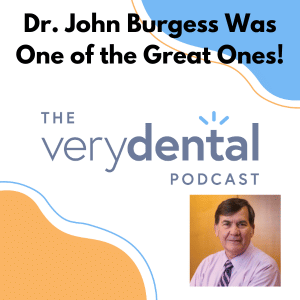
This throwback episode features Dr. John Burgess. I heard of his recent passing and thought it would be very appropriate to replay a spectacular interview I was privileged to have with him back in 2022.
Do you have advice that you've heard that you use on almost every single procedure? I do. And it came from today's guest, Dr. John Burgess.
Dr. Burgess is the assistant Dean for Clinical Research at the University of Alabama at Birmingham as well as Director of the Graduate Biomaterials Program and was recently featured on the main stage at the Spear Summit 2022.
But I heard John at the Spring Vedder society meeting some years back and some of the things he said have stayed with me to this day. It was a true pleasure to get to talk with John about what he does, how materials research should be done and how dentists can be better at understanding materials.
- How does someone get in to biomaterials research?
- Clinical research at LSU
- How to find unbiased information...how do we evaluate literature?
- Is the research measuring what they think it's measuring?
- Bevels on posterior composites? How do we test this? (spoiler alert: don't bevel occlusal margins)
- The best material is "abuse tolerant."
- How do patients get screened for clinical research?
- NCCLs (noncarious cervical lesions) and the controversy surrounding them
- New chemistry
- Read the instructions more often than you think you should!
- "Dentists don't read"
- Manufacturers take their instructions very seriously...you should, too.
- Burgess on zirconia
- Designing research equipment on a napkin
- Zirconia is very kind to the opposing when polished
- Cementing zirconia crowns
- Cement removal...he REALLY likes Panavia SA Universal
- Polish vs. glaze on zirconia (glaze facial on premolars)
- The power of a credible speaker and disclosure of honoraria
Some links from the show:
- Dr. John Burgess' website
- Spear Practice Solutions
- Panavia SA Universal
- Axis by Kerr zirconia polishers
Join the Very Dental Facebook group using the password "Timmerman," Hornbrook" or "McWethy," "Papa Randy" or "Lipscomb!"
The Very Dental Podcast network is and will remain free to download. If you'd like to support the shows you love at Very Dental then show a little love to the people that support us!
--
Crazy Dental has everything you need from cotton rolls to equipment and everything in between and the best prices you'll find anywhere! If you head over to verydentalpodcast.com/crazy and use coupon code "VERYDENTAL10" you'll get another 10% off your order! Go save yourself some money and support the show all at the same time!
--
The Wonderist Agency is basically a one stop shop for marketing your practice and your brand. From logo redesign to a full service marketing plan, the folks at Wonderist have you covered! Go check them out at verydentalpodcast.com/wonderist!
--
Enova Illumination makes the very best in loupes and headlights, including their new ergonomic angled prism loupes! They also distribute loupe mounted cameras and even the amazing line of Zumax microscopes! If you want to help out the podcast while upping your magnification and headlight game, you need to head over to verydentalpodcast.com/enova to see their whole line of products!
--
CAD-Ray offers the best service on a wide variety of digital scanners, printers, mills and even their very own browser based design software, Clinux! CAD-Ray has been a huge supporter of the Very Dental Podcast Network and I can tell you that you'll get no better service on everything digital dentistry than the folks from CAD-Ray. Go check them out at verydentalpodcast.com/CADRay!
[00:00:01] This is a production of The Very Dental Podcast Network.
[00:00:05] This is The Very Dental Podcast
[00:00:17] Welcome to The Very Dental Podcast where you'll find entertaining and relevant conversations with visionaries, clinicians, and your friends in the dental space.
[00:00:26] Now here's your host Dr. Alan Mead. Very Dental people welcome back to another episode of The Very Dental Podcast.
[00:00:33] I still am here in Arizona. I'm kind of sitting outside the exhibitor like area for the Spear Summit 2022.
[00:00:40] And they have a speaker going right now, so it's a little quiet out here and I have the chance to speak with Dr.
[00:00:46] John Burgess today. John, how are you doing? I'm doing well. Thank you. So something you don't know about me.
[00:00:52] I'm from Michigan and I saw you speak at the Vetter Society.
[00:00:57] I don't know if you remember that. It was several years ago and you did a one-day program and it was in Lansing.
[00:01:03] It's really funny. You did a lecture here at the Spear Summit yesterday. It was very, very
[00:01:11] kind of in-depth on kind of what we know about adhesives and stuff like that.
[00:01:14] I'm gonna talk to you about that a little later too, but there's a lot of...
[00:01:20] I have a little John Burgess sitting on my shoulder a lot of times when I'm working because I heard some of the stuff you said
[00:01:26] at the Vetter meeting and then what's cool about when you're lecturing about
[00:01:31] materials and adhesives and stuff like that. Some of the stuff you see at the Spear Summit is pretty
[00:01:39] cutting-edge. You know what Greg Kinzer gets to do in his office is maybe not what I get to do in my office all the
[00:01:44] time, but you know what I do do all the time is I use adhesives all the time.
[00:01:47] And we have to choose materials on the regular basis whether we're gonna do zirconia or gold or what in any case.
[00:01:55] So and that's... you do a lot of that because you do a lot of research. Research is kind of your thing and
[00:02:01] more than that, I could go so many places with this, but the little John Burgess on my shoulder is that you said it yesterday too.
[00:02:09] When you
[00:02:10] are applying an adhesive and of course you're supposed to dry it, it's not that you're drying it.
[00:02:16] It's that you're evaporating the solvent and you actually have to know what the solvent is because they're gonna evaporate differently,
[00:02:21] alcohol and that. So I mean, I don't think I had heard that before you said that before.
[00:02:26] And you said you start from a distance with your air syringe and you come in closer
[00:02:30] and I'm just like that makes a ton of sense, but no one, you know...
[00:02:35] Yeah.
[00:02:35] So I've got a little John Burgess sitting there because I have to, you know,
[00:02:39] it'd be easier for me to just go in with my air syringe and just...
[00:02:42] you know, and but I know that that's not what I'm doing.
[00:02:45] Like I actually know, like you help me understand. The other thing that this is really funny
[00:02:49] when you think I use a gel etchant. I've been using the same, it's an ultra dent gel etchant.
[00:02:54] I've been using it a hundred years and you said you need to
[00:02:57] stir it up when you're placing it because this stuff will come out in bubbles.
[00:03:00] And so you could actually have
[00:03:01] a piece of the surface that didn't get etched because it was a bubble.
[00:03:04] So you have to move it around a little bit and
[00:03:06] you have to rinse it for a lot longer than you would,
[00:03:09] your gut would tell you because you really have to neutralize that stuff. And I'm like thinking to myself,
[00:03:13] so every day I've got John sitting on my shoulder.
[00:03:15] And you didn't even know you were sitting on my shoulder. That's the thing that makes me laugh.
[00:03:18] So I wanted to start the interview saying, I heard you.
[00:03:21] And if you get a chance to see John, you really need to because
[00:03:24] he probably doesn't have as flashy of visuals as some of the people that are
[00:03:30] presenting at the summit because these guys are photographers.
[00:03:32] But like there was everyone taking pictures of your slides because you list the stuff that dentists need to see.
[00:03:38] So I welcome you to The Very Dental Podcast knowing that I think very highly of what you do.
[00:03:44] But
[00:03:45] so I'm curious about, I don't know you very well.
[00:03:49] So I'm curious, how did you get into the business of doing what you do?
[00:03:55] And I'm gonna have you describe kind of what you do because you're at LSU now and you run a lot of research.
[00:04:00] But I'm curious, how did you get into the research aspect of dentistry?
[00:04:03] Well, it took me a little while to get into research. I was in the Air Force at the time.
[00:04:10] Trying to find out exactly what I wanted to do.
[00:04:13] I thought I wanted to be one of the generals in the Air Force and stay there forever and all that.
[00:04:20] But the more I started doing biomaterials kind of
[00:04:26] evaluations and testing and the better I liked it.
[00:04:30] And I really got to the point where I remember one day I came home to my wife and
[00:04:36] she was sitting there and I said, you know, I cannot believe somebody pays me to do this.
[00:04:41] Yeah.
[00:04:42] And she looked at me and said, I'm glad they do.
[00:04:44] Awfully glad they do, exactly.
[00:04:45] Well, something interesting too, Air Force, I think the Air Force in particular has,
[00:04:50] like there's a lot of the research we get.
[00:04:53] Why is the military, like why do they have the military or why do they have the research base?
[00:04:58] What about the military is that?
[00:05:01] Yeah, they used to a long time ago when the American Dental Association was just forming
[00:05:07] and they're forming their standards, they needed a standard for amalgam because amalgam was made in
[00:05:14] all kinds of ways.
[00:05:15] Yeah.
[00:05:15] And there was no definite formulation for it.
[00:05:19] And so they turned to the military in part and said, hey, we know your amalgams are failing
[00:05:27] because you're putting all this stuff into these recruits and it's not working and they're on the
[00:05:32] battle line and they're having dental problems.
[00:05:35] And so let's standardize what we're doing.
[00:05:38] And so then they developed the Paffenberg Research Center and we developed all kinds of standards.
[00:05:48] And I've done some work there and I started working over at Wilford Hall, which is our big area,
[00:05:57] the Air Force's big facility.
[00:05:58] It's been downgraded now, but it's a thousand bed hospital and I was working there and so I had
[00:06:05] access to toys, all kinds of toys.
[00:06:07] And so the more I did, the more I liked it and the more inquisitive I got.
[00:06:13] So we started beginning testing and I could look at an article and go, this is terrible.
[00:06:18] And one of the commanders there turned to me and said, if you think that's terrible,
[00:06:22] why don't you do something that you think is correct?
[00:06:24] Interesting.
[00:06:25] And so he encouraged me to do this.
[00:06:27] And so I started and then I moved to clinical research.
[00:06:32] We had a speaker come in and he was talking about, John Osborne was his name.
[00:06:36] And we were talking about different types of clinical research.
[00:06:41] And I thought that is really fun.
[00:06:43] And then Miles Markley, they brought Miles Markley down and he was,
[00:06:50] I was asked to sit in the front for some reason.
[00:06:52] So I sat in the front.
[00:06:53] Okay.
[00:06:54] And I'm sitting here and he goes, this amalgam was a failure.
[00:06:58] And he showed a slide up there with an amalgam.
[00:07:00] And I looked at it and I thought, yeah, I think that thing will probably last a few more years.
[00:07:04] And he said, after 37 years, I had to replace this amalgam.
[00:07:09] And I'm going, I'm not even 37 years old.
[00:07:12] Exactly.
[00:07:13] That's something that's so funny.
[00:07:15] Oh, it was amazing.
[00:07:16] And so that encouraged me further to begin to look at this stuff in the clinical environment.
[00:07:22] And the testing that we do, we try to make it as close to the clinical environment as we possibly
[00:07:27] can because it has more relevance.
[00:07:31] So it turned out well for me.
[00:07:33] Yeah.
[00:07:34] What's interesting about, I think sometimes the military is awfully proud.
[00:07:38] I interviewed a friend of mine, Mike Manziel, who was, he was like a SEREC trainer in,
[00:07:45] I can't remember what, he's a military guy.
[00:07:47] And what was really cool, he's like, one of the great things about having a chance to do
[00:07:50] this stuff in the military is that you kind of have the command and control aspect of it.
[00:07:55] You sort of, and you get a ton of data because you got a bunch of people that you can follow.
[00:07:59] You don't have to worry about following them because they're there.
[00:08:02] You know, so it is interesting.
[00:08:03] It makes a lot of sense that it kind of started with the military.
[00:08:06] But so, and now you have what you're doing at the moment is at LSU and you're doing a
[00:08:13] lot of clinical research there.
[00:08:15] Is that right?
[00:08:15] Yeah, right.
[00:08:16] I run the clinical research area after, and I was there before.
[00:08:20] This is my second time back.
[00:08:21] So first time Katrina came in and wiped out everything that we had.
[00:08:27] We had a good clinical research area going.
[00:08:31] We had, boy, we had amazing people.
[00:08:34] People used to come in and say, you've got the best staff physically for the faculty
[00:08:39] of any place that we've been.
[00:08:41] And so it was good.
[00:08:42] And I really enjoyed that.
[00:08:45] And so I went back to LSU.
[00:08:48] They gave me a nice offer.
[00:08:51] And so I went back.
[00:08:52] I worked two weeks out of the month there.
[00:08:55] And then I go home to Birmingham.
[00:08:57] My wife is in Birmingham, so I go back to Birmingham.
[00:08:59] So it's been a very good environment for me.
[00:09:05] And the transition has been minimal.
[00:09:10] I knew a lot of the people that were there.
[00:09:11] Sure, sure.
[00:09:12] It's like a homecoming.
[00:09:13] Yeah, exactly.
[00:09:13] And it was.
[00:09:14] People would come out from their offices when I walked down the hall and give me a hug.
[00:09:17] And I mean, that's a lot.
[00:09:19] That's fantastic.
[00:09:20] It was very, very good.
[00:09:21] And we're building a good clinical research facility.
[00:09:25] We've got some really good operators replacing restorations.
[00:09:30] We've done evaluations, calibrations, standardization.
[00:09:35] We're on our way.
[00:09:36] That's exciting.
[00:09:38] OK, so one of the classic lectures at bigger dental meetings is sort of, you know,
[00:09:45] a lot of times it's much like what you did yesterday.
[00:09:48] What I thought was funny is you basically said, I don't care what you use,
[00:09:52] but this is what's happening.
[00:09:53] In other words, and I mean, you were not a salesman.
[00:09:57] And I think that's interesting because, OK, I've thought about this a lot,
[00:10:01] but I'm just going to put it out there.
[00:10:03] Going on the exhibit floor in the Chicago Midwinter,
[00:10:07] you can find the very best bonding agents at about 30 different booths because they all say
[00:10:14] that ours is the very best.
[00:10:15] And the story is dentists find sales pitches much more compelling, I think, than research.
[00:10:23] And I do think it's because I mean, I graduated in 1997 and it wasn't great then.
[00:10:29] It can't be much better now.
[00:10:30] They never taught us how to read a paper.
[00:10:32] They never really taught us how to evaluate data.
[00:10:36] They didn't.
[00:10:37] And I mean, on some level, we're busy being clinicians and so, but they don't even,
[00:10:44] I never knew enough to even know.
[00:10:46] So, you know, I think that made me very susceptible to the sales pitch.
[00:10:50] I mean, like that's a fat pitch for John because you're literally, you do clinical research.
[00:10:54] How do you, what do you have to say to that?
[00:10:56] Tell me what you think of that.
[00:10:57] I think that slowly, at least where I am and where I have been, that's changing.
[00:11:03] Okay.
[00:11:03] And what we do is have literature reviews.
[00:11:06] We bring in good papers.
[00:11:08] We bring in terrible papers where they've made all kinds of mistakes and we pick them out and
[00:11:12] we let them pick them out at a period of time.
[00:11:15] And so we work with the prosthodontic group mostly.
[00:11:19] Okay.
[00:11:19] And I also lecture to the dental students themselves.
[00:11:25] So, and.
[00:11:28] Are you able to, in undergrad dental school, are you able to do literature review with them?
[00:11:31] Because that would be, they would pick it up and do it.
[00:11:33] Yeah.
[00:11:34] Okay.
[00:11:34] And that's a fledgling at LSU.
[00:11:39] They had it and then they got away from it, but we're bringing it back again.
[00:11:44] Also, I work with, you know, 10 dental students and we do research projects with them.
[00:11:53] So they learn what a hypothesis is.
[00:11:55] Yeah.
[00:11:55] They learn what the statistics are.
[00:11:57] They learn what the conclusions are.
[00:11:59] They learn how to set it up and design it and I learn how to do it.
[00:12:02] And then they turn around and learn how to publish it as well as look up the literature.
[00:12:07] That is a skill set that even if you're not doing research, I feel like,
[00:12:13] like, you know, right next to, you know, an hour of biochem every day for the first two years of
[00:12:19] dental school, like, just a little bit on scientific, like experimental design.
[00:12:23] I am going to tell you that right now.
[00:12:24] One of the things that there's a couple people that I really look up to,
[00:12:27] one of them is a guy by the name of John Cottamey, who's an endodontist and he's just excellent.
[00:12:34] But more than that, he sort of gave me an in on scientific skepticism.
[00:12:40] And the reality is, is like much of the research you see isn't measuring what they tell you it's
[00:12:45] measuring.
[00:12:45] You know, like, it's like if you look at the experimental design, you realize it's not really,
[00:12:49] saying what they're saying it's saying.
[00:12:51] But the problem is you really have to dig in on some of that stuff and you have to,
[00:12:55] you have to understand the basics of experimental design.
[00:12:57] So he didn't have anything like that.
[00:12:59] And you're a clinician trying to help people with their teeth.
[00:13:02] It's really, it's hard to make that connection.
[00:13:05] It is.
[00:13:06] Like experimental design is fascinating to me because I think people are really good
[00:13:10] at making things complicated when in reality,
[00:13:12] experimental design should be as simple as possible.
[00:13:14] So you can measure what you want to measure, you know?
[00:13:17] This compared to this, compared to this, compared to nothing,
[00:13:19] compared to the best thing in the world.
[00:13:21] Yeah.
[00:13:22] Those are how basically most things are set up.
[00:13:25] So we look at a lot of techniques as well because we run,
[00:13:29] because I run the clinical research area.
[00:13:31] We can take things in the, in vitro or the laboratory environment
[00:13:36] and move it over to the clinic and really see how it works.
[00:13:41] For example, bevels on posterior composite preparations.
[00:13:47] Do you put bevels on them?
[00:13:49] And for a while people were doing it and we,
[00:13:53] I get frustrated because I would talk to different people and they said,
[00:13:57] no, you put bevels on.
[00:13:58] And I go, no, I don't think so.
[00:14:01] And so then we designed a clinical study where half the tooth,
[00:14:07] we put a bevel on.
[00:14:08] Oh, interesting.
[00:14:09] The other half, no bevel.
[00:14:11] And a coin flip determined that.
[00:14:13] So all the working cusps didn't get a bevel and all the non-working cusps did get a bevel.
[00:14:19] So, and at the end of the day, whenever you put a bevel on,
[00:14:23] there was more wear on that restoration and the margins broke down faster.
[00:14:27] Well, you know what's interesting about that too is like you could even,
[00:14:29] that's not even intrapatient variability.
[00:14:33] That's tooth, that's within the tooth you're getting variability.
[00:14:36] That's pretty interesting because you're like, I mean, that's,
[00:14:39] and that's an experimental design thing.
[00:14:41] It's a perfect example of what I'm talking about.
[00:14:42] Like, like you're, you're actually able to measure it in a, in a,
[00:14:46] you're reducing all the variables.
[00:14:48] It's the same damn tooth.
[00:14:49] I think that's really, I think that's really cool.
[00:14:51] I think that's really good.
[00:14:52] But I guess it's, it's frustrating as a, as a clinician because it's, for one thing,
[00:14:58] this probably, this probably curls your hair when people say that,
[00:15:00] well, in my hands, it works fine.
[00:15:02] And I mean, like if you have good hands, you can probably make almost anything work.
[00:15:07] But the problem is you can't design a product for someone with good hands.
[00:15:10] You got to design a product for the, for the bulk of us that are, that are okay.
[00:15:13] You know, like on some level, that's a tough, it's a tough sell, right?
[00:15:16] Yeah.
[00:15:17] The best material is material which is abuse tolerant.
[00:15:21] That's why amalgam is so amazing because you could put it in underwater saliva,
[00:15:26] blood and everything, and it would last 25 years.
[00:15:29] And composites won't do that.
[00:15:31] No, no.
[00:15:32] So they are much more intolerant.
[00:15:34] Yeah.
[00:15:35] And what we are trying to do is build everything into the composite that we can build.
[00:15:41] Yeah.
[00:15:42] So to reduce the number of application, the best adhesive, for example, would be no adhesive.
[00:15:48] It would be an adhesive that's built into the restorative material.
[00:15:51] So you can just put it directly into the tooth, had it maybe like cure it.
[00:15:56] And so there's going to be changes.
[00:15:59] Yeah.
[00:15:59] Changes are coming.
[00:16:01] Yeah.
[00:16:01] That's interesting.
[00:16:02] That's interesting.
[00:16:02] And you'll probably get a chance to, what's interesting now, you get a chance to see all
[00:16:06] the materials they put in for it.
[00:16:07] You're actually putting with people's mouths.
[00:16:08] I mean, that's kind of great.
[00:16:09] It's really fun.
[00:16:10] So when you're doing clinical research, how, and you're at the, I'm assuming you're right
[00:16:15] in with the dental school.
[00:16:16] Is that right?
[00:16:17] Okay.
[00:16:17] So how do you screen patients for, you know, because on some level it's like,
[00:16:25] I have a couple of questions that go along with this, but it's like, you got, you got,
[00:16:28] I mean, dental schools are a great place to do this because you've got a lot of people
[00:16:30] coming through and you can, you can do a lot of things for people, but it's hard to
[00:16:33] standardize stuff.
[00:16:35] It's really hard to standardize what, you know, what one person needs over another.
[00:16:38] And you're actually trying to measure different materials and different.
[00:16:40] So how does, how do, how does a patient get into the clinical research facility?
[00:16:45] Yeah, we advertise and we advertise sometimes in the newspaper, sometimes on television.
[00:16:51] Sometimes we put flyers up all over the place and they call us.
[00:16:56] We have a person sitting at the research desk.
[00:17:00] So she takes the call and, and talks to them.
[00:17:03] We have a script that's written out.
[00:17:05] So it basically describes the study that we're looking for.
[00:17:09] Okay.
[00:17:09] Non-carious cervical lesions.
[00:17:11] Yeah.
[00:17:12] I'm going to talk to you about that in a second too.
[00:17:13] Carious lesions, whatever they are, that person will describe it because they'll read it.
[00:17:19] And so they.
[00:17:20] So the patients when they're being screened, get the same message every time, which actually is,
[00:17:24] you're also reducing the variability there.
[00:17:26] And then we have a lot of forms.
[00:17:28] I've never seen so many forms in my entire life.
[00:17:30] Yeah, that makes sense though.
[00:17:31] Yeah.
[00:17:32] Yeah.
[00:17:32] That's a packet.
[00:17:33] Yeah.
[00:17:33] And we go through the consent form, tell them exactly what it is.
[00:17:38] In this particular study that we're starting now with 3M, they supply the composites.
[00:17:47] We use one composite.
[00:17:48] We use two adhesives, an older adhesive, Scotch bond multipurpose and a newer adhesive, which is
[00:17:56] Scotch bond universal plus.
[00:18:00] Yep.
[00:18:00] Yep.
[00:18:00] Yep.
[00:18:01] And so it's relatively new on the market, but they want clinical proof that this stuff works
[00:18:06] better than the other before they make that transition to the new one.
[00:18:11] So they're both on the market.
[00:18:13] You go downtown and have a private dentist put the same restoration in,
[00:18:17] except you'd have to pay for it.
[00:18:18] We don't charge them anything.
[00:18:20] The sponsors pay for what we're doing.
[00:18:23] Okay.
[00:18:23] So they pay the incentive.
[00:18:26] I give people cleanings every time they come in and all that sort of stuff just to keep them
[00:18:30] coming back in.
[00:18:31] Yeah.
[00:18:32] And our retention rates are generally pretty good, but we try to make sure we have inclusion
[00:18:39] criteria and exclusion criteria built into the protocol.
[00:18:43] The inclusion criteria is you have to have so many teeth.
[00:18:47] You have to have a carious lesion.
[00:18:49] You have to be able to come in.
[00:18:51] You have to have good oral hygiene on and on and on.
[00:18:55] The exclusion criteria would be, well, the only thing you have are curious teeth and we're not
[00:19:01] looking for those.
[00:19:01] We're looking for non-carious cervical erosions or raisins.
[00:19:06] And so we look at those and I do the screening.
[00:19:10] So patient comes in, I look at this, we measure the depth of these lesions.
[00:19:15] And for non-carious cervical lesions, they have to be 1.5 millimeters deep or deeper.
[00:19:20] And we use a perioprobe to do that.
[00:19:22] And we've tried different ways to do it and impression and measuring it would be the best
[00:19:27] way, but that's another.
[00:19:30] Yeah.
[00:19:32] That's a whole other level of precision, I guess, which makes sense.
[00:19:40] And for a while, we were actually making impressions and scanning the depth of those
[00:19:45] lesions on a scanner so that it was very accurate.
[00:19:49] And we did that.
[00:19:50] And what we found was that the higher the occlusal forces on that tooth, the faster
[00:19:57] those non-carious cervical lesions would progress.
[00:20:01] Doesn't mean that that's the only ideology because we looked at diet, we looked at
[00:20:06] toothbrushing techniques and they carried around a diet and wrote down all the food
[00:20:11] that they did and all that.
[00:20:13] And we then discovered occlusal forces were the main factor, but you had a lot of other
[00:20:21] factors contributing to the non-carious cervical lesion.
[00:20:24] It's really funny that there's, that's an argument that gets pretty heated in dentistry.
[00:20:30] I know.
[00:20:30] I remember you were talking about it then and it's not gotten any less heated since
[00:20:34] I heard you talk about it.
[00:20:35] That's exactly right.
[00:20:36] So there's people that believe a lot of stuff there.
[00:20:38] And what's really interesting is I thought about it when you were talking yesterday.
[00:20:41] The non-carious cervical lesion is sort of, for a bonding agent, that's a tough challenge.
[00:20:47] That's probably the, and it's one of the, I guess it makes the most sense to measure
[00:20:51] it on that.
[00:20:52] When I'm seeing, you were showing some data showing retention of those things in the
[00:20:57] really high percentage.
[00:20:58] And I'm like, man, that's a hard restoration to restore.
[00:21:02] It's got no natural retention whatsoever.
[00:21:04] You're completely basing it on the, and so, and I was thinking like, that's why the non-carious
[00:21:08] cervical lesion is the standard because I mean, literally you're, the only thing holding
[00:21:12] it in there is the bonding agent.
[00:21:14] So, so they got to have their stuff figured out there.
[00:21:17] It's interesting too.
[00:21:19] And you're right.
[00:21:19] That is a very difficult standard.
[00:21:23] The surface of the non-carious cervical lesion is atubular.
[00:21:27] And so if you look at it, it's sclerotic dentin, it's very hard and there are no tubules there,
[00:21:32] one or two, I mean, not many.
[00:21:34] And depending upon the sclerosis, but it's like a scar.
[00:21:37] And so you've got to break through that scar somehow.
[00:21:40] A lot of people make undercuts, a lot of people grind on the whole thing.
[00:21:45] We etch and that works out very well.
[00:21:48] But if John Gwinnett has shown that when you go through that scar, right through the sclerotic
[00:21:57] dentin, you increase the bond by 40%.
[00:22:01] Well, if you lose that tubular penetration, that's 40% of the bond.
[00:22:06] So, so you've got to make sure that you're going through it.
[00:22:10] That's one reason why the retention rates have gone up so much.
[00:22:13] Plus we've got materials now that bond to the calcium.
[00:22:17] And so the bonds, they're giving you a chemical bond, which is different than the hybrid layer
[00:22:22] inclusion over the collagen.
[00:22:24] So that's a micro physical bond on that.
[00:22:26] I get it.
[00:22:27] That's interesting.
[00:22:27] Some of you put yesterday, I thought was really funny.
[00:22:30] You literally were showing just the ingredients in all the new bonding agents.
[00:22:34] The list of ingredients, like they're throwing everything, you know, they're throwing everything
[00:22:38] at the wall to see what works.
[00:22:39] And I'd like you to say a little something about that because like, well, we'll put some
[00:22:44] of this in, we'll put some of this in it, which is really interesting.
[00:22:47] It's one of the reasons to maybe look at some of the newer things because they're, they're
[00:22:50] sort of doing a lot.
[00:22:51] I think that's what the universals would be right?
[00:22:53] Like they say something about that.
[00:22:57] Well, it started off the first universal that was being developed.
[00:23:02] I went to a big laboratory of one of the companies and they wanted me to test it.
[00:23:09] And so in the laboratory, so I said, okay, yeah, I do a lot of that.
[00:23:14] It's not a problem.
[00:23:15] So I talked to them about what they had in it.
[00:23:18] And I thought, man, that stuff's going to be hard to keep in the same solution without
[00:23:24] layering, having rich areas and poor areas.
[00:23:27] And well, and then they dumped in the HEMA and stuff.
[00:23:31] And all of a sudden things started becoming one layer, one big layer.
[00:23:35] And you didn't have to shake the vial and all that.
[00:23:39] So it really takes a lot of work to balance these things out.
[00:23:45] And that's why initially I thought, okay, if you took the top off and left the top off
[00:23:50] and the solvent evaporated out of that, it's going to change the dynamics of that entire
[00:23:55] system.
[00:23:56] Yeah.
[00:23:57] But it doesn't.
[00:23:58] Interesting.
[00:23:59] Interesting.
[00:23:59] They really, I mean, the chemists at these big companies are amazing.
[00:24:05] Yeah.
[00:24:05] They really are.
[00:24:06] They're very intelligent people and they work hard.
[00:24:10] Okay.
[00:24:10] So I got another, this is something I wanted to ask you for years because I think that,
[00:24:15] so here's the thing.
[00:24:16] Dentists are not awesome at necessarily reading directions, I think.
[00:24:21] Because, okay, so let's just say you've been using a certain bonding agent or etching a
[00:24:26] certain way for a really long time and it seems to have worked for you.
[00:24:29] And so there's a new material and you're like, well, of course it works like the old material.
[00:24:32] I think we're probably notorious for that.
[00:24:35] But also I want you to comment, how often should you go back and read your instructions?
[00:24:40] And they do change.
[00:24:41] They do.
[00:24:43] But also dentists, this dentist, me, I apparently I put my own spin on things when I,
[00:24:50] because I have gone back and read the instructions of a material I've been using for a long time.
[00:24:55] I'm like, wow, that's not what I'm doing.
[00:24:58] And maybe they have changed.
[00:24:59] But the reality is like, honestly, listeners do this and then report back to me.
[00:25:05] You might not be using it the way that the manufacturers are recommending because
[00:25:09] you sort of don't remember it.
[00:25:10] So tell me about that.
[00:25:13] A person told me a long time ago, dentists don't read.
[00:25:17] That's true.
[00:25:18] And it's unfortunately, every material comes with the pictures.
[00:25:22] Thank God.
[00:25:22] Right.
[00:25:23] The pictures help.
[00:25:24] Yeah, really.
[00:25:25] And the Mac showed that really quite well.
[00:25:28] But a lot of times what we do is test each specific direction to see what kind of an
[00:25:37] effect it has on the adhesion of that adhesive or that composite or ceramic.
[00:25:45] We do a ton of ceramic testing.
[00:25:50] I know zirconia well.
[00:25:52] I know you do.
[00:25:53] Yeah.
[00:25:54] And so we really have worked hard on that, but we test the manufacturer's directions.
[00:26:00] Is this firing time okay?
[00:26:02] What happens to the translucency?
[00:26:04] What happens to the strength?
[00:26:06] What happens to the crystals that are in the zirconia if you over or under fire it?
[00:26:12] Does it affect translucency?
[00:26:14] It certainly does.
[00:26:15] So you can use the right material, but abuse it on the other side and get terrible results
[00:26:21] when in reality, the material is a good material.
[00:26:24] So I try to emphasize that and we try to do research on the different steps that manufacturers
[00:26:30] are espousing.
[00:26:33] The assumption has to be that the manufacturers really do want you to do it this way.
[00:26:38] They're not taking their instructions lightly.
[00:26:41] They've done a lot of research on the front end of this stuff so that you do it the way
[00:26:44] that they're describing.
[00:26:45] And I'm sure they work in tolerant, make it as tolerant as possible, but there's a reason
[00:26:50] that the instructions are the way that they are.
[00:26:52] It's amazing how much time, effort and energy they really put into the directions.
[00:26:59] And I've gone, well, what's the deal?
[00:27:01] Just change the directions.
[00:27:03] They go, uh-uh.
[00:27:04] It's got to go all the way back through the FDA again.
[00:27:06] Oh boy.
[00:27:07] I go, you're kidding me.
[00:27:09] All the way back.
[00:27:10] Okay, so the regulation of it makes it that much harder too.
[00:27:12] It's tough because as a dentist, you're busy filling an MO on 15 and you're not thinking
[00:27:18] about there's a lot that went into this product to be used a certain way.
[00:27:22] And so, okay, this is just a message.
[00:27:25] We're going to like next time at the office, go read your instructions and see how you
[00:27:28] do it because I'm going to do it when I get home too.
[00:27:30] We have calibrations for the clinical research area.
[00:27:33] We'll sit down, we discuss it, the inclusion, the exclusion criteria.
[00:27:38] And if they see something that's wrong along the way, we exclude that patient.
[00:27:43] They also have calibrations on how to apply it, insert it incrementally, bulk.
[00:27:50] And then also we put in how to finish it because we want the finishing to be very standard.
[00:27:57] The nice thing about doing clinical research with multiple companies is that I get to
[00:28:03] use multiple companies stuff.
[00:28:07] 3M will come in and they want it done this way with their instrumentation, the polishing
[00:28:13] stuff.
[00:28:13] Cogden Supply will come in and they want it this way.
[00:28:15] Ivoclar will come in and they want it this way, which is, at first I thought, oh man,
[00:28:19] why do I have to use this?
[00:28:21] But then it turned out to be a real blessing there because I got to use each one of these
[00:28:28] materials and it got an expertise on them.
[00:28:31] And so I knew then which one was working better because I'd used them personally and looked
[00:28:36] at them and they did work.
[00:28:40] So I'm going to shift gear a little bit because this is also something I heard at the Venner
[00:28:45] Society that really surprised me because, it didn't surprise me, but I take to heart
[00:28:51] what you said.
[00:28:53] Zirconia of course is as a crown and bridge indirect on a tooth, which obviously we talk
[00:28:59] about full arch Zirconia.
[00:29:02] I'm talking about as a crown has become, I don't know if it's the most popular, but it's
[00:29:07] got to be close to the most popular, most used at this point.
[00:29:10] And that, I think that seems like a pretty quick adaptation and there's a lot of reasons
[00:29:13] for it because you just don't see the breakage and it looks nice enough, particularly in
[00:29:17] the posterior that, I mean, I'm going to tell you, I use it a ton myself.
[00:29:21] I don't think that when this was sold to dentistry that they explained how important it is to
[00:29:28] have a well polished surface to us.
[00:29:31] Like the wear, you explain this, the wear properties of Zirconia are terrific, but only
[00:29:38] if it's very well polished.
[00:29:40] And I think, I mean, over the last year, I've kind of realized that I think dentists sometimes
[00:29:45] think about polishing as sort of like that last step.
[00:29:48] We're almost on the home stretch.
[00:29:50] You know, I just got to drop some floss in there and polish and they're out of here.
[00:29:53] And I'm thinking to myself, you know, you might be able to get away with that on some
[00:29:56] materials, but particularly for Zirconia, I think that we sort of missed that a little
[00:30:01] bit.
[00:30:01] Can you say something about that?
[00:30:02] Sure.
[00:30:04] We really did a lot with Zirconia when it first came out and we were working a lot with
[00:30:09] 3M and then Ivoclar and then Karari began to work a lot with us.
[00:30:15] And so right now the Katana, which is Karari, the biggest selling material on the market,
[00:30:22] their Zirconia is very good.
[00:30:23] It's layered and they have little blocks in the pucks as well.
[00:30:27] And the blocks are colored and they actually diffuse those colors so that there's a really
[00:30:34] good transition from the bottom, from the general.
[00:30:36] Pretty neat.
[00:30:37] Yeah.
[00:30:37] It's really a nice material.
[00:30:40] And we measured wear.
[00:30:42] We've got big wear machines at UAB and we were measuring.
[00:30:46] You had slides of those.
[00:30:47] It's those machines are something else too, by the way.
[00:30:50] Yeah.
[00:30:51] I designed the first one on a napkin and took it down to, we've got a prototyping shop
[00:30:56] downstairs that would build all this stuff.
[00:30:59] And so I took it down.
[00:31:00] The guy looked at it and laughed at me.
[00:31:03] I said, no, I really want to.
[00:31:04] No, seriously.
[00:31:06] And so he said, well, we'll make a drawing of this to scale and I'll bring it up to you.
[00:31:12] I go, oh, okay.
[00:31:13] And he said, do you want to do this?
[00:31:14] Do you want to do this with this?
[00:31:15] Do you want to be able to exchange and ask all kinds of questions?
[00:31:18] And that's what a prototyping shop is.
[00:31:20] A machine shop.
[00:31:21] Okay, you've got to have this.
[00:31:22] You've got to have this hole and how big is this hole and all that sort of stuff.
[00:31:26] But the prototyping shops interested in improving the machines that you're using.
[00:31:30] So it's been a wonderful relationship with those guys.
[00:31:36] And I spent a lot of time down there, but we found out with zirconia, the wear really changed.
[00:31:44] I thought initially that if you had just all zirconia surface, because it's three times
[00:31:49] harder than enamel, I thought, I thought, well, that zirconia is going to eat the enamel up.
[00:31:53] This is crazy.
[00:31:55] And so I said, okay, let's measure this.
[00:31:58] And so we started off measuring with an overglaze.
[00:32:03] Well, the overglaze ate the opposing enamel up until you broke through that overglaze.
[00:32:09] And so, okay, well, let's see.
[00:32:12] Let's try other ceramics.
[00:32:13] And then let's try the zirconia unpolished.
[00:32:19] Well, it was not like felspathic porcelain, like porcelain fused to metal.
[00:32:26] That surface on the porcelain will eat up the opposing enamel.
[00:32:33] Oh, yeah.
[00:32:33] Just eat it up.
[00:32:35] And this was much kinder in the very beginning, even though it was still rough.
[00:32:39] And I went, huh.
[00:32:42] Wasn't what you'd expect for that hard of material.
[00:32:44] Yeah.
[00:32:45] I made him repeat the entire experiment.
[00:32:46] You didn't believe me.
[00:32:47] I didn't believe it.
[00:32:49] And so we repeated it again and I said, well, okay.
[00:32:53] I said, okay, let's polish it.
[00:32:54] And so I did the polishing on all these specimens and learned which ones would do really quite
[00:33:00] well.
[00:33:01] And so we did.
[00:33:02] And we put the polished zirconia surface in and measured it against an enamel cusp.
[00:33:08] It comes down, hits, slides and goes back up.
[00:33:12] So it was like going through an excursive movement all the time.
[00:33:15] And then we would scan that surface and very accurately down to the micron level tell you
[00:33:22] exactly how much wear was occurring.
[00:33:24] And we had a lot of materials that did wear, but the zirconia polished just doesn't wear.
[00:33:34] I mean, it doesn't wear the opposing enamel.
[00:33:36] And then we got into this thing where, well, if it doesn't wear, is it going to be in hyper
[00:33:42] occlusion over time?
[00:33:43] Well, fortunately you have the periodontal ligament that compensates for that.
[00:33:48] But we've had now so many zirconia restorations in the posterior part of the mouth that there's
[00:33:55] no problem where it would have shown up way before.
[00:33:58] It's really interesting.
[00:33:58] The same Vetter Society meeting that you came and spoke at in Lansing, we had it this year
[00:34:03] in Lansing and a guy by the name of Tomas Linkovicius was there.
[00:34:07] And he talks a lot about implants and there was really interesting, the underside of a
[00:34:12] zirconia crown and an implant well polished has magical properties.
[00:34:18] It's interesting how this material has literally, you could hate on it, but all of a sudden
[00:34:23] you're like, man, this is really revolutionizing.
[00:34:25] It's not really expensive.
[00:34:26] And we've really kind of, I mean, in my career, in my span, I've been practicing for 25 years.
[00:34:33] It's a wildly different landscape of what you do to crown a tooth now.
[00:34:38] And you could cement them.
[00:34:40] And I do, I do.
[00:34:42] Okay, so let's just talk about that.
[00:34:44] Everyone loves to get so complicated with their bonding procedures.
[00:34:47] I'm like, why the hell you do that?
[00:34:49] I mean, if you've got reasonable retention and to be honest, most of the crowns I do,
[00:34:53] I would argue even most of the second molars I do, I got decent retention on it.
[00:34:58] Have you ever had to cut one of those off that you just cemented?
[00:35:02] I don't know that I need to bond it, but you say that around people and they're just like,
[00:35:06] oh, I don't even know what you're talking about.
[00:35:08] I mean, I'm going to cement it every chance I get because why not?
[00:35:11] Am I crazy to say that?
[00:35:13] No, if you've got adequate preparation, the walls are reasonable parallel, sorry.
[00:35:21] And you've got three to four millimeters of actual preparation height.
[00:35:27] You're in pretty good shape.
[00:35:28] You can cement those.
[00:35:29] And we started off with the first clinical study on zirconia with 3M here.
[00:35:38] And they told me, I said, how much do you reduce it?
[00:35:43] They said, well, you reduce it two millimeters on the top for the porcelain that's going to go on
[00:35:48] the top and then you reduce it again six tenths of a millimeter for the zirconia or maybe a little
[00:35:54] more.
[00:35:55] Okay.
[00:35:56] Well, that means that you've reduced this thing almost three millimeters.
[00:36:00] There are some teeth that bicuspid is a real short second molars or sometimes really short.
[00:36:07] And you're sitting there looking at this and go, well, that's just about even with a soft tissue.
[00:36:11] Yeah.
[00:36:11] We haven't yet.
[00:36:11] We've run out of room.
[00:36:12] Yeah.
[00:36:13] I'm going, how in the world is this going to work?
[00:36:15] And so I'm bonding these things in for this study and I was looking at this one tooth and it was
[00:36:24] really a short tooth.
[00:36:26] And I thought, man, if this were a casting, I'd put a groove here.
[00:36:30] Yeah, yeah, exactly.
[00:36:31] And it would work fine.
[00:36:32] No problem.
[00:36:33] We didn't have to worry about it.
[00:36:34] So I said, I'm going to try that.
[00:36:36] Yeah.
[00:36:36] And I put grooves in those things, sent them off to the laboratory.
[00:36:40] They milled those things right out and sent them back to me.
[00:36:42] And the crown came back and didn't go like this.
[00:36:45] It went straight down.
[00:36:48] And so it made cementation much easier.
[00:36:51] Gave me that option to put a groove there and be happy about it.
[00:36:55] But zirconia has transformed the way we do dentistry now.
[00:37:00] And there are a number of resin cements that are amazing in that they've worked hard on
[00:37:07] these things to duplicate cement removal.
[00:37:11] And it was mentioned yesterday in one of the lectures that cement removal is a very difficult
[00:37:19] thing.
[00:37:20] Well, yes and no.
[00:37:21] If you're using the right resin cement with a prolonged gelation time, it absolutely is.
[00:37:27] Simplifies it a lot.
[00:37:28] Simplifies it amazing.
[00:37:29] I mean, the Panavia, I got to make sure I get this one right.
[00:37:37] Panavia 21, no, Panavia SA Universal.
[00:37:42] Okay.
[00:37:42] Okay.
[00:37:42] Panavia SA Universal has two syringes.
[00:37:46] One side of the syringe contains a long silane.
[00:37:51] It's a different silane than what you'd use in your bottle.
[00:37:54] It's a silane they use to put on the filler particles so they stay in the composite.
[00:38:00] Up here is the 10 MDP monomer.
[00:38:04] If you mix the two together early, you mess up everything.
[00:38:08] It really is a mess.
[00:38:10] So by golly, going through that little baffle down here at the end, this works really well.
[00:38:15] And they increase the gelation time.
[00:38:18] So do you remember zinc phosphate cement?
[00:38:21] Sure.
[00:38:21] And you could take, we'd wait, wait, wait, and the whole thing would come right off.
[00:38:27] That's the cement.
[00:38:28] That's huge.
[00:38:28] That's yeah.
[00:38:29] And boy, I did that the first time and I went, I'm hooked.
[00:38:32] Yeah.
[00:38:33] Well, I mean, that's the reason that resin cement makes people like me nervous because
[00:38:37] it's the cleanup.
[00:38:38] If you don't get it, man, that's the worst part of your day.
[00:38:41] 12B blade and sit there.
[00:38:43] Oh yeah.
[00:38:44] Oh yeah.
[00:38:44] And it's, and as Jeff said, it's like, yeah, you want to, patients need to be numb for
[00:38:48] this.
[00:38:48] If you got to get in there and do it.
[00:38:49] That's exactly right.
[00:38:50] It's exactly right.
[00:38:50] Okay.
[00:38:51] So I'm going to one more question on zirconia.
[00:38:53] So knowing that so much of zirconia, a lot of people are using digital impression techniques
[00:38:59] or whatever.
[00:39:00] And honestly with milling, a lot of the accuracy is really quite good.
[00:39:04] I'm finding that a lot of times, a lot of times, you know, you're cementing and the bite's kind
[00:39:09] of dead on the money because, you know, we've given them a really accurate scan and we really,
[00:39:14] and so I want my lab to send it back polished because a lot of times I don't have to adjust
[00:39:19] the occlusion at all.
[00:39:20] And why, why have me go through the polishing?
[00:39:23] So like, you know, uh, and I, some labs want to glaze it cause that's what they've always
[00:39:29] done.
[00:39:29] And it's like, you kind of have to have that conversation on some level.
[00:39:32] I wonder when, will it become standard that these things come back polished instead of
[00:39:35] glazed or is it just because it's so easy to glaze it?
[00:39:37] So yeah, I really do.
[00:39:39] Um, the thing is if you've got a posterior tooth by cuspid, for example, you can glaze
[00:39:46] the facial surface, but just leave the occlusal interesting, polish the occlusal.
[00:39:50] That's all you really have to do.
[00:39:51] Yeah.
[00:39:52] And it works out well.
[00:39:52] It simplifies your procedure across the board.
[00:39:54] So yeah, I know there's a lot of dentists that don't want to have a, um, a lab handpiece in
[00:39:59] their office or whatever they want.
[00:40:00] And I'm just like, I know they got to do it.
[00:40:02] It's so much easier, so much easier if you have a lab handpiece with wheels and just like,
[00:40:05] it's a piece of cake.
[00:40:07] I don't know.
[00:40:08] I just, that's in, and I have to remind myself cause yeah, it'd be a lot easier not to have
[00:40:13] to spend a lot of time polishing, but it's such an important part, particularly for that
[00:40:16] material.
[00:40:18] And there's a lot of polishing systems out there, the Messner polishing system, which
[00:40:24] a lot of people recommend, but, uh, a good economical system is the axis bike by Kerr.
[00:40:31] Okay.
[00:40:32] And it polishes, it polishes it until it's like a mirror.
[00:40:38] I mean, it's that part and we measured the reflectivity of the system.
[00:40:41] So that's how we actually knew what the poly, what the, how polished it was.
[00:40:46] Yeah.
[00:40:46] That's, that's really interesting.
[00:40:47] So the last thing I want to tell you, you were, you were sort of laughing about you,
[00:40:51] you had made your, made it very clear about getting an honorarium for speaking here and
[00:40:57] explaining that these are people that you work for and you've taken.
[00:41:00] And I'm curious about your thoughts on, on, on that kind of disclosure and how we should
[00:41:07] probably do better in dentistry than we do, particularly in a continuing education situation
[00:41:11] where, cause, cause what happens is, is someone with credibility, whether it's me saying,
[00:41:17] I like something on a podcast that someone's been listening to a long time, or you being
[00:41:20] John Burgess in front of a group or whatever the influence, we can sell stuff without even
[00:41:25] trying to sell it.
[00:41:26] If we say that we love this stuff and they look, they look to us because everything's
[00:41:30] kind of a shortcut to doing the, to knowing and understanding the real research.
[00:41:34] So on some level, how does, how does a dentist take that ethically?
[00:41:38] Like how, how can someone who's in a position of influence, how, you know, what's the best
[00:41:42] way to handle that?
[00:41:44] That's a tough question, but I'm just curious what you think about it.
[00:41:46] It is, but I take that to heart.
[00:41:48] I really do.
[00:41:49] And I remember the first one of early was lecturing early and I made a comment about
[00:41:55] an adhesive and I said, this adhesive is giving us the best bond strength that we've
[00:42:00] ever recorded.
[00:42:01] And I was walking, I finished the lecture, I was walking down the aisle and the people
[00:42:06] from that company came up and said, thank you for talking about our material because
[00:42:11] we had people all the way out the building lined up to buy our stuff.
[00:42:16] And I'm like, Oh my, that wasn't the intention.
[00:42:18] No, it was not.
[00:42:20] And it scared me.
[00:42:21] It really did because I didn't want to be responsible for something that might show
[00:42:26] up six months from now or a year from now.
[00:42:29] And so that was different.
[00:42:34] I know no manufacturer tries to make a bad product, right?
[00:42:37] None of them do.
[00:42:38] And a lot of people treat manufacturers like that's the way it is.
[00:42:42] But I tried to look at those people as partners because we give them feedback and they modify
[00:42:47] materials because they won't forgive them.
[00:42:49] Sure.
[00:42:50] And so I try, what's the best material?
[00:42:54] Well, okay, this is good.
[00:42:56] This is good.
[00:42:56] And this is good because I know there's three are going to be really good.
[00:43:00] What's the best?
[00:43:01] Of course, everyone wants to, because they want the shortcut, John.
[00:43:03] They want the shortcut.
[00:43:04] They don't want to have to do any thinking.
[00:43:06] But they'll put you in a corner and sometimes you go, well, okay, I use this material because
[00:43:12] I found that it's pretty robust and it's abuse tolerant and it gets the job done.
[00:43:20] But I try to give them more than one.
[00:43:23] You did very well yesterday and you noticed that I haven't asked you about any specific
[00:43:26] materials right now because I don't want to, like partly they need to come see you speak or go to
[00:43:31] the website or, and John graciously gives out his actual email address, which I know that he answers
[00:43:38] and like his cell phone number and stuff like that because he wants to help.
[00:43:41] But the reality is, it's an interesting thing because people are listening and
[00:43:48] they want to know what works.
[00:43:49] They want to know what works, but it's also, it's not like your job to sell them on anything
[00:43:52] in particular.
[00:43:53] It's kind of hard.
[00:43:54] It is.
[00:43:56] It's a balancing.
[00:43:57] It is.
[00:43:58] It is.
[00:43:58] Because you don't, like if a material is really good, you kind of want them to know.
[00:44:01] I mean, you want them to know that it's good stuff.
[00:44:04] It's interesting.
[00:44:05] If there's a major advantage with this material over the other materials,
[00:44:08] and that's kind of how development works.
[00:44:10] Things will be going along very smoothly and then all of a sudden one company will discover
[00:44:15] something, the MDP molecule.
[00:44:16] MDP molecule, your monitor, exactly.
[00:44:18] Yeah.
[00:44:19] And then people need to use that.
[00:44:22] Yeah.
[00:44:24] The patent literally just in the last year or two years came off.
[00:44:27] And so all of a sudden, you look at the ingredient list and it's in everything now.
[00:44:31] Yeah, exactly.
[00:44:32] Which, well, I mean, that actually tells you that they tell you all you need to know on some level.
[00:44:36] It's doing well.
[00:44:37] Yeah, definitely.
[00:44:38] John, this was a real pleasure.
[00:44:39] I really appreciate you having me on.
[00:44:40] And I think you guys will have a lot of questions.
[00:44:44] And guess what?
[00:44:44] I've got John's email address.
[00:44:45] I'll make sure you guys get hooked up with him.
[00:44:47] And I really appreciate that you got to speak here.
[00:44:49] So thanks a ton for being on.
[00:44:50] I appreciate it.
[00:44:50] Thank you.
[00:44:51] I really appreciate your enthusiasm and your inquisitiveness and your trying to help people.
[00:44:55] Yeah, definitely.
[00:44:56] That's the bottom line.
[00:44:57] That's the best thing.
[00:44:58] Yeah. Thanks, John.
[00:44:59] Okay.