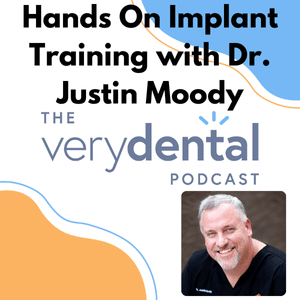
Alan catches up with Dr. Justin Moody, his friend and business partner. They reminisce about their experiences in dental school and how dentistry has changed over the years. They discuss the importance of hands-on training, especially for new dentists, and the need for critical thinking and humility in implant dentistry. They also touch on the challenges of treating patients with full arch implant cases and the importance of ethical considerations.
7:18">Key Takeaways:
- 9:80">The importance of hands-on training in dentistry, especially for new dentists.
- 10:67">The need for critical thinking and humility in implant dentistry.
- 11:67">The challenges of treating patients with full arch implant cases.
- The importance of ethical considerations in implant dentistry.
7:18">Some links from the show:
- 9:80">Implant Pathway
- 10:67">Extraction and Grafting at Implant Pathway
- 11:67"> Fast Track Implants!
Join the Very Dental Facebook group using the password "Timmerman," Hornbrook" or "McWethy," "Papa Randy" or "Lipscomb!"
The Very Dental Podcast network is and will remain free to download. If you'd like to support the shows you love at Very Dental then show a little love to the people that support us!
--
Crazy Dental has everything you need from cotton rolls to equipment and everything in between and the best prices you'll find anywhere! If you head over to verydentalpodcast.com/crazy and use coupon code "VERYDENTAL10" you'll get another 10% off your order! Go save yourself some money and support the show all at the same time!
--
The Wonderist Agency is basically a one stop shop for marketing your practice and your brand. From logo redesign to a full service marketing plan, the folks at Wonderist have you covered! Go check them out at verydentalpodcast.com/wonderist!
--
Enova Illumination makes the very best in loupes and headlights, including their new ergonomic angled prism loupes! They also distribute loupe mounted cameras and even the amazing line of Zumax microscopes! If you want to help out the podcast while upping your magnification and headlight game, you need to head over to verydentalpodcast.com/enova to see their whole line of products!
--
CAD-Ray offers the best service on a wide variety of digital scanners, printers, mills and even their very own browser based design software, Clinux! CAD-Ray has been a huge supporter of the Very Dental Podcast Network and I can tell you that you'll get no better service on everything digital dentistry than the folks from CAD-Ray. Go check them out at verydentalpodcast.com/CADRay!
[00:00:00] Let's be honest, running a dental practice takes grit and determination. Between keeping your schedule on track, supporting your team, and delivering top-notch care, it can feel like there's never enough time in the day. And when things aren't organized, that's when the real stress starts to build. I've talked to so many practice owners who say the same thing. There's got to be a better way to stay organized. And the truth is, there is. They developed the Color Method, a smart, color-coded system for organizing our instruments and materials. We're talking procedure tubs, trays, burr blocks, and affordable cassettes,
[00:00:29] that make it easy to stay on top of everything. So your team works more efficiently and your day runs smoother. I've had the Zerk team on the podcast a number of times to talk more about this. And the fact is, you can no longer afford to ignore lean clinical performance. Just picture it. No more of your assistant getting up to retrieve something mid-procedure. No more frustration with misplaced materials. No more expired materials costing you thousands. Imagine easier onboarding with new hires. And best of all, being self-sufficient for weekend emergency calls. With Zerk's Color Method, you're not just saving time. You're creating an environment where you're not just saving time. You're creating an environment where you're not just saving time. You're not just saving time. You're not just saving time. You're not just saving time. You're not just saving time. You're not just saving time. You're not just saving time. You're not just saving time.
[00:00:59] Where your team can thrive and your patients and your bottom line feel the difference. If you're ready to trade clutter and disorganization for control, visit colormethod.com. Trust me, you'll wonder why you didn't do it sooner. That's colormethod.com. Your path to a more efficient, stress-free practice. Check it out today. Your future self will thank you. This is a production of the Very Dental Podcast Network. This is the Very Dental Podcast.
[00:01:35] Welcome to the Very Dental Podcast, where you'll find entertaining and relevant conversations with visionaries, clinicians, and your friends in the dental space. Now, here's your host, Dr. Alan Mead. Very Dental people, welcome to another episode of the Very Dental Podcast. I'm your host, Dr. Alan Mead. Joining me, it's been a little while, actually.
[00:01:56] One of my friends, business partners. Used to be a South Dakotan, now is an Arizonan. Dr. Justin Moody. Justin, how you doing? I'm great. Good to be back, my friend. Yeah, it's very good to see you. You're looking good. Your color's good. You're slim. All these good things. I love this. Ah, yeah. You know, like, happens, you know, you go north of that 50 mark, and you're just like, man, I think I am. Where's my life been? Where's it gone?
[00:02:25] It's very true. I've had lots of thoughts like that lately. So here's a thought for you. I literally just helped one of our horse boarders get unstuck from our driveway because we have a bunch of snow, and she got stuck. And there's a chance, a decent chance, that school will be canceled tomorrow due to wind chill. So I'm just wondering, are you missing South Dakota at all? Let me think about that. No. No, no.
[00:02:56] So you're not having to get people unstuck out of your driveway from the snow, I see. That's not something you've had to do lately. No, I haven't had to shovel any snow around my cactus or anything like that. I'm literally looking at Justin, and there's a window behind him, and there is no grass. It's like desert plants back there, and I am here for it. I am here for it. Oh, my gosh. It's been a long time since I've been to Arizona.
[00:03:25] I mean, this weekend I'm going to Chicago, which frankly is probably not going to be much better than where I am anyhow. As you know, Chicago in February, it's a toss-up. You never quite know what you're going to get. You never know. You never know. Yeah, you're 100% correct. Chicago is always fun. I'm missing it for the first time in a long time.
[00:03:48] And we just got so many courses going on, and the reality is it's not much of an implant meeting. There's nobody really on the podium that's on implants, and most of the vendors don't go there anymore. The only thing that's worth a shit probably in the implant world is down at Lab Day,
[00:04:13] which actually, to me, has kind of eclipsed the dental part of that meeting. I think that those of us that live in the implant world, the good stuff is down in the North Loop, not down at McCormick. It is. I mean, it's getting bigger and bigger. Honestly, at some point, the Chicago Dental Society might just want to switch venues with the lab meeting. It might make more sense at this point.
[00:04:42] For the lab meeting to be in McCormick, and we could just be in a little hotel. I mean, there's a bunch of speakers and stuff, but I'm going there to record podcasts. I haven't really participated outside of that for a while. And I like the exhibit floor. There's a lot of stuff to see. But like you said, it's not particularly implant-centric there. And that's kind of your ball of wax. Although there's always a lot of people there. Because a lot of people are just used to that meeting. But, I mean, I don't know that these meetings are going to last that much longer.
[00:05:12] I don't know how they do it. I've heard from vendors that New York was terrible last in December. And that the Hinman was – no, no. What was the last – the Yankee was small, too. The Yankee was – and so when vendors are starting to go, okay, you can – there's just no one on the exhibit floor. They've got to start thinking about whether they're going to drop that cash. Because they're not giving those booths away. No.
[00:05:37] And there's a lot of – you know, I just don't think that – you know, I think the dentists that are – have been out 10, 15 years or less. They consume their education differently than – I mean, let's be honest. Like the greatest dental school class of all time is going to – history has got a way out to be 1997. In 1997. In 1997. There's no question about that. There's no question.
[00:06:06] I mean, it's not a question, right? So – Clearly. Clearly. And it's all downhill from there, really, is what it comes down to. It's so funny because we laugh about that. Dude, we're freaking old. We're old. Yeah. It's – every time I think about it, like, I don't feel – in my brain, I'm not old. My knees – and we'll tell you otherwise. But my brain, I don't feel old.
[00:06:31] But, like, you know, I started – I bought my practice in 1998, which was a different century than this one. Like, I mean, it's crazy. We're old. I don't know, man. I don't know. Well, I saw something the other day that said that, like – oh, I know what it was.
[00:06:51] Is that it was a shorter period of time from D-Day to my birthday than from the birthday to my present age. Yeah. Yeah. And I think that's right. I'm like, yeah, don't think too hard about that. Yeah, yeah. I try not to get into that. When you think about the 80s, the 80s always seemed like they were about 20 years ago, except they were like 40 years ago. That's the crazy thing. My 17-year-old son wishes he could have been born in the 80s.
[00:07:21] And I don't know that he's wrong. I do think that – I have to say that we've lived through – I mean, we've lived through no computers and we've lived all the way up to complete social media. We've seen all of it. We've seen a lot of stuff. We've seen a lot of stuff. I tend to wish that I could step back into the 70s every once in a while just to not have the overwhelming kind of internet presence and all that stuff around sometimes. But it's – I don't know. I think we've seen a lot in our age bracket.
[00:07:51] I was trying to explain to someone the other day that in 1989, when I showed up at the University of Nebraska, that there were no computers. So we stood in line at the registrar's office and you hoped that the section that you wanted to get into, or bio 101 or whatever, was open.
[00:08:19] Because if you didn't get your butt out of bed and go down and get in line, you weren't going to get the classes that you wanted. And I didn't have to get on my app or my desktop. And I swear to God, like I feel the desktop is like becoming a thing of the past. It is. I'm a guy who prefers the desktop. Yeah, I prefer the desktop. But yeah, I mean most people live on their phone. I remember when you got courses, I remember you'd go to this great – it was always in like the giant – like the arena.
[00:08:47] And you had your like little cardboard cards and hoping to get the right courses and stuff. And then I remember when I was like a senior in college, they had something where you could call in on the phone. That was like the height of technology. And I do remember I had my first email address at the University of Minnesota in dental school. I had – and it was like – because Minnesota is maroon and gold. So you were either on the maroon server and the gold server.
[00:09:14] And your email was like 30 characters long and made no sense whatsoever. And of course, no one had a computer to use email. So it didn't – like you would get your email at the computer lab at the University of Minnesota. I think when I was a junior, I had my first like 1,200 baud modem so I could go on America online. This is great. This is two old guys talking about, well, in my day. But it is. It's sort of true. We've seen a lot of stuff. We've seen a lot of stuff. Yeah.
[00:09:42] I think that the other thing that's important to remember is like we have seen a lot of that. And I think it ties back to what we started here is the younger dentists, let's just say half our age, half our time in service, they consume their education differently than we did because we went to in-person stuff because when we got out, that's all there was. That's what there was.
[00:10:38] Yeah, exactly. In-person portion. And we've really dialed the didactic portion of our intro courses, the fast tracks, to like I lecture a little. We go straight to doing model work, hands-on. And then we do some lecture. And then we go back to the model. We get some lecture. We go to the pit jaw. We get some lecture. We go to the 3D printer. We print the guides to work on the models and things like that.
[00:11:03] And then the most important thing that we offer is the ability to do live patient training in the United States. And the funny thing is, though, is that like because you offer a lot of the preliminary stuff online, they can't not do that. They have to do that to get up to speed. But at least when they're in person, you're not wasting their time.
[00:11:30] You're not like – they're not like – they don't have a moment to waste when they're there. And I do think this group of younger folks, they would probably be much quicker to complain about wasted time on some level. Like I don't think they would tolerate a big, long lecture thing if you weren't doing – I mean the reason to go to Pathway is because of hands-on. That's the reason to do it. I mean you can get lectures anywhere, I suppose.
[00:11:55] It's just – so the fact that you do all the stuff online before they get there makes a ton of sense to me. I think it does and I think it has over time. We're over 3,000 alumni now, which is pretty insane to think about it. But we've been doing these pop-up alumni parties around the country. Yeah, I've seen those. I've seen online, yeah.
[00:12:22] Yeah, we did one in Bend, Oregon, one in Chicago. We were down in Tampa, Florida a few weeks ago. And man, it's good to connect with the people that have gone through. And it is so fun to hear how they've done. Sure, sure. And I've learned a lot from the alumni over the last six months too in that every course that goes through here,
[00:12:52] like I completely ruin one or two people in each class. And when they're done, all they want to do is do implants and go into full arch and all this other stuff. But the vast majority of the people that come through Pathway, like the ones that just really buckle down and go home and do it, they start to refer out far less.
[00:13:17] They do the abundant bone, healthier humans, break a tooth, fix a tooth type stuff. And, you know, it adds a lot of value to their practice. Sure, it does. Yeah, yeah. I feel like implants are – it's funny because there's a few things there.
[00:13:38] First off, I'd love to know what are all the different ways that someone can take a course on, let's just say, on surgery at Pathway. In other words, do you have an extract and graft only class? Or let's say someone wants to just learn to extract teeth and learn how to graft, like the very basics. Is there such a thing? Yeah, we do. We offer a straight extraction grafting course a couple times a year.
[00:14:05] This year we're actually offering it twice in Arizona, and then we're offering it once in Nebraska. Oh, wow. I'm going back to Omaha. I like that. One of my alumni, a good friend of mine, Mark Paninson, has a big office there. Okay. And you've got to have a Nebraska license. You know, it's a little different than Arizona. Sure, sure. You know, we take about 10 docs.
[00:14:29] But it's funny you mention that course because, like, everyone that takes the course is like, oh, my God. Like, it made such a difference in my practice. You know, like, learn how to section a tooth or, like, figure out how to get the tooth out. But it's the hardest course that we have to, if you want to call it, sell. Because when it comes to hitting the buy button, it's like, ah, I know how to take teeth out. Sure, sure. Oh, yeah.
[00:14:57] Like, it's not like learning a skill. Like, you either know how to place implants or you don't. But then, you know, we have – and many people are quite good at extractions. Sure. But getting the opportunity to work with some faculty and just the tips and the tricks of the trade, it's a great course. It really is. Well, see, it's funny, too, because I know that's sort of the basics. And it's maybe the starting point for, you know, adding implants to your practice.
[00:15:27] And maybe people are like, okay, no, I've got to get into the implants. But the reality is that's where you start. That's where you've got to know how to do that stuff before you can kind of – I mean, the reality is that I've been taking teeth out for a long time. And typically, the ones that I struggle with the most are probably ones that you would have – like, the treatment planning, like, thinking that they're easy when they're not or something like that. And I suspect you guys talk a lot about that in an extraction and grafting course.
[00:15:55] Yeah, you know, perception is never reality. Yep. When it comes to taking teeth out. And I also think that people have to – if you really step back and think about implant dentistry, like, you can't do implant dentistry without extractions and grafting. Because, like, if you don't extract a tooth, like, there's no reason to put an implant in there, you know. So, it all comes down to that.
[00:16:20] And if you want to have good clinical cases to do implants in, you know, you need to get good at taking teeth out without destroying the buccal place. Well, you remember, too, when you and I were in dental school. And I don't know – you did a ton of surgery in dental school. I did whatever the bare minimum to get me through the University of Minnesota was. And frankly, it probably wasn't much.
[00:16:43] They – and many of the oral surgeons that I knew early on in my career, as soon as the tooth wasn't just falling out with a – you know, like, nothing. And that handpiece went after – I mean, of course you take out the buccal bone. That's how you get the teeth out. And that – I think before the mindset was implants, it was just like – and so I saw some stuff that was horrifying. And I never really wanted to – I never really wanted to do that.
[00:17:07] Like – and I like the fact that surgery now and extractions now are talking about a minimally invasive way of taking teeth out and leaving as much there as possible. Because I know you guys are perfectly happy laying big old flaps and stuff. But the reality is some of the stuff I saw was, you know, in dental school, you take the – you just take the bone away until the tooth falls out. I'm like, well, I didn't want to do that because it seemed horrifying.
[00:17:31] But then also it's very gratifying to hear people like you go, oh, yeah, by the way, leave as much of that bone there as you can because that makes it much easier when you come back in and place an implant. I have to tell you, I think there's probably a lot of younger dentists that have surgical experiences in dental school like mine or even less so. Because in dental school now, every kid is coming out from dental school with just less experience in everything. It's just the way – they pay a lot more for what – than we paid, but they're just getting a lot less experience. Is that what you're seeing?
[00:18:02] Yeah. It's almost like, you know, we went to dental school in the McDonald's era. And today, I swear to God, they go to school in the Michelin star era. You know, like you pay more for less food, right? That's exactly right. That's exactly right. Yeah. And, you know, COVID was a multiplier of that, you know.
[00:18:25] So, and then, you know, that so many of the schools had to reduce the requirements and the things to get them to matriculate through and the number of patients. And, like, yeah, I don't know, you know, that, you know, we could talk for days on, like, what, you know, what we think, you know, or how we would fix this. But it's a, you know, it's a subject, you know, we don't really need to hash over because I don't think that there's a, you know, a solution that any of the schools would come up with. No.
[00:18:55] But there's a strong need for – there's a strong need for continuing education that's live patient training. Because if you think about it, that's what – that's all dental school was, was live patient training. It was supposed to be. It was supposed to be, yeah. You did didactics for a couple years or a year and a half and then you went into the clinic and ultimately, you know, your last year, your D4, you should be all in clinic, all live patients and – Allegedly.
[00:19:25] Allegedly, yes. The problem is I think that that wasn't – like, I know of people that took their – basically for COVID, their entire senior year was done on a typeidon. I'm like, that's awesome except that doesn't mean anything. And think of how much they paid for it. So, I mean, my only suggestion is if you're out of dental school first year, even if you're not planning on placing implants, you ought to go take a course like this where you're taking teeth out and grafting and just the basics.
[00:19:51] I mean, obviously great if you want to do implants too but the reality is you almost have to supplement your dental school learning with the basics, these fundamental stuff. Because I don't know that they're getting it in dental school. And I know every dental school is different and some of them may have a more comprehensive, you know, surgical training or whatever. But I just feel like – and I have to say I have not dealt with any newer grads clinically in my life. I don't have any associates I'm dealing with. But it's just from what I've heard, they just – they have a lot of confidence and they don't have a lot of reps.
[00:20:21] And that's a little dangerous I think in some ways. I think it's a fair statement and it's not putting down the young desk. You know, like it – you know, it's truly it's not their fault that they don't have the reps that we got because the system doesn't allow for it anymore.
[00:20:39] And their access, like we've already talked about, their access to quality, you know, online learning and YouTube and all the other things, I do believe brings a sense of confidence that is hard to bridge the gap between reality and online. I agree. Like there's a bridge to that and the only bridge is clinical reps. Yeah.
[00:21:08] And that's the thing. I think Pathway really is very special in that way for the fact that there's not a lot of places you can get clinical reps except what you guys are doing essentially for – like even for – I always think about for restorative fundamental stuff. Like I know that's not your – you're necessarily what you specifically teach yourself but I mean even like they're getting out of dental school without having done much restorative dentistry.
[00:21:32] And you're just like, God, how do you – and I mean it makes – what I would say is every dental student should be looking at some kind of residency. If you can get into a residency that does a lot of this stuff, you're going to be glad you did. And mind you, I didn't do any residencies. My residency was – I went and worked in Raj's office. I went and worked in my dad's office. I saw a lot of stuff.
[00:21:52] But I do have to say residencies make a lot of sense or at least being ready to invest in the kind of hands-on stuff that will – I mean as much as you can add reps to your experience in whatever best way you can. Now, I mean there's some people that are doing like a hybrid online – I know for instance Dennis Hartlieb has a really cool system where they send you the kit for all this different cool restorative stuff.
[00:22:21] And he does the course live but you're in your office in your dental chair and you're doing – on a type of – but it's pretty good. It's much – and you don't have to do the traveling. Or you can go take a course from Cosmin – Cosmin and from him and there's a lot of hands-on. Now, it's not a patient thing. Like I got to tell you, Pathway's got it figured out. You get to work on patients but there are patients in the United States that you don't have to worry about informed consent because they speak the same language that you do and that sort of thing. I've struggled with that a little bit in the past.
[00:22:50] So I guess it's just you guys kind of have – Arizona has allowed for you guys to really, really hit on all cylinders with that kind of thing. You know, it has and we're great – like that's partly why we're here. And we're grateful that the state allows these restricted permits in this good Samaritan fashion for us to work on patients. And, you know, we've – You know, the Pathway works on one side and the nonprofit clinic works on the other. Yep.
[00:23:20] Truly, neither one of them would exist without the other. Yeah. And a – you know, in a significant portion of the tuition revenue goes to the clinic to pay for, you know, the seven full-time docs that it takes to, you know, do a comp exam. Yep. You know, on these – and take the cone beam and, you know, get the perio done before they get into the course.
[00:23:44] Like there's just a lot of – you know, there's a lot of prep work and it is all done, you know, I think very ethically. Yeah. You know, like everyone gets restored. Like the only way they don't get restored is if they die or leave, you know, because the, you know, the extraction scrafting implant, like that's all free if it's in a course. Mm-hmm.
[00:24:08] And they might pay something for the, you know, the restoration that it's at a reduced fee and it makes it a lot more affordable for people. It's tough because – and I don't know how other courses outside of the United States are doing with that. I know that with the ones I took, I wasn't – I didn't feel confident that the implants I was placing were necessarily going to be restored. And that's – that would make me feel a lot better having that situation. I am curious.
[00:24:32] So, you see a ton of – I know that you've got to see a lot of new dentists, a lot of, you know, within the first couple years of their dental career. What's your percentage of dentists that are that new versus older dentists, do you think? Just eyeballing it. It is such a change, Alan, from, you know, we're just – you know, we're not – later this year we'll have our 10-year anniversary of being a dental CE provider. Like that's – That's huge. That's pretty cool. Yeah, it is.
[00:25:03] But, you know, when I first started, you know, I would say that the average doc had been out of school five to 10 years. And, you know, had some experience and so forth. But today, like, well, we had a fast track last week. And of the – I think we had 16 docs in that course.
[00:25:24] I think of the 16, 14 of the 16 were 21 to 25 grads. Oh, wow. So, we're talking new. We're talking really new. Okay. Makes sense. We had 20 quarterbacks. I guess we don't have the 25 yet. Yeah. Yeah. It was 20 to 24. Okay. So, it was – you know, and then I think there was a – I think there was a 2018 and a 2014.
[00:25:52] And maybe, like – it's funny because when we have a course, people will be like, ah, I graduated in 08. You know, I'm the old one in here. And I was like, hmm, not quite funny. But, you know, I hope you think that. That's funny. I go to the bottom of the whiteboard where I write everybody's, you know, age, year, you know, year graduation in school. And I put mine – Yeah, on the bottom. Down the bottom. And, I mean, what's funny is there's obviously even people that have been doing it longer than us.
[00:26:18] But it does – it puts a little perspective into the experience that we've had. So, when you see these new grads, I'm a little – okay. So, Wade was on the podcast a few weeks ago. And Wade and I were sort of talking about the – there's a bit of concern about a lot of these young folks are looking at it going, you know, teeth are for chumps. It's time to go full arch or full arch or nothing.
[00:26:46] And I feel like there's been a little pendulum swing for how implant education in a lot of places have been marketed. You know where I'm going with this. I mean, like, tell me how you feel about the big talk about teeth in a day and all on X and that's where all these new guys want to go. Am I exaggerating or is that real? Or just tell me what you're experiencing there.
[00:27:10] You know, we've always done and our core course is still what I call a foundational course. You know, it's like – and it's designed to take you from zero implants or, you know, I'd say minimal implant experience to having done, you know, four, five, six, eight implants with your mentor over your shoulder. And, like, you go back to your clinic and you do that.
[00:27:37] There is a – if you look at the CE that's out there, you know, when Carl passed away, Carl Misch passed away, you know, like, that was his wheelhouse was getting you into implant dentistry. Yes, yes. And it's really my wheelhouse as well, you know, like, you know, if I do – if I done and I do arches, yeah, I do. But, you know, in my private practice still, like, the vast majority of the implants I do are one at a time. Okay.
[00:28:06] You know, because the most commonly missing tooth is a molar. Yep. And that's what I do. As far as, like, education that's out there, though, like, there's a log jam at the top to train people to do all on X. You know, you've got – and we offer the courses, right? Like, you know, we offer – you know, I think we probably have the most extensive offering because we have lateral window sinus augmentations.
[00:28:35] We have a GBR course. We've got an all on X course. And then Dan Holzlaw teaches the remote anchorage course. Yep, yep, yep. And – but the log jam is up there at the top where – and there's some great educators up there, you know. You've got Mike Picos talking about Full Arch and Zygos, and you've got Ryan Dunlop out at Full Arch Masters,
[00:29:01] and you've got Adam Hogan and Danny Domain and those guys at Atlantic, and you've got a host of courses, you know, being done, you know, around the globe, basically south of the border. And I think that there's a bit of self – I think there's a bit of – there's a bit of that education that makes it sound easier than it is.
[00:29:29] And I still 100% believe, like, you need to put hundreds of singles in before you think about the ramifications of Full Arch. And the thing that we forget is that the TREMA planning of it is what we think is, oh, they're terminal dentition. We'll take them out. We'll mow the bone down. We'll put X number of implants in. We'll hang up this prosthesis. We'll photogrammetry them.
[00:29:59] You know, we'll do all this fancy stuff. And you know what? That is getting dialed in so tight. Like, our residents here, like, they just crush it. And I'm in awe of them every time I walk down the hall and they're doing that stuff. But the reality is that we put our desires and maybe our financial needs over the true look at the human that we're going to do this on.
[00:30:27] And, you know, they lose their teeth for a reason. Yep. And we need to be cognizant. How is it that we forget that? How is it that we forget that? And, I mean, I'm not saying that – I am not seeing lots of recalls of full large implant case. I don't see much of it around here. I don't see much of it at all. But I do know that, like, so many different cases. They didn't get that way for no reason. They didn't get that way for no reason.
[00:30:56] And we tend to think that we can wave the magic wand and our healing powers are going to change it. It's not how this works. Yeah, it's not. You know, like, there's two main ways you lose your teeth, right? You lose it through perio or you lose it through decay. Yeah, I mean, it's not brain surgery. That's right. You know, and, you know, sometimes a combo of the both. But, like, really it's pretty one or the other.
[00:31:23] And you think about, like, the goods and the bads with either one. Like, you know, okay, we lose it to perio. Well, we've already lost the bones. So, yes, we have less that we have to cut down. But their mouth's infected with bacteria. They, like, don't like what we're doing anyway. The bad kind. The kind that's real bad for implants. Exactly. Real bad. Yeah. And the patient is susceptible to those kinds of bacteria. Absolutely they are. They didn't get that way for no reason. That's right. Yeah.
[00:31:49] You know, and then you've got the patient that, you know, has had a, you know, profound love for crystal meth for a number of years. And, you know, they're. Or Mountain Dew. Or. Yeah, exactly. For sure. For sure. Maybe both. Maybe some of both, you know. Yeah. And they, you know, and they lost their teeth. But the bone is still behind. Yeah. So. And this is the one. You want to talk about something that I think that Wade Pilling and Josh Nagao nail.
[00:32:18] And that is we are like, we've been in a cycle where, you know, people lose their teeth because of their terminal. And people just reach for the hand piece and they cut the, they cut four or five, eight millimeters of bone off. They put their all on four or six in there. And, and you do that to someone that's in below 50. Like that, that prosthesis is not taking them the distance. Like I'm sorry. Exactly. Exactly.
[00:32:46] And, and the other thing is, is the other thing is, is you got to be, I mean, you, you guys talk about this a lot. The treatment planning is really important. It's like, you can't, it, this is definitely the kind of thing where you can't, it's not, you know, when you got a hammer, everything's a nail. I mean, you got, you got so many different kinds of ways of going about this. And I'm not even going to pretend that I know that. But, but having talked to Wade, it's like, it's just, I do think there's a, there's a certain segment of cowboy that decides this is what they're doing for life.
[00:33:16] I'm not treating teeth anymore. We're just going for, and, and there might be a place for that, for someone with a lot of training in the right place and with the right understanding. But I don't know, I, I feel like the pendulum will swing back a little bit for, for natural teeth. The other thing is Wade's like, yeah, you know, you can put implants in with teeth too, you know, you don't, you don't have to clear the whole head. You know, you can, there's some teeth worth saving and implants. And that's kind of what you were saying. You're like, look, you know, onesie twosies is a great way to build your practice.
[00:33:44] And also it's not, it isn't the biggest change for this patient, you know, where, where their everything's, you know, their whole life's going to change and all sorts of things. There's a lot of ways that you can, you can hang on to teeth and implants. I mean, imagine that. And we're also seeing, like, we're also seeing really long-term good success with people.
[00:34:04] Because the reality is you can take care of your teeth really well and still lose a tooth from fracturing, you know, biting on a chicken bone or like old filling fractures the tooth. Or the whole life cycle of the tooth, endo, core buildup, crown, extraction. And those sites amongst teeth that are being taken care of, the implant gets taken care of. And people could, people very well could take those the distance. Yeah.
[00:34:34] But it's these complex, big cases that require, like, they require so much thought to it. And you need the history of the patient, not just that medical and dental history, but like, how did they get here? Yeah. And just because they can afford this doesn't mean this is what they should do because they're not going to take care of it. Yeah. Yeah. I got a thought. You and I have sort of, we may have talked about this before, but okay.
[00:35:01] So at one point I think we were all excited or I was excited to say, should implantology be its own specialty? And it kind of, it is in some ways. My question is, should full arch implantology be a specialty? That is a hot, that's like a really hot take. But I'm just curious because it is such a different animal than anything else in some, in some ways. You know, I have a lot of thought around that.
[00:35:31] And, you know, you're actually, you know, you talk about someone that, you know, believes that implant dentistry is a, you know, which I believe is a, if you want to call it a specialty. But like when you limit your practice to it, like, you know, you're, you're practicing a trade at a level that is above everything else. And that's what, you know, the ADA asks of the, you know, the specialties. Yes. Yes.
[00:35:56] You know, I've been, you know, I'm two months into being the president of the American Board of Ampliancology. Yep. Yep. And I fight for, you know, our credential and the things that we do. But there's a, there is a difference in the way you practice implant dentistry.
[00:36:16] Like if you're, if you're practicing a, what I would call a comprehensive family dental practice, you're putting implants in single, you know, extracted teeth, teeth that need to be extracted, maybe replacing an old partial with, you know, with a bridge, with an implant bridge. You know, that there is, I don't believe that that is necessarily the guidelines for being a specialist. Right.
[00:36:46] And also because you know that you can train a good general restorative dentist to do that because you've been doing it for years. Yes. And, and I can, I, I full, I full heartedly, and we have for 10 years now, like we have trained doctors to, you know, provide true tooth replacement solutions at the, amongst real teeth.
[00:37:10] And it's what I would want because I always, you know, I open every course and I have for 10 years with this same, this, this philosophy. And I tell them that, you know, once they sit in our classroom, they've just begun a little bit of an ethical dilemma down there, down this road. Because if, if you're providing a service like a bridge and don't get me wrong, there are scenarios where I would have a bridge. Sure. I would do a bridge or I would have a bridge done.
[00:37:39] Like, like, uh, and there's a number of them and that's why that's never going away. But if you're going to talk to a patient about a site that is, has abundant bone or adequate bone, the patient is healthy enough to have an implant, the adjacent teeth don't like have a lot of. It's a classic. It's a classic. Yeah. Yeah. Like, like if you ask, I would always ask the doc side, like, would you ever have a bridge done in that scenario on yourself? Yeah.
[00:38:08] And, and they all say, no, I've never had someone say yes. Yeah. Then, then why would you ever do it to someone else? Yeah. Because I think, I think it's very clear in my mind as I'm talking to a patient about implant dentistry and I'd be like, Hey, listen, you know, Ms. Jones, like, like, you know, what you have here is, is, uh, is what I call the standard of care for the replacement of it with a dental implant.
[00:38:33] And I don't want to permanently destroy your adjacent teeth for something that an insurance benefit plan would tell you that they will replace it once every five or seven years because they believe that's all the better longevity it has of doing that on real teeth. So, um, I think that's, uh, I think that for me is a, is where we, we, we go with, with implant dentistry.
[00:38:56] And, you know, uh, I would, I would never want, I would never want that kind of dentistry to be only done by a specialist. Like that's ridiculous. Right. You know, like, and the periodontists and the oral surgeons and whoever places implants in that world, you know, they can't, they can't look you in the face and say, well, like every single two should go to a specialist because, uh, a number 19 and an abundant bone site with treatment plan with a cone beam. That's no special thing.
[00:39:24] That should be the right training. That should be as, that should be as predictable as a crown prep. I mean, that's not to your point, Alan, if you're going to open up a shop as an all implant, all on X, uh, uh, uh, facility, uh, you are, you are practicing at an, at a, at a, at a elevated specialist.
[00:39:48] Like, I mean, I think that like a full arch implant clinic, you're talking about having the, you're literally talking about having the expertise and the knowledge of an oral surgeon for bone and bone manipulation. You're talking about having the expertise of a periodontist in the management of keratinous tissue and collapse and so forth. And you're also now talking about having the knowledge of a prosthodontist and how does the joint work? How does the video work and stuff?
[00:40:18] And if you don't think that that is, if, if you don't think that full arch dentist that does that reliably and predictably, uh, isn't a specialist, you're crazy. That's dude, I'm right there with you. And I've been, honestly, I'm a little tired of people acting like this is the kind of fit that, you know, a regular, regular family practice doc ought to just throw in a, an all on four every once in a while just to keep it interesting. I'm like, that's nuts, man. That's crazy.
[00:40:45] I mean, it's, if you have the training and the situation comes about, I guess, but if you actually have the training for that, I can't imagine you want to like, you know, you want to be doing endo on 14 in a crown. Like if you, if you've trained in that stuff, cause that's, that is a really, that's a very specialized treatment. I mean, I guess if you're just a CE junkie and you just want to hang out with Justin all the time, maybe, but I look at that as like a, I mean, that is a, that's a huge, that's a huge commitment to knowledge.
[00:41:14] And frankly, I mean, your patients are leaning on you really hard. The other thing about that is that no one wants to talk about is of course the best surgeons in the world that are really well trained in that still have complications probably more often with those situations than most. Am I right? Yeah. You know, I'll tell you how my practice has evolved, right? You know, like when I was in South Dakota, you know, I, in 08, I moved to Rapid City and opened an implant only office.
[00:41:40] And, uh, what people think about my 08 practice was not what you think about today. Like if someone says, you know, like a borehole or, uh, or, you know, someone says, you know, I'm, I'm in, you know, I'm working this, uh, implant center. Well, today that really means you're a full arch, large center. Yeah. Yep. You know, my, my implant only office, the dental implants that are at Rapid City, South Dakota, 80% of the implants that I put in were one at a time or maybe a couple at a time.
[00:42:09] And then followed up by another 12%, uh, of, uh, just over dentures, you know, like anchoring down, uh, uh, stabilizing a lower denture. And only 8% of that practice was fixed full arch. Yep. Uh, and it didn't start that way. It may have ended that way. Yeah. And it's, it's such a, it's such a different mindset.
[00:42:33] And now I think about what I view and we have this, uh, we have five residents, uh, through Jacksonville university working on their mass two year master's degree in implantology. Okay. And, uh, I think about how they, how we're teaching them how to be an arch doctor. And it is, I mean, it starts with, it doesn't just start with a health history. Like it starts with, they go to the physician and we get, we get an entire blood panel.
[00:43:01] Like we're looking for, we're looking for vitamin D deficiencies. We're looking for thyroid deficiencies. Uh, like we're really trying to understand, are we really working on someone that's a, that's a host. Like, are they going to be a good host for what we're going to do? Because if they're not, we made, we made the decision as, as when we joined this profession that we do no harm. Yep.
[00:43:26] And some people, the best treatment is no treatment as far as implants are concerned. Still is. That's right. It still, it still is. It sounds like to me what you're doing is you're trying to go above and beyond to avoid the, the complication rate. So in other words, you know, complications are, are a reality, but you know, if there are things you can do in the planning to avoid the complications, that's what you're trying to do. I'll tell you, I'll tell you a quick story about, uh, uh, it involves Wade.
[00:43:53] Um, and it, and I don't remember which one of the mentors saw this patient first, but, uh, she was 40, had a few health histories, but you know, issues, but it wasn't a huge issue. Um, and she had a failed number 10 and there's a lateral incisor, you know, Ben Endo, non-restorables.
[00:44:14] We took it out, there was good buckle plate, an immediate implant went in, uh, had good torque values, put a temp on it, all the things, you know, uh, you know, technically, you know, we take all the pictures. I look beautiful. Like, you know, like I'm sure we, uh, uh, you know, we posted it to the, uh, the dental porn site, Instagram. Did the social sites, right? Sure. Uh, and then, you know, a couple of weeks later she comes in and it's, it's fire engine red.
[00:44:41] And then, uh, you know, a couple of weeks after that, the implants out and then she ends up with this, this big defect there. And so the residents, um, you know, one of the residents, uh, took the implant out, we cured it at the side. We did a beautiful graft, closed it up. Um, graft like was average at best. Then it started to deteriorate.
[00:45:04] And like, it was like, you know, now we got tissue that's, you know, going down the side of the canine and the central. Oh. And she's, you know, and, and so I, I started to, uh, uh, so when I told her, I told the, the, I told the resident, I said, you know, the first thing we're going to do is we're going to put the scalpel down. Yeah. Like, like we're going to, you know, we got to, we got to, we got to, we got to find out what's causing this. Yeah.
[00:45:30] We didn't really get very clear on why, but I talked to, uh, you know, and I talked to Wade and I talked to David Wong and Curry Leavitt periodontist and Dave Holtzclaw is a periodontist. And all of them, you know, we all came to the same realization or the same decision. And that is that she's not a good host.
[00:45:55] Like, like, like, and, and so I, um, so I, so I went back to Wade and I said, Hey, like, uh, you're coming. It was this, it was, uh, last Friday. I said, you're coming down to mentor a course. I said, um, would you see this lady and prep her teeth and make her a temp bridge that she can smile again while we get all the stuff to heal?
[00:46:20] And then we'll come back and we'll make her a beautiful porcelain, you know, with some pink porcelain and stuff. And, uh, you know, he did that. And I mean, she hugged him and she thanked him and, uh, and, but he was, he was really good with her in his discussion. And he just said, Hey, listen, Mike, like for some reason, you're not a good host for these procedures because you've had good work. You just haven't had good clinical outcomes.
[00:46:46] And I think that's where as this dentist need to draw a line and say, listen, like huge, you can, you can have a good treatment plan and you can do the best work and you can. And sometimes we get clinical outcomes that don't look that well, you know, that don't go well. And when I, when we don't twice, like she's a bridge candidate and she's happy with it.
[00:47:07] And Wade painted like she, I, I just, uh, there's, we need, we need more of this critical thinking. Yeah. And honestly, and honestly, a little humility because most of the cases, most of the cases go amazing. So of course, so it's, it's a bit of a, it's, it's kind of a, kind of a kick in the nuts when the stuff, you know, you're doing everything right and it still didn't turn out the way you hoped. I get it, man. That is so true.
[00:47:34] And, and, and just the fact that, I mean, when I think about that happening in your clinic, think of all the big brains and the people who really know what the hell they're doing. And, and it still was like this. And all of these people came up with the same conclusion that like, man, this poor woman is just not great for implants. She's not a good implant candidate. That's, that's, that takes humility. It takes a lot of humility. You guys are the all-stars and you still have to say, God, you know, she's probably just not an implant candidate. You know, uh, I think about like that.
[00:48:03] I thought a lot about that case over the weekend, you know, and like how we ended up with a bridge as a positive outcome for it. And, you know, so many people, you know, and, you know, we're thinking like, you know, you just need to keep picking up the scalpel and pick it up the scalpel and so forth. But like the people that I, the people that I, that I went back to for, to put a pair of eyes on it and I respect their opinions.
[00:48:29] The, the five people that I run that case by are also the same five people that if I had that going on in my mouth, that's who I would go to. Yeah. You know, and the patients. They're like, we'll never know the think tank that they, that they got. Yeah. With that. But it's a, it's a dose of humility. It's a dose of humanity. Like, like empathy and all the things that we need to do a better.
[00:48:56] And myself, like I got to do a better job of, of, of helping the next generation of doctor. Do this kind of critical thinking. Yeah. Yeah. That's, that's, that's what, that's the work I've got left to do. Yeah. And I mean, honestly, I still think pathway is probably the place to learn that stuff though. I mean, like that's where the brain trust is and that's where, that's where. I think, I think it's certainly one of the places. I mean, like, listen, you know, I mentioned, I'm sure people are just like, oh my God, he mentioned all this competition.
[00:49:23] Like, well, listen, there's, there's, there's almost 10,000 young dentists coming out of school every year now. And, and like, I'm like, I can only, I can only train and see so many people. And I, and, and I, I would never want to be any bigger than what I am because if I was, it would go back to like these, uh, uh, these hotel ballrooms. It'd be too, it'd be too much. Like I, like I learned from Carl Mish in Detroit, Michigan. And I'm just like, that wasn't real education.
[00:49:52] Like these docs, you know, like I bring them out here and they get, they get myself and a, and a host of mentors and lecturers that are, that are the best in class. And I, and I bring them all to my house on Tuesday night to, uh, uh, watch the sunset, have some food, drink some wine, you know, talk football, talk dentistry, talk whatever. And I want to get to know them because I can't, I can't make a difference in their life from the front of a podium and then just walk out of the room. It's very true. It's very true.
[00:50:22] Yeah. That's, that's fantastic. So for the listeners, I'm going to make sure that all the links are in the show notes, all the different courses. Cause honestly, I think, I think people may not understand all the different courses and all the different restorative dentistry stuff that, that you guys, you're offering a lot of stuff out there. I think they need to know that. But, uh, I mean, that's, that's fantastic. And I, I feel bad. I haven't been out there to see you guys for a while. So I want, I want to change that. So we'll figure, we'll figure. Yeah.
[00:50:46] I mean, we should probably, we should probably work on, uh, like getting a certain group of, you know, dentists that like to talk into microphones and stuff. I agree. I agree. And the fact that we didn't do that this year falls to me. So we're going to have to look at a calendar. No, it doesn't. It doesn't. It's all right. The funny thing is though, when we're able to do it, I know we're going to do it. I mean, that, that's the easy part. The, the only, the only real problem for listeners, if they're interested in coming, they better buy the tickets fast.
[00:51:14] Cause once, once they're out, they're going to sell. We're going to do it. It's a smaller, more streamlined deal. We'll do it. We'll do it. It'll be the first time to get a ticket. And I tell you, you will, uh, you will not regret that. Yeah. I totally agree. It sounds great. Justin, this was awesome. I really appreciate you being on again and, uh, and we'll be in touch. We'll be in touch. We'll keep, we'll keep the, keep this fire burning. That's good. Yeah. Well, I, uh, uh, always appreciate catching up with you. Uh, so, uh, stay, um, stay warm in Chicago.
[00:51:44] Uh, you know, they, they, they, they, they, that week is always like if you, if you, I think the weather, man, if you want to have a, if you want to have a, a cold snap in Chicago, just remember what week the midwinter is. Yeah. And every, every once in a while, every like sixth year you'll go there with, and you've got like the long underwear and you got your beard. Big Down coat. And it's like 65 degrees and rainy. That's, that's the other thing.
[00:52:10] Like occasionally Chicago just throws you something just cause it's weird, but yeah, you can pretty much count on it being polar. Uh, and I, I expect that too. So, well, I'm sorry. I'm going to miss you there, but we'll catch up soon. We will do that. Uh, I appreciate your time. All right. Bye. We'll talk to you later, Justin.