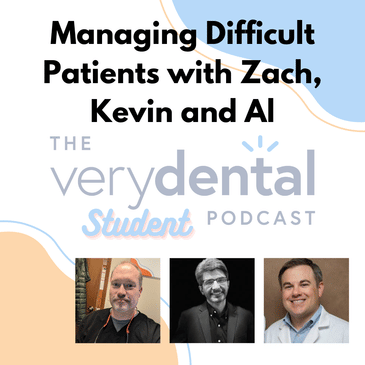
Mohamed is back with Kevin, Zach and Al to pose dental student questions to these grizzled veterans.
The guys start out with a raucous discussion of NCAA brackets and what's wrong with basketball but then move to answering questions from curious dental students!
Some key topics of discussion:
- 4:109">Post-Op Sensitivity: What are your protocols for managing post-op sensitivity for fillings or crowns?
- 5:133">Challenging Patients: How do you handle patients who challenge your clinical recommendations or demand unnecessary treatment?
- 6:128">Soft Tissue Management: What are your best practices for managing soft tissue during restorative or surgical procedures?
- 7:118">Referral Management: How do you manage patient referrals to a specialist while maintaining continuity of care?
Join the Very Dental Facebook group using the password "Timmerman," Hornbrook" or "McWethy," "Papa Randy" or "Lipscomb!"
The Very Dental Podcast network is and will remain free to download. If you'd like to support the shows you love at Very Dental then show a little love to the people that support us!
--
Crazy Dental has everything you need from cotton rolls to equipment and everything in between and the best prices you'll find anywhere! If you head over to verydentalpodcast.com/crazy and use coupon code "VERYDENTAL10" you'll get another 10% off your order! Go save yourself some money and support the show all at the same time!
--
The Wonderist Agency is basically a one stop shop for marketing your practice and your brand. From logo redesign to a full service marketing plan, the folks at Wonderist have you covered! Go check them out at verydentalpodcast.com/wonderist!
--
Enova Illumination makes the very best in loupes and headlights, including their new ergonomic angled prism loupes! They also distribute loupe mounted cameras and even the amazing line of Zumax microscopes! If you want to help out the podcast while upping your magnification and headlight game, you need to head over to verydentalpodcast.com/enova to see their whole line of products!
--
CAD-Ray offers the best service on a wide variety of digital scanners, printers, mills and even their very own browser based design software, Clinux! CAD-Ray has been a huge supporter of the Very Dental Podcast Network and I can tell you that you'll get no better service on everything digital dentistry than the folks from CAD-Ray. Go check them out at verydentalpodcast.com/CADRay!
[00:00:01] This is a production of the Very Dental Podcast Network. It's time for a Very Dental Podcast just for students and new dentists. Welcome to the Very Dental Student Podcast. And now here's your host, Mohamed Aboubasha. Hello, everybody. Welcome to another episode of the Very Dental Student Podcast. I'm your host, Mohamed Aboubasha.
[00:00:26] And I'm coming at you with another Q&A with our three favorite guests. We got Alan, and then we have Kevin and Zach. Word up. What is up, yo? I think, so I'm gonna let Kevin and Zach kind of take it away for our kind of introductory topic of the day. So... What's the bit, fellas? I'll make a fast break.
[00:00:55] I'll see what you did there. Dunk this. Do you guys... It's the NCAA tournament. It's on. It's happening. Yeah. March Madness. Yes. This is gonna get released in March, right, Alan? Just barely, but yes. Barely? Okay, good. So the final four is gonna happen. Everything that we say will have been out of date because there will be a weekend between now and when it's released. So sorry. Fair enough. So, I'm not doing a bracket. I haven't done it for years.
[00:01:22] I don't care about college basketball anymore, but I used to care a lot. So, who is... has a stake in this tournament? Oh, I do. I do. Five bucks riding on it. Five bucks. Five dollars? Yeah, five bucks. My lab guy came over last week and had... I got my two assistants and myself each filled one out. So yeah, I'm pretty excited about that.
[00:01:47] I have a bracket which is with my family and friends and it's a freebie so I don't care. Are you pummeling your children, Zach? Huh? Are you pummeling your children? That's all I wanna know. I am beating my children, yes. Yes. I'm taking that out of context. Yes. All right, authorities. But Missouri got eliminated immediately so that was my team and they're out. What team? What was your team? Missouri. Missouri. I went with Missouri too, Zach. Thanks for nothing, you guys. Geez.
[00:02:17] I picked against them because I knew they were fixing to fall. Are you the gambling type? No. Do you care about basketball? I care about basketball but I don't care about college basketball. Okay. Really. I don't watch even professional basketball. I don't really watch it. I just follow the... The highlights. The highlights, yeah. Kevin, basketball's broken. Yes. Basketball's broken. I believe... It's not the sport it was. I believe basketball... Yes, I agree.
[00:02:45] And I was thinking about this a lot today. A lot of it has to do with our change in physiology and we have taller, faster, better athletes and it's made a bigger impact, in my opinion, in basketball than any other sport. Yeah. Interesting. You can make an argument in football but basketball has become boring. So, the only... Not the only...
[00:03:13] A way to fix it, Zach, we've talked about maybe some rule changes, is to either raise the basket. That's number one. Raise the rim. Increase the size of the court. Yeah. Uh... Particularly in professional basketball because the guys are too big and bigger guys hog up more space. Yeah, they do. Or number three, my father's favorite, um, uh, uh, point was to make the ball bigger.
[00:03:44] Oh. Interesting. I hadn't even thought about that. So they can't palm it as easily? I mean, some of those guys are gonna palm whatever size basketball you made. If you put the ball bigger and the hoop the same size, you're gonna miss more. Okay. The fourth thing, trampolines. Wasn't there like a Doritos or a beer commercial back in the day where they had... No, it was a... Basketball, right? Well, basketball was the... Basketball was... They had all kinds of stuff.
[00:04:10] But like, there was some kind of a beer commercial where it had, you know, like the hoops were moving and like they were... The hoops were like 80 feet up there. So I just remember that. Sorry. I'll find... I'll see if I can find a link. I will also submit that the new portal rules in football and basketball, although I understand and support what the overall thing that's happened, I think it's ruined both sports. Uh, yes. And there's a middle ground somewhere. That's a complicated topic.
[00:04:38] That's outside the realm of this, uh, this show. You may need to have a supplemental podcast. Yeah. I like your idea of expanding the court except that... Yeah, you're right. That's gonna be a... That's a tough ask for every... Yeah. Everyone to expand their court. The main reason they need to do that is because there's too many three-pointers. I don't know if you guys... Yes. Lately. Uh, Steph Curry ruined the game by shooting all those threes and because he's so good at it and now it's forced everyone to get good at it. Yep.
[00:05:06] And now if you watch especially an NBA game, he has a three-point shooting contest. Yes. To the point where some of the older NBA players that were dominant when I did watch, Patrick Ewing, Hakeem Olajuwon, Shaq, all those guys, I don't think they have as much value today because of... Mm-hmm. ...the analytics that have said, well, the three-point shot is worth 50% more than the
[00:05:35] two-point shot. Mm-hmm. So you've gotta chuck more of them up. So here's my radical thought. I'm not opposed to your rim idea and I hadn't even thought about the ball. Mine is... We need to change it up so that the three-pointer cannot be 50% more valuable than the two-pointer. You've gotta change... We gotta make it so that it's like the regular basket is three and then the three-pointer is four. So it's only like a little bit better to bring a little bit of balance back. It's gonna make the scores look wonky. Mm-hmm.
[00:06:06] But that's my... That's my solution. We need to just shift the way they're scored so the three-pointer isn't so... ...much better than the two-pointer. Yeah. That's my... Even as you're saying that, moving the line back doesn't matter because Steph Curry's shooting from... ...in between the half court and the three-point line. Half court, yeah. And making them. You can't move... You can't move the line back on the corners because it's already to the edge anyway. Yeah. So without your court solution... Unless you expanded the court. Unless you expanded the court. And expand the lane. Yes.
[00:06:36] You're right. Both those things. There's a... Don't you think there's a marked difference in college football because of the way the hash marks are? It's a wide open game. Sure. And it has to do with not all the athletes are the biggest and fastest. Sure. In the NFL, you have only the biggest and fastest. So it kind of clogs down the game because everyone's so big. So getting everything like nice and wide open would make it more fun. But I don't know. I think... I think we can do both these things. Height limits. Change the points. Height limits. Expand the...
[00:07:06] 5'4". That's it. No taller. That'd be a different game. No more dunking. Yeah. Exactly. I'm also here for the trampolines again. I'm going to weigh in with that. Maybe they could do a volleyball rule where you only get three passes or something. Yeah. Right? I will say that I watch the local college, Northwood University, which is a tiny college. We'll go watch them play basketball. It's fun because they're not that big and they're not that good. I feel fun.
[00:07:32] Because honestly, live basketball to me is way more fun than watching it on TV. Oh, yeah. Yes. For sure. The ratings are down all over. It's just... It's not what it was. And I did like your comment earlier today, Zach. I don't want to be the old man, get off my lawn, but I don't get it. Yeah. It's not for me anymore. No, it's not. Basketball is so significantly changed from the product that I watch. And you could say the same about football, but I can argue maybe that change is better.
[00:08:02] Mm-hmm. But it's markedly... All sports are markedly different than they were years ago. It's just that some have been either... It's either level or better. And in basketball's case, I think it's a much worse product to me. But anyway... All right. If you're not saying anything about any teams at all, I still have 11 out of 16. All right. Well, if you win your five bucks back, your... I could win 20. Yeah, make sure to tell us about that, Alan. I'm very concerned about your $5 at stake here. Yeah, it is. It's scary. Absolutely.
[00:08:31] If you have a gambling problem, please call 1-800-G-A-M-B-L-I-N-D. It's 1-88-B-S-O-F, Kevin. 1-88-B-S-O-F. I don't... You're asking the wrong guy. I know the number. I know the number. DraftKings. Yeah. 1-800-DraftKings. There you go. Perfect. Okay. Onward! Perfect. This is a dental podcast. Sponsored by DraftKings. That's the most sports the very dental student listeners have gotten so far. That's right.
[00:09:00] So, we'll jump right back into our Q&A. We left off... The last time we talked, the very last question was about cracked teeth, which I thought was a good one. And then, so, the next question I had on the list was, what are your protocols for managing post-op sensitivity for, you know, either fillings or crowns? Zach. I hate that topic. But you too. I hate that. It's a bit of a roll of the dice, honestly.
[00:09:31] So... Okay. First of all, Zach gave me some good advice for my associate when he was having a problem. Make sure you're following the directions. Mm-hmm. Imagine that. Like, go back... That's one of those things like, go back to fundamentals. Right. You know, make sure you're following the directions. And number two, adjust the heck out of the occlusion. Because nine times out of ten, that's the problem. Just, you know... Manage expectations. Things are in light occlusion.
[00:10:02] So... Like, for crown seeds though, I'm going to say manage expectations too, because particularly with the cement I'm using, it's a glass ionomer most of the time. It's going to be cold sensitive for a week, a couple weeks, something like that. That's pretty normal. That's not out of the weirdness. I mean, feelings are a different animal, but I would say that's... I just let them know to expect that. And rarely do we get people calling back. Kevin is right though. If there's something wrong, and it wasn't a questionable, like, questionable pulp health, it's always the occlusion. And even if they can't feel it, it's always the occlusion.
[00:10:31] But see, no... See, I don't agree with that. There's going to be a time... Because I think we've all had that. There's going to be times where you didn't bond or you messed up, you know? You messed up with your bonding protocols. You messed up with the way you packed it in. You know? Yeah. I... There's sometimes, after you've adjusted the bite, especially if it's like they talk
[00:10:57] about it hurts when they floss or if it's something, you probably, odds are you have to strip it out. Yeah. That definitely happens to me. If I get a sensitive filling, I'm so careful with the occlusion on the appointment, the odds that it's that, unless the person, like, couldn't bite right, because some people, when they're numb, they just... They don't bite worth a darn. But that's rare. It feels like...
[00:11:21] I don't want to brag, but like, I have so rare cases of it that if it happens... You're going to just take it out. I probably messed up. You're talking for... I'm talking about a filling. I'm talking about a filling. I'm talking about a crown. I'm talking about a crown. Yeah. If it's a crown, I mean, obviously, the occlusion's one. And then it's a, well, was this, what I was like, crowning a crack tooth? Yeah. Are we screwed on the deal?
[00:11:49] Was I crowning a deep, deep carries thing? Are we got a... Do we have a nerve problem? Or once in a while, you'll get like some kind of a cementation issue where you've got some kind of a void in it. Mm-hmm. And that's a bummer too, because now you're cutting off a crown. And it's tough to know when to do that versus when to go to endo. That's tough. And I don't know if I have any hard and fast advice for that. Some of this is the art and science of dentistry.
[00:12:18] And the art part is knowing how to handle these things. Yeah. Yeah. When they happen. And they're going to happen. So let me ask... I'll turn the tables back to you, Kevin. After some of the... You know, after you guys were having some of those issues and I said, well, you probably got some kind of a bond set. Yes. Did those teams eventually resolve or did you have to cut some of them off? It was... Well, first of all, it was both things. It was not following the directions and the occlusion was an issue. Okay. Gotcha. I went in and checked them.
[00:12:48] And once I said... I said to Matt, just do me a favor for the next couple of crowns you do, take them out of occlusion. And he looked at me like I was a crazy man. And magically, nothing was sensitive. Okay. So... Well, that at least eliminated the bonding. And the reason I said that, I wanted him to overdo it. You know, that's not the right thing to do, but it's also like solving the problem.
[00:13:16] So like, you know, you go too far in one direction, then you can dial it back to being correct. If that makes sense. Sure. Some of those required end up. I don't... You know, I can't tell you a percentage now, but some... No, no, no. I'm looking for a percentage. I just didn't know like, you know, sometimes if it is a, you know, you didn't follow the bonding steps right, there's not... It's not going to get better on its own with time necessarily. Right. So, Alan, what about you? How do you handle it?
[00:13:44] I know you don't get sensitivity, but like if someone else got it, you know... Yeah, I wouldn't have. You know what's funny about... You were talking about the filling thing. I'll tell you what. If you have a light interproximal contact on a posterior filling, those are sensitive in there. It's typically because it's food impaction. You know what I'm saying? Oh, yeah. Absolutely. I would rather have a too tight contact. And it's not always your choice. It depends on the tooth, depends on the person, but that's like... That's a thing you should think about too. Sometimes it isn't...
[00:14:13] You know, if it's not necessarily cold, hot, but it's just sensitive gum or whatever, it's probably the contact on somebody. Very rarely is the contact too tight. And I have to tell you, if it's too tight and you can get in there with like a strip and lighten it, you do look like a hero. But like if... Yeah, I'd rather err on too tight of a contact than too loose, because too loose is going to be food impaction and very irritating in a lot of different ways. That's something to think about as well. Hate to say it, with crowns, same thing, but it's less common on crowns.
[00:14:43] When do you replace versus trying to kick the can down? I have a case right now. I have a case right now that I'm... It's a woman who's got... She's got, excuse me, long teeth with perio and stuff like that. And I left... You know, I did. I left the margins high and dry. And so she's got really sensitive... Sorry, wow, my camera just did something crazy. Ah, disappeared. Sensitive... That was a magic trick. She's got sensitive roots. You know what I'm saying? Like, you're just like, ah, I'm trying to desensitize them and all this. I'm like, you know what?
[00:15:12] I probably going to put another crown on there, just cover all that stuff up. So it happens enough that it's, you know, you kind of... I don't know. If you can get ahead of it, you know, if you can figure out which teeth are going to be sensitive, that's the trick. Kevin was sort of saying that too. That's the art of it. You know, like, if you've seen enough of them, sometimes you can kind of guess it. But yeah, I will use like a... I'll use a bonding agent desensitizer on the root surface quite often. And that often does really good stuff. Yeah, that's good. The problem is sometimes you have to do that more than once too. That's kind of a weird thing, but yeah.
[00:15:43] Interesting. Kevin, what about you? When do you strip a filling out versus when do you, you know, try to, you know, wait it out? I mean, more likely to replace a filling if it's gone on for a long time. Sure. And for a crown, I'd rather just do an endo. I mean, by the time you take the crown off again, you've already... You've beat up the tooth again. Yeah, exactly. Yeah, so I'll just do the endo. Yeah. So today, very deep carries on this lady.
[00:16:12] Marginal symptoms before we started. I could see the pulp through the denton after I removed the decay, after I prepped the crown. I'm like, I'm just doing this. Like, I flat out told her, you're gonna... I'll either do this now or you're gonna come back in three weeks. I'm gonna do it then through my crown. Let's just do it. And she was like, okay, fine. Yeah. That's the move too. Cause you've also gotta... I mean, I hate to say it, but the endo I do most often is necrotic just because we didn't catch it in time or it didn't hurt at the time. But man, if you can do a...
[00:16:40] If you can do on a vital tooth, man, your prognosis is way better. Yeah. Mo, have you done enough feelings? Have you had someone come back and complain about sensitivity? Yeah, I've had... I mean, there was the one case I told you guys about that ended up being a cracked tooth. That was a big one. And then we delivered a crown finally and it remained cold sensitive for like five weeks after that.
[00:17:05] So that was like one that we were just like, you know, kind of, I don't know, clenching our cheeks a little bit wondering what was happening. How did your staff advise or how did your faculty advise you? What did they tell you to do? Well, they did say they were like, well, since it's mostly cold sensitivity, then they said we want to give it at least a couple months to see if it'll eventually go away. And it did. Yeah, but from a business standpoint and from doing this for 36 years standpoint, that cold
[00:17:35] sensitive tooth, it's fine right now, but it's probably going to become necrotic and you're probably going to need to do an endo or extraction and bone graft in a few years. So I'm just of the mindset just to get ahead of it. Like, don't be afraid of the endo is what I'm trying to say. First of all, be preemptive. Good isolation if it's a filling. Rubber dam, isolate, whatever. No moisture. Follow the directions. You've done everything right. Things still sensitive. Do the endo. Yeah.
[00:18:06] Mo, are they teaching you to put glutaraldehyde on the teeth before you cement them? We have a desensitizing agent. I don't know what exactly it is, to be honest, chemically. Copalite? Is it copalite? Nice. I'm joking. I'm sorry. I didn't mean to interrupt. That's good. It's a, it's a telio, telio desensitizer. I don't know what it is. Yeah. I think it's a derivative of copalite, I think. Telio light.
[00:18:36] Made by the same people. So we're, that's part of our bonding protocol. And I don't know, this is actually a question I have for you guys is, is there a difference in sensitivity based on your, like, what kind of bond or cementing versus bonding? Cause I know Alan said something about glass ionomer. He expects maybe some more, uh, temperature sensitivity. Is that, is that the case? Like for if you're bonding versus just cementing?
[00:19:03] If, if I were bonding, like if I were, if I were going through all the bonding steps, I would not expect cold sensitivity in the same way that I would with glass ionomer. I'm a great majority of my crowns. I'm just plonking with glass ionomer because I'm just prepping a, a zirconia crown. It's, it's easy and unpredictable. And the other thing is, is that about half or more of the people that I say, you'll expect this to be cold sensitive. They say, no, it wasn't. And you know what? Like I said, get, get the expectations down. That's, that's never a bad move, you know, to suggest some things that could happen.
[00:19:33] And then when they don't happen, you look like a hero. I'm going to, I'm going to throw another thing out. If now, this is something that you will be able to apply in school, but when you get into practice, especially when you've been doing it for a while, you'll have these patients, you know, you just know, like this is the kind of person who has post-op. This person's every time you do anything is going to be, I have, I have found that if I have a crown with a good enough walling, not a short tooth, good walling.
[00:20:02] If you cement those with a polycarboxylate, that, that will virtually ensure that is like your desensitizing cement right there. That is old school too. It's old school. And the likelihood of a, of a D bond is, is there. But if you've got long walls, I mean, shoot, nothing will, I mean, temporary cements will hold on.
[00:20:23] But I mean, polycarboxylate is the most desensitizing cement that there is by a long shot for what it's worth. It's, it's, it's gotten me out of a few situations for sure. All right. Keep that in mind. Yep. All right. What's next? Yeah. Perfect. For next question. Um, how do you handle patients who challenge your clinical recommendations or demand unnecessary treatment? Well, what? All right.
[00:20:52] First of all, what was the first question? Cause the second one, what was the first question? Challenge your, challenge your recommendations. So basically. So here's, here's the thing. I like at some point, Muhammad, you will have enough years under your belt where you will be confident right now. You're not. And you won't be for a while. You don't know what you don't know and all of that. But at a certain point you do.
[00:21:22] And like, it's not that I take offense to it, but I don't need the business. So in other words, uh, you know, a classic one is your, your tooth is broken. It needs a crown. Can't you just fill it? And the answer is no. And I don't say anything more. I can't. Right. It needs a crown.
[00:21:43] That would be like me going to my doctor and, um, I have gonorrhea and saying, he says, you need a shot, a penicillin shot. I'm like, no, can't you just wipe it off? I, I, I, like, I'm not going to wash it. No, this is what you need. So like, I, I got, I don't. That's the highlight reel of this, this episode. I got to tell you that right now.
[00:22:11] It's all of that has to be delivered in a confident, empathetic, but confident way. Um, so I, I don't people, I don't have people challenge me. It doesn't happen. I have people that don't photography. Yeah. Yes. Good photography. Beats your words. Yeah. So let's start back with. If you can show them.
[00:22:39] Develop the trust through the photography. We've talked about this on this show and our show and Alan's talked about it with his microscope so many times, like, you know, with as good of a job as you can do with today's mirrors and photographs and all that. Like, they're going to see the crack in that tooth or they're going to see that. Now, if they say, you know, isn't there a different way to fix it? You know, then it's, it's on you to confidently deliver that.
[00:23:07] And that is hard as hell when you're young and you need the money and you don't have, and you need the patience. And you gotta, if you don't do this procedure, you gotta, nothing but a hole in your schedule. That's hard. That is hard. It gets easier. The other thing is some people leave. Some people, some people really don't want to do it. And then, but who cares? It's, I mean, like, like Kevin said, you care when you have a massive amount of debt. A hundred percent. A hundred percent. And you deserve a said debt. But you don't care when you don't need the money that bad. Yeah. That's the difference. You know, and that's tough.
[00:23:36] You can't teach that. Right. You know, you can't teach that. But in terms of challenging recommendations, there are options, not always, but there's, you know, there's options on things and you can give them to them, pros and cons. If you're talking about a whole complicated treatment plan, that's a whole different book. Yeah. Yeah. If you're talking about a full mouth rehab or like this guy that I have coming up that, you know, a treatment plan that you give to 10 different dentists and they're going to give you treatment plans.
[00:24:05] That's a whole different thing versus this tooth is broken. One tooth or one situation. Yeah. So, but also, you know, some of it is a pushback from finances. So having, you know, firm financial recommendations, a firm financial menu, payment options, all that sort of stuff, that helps, you know? Do they, I think a lot of it is the way you carry yourself. Do they let you show photos in school? Can you take photos?
[00:24:32] Do you have anything photographically you can do? We have an intraoral camera. Oh, that's great. That's pretty good. That's pretty good. That's good. Yeah. That's not great. All right. The second part of the question was demand unnecessary treatment. Are you talking about like putting bangs on people or like, you know, gold front teeth or are we talking about like replacing amalgams with composites that aren't, that aren't decayed or broken? What are we talking about here? I don't know who, who, the person who asked this question. Well, then you make it up.
[00:25:00] I don't know what they were trying to say, but let's, I mean, let's say, for example, they're like, yeah, asking for like extractions and implants on like perfectly fine teeth or something. Let's like, look, no, no, no, thank you. Try the guy down the street. I mean, it's just. Yeah, I have no problem with saying that's not something that that's not something that I'm going to do in this office, meaning you can go somewhere else. But the classic.
[00:25:29] I've never been asked for something that that while. How about how about some young female with a perfect smile that wants veneers? Something like that. Or something like that. It's never happened. I was just telling them I'm not good enough to make this smile any better. Move on. You know what I mean? Yeah. The people, the people who, when you tell them they need a couple of crowns and like, oh, you should just pull all my teeth and put dentures in. And of course, that is a reflex thing. I mean, there's a million good response responses to that. And they don't actually mean it either, by the way. They don't mean it. They're just being jerks about something.
[00:25:59] I had someone that didn't mean it the other day. They absolutely were like, I'm just not going to fix any more teeth. I'm done with them. I'm done with you too. Thanks. I'm not going to do that. Bye-bye. So that's it. Just say no. Now, if you're talking about something a little more like, if you were going to come up with a scenario of like, they've got some amalgams in their teeth. They don't like them. They're not decayed. They're not broken. Anything like that. They want those out. I mean, I'll entertain that. I'm not going to say no to that.
[00:26:25] Dude, the best part about it though is the composites you put in are guaranteed to be sensitive. Just because it ain't broke kind of thing. I'm just joking. Not Kevin's. Kevin's would be perfect. They'd be great. No, no. It definitely happened to me. Yeah. Okay. We can move to the next question. What's your best practices for managing soft tissue during restorative or surgical procedures? So I guess we could do that in like a two-parter as well.
[00:26:55] Managing soft tissue during restorative first. You mean like retraction? Retraction? I suppose that's probably what they're referring to, yeah. Retraction. All right. Well, I'm the king of prepping my crowns with rubber dam on, which makes me a weirdo. But, you know. Can't get any better attraction than that though. Yeah. That's a good way to not have soft tissue problem. But I'm a cord packer from way back.
[00:27:21] I mean, that's the easiest, quickest thing for me to do to get tissue out of the way. And it works fine for me. When you're packing cord, use bigger cord than you think you need to. I mean, you can go ahead and lay the thin one down first. But if you're for the last one, use bigger cord than you think you need. That's the – I've found that to be the case. If you're talking about for like fillings, especially in those class five areas, which is – I think that's actually a pretty – But, you know, don't be afraid to pack cord on those teeth also.
[00:27:51] Yeah, yeah, yeah. You know, or even in some of your deeper class three situations where like it's – You know, there's nothing wrong with packing some cord in those to get some good isolation. I continue to be surprised when I think to do that. I'm like, man, that was a lot easier. Why don't I do that all the time? Yeah. There's some times where especially if you have, you know, relatively easy access to a laser or electro surge device to – Or if someone sends you one in the mail. Yeah, or if someone sends you one in the mail that hopefully works. I don't know. Still don't know.
[00:28:21] Still don't know. Okay, fair enough. It's been too busy. You could – lasering out some tissue to get to access to your cavity isn't a bad thing to do either. It's a fine line between when to just push it back versus when to cut. But I don't think you should be afraid of either one. Yeah. And surgically, are we talking about reflecting flaps and stuff? Because – Yeah, that's a whole topic. Out of school. Yeah.
[00:28:48] So just teaching people how to do this. To reflect the flap properly and sort of atraumatically, when you're making an incision – like let's say you're doing extraction and graft where we need to reflect the tissue to gain access to place a membrane or something like that.
[00:29:14] You need to maintain firm pressure with the scalpel like you're scoring the bone. And then what I teach the newbies is that the papilla – I like to come up with these phrases that make sense to people. The papilla are like zippers. That's what undoes – that's what undresses the gums off the teeth.
[00:29:38] So getting in there with firm pressure and sort of literally scraping it off the bone to expose the periosteum, there's a trick to that. But once you kind of get that in your head, it becomes very easy. Perfect. I think – do you guys want to do one more or do you want to go ahead and wait? Let's do one more. Okay.
[00:30:01] So the last one is how do you manage patient referrals to a specialist while maintaining continuity of care? So I'm guessing like follow-up and staying in the loop. That's a great question. Great question. Let's start with Alan. It's hard. It's hard to do that. It depends on the specialist that you have available. Depending on what I'm trying to do, where I'm trying to send them, ortho is a piece of cake. They do great documentation. They're really good at following up.
[00:30:30] That's like their whole office is built to do that. Getting into an endodontist around me is not too bad, but there's a bit of a wait. And all of the endodontists are out of network, so patients are pissy about that. But actually their documentation is usually quite excellent too, so that's not so bad. Oral surgeons are really hard to get in. And many oral surgeons around me, back when we used to use facts, my team would say their facts just goes directly into a shredder.
[00:31:00] You send everything, you talk a good game, and then they call the same day and say, we need another referral kind of thing. So it's really depending on the situation, the continuity is kind of hard. But I try and explain to patients what to expect when they get to the specialist's office. And I have to tell you, a lot of times I don't know that what I'm explaining is exactly right. I do the best I can with that.
[00:31:23] And if you can form a relationship with a specialist that you talk to pretty regularly, that helps a lot. It helps a lot to know. And honestly, I would go, honestly, if you're putting a relationship like that together, go visit their office and kind of ask these questions and stuff. It's not easy. It's not easy. And it isn't necessarily intuitive, or at least around us it isn't. I'd love to hear that it's much easier and better in Cleveland or Kansas City. I don't know. What do you think, guys?
[00:31:53] So, I mean, I would echo what you said. You referred to the orthodontist. Their communication is always excellent. And same thing with the endodontists that I utilize. The real tricky part is when the person chooses to go to someone that you didn't send them to. Yeah. Especially if you don't use that referral source. Or maybe in some cases they haven't even heard of them or they're in a different part of town.
[00:32:22] That can get really challenging. And I've had some semi-bad situations from that. Pedo, you refer them there. And, man, it's like I don't even hear. I never hear from them again. It's like the work gets done. They keep the patient. Same with Perio. That's that. And then I was just going to say I hate to dog on Perio, but that's been my experience there as well.
[00:32:45] And things can sometimes get weird when those specialists then refer to another specialist without even telling you where they're going. You lose track fast. That's tough. You have to be willing to get on the phone and make some calls and hope that the doc on the other end will pick up. My experience with Perio has been everyone that goes to Perio for anything, whether it's a consult for an implant or whatever, they all get four quadrants of scaling and root plating whether they need it or not.
[00:33:14] That's sort of what happens. But, I mean, in that way, you really need to be specific about what you want, what you're looking for. Because, I mean, in some cases, this is a person who, you know, you want them to do a gum graft on some recession or something like that. It's just a matter of you need to be very specific, particularly if you have a specific request, be very specific in the referral. What about you, Kevin?
[00:33:37] Well, thinking about this over the long span of my career, I have forged some good relationships, particularly with my oral surgeon and particularly with my favorite orthodontist. Now, people can go to different orthodontists, but I agree generally the information back is stellar. All orthodontists do a great job at that.
[00:33:59] But what I'm thinking of what has happened over the course of this long career is that the communication has become different because we can text now. So, I know I can text my orthodontist or he can text me, hey, I need, you know, these baby teeth extracted. Or a lot of times he wants me to do composite buildups on peg laterals or something like that. And that's all done through text. And that's great.
[00:34:27] My oral surgeon, I consider, he's a friend of mine. So, like, we can text back and forth. So, having built a trusted relationship, I think, solves, and particularly our oral surgeon and I are trading patients back and forth all the time. Like, he's referring patients to us for restorative stuff. So, build relationships. I agree.
[00:34:55] Which, honestly, was hard for me to do as a young person. Oh, it is. And it requires some face-to-face time. You've got to go to the meetings they go to. Or instead of, usually you want the specialists to take you out to lunch. Sometimes you take them out to lunch. You let them know you're interested in communicating. Meet them for a dinner after work or something like that. It may have to go the other way.
[00:35:19] But, like I said, the real only challenges I've run into lately is when people go rogue and don't pick someone I work with. And some things can go awry then. Yeah. I mean, hey, you went rogue, you know. Yep. Yep. Well, that makes perfect sense. I believe part two will be released tomorrow. Yeah, yeah. If you like this, get ready. Yep.
[00:35:45] So, for all the listeners, why don't you tune in tomorrow on the Very Clinical podcast for part two. And we'll see you. See you. See you. See you.